Summary
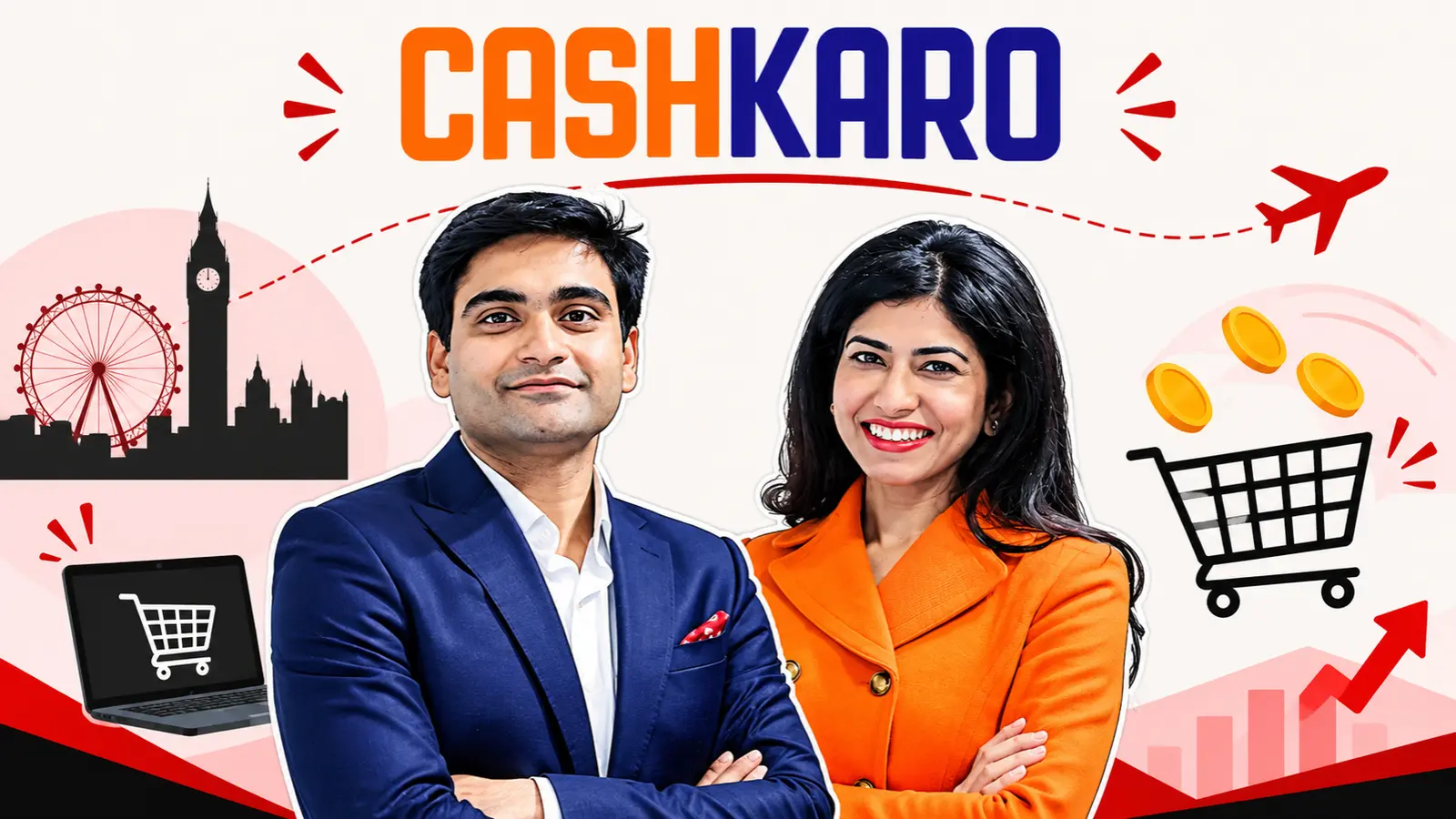
- Swati and Rohan Bhargava launched UK site Pouring Pounds in 2011, then CashKaro in India in April 2013, backed by $750,000 in angel money.
- CashKaro earns commission on each sale it sends to brands and passes part back as cashback. Its ₹600 crore FY26 revenue is a company claim.
- Funding is reported at about $30 million across five rounds, including Ratan Tata, though sources differ on the total and on who led Series B.
Swati and Rohan Bhargava set out to raise $250,000 for CashKaro in 2013. Within four hours, investors had promised $750,000, Swati told Open Magazine in 2017. Thirteen years on, this CashKaro founder story has grown into a business that claims ₹600 crore ($63 million) in revenue for FY26.
That claim needs care. Some of the numbers behind it are filed with the registrar. Others come from the company’s own statements. This profile keeps them apart.
USD figures in brackets are converted at ₹94.7 per dollar, the rupee’s close reported by PTI on 3 November 2026, unless a source gave its own dollar figure.
In this story (about 10 minutes)
Table of Contents
A honeymoon refund that started a company
Swati Bhargava grew up in Ambala, Haryana. She met Rohan at the London School of Economics, where both studied, according to Open Magazine. Swati went on to investment banking at Goldman Sachs in London. Rohan joined Aladdin Capital, a US-based hedge fund. His YourStory author profile adds that he is a CFA charterholder and also worked at Washington Square Capital.
Both had wanted to run a business since college. They married in 2009, and the idea arrived on their honeymoon, where they got close to ₹25,000 back through cashback, Swati told Open. The couple saw the business angle straight away.
It was a sort of now-or-never moment for us.
Swati Bhargava, Open Magazine, October 2017
In 2011 both quit their jobs and started PouringPounds, a cashback website in the UK. Rohan’s profile on the Aspen Global Leadership Network also dates his first cashback business to 2011. By Swati’s account, the UK site tied up with retailers including M&S, Debenhams, Tesco and Expedia within a few years.

The dates matter here. Pouring Pounds began in 2011. CashKaro, the India business, launched in April 2013. Several profiles blur the two.
Read More: Kailash Katkar Quick Heal Story: The Brothers Who Kept Postponing the Shutdown
Why a UK cashback site moved to India
CashKaro launched in April 2013, per YourStory. The founders emailed a few investors with a target of $250,000 and had promises of $750,000 within four hours, Swati told Open. Inc42 Datalabs lists the angel round as $750,000 in July 2013, and Business Standard reported that the money came from London-based investors.
Raising money was easier than selling the idea. Retailers were sceptical, Swati said, and many had no process to track and pay affiliates. Shoppers needed time to believe they could earn money back on a purchase.
The founders first tried to run CashKaro from the UK. As the company grew, they wanted bigger partners such as Amazon and Flipkart and a second funding round in India, and face-to-face meetings mattered. They moved back after about 12 years abroad, Swati told Open, and called it one of their toughest decisions.
One partnership began on social media, by Swati’s account. A user tweeted asking for an Amazon offer. She replied that CashKaro had Flipkart cashback but nothing for Amazon. Someone at Amazon read the exchange and turned out to be the right person for an affiliate tie-up. StartupIndiaX found no second source for this anecdote.
The model had overseas precedents. In its 2015 Series A report, TechCrunch said the founders drew inspiration from Ebates in the US and Fanli in China, and noted that Rakuten had bought Ebates for $1 billion.
Who backed CashKaro, and what each round was for
Kalaari Capital led the $3.8 million Series A in November 2015, which Business Insider India reported as about ₹25 crore ($2.6 million). TechCrunch said the company planned to expand in South East Asia.
Two months later, in January 2016, Ratan Tata invested an undisclosed amount in his personal capacity, Business Standard reported on 19 January 2016. Exchange4media noted that Tata sat on Kalaari’s advisory board. Swati’s account of the deal is practical. The hardest part was getting an appointment, which took a few months. At lunch, she said, she talked through the business plan and growth model rather than a slide deck, and the money arrived within two weeks of the meeting.
The next institutional round came in September 2020. Korea Investment Partners led a $10 million Series B with Kalaari returning, Inc42 and KrASIA reported. Rohan Bhargava said the money would go to marketing, brand building, user acquisition, product development and hiring, and to growing EarnKaro, which had launched a year earlier. Inc42 Datalabs lists Kalaari as the lead, but the news reports name Korea Investment Partners.

Affle Global led the Series C in November 2022: ₹130 crore, which Inc42 put at $15.69 million. Entrepreneur India reported that the investment sits in Pouring Pounds UK, the parent of the India entity. The stated purposes were expansion of CashKaro and EarnKaro, new technology and product development.
Totals differ by source. Inc42 Datalabs puts total funding at $30.27 million and CB Insights at $30.45 million, while company statements in May 2026 say more than ₹250 crore ($26.4 million). StartupIndiaX has not reconciled these figures. No source disclosed a valuation for any round. The only figure we found is Inc42 Datalabs’ $18.69 million as of January 2016.
How CashKaro earns, and what EarnKaro adds
CashKaro is paid by the seller. A retailer pays it a commission when a sale arrives through its link, and CashKaro passes part of that commission to the shopper as cashback, Swati explained to Open. The cashback sits on top of any retailer sale or card offer. It works only if the shopper clicks through CashKaro’s link first.
Rates vary. TechCrunch reported in 2015 that commissions ranged from 1% to 30% depending on retailer and category. We found no current range. For brands, the appeal is that they pay only when a sale happens, an Open Magazine analysis noted in May 2026.
Revenue now comes from more than shopping:
- Finance: BankKaro recommends credit cards and similar products. Swati told Inc42 that the finance vertical made up about 20% of CashKaro’s revenue in FY24.
- E-vouchers: Inc42 reported them as a new revenue stream in FY23.
- EarnKaro: a platform where individuals share deals and earn commissions. CashKaro claims 80% share of e-commerce affiliate channels on Telegram and says top earners make up to ₹40 lakh a month. Both are company claims.
Scale figures are company claims too. As of May 2026, CashKaro says it works with about 1,500 partner brands, has driven ₹10,000 crore ($1.06 billion) in sales for them and has paid users over ₹2,000 crore ($211 million) in cashback. Swati told Inc42 in its FY25 coverage that the user base was about 27 million.
Read More: Ghazal Alagh’s Mamaearth Story: From Six Baby Products to a ₹1,701 Crore IPO
₹600 crore: the claim, and the filed numbers beneath it
Filed numbers come first. Open Magazine, citing regulatory filings accessed through business intelligence firm Tofler, reported CashKaro’s sales at ₹98.8 crore ($10.4 million) in FY21 and ₹217 crore ($22.9 million) in FY22. It then reported ₹248.9 crore ($26.3 million) in FY23, ₹282.3 crore ($29.8 million) in FY24 and ₹341.3 crore ($36.0 million) in FY25.
Other figures sit close by but do not match. Swati told Inc42 that FY24 operating revenue crossed ₹300 crore, at ₹302 crore ($31.9 million), before the company filed. Inc42 Datalabs later showed ₹291.6 crore ($30.8 million) and a net loss of ₹23.5 crore ($2.5 million). For FY25 the company said about ₹348 crore ($36.7 million), against ₹344.6 crore ($36.4 million) on Datalabs. These sources may define revenue differently, and StartupIndiaX has not confirmed how.
Then the claim. On 5 May 2026, CashKaro said operating revenue rose 72% to ₹600 crore ($63 million) in FY26, from ₹348 crore. It said its EBITDA loss narrowed 40% to ₹17.7 crore ($1.9 million) from ₹29.2 crore ($3.1 million). Marketing spend across CashKaro and EarnKaro rose only 7.6%, it said, while employee and infrastructure costs stayed stable as it invested in AI and automation. As of November 2026, StartupIndiaX found no FY26 filing. Treat these as company claims.
we are unit economics positive on every transaction
Swati Bhargava, in a company statement reported by Inc42, May 2026
Open Magazine raised questions the headline does not answer. From the filings it saw, gross margin fell from 100% in FY23 to 66.1% in FY25. The company’s own net worth on its balance sheet rose from ₹68 crore ($7.2 million) in FY21 to ₹173.6 crore ($18.3 million) in FY23, then fell to ₹112 crore ($11.8 million) by FY25 as losses built up. Borrowings were zero in every year reported. None of this suggests distress, Open said, but growth now has to cover fixed costs.
Rohan Bhargava made the commercial argument for why growth may continue.
brands are increasingly seeing 4–10x better returns through affiliate models
Rohan Bhargava, quoted by Open Magazine, May 2026 (a company claim)
Where CashKaro sits among cashback rivals
Rivals named in the sources include GoPaisa, CouponDunia, PaisaWapas and GrabOn. Only PaisaWapas has recent filed numbers in what we found. Entrackr reported that its revenue from operations rose 24% to ₹68.7 crore ($7.3 million) in FY24, with a profit of ₹3.5 crore ($0.4 million), citing registrar filings.
On those figures, CashKaro is roughly four times larger on sales (₹282.3 crore in FY24, per Open’s filings data) but recorded a net loss of ₹23.5 crore on Datalabs. The measures differ, sales against revenue from operations, so treat this as a rough comparison.
CashKaro also competes for attention. Under its #CoinsVSCashback campaign, produced in-house, it has run spoof ad films arguing that real cashback beats coin-based rewards. afaqs reported that one film took a jab at CRED. The pitch targets shoppers tired of coins with expiry dates.
Read More: ClassMonitor Founder Story: How Two Indore Friends Turned a School Chat App Into Learning Kits
The CashKaro timeline, year by year
Ten dated milestones, each tied to a named source, show how a UK experiment became an India-first business.
What shoppers report about tracking
Founder profiles rarely cover what happens when cashback does not arrive. CashKaro earns only when a retailer confirms a tracked sale, so a missing or cancelled payout usually traces to tracking.
Public threads are mixed. A cashback-myths blog in September 2025 quoted a Reddit user who said CashKaro cancelled their cashback over a coupon they said they had not used. On Desidime, a thread about a rival app drew some commenters who grouped CashKaro with the app they were criticising, and others who said they received cashback on time. A 2026 review on Infobits says that opening another coupon site, or using an outside code between the click and the purchase, can break attribution.
StartupIndiaX has not verified any individual case and found no public CashKaro response to these specific complaints. The pattern still matters. The model depends on retailers reporting sales accurately, and shoppers should read each store’s terms.
Swati Bhargava’s net worth: what can and cannot be said
No credible source gives a verified personal net worth for Swati or Rohan Bhargava, and published estimates do not agree. StarsUnfolded lists about ₹1,900 crore ($201 million) for Swati as of 2025, without a citation. A DNA India report cited Financial Express for about $2 million, and the report is undated in our copy. Mad4India gives ₹225 crore ($23.8 million) for the company in 2022 and $2 million for Swati. Executive-data site Affluense shows a range from ₹0 to ₹1,000 crore or more. These are estimates, and StartupIndiaX has not verified any of them.
What can be said is narrower. No funding round’s valuation was disclosed in the sources we reviewed, and Inc42 Datalabs’ $18.69 million figure dates to January 2016. The company’s own net worth, from filings reported by Open Magazine, was ₹112 crore ($11.8 million) in FY25. That is a balance-sheet figure for the company, not the founders’ wealth.
Beyond the business
Swati and Rohan Bhargava appeared on Fortune India’s 40 Under 40 list in 2019, where their ages were given as 35 and 38. Outlook Business reported that Swati studied in Singapore on a Singapore Airlines scholarship given to 35 students across India, and that she was the only girl in her batch. In late 2024 the couple launched the BAD podcast on affiliate marketing, which Swati said is aimed at aspiring dreamers from smaller towns, according to CXOToday.
Five lessons from thirteen years of CashKaro
Use the product before you sell it. The honeymoon refund of close to ₹25,000 came before the business plan. The founders had felt the benefit as customers.
Prove the idea in a smaller market. Pouring Pounds ran in the UK, with retailers such as Tesco and Expedia on board, before CashKaro went to India.
Move to where the work is. Running CashKaro from the UK got harder as bigger Indian partners and a second round needed meetings in person. The founders relocated after about 12 years abroad.
Treat fundraising as a conversation. For the Ratan Tata lunch, Swati said she talked through plans and the growth model instead of a presentation. The appointment itself took months to secure, so the conversation was the easy part.
Watch margin as closely as growth. Open Magazine flagged gross margin falling from 100% in FY23 to 66.1% in FY25 while sales rose.
The next test: a filed FY26
A filed FY26 balance sheet will show whether the ₹600 crore claim and the narrower loss hold up in the registrar’s format, and whether gross margin recovered. Until then, the CashKaro founder story is well sourced up to FY25 and company-claimed after that.
Tell us in the comments which part of the CashKaro story you would test first, and share this with a founder weighing a move from a smaller market to a bigger one.
FAQs
Who founded CashKaro?
Swati and Rohan Bhargava, a husband-and-wife team who met at the London School of Economics, founded CashKaro. They started the UK cashback site Pouring Pounds in 2011 and launched CashKaro in India in April 2013, according to Open Magazine and YourStory.
How does CashKaro make money?
CashKaro earns a commission from partner brands on each sale that arrives through its links, and passes part of it to shoppers as cashback. It also earns from finance referrals through BankKaro, which Swati Bhargava said was about 20% of revenue in FY24.
How much funding has CashKaro raised?
Inc42 Datalabs puts CashKaro’s total funding at $30.27 million across five rounds, while CB Insights says $30.45 million. Company statements in May 2026 say more than ₹250 crore. The sources differ, and StartupIndiaX has not reconciled them.
Did Ratan Tata invest in CashKaro?
Yes. Business Standard reported on 19 January 2016 that Ratan Tata made an undisclosed investment in CashKaro in his personal capacity. The amount was not disclosed in the sources StartupIndiaX reviewed, and later company coverage still lists him among its backers.
What was CashKaro’s revenue in FY26?
CashKaro says operating revenue rose 72% to ₹600 crore ($63 million) in FY26 from ₹348 crore, with an EBITDA loss of ₹17.7 crore. Inc42 reported this on 5 May 2026. It is a company claim, and StartupIndiaX found no FY26 filing.
What is Swati Bhargava’s net worth?
No credible source gives a verified figure. Published estimates range from about $2 million to ₹1,900 crore and are not sourced consistently. Valuations for CashKaro’s funding rounds were not disclosed, so StartupIndiaX does not state a personal net worth as fact.
What is EarnKaro?
EarnKaro is CashKaro’s affiliate platform, launched in 2019, where individuals such as students and homemakers share deals and earn commissions on resulting sales. CashKaro claims 80% share of e-commerce affiliate channels on Telegram, a company claim that StartupIndiaX has not verified.
Is CashKaro safe to use?
CashKaro pays cashback from commissions that retailers report, so payouts depend on tracking. Some users post complaints about cancelled or missing cashback, while others report timely payment. StartupIndiaX has not verified individual cases, so check each store’s terms before buying.
Sources and disclosure
Story type: public-source profile.
Sources
- Open Magazine, “Swati Bhargava, 34, Co-Founder, CashKaro”, 12 October 2017. https://openthemagazine.com/specials/wealth-issue-2017-comeback-kids/swati-bhargava-34-co-founder-cashkaro
- Open Magazine, “When Google and Meta Became Too Expensive, CashKaro Found Its Moment”, 5 May 2026. https://openthemagazine.com/branding-marketing-and-advertising/when-google-and-meta-became-too-expensive-cashkaro-found-its-moment
- Inc42, “CashKaro’s FY26 Revenue Jumps 72% YoY To ₹600 Cr”, 5 May 2026. https://inc42.com/buzz/cashkaro-fy26-revenue-jumps-72-yoy-to-%e2%82%b9600-cr/
- Inc42, “Exclusive: Ratan Tata-Backed CashKaro’s Revenue Crosses INR 300 Cr Mark In FY24”, date not shown. https://inc42.com/buzz/exclusive-ratan-tata-backed-cashkaros-revenue-crosses-inr-300-cr-mark-in-fy24
- Inc42, “CashKaro’s FY25 Revenue Jumps To INR 350 Cr”, date not shown. https://inc42.com/?p=526923
- Inc42, “CashKaro Narrows Its Loss 25% YoY In FY23”, date not shown. https://inc42.com/buzz/cashkaro-narrows-its-loss-25-yoy-in-fy23-crosses-inr-250-cr-revenue-mark
- Inc42 Datalabs, CashKaro funding and financials pages, viewed November 2026. https://inc42.com/company/cashkaro/funding/ and https://inc42.com/company/cashkaro/financials/
- Inc42, “CashKaro Raises $10 Mn In Series B Funding From Korea Investment Partners & Kalaari Capital”, September 2020. https://inc42.com/buzz/cashkaro-raises-10-mn-in-series-b-funding-from-korea-investment-partners-kalaari-capital
- KrASIA, “Korea Investment Partners leads USD 10 million round in Indian cashback startup CashKaro”, date not shown. https://kr-asia.com/korea-investment-partners-lead-usd-10-million-round-in-indian-cashback-startup-cashkaro
- Business Standard, “Cashback and coupons firm CashKaro raises Rs 130 crore in funding”, 3 November 2022. https://business-standard.com/article/companies/cashback-and-coupons-firm-cashkaro-raises-rs-130-crore-in-funding-122110300606_1.html
- Entrepreneur India, “CashKaro Raises INR 130 Crore In Series C Funding”, date not shown. https://www.entrepreneur.com/en-in/news-and-trends/cashkaro-raises-inr-130-crore-in-series-c-funding/438436
- TechCrunch, “CashKaro Raises $3.8M Series A To Become The Ebates Of Southeast Asia”, 2015. https://techcrunch.com/?p=1238204
- Business Insider India, “Ratan Tata makes his third investment in 2016”, 19 January 2016. https://www.businessinsider.in/ratan-tata-invests-in-cashkaro-com/amp_articleshow/50635832.cms
- Business Standard, “Ratan Tata invests in cashback, coupons site CashKaro”, 19 January 2016. https://www.business-standard.com/article/companies/ratan-tata-invests-in-cashback-coupons-site-cashkaro-116011900350_1.html
- exchange4media, “Ratan Tata now invests in CashKaro.com”, 19 January 2016. https://www.exchange4media.com/digital-news/ratan-tata-now-invests-in-cashkaro.com-63045.html
- YourStory, CashKaro company page and Rohan Bhargava author profile, viewed November 2026. https://yourstory.com/companies/cashkaro and https://yourstory.com/author/rohan-bhargava
- Aspen Global Leadership Network, Rohan Bhargava profile. https://agln.aspeninstitute.org/profile/6180
- Fortune India, 40 Under 40 2019, Rohan Bhargava and Swati Bhargava. https://fortuneindia-web.quintype.io/40under40/rohan-bhargava-swati-bhargava?year=2019
- Outlook Business, “From Ambala’s small town girl to London’s investment banker, Swati Bhargava has lived life upside down before launching CashKaro”, date not shown. https://wow.outlookbusiness.com/?p=4552
- Entrackr, “PaisaWapas revenue nears Rs 70 Cr in FY24, remains profitable”, date not shown. https://entrackr.com/fintrackr/paisawapas-revenue-nears-rs-70-cr-in-fy24-remains-profitable-8742881
- afaqs, “How CashKaro’s new ad spoofed ‘India’s Got Latent’ and took a jab at CRED”, 2025. https://www.afaqs.com/marketing/how-cashkaros-new-ad-spoofed-indias-got-latent-and-took-a-jab-at-cred-9049607
- CXOToday, “CashKaro Founder Couple Swati & Rohan Bhargava Launch ‘BAD’ Podcast”, 2024. https://cxotoday.com/media-coverage/cashkaro-founder-couple-swati-rohan-bhargava-launch-bad-podcast-to-inspire-indias-next-generation-of-dreamers/
- Infobits, “Is CashKaro Safe? Honest 2026 Review”, 2026. https://www.infobits.in/?p=33006
- Cashback myths blog (Reddit comment quoted), September 2025. https://promiseapp.blogspot.com/2025/09/10-common-cashback-myths-in-india.html
- Desidime discussion thread, date not shown. https://www.desidime.com/discussions/paisawapas-credit-card-cashback-scam-2102895
- Net worth estimates: StarsUnfolded (https://starsunfolded.com/?p=790410), DNA India (https://dnaindia.com/business/report-meet-husband-wife-duo-from-gurgaon-built-rs-4000-crore-gmv-firm-with-ratan-tata-help-swati-rohan-bhargava-3064923), Mad4India (https://mad4india.com/?p=38332), Affluense (https://www.affluense.ai/profile/swati-bhargava-cashkarocom-ed8d14). All undated or as stated in text.
- PTI via HDFC Sky, “Rupee rises 13 paise to settle at 94.71 against US dollar”, 3 November 2026. https://hdfcsky.com/news/rupee-rises-13-paise-to-settle-at-94-71-against-us-dollar
AI-assistance note: This article was drafted with AI assistance and reviewed and fact-checked by StartupIndiaX Editorial Team.
Corrections: Spotted an error? Email corrections@startupindiax.com and we will review and update the article.
Written by StartupIndiaX Editorial Team, StartupIndiaX writer covering Indian startups, founders, and entrepreneurship.