SUMMARY
- Founder vesting means each co-founder earns shares over time, usually four years with a one-year cliff. It is market practice, not Indian law.
- In India it usually works as reverse vesting: founders hold shares from day one, and the company can buy back the unvested portion on exit.
- Put vesting, leaver terms and buyback price in the shareholders’ agreement before you raise, and have a CA check the tax on any buyback.
Picture two friends who start a company, split it 50-50 and shake on it. In month eight, one of them takes a job elsewhere. Does that person still own half the company?
Without vesting, yes. Every share allotted at incorporation is theirs, whether they stay four more years or never open the laptop again.
Search “founder vesting India” and nearly every result gives the same answer: four years, one-year cliff. The more useful questions are why investors insist on it, and what happens in the paperwork when someone actually leaves.
What “4 years with a 1-year cliff” really means
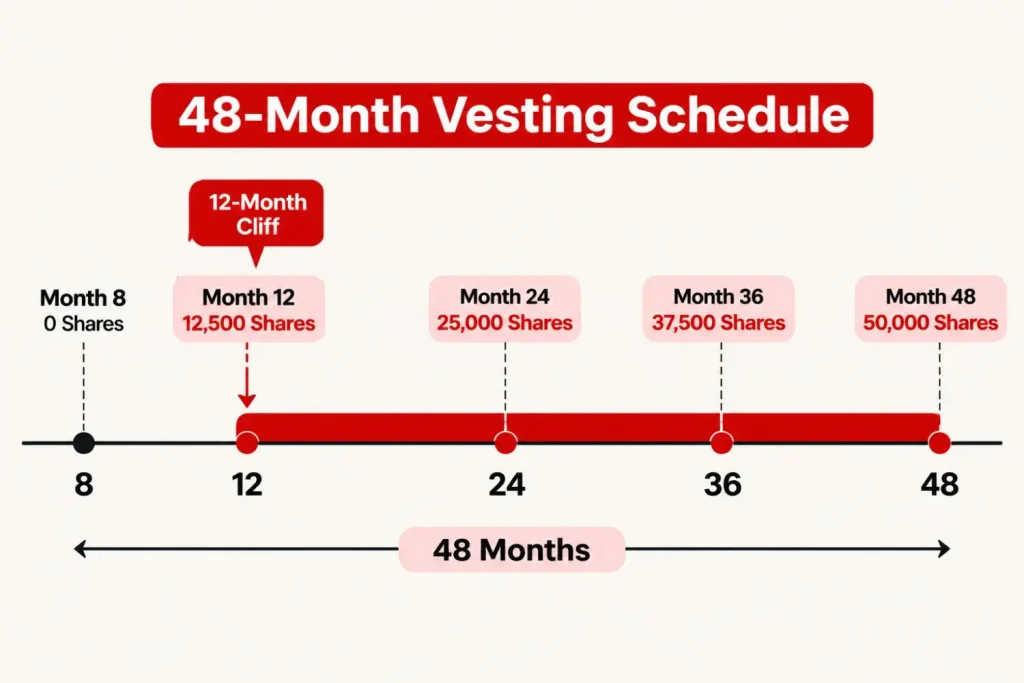
Under the standard setup, nothing vests in the first 12 months. A founder who leaves at month 11 walks away with none of the vesting shares. At month 12, 25% vests in one go, and the rest builds up month by month until the fourth year ends.
Here’s how that plays out for two co-founders who hold 50,000 shares each. The numbers are an illustration, not a rule.
| Founder leaves at | Shares vested | Shares unvested |
|---|---|---|
| Month 8 | 0 | 50,000 |
| Month 12 | 12,500 | 37,500 |
| Month 24 | 25,000 | 25,000 |
| Month 36 | 37,500 | 12,500 |
| Month 48 | 50,000 | 0 |
Some founders negotiate credit for time they worked before the first funding round, so the clock doesn’t always start at zero.
It’s a contract, not a law
Nothing in Indian company law sets the four-year, one-year-cliff pattern. IncorpX, an incorporation platform, describes it as a contractual arrangement shaped by international venture practice, not a statutory rule. Razorpay’s founder programme, Rize, notes that schedules can run anywhere from two to five years depending on role and stage.
That matters because everything is negotiable: the length, the cliff, what happens on exit. It also means nobody will enforce a schedule you never wrote down.
Read More: ESOPs in India: Fewer Than 4,000 Startups Can Defer the Tax. Is Yours One?
How vesting works when founders already hold their shares
Most founders get their shares on day one, so vesting runs in reverse. You keep the shares, but the company, its investors or the remaining founders get a right to buy back the unvested portion if you leave early, typically at par or cost, according to CalcGuru’s India guide.
That right lives in the shareholders’ agreement and the articles of association, along with transfer restrictions so nobody can sell the shares in the meantime. Law firm Treelife warns that a co-founder agreement alone isn’t enough: the articles, the shareholders’ agreement and the cap table all have to say the same thing.
Drafting matters for another reason. Bharucha & Partners points out that a buyback needing the leaver’s cooperation is harder to enforce than a call option.
Read More: Term Sheet Explained for Indian Founders: 12 Clauses That Decide Who Controls the Company
Good leaver, bad leaver, and the clause everyone fights over
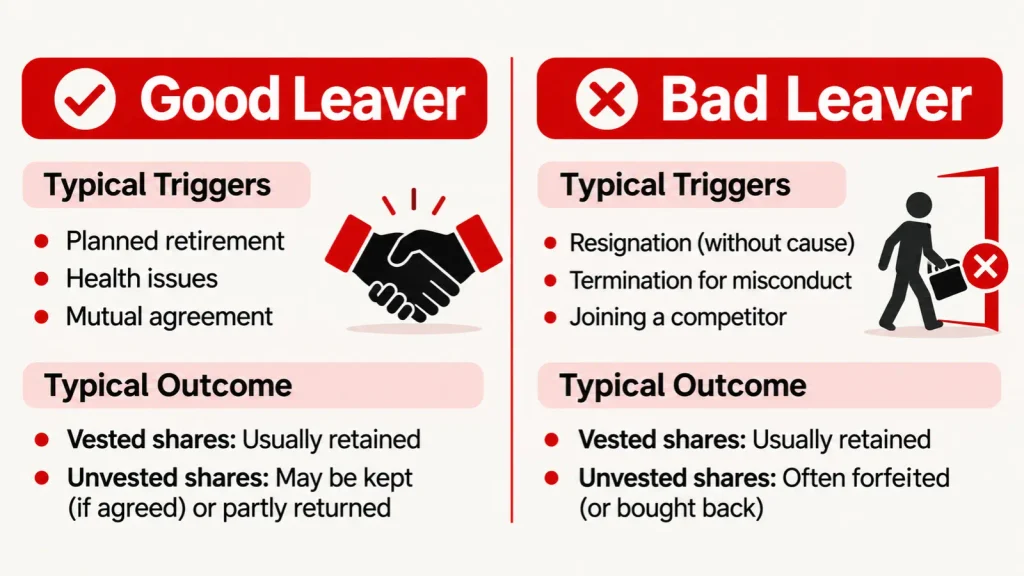
Not every exit is treated alike. A good leaver, someone who goes because of death, disability or termination without cause, typically keeps what has vested. A bad leaver, whose exit involves fraud, gross misconduct or serious breach, can lose unvested shares at cost and sometimes face a discounted buyback of vested shares too.
Where that line sits is heavily negotiated between founders and investors. BharatPe is the best-known Indian example. Treelife’s analysis says its 2019 shareholders’ agreement carried reverse vesting and a bad-leaver clause that let the company reclaim unvested shares and buy part of the vested stake at a discount. That clause has since featured in the public dispute between the company and co-founder Ashneer Grover.
The lesson isn’t who was right. It’s that a vague definition of “cause” is where a good agreement turns into a bad fight.
Why investors check this before the cheque
Treelife notes that institutional VCs run legal diligence on the co-founder agreement before they finalise a term sheet, not after. A founder stake with no vesting, or full vesting from day one with no cliff, gets treated as a cap table defect rather than a paperwork gap.
Our view: that’s fair. An investor is backing a team’s next four years, not its last four months. If a partner who left in year one still holds a large slice, every future round starts with an awkward cap table and a harder conversation.
It also gets more expensive to fix. Treelife’s guide says correcting a split before investors are on the cap table is structurally easier and cheaper than doing it afterwards.
What to settle before you sign
Three checks are worth doing now, not at the term sheet stage.
Write it down. Put the schedule in the shareholders’ agreement and mirror it in the articles. A handshake vest isn’t a vest.
Define “cause” and fix the price. Spell out the good and bad leaver categories in plain language, and agree the buyback price in advance.
Ask a CA about tax. Buying back shares below fair value can carry tax consequences, and a non-resident founder brings FEMA pricing rules into the picture. Stamp duty on the agreement also varies by state.
This article is general information, not legal advice. Have a startup lawyer draft or review your agreement.
The short version: founder vesting means shares are earned, not just allotted. Settle the schedule and leaver terms before you raise. Get a CA to check the buyback tax before you sign.
Still working out the split itself? Try our free Co-founder Equity Split Calculator, and when you’re ready to raise, browse the Indian VC & Investor Database. Have you negotiated vesting with your co-founder? Tell us how it went in the comments, and share this with the partner you haven’t had that conversation with yet.
FAQs
What is founder vesting in India?
Founder vesting means co-founders earn their shares over time instead of owning them outright from day one. In India it’s set by contract, usually in the shareholders’ agreement, not by any statute.
What does a 1-year cliff mean for a co-founder?
Nothing vests during the first 12 months, so a founder who leaves earlier keeps none of the vesting shares. At month 12, 25% vests at once, and the rest typically vests monthly after that.
What is reverse vesting?
Founders hold all their shares from incorporation, but the company can buy back unvested shares if they leave early, usually at par or cost. It’s written into the shareholders’ agreement and the articles of association.
Is a four-year schedule required by Indian law?
No. It’s market practice borrowed from global venture investing and agreed by contract. Founders and investors can negotiate the length, the cliff and the leaver terms to suit the team and the round.
What’s the difference between a good leaver and a bad leaver?
A good leaver exits through death, disability or termination without cause and typically keeps vested shares. A bad leaver exits through fraud, serious misconduct or breach and can lose unvested shares, sometimes vested ones at a discount.
Do investors really check founder vesting?
Yes. Legal diligence on the co-founder agreement often happens before a term sheet is finalised, and a founder stake with no vesting is treated as a governance risk on the cap table.