Summary
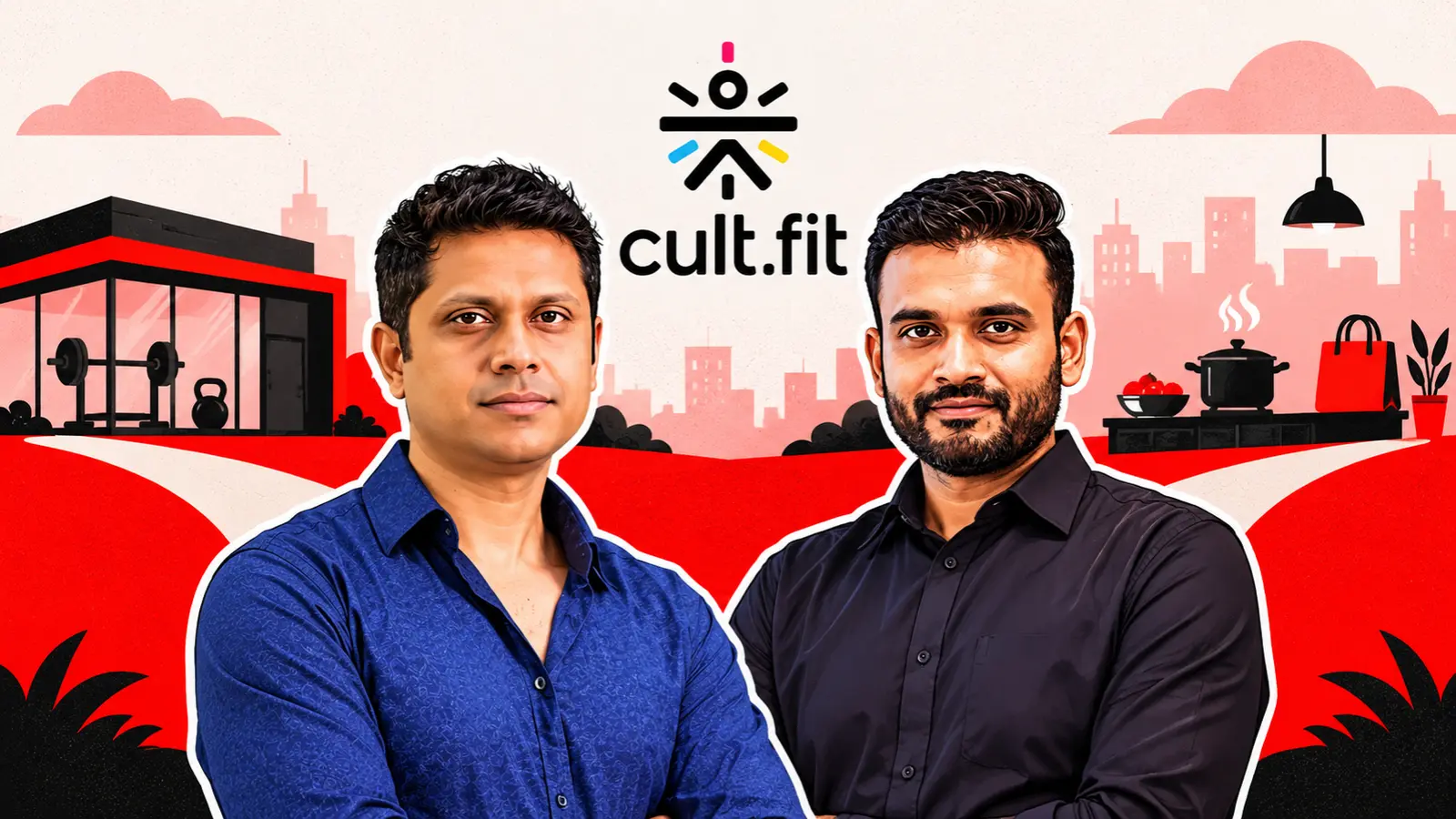
- The Cult.fit founders, Mukesh Bansal and Ankit Nagori, started Cure.fit in 2016; Cult.fit now has SEBI’s observations for its IPO, with no dates set.
- Cult.fit’s FY26 revenue hit ₹1,721 crore ($184M), yet it still lost ₹251.8 crore ($27M), per its DRHP.
- Nagori left in 2020 and built Curefoods, whose IPO was reportedly postponed. Bansal remains executive chairman and is selling part of his stake.
On 12 October 2026, SEBI issued its observations on the IPO papers of Cult.fit, the next step toward a listing. The Cult.fit founders took very different roads to that moment. Mukesh Bansal still chairs the company and is selling part of his stake in the offer. Ankit Nagori left in 2020 and now runs Curefoods, whose own IPO was reportedly postponed in June 2026.
USD figures in this article use ₹93.6 to the dollar, the rate implied by Entrepreneur India’s March 2026 conversion of the Cult.fit Series G. They are approximate.
Contents (about 11 minutes)
Table of Contents
Two Flipkart careers, one 2016 decision
Mukesh Bansal grew up in Haridwar, Uttarakhand, and studied at IIT Kanpur (India Retailing, Wikipedia). He built Myntra, which began as a personalisation platform before settling on fashion. Bansal has said that pivot took four years (Inc42). Flipkart bought Myntra in 2014, a deal Business of Fashion reported at $375 million. Bansal then ran Flipkart’s commerce business.
Ankit Nagori reached the same company by a different road. He started a social media company, Youthpad, soon after graduating from IIT Guwahati in 2007 and ran it for three years (Restaurant India). He spent six years at Flipkart and left as Chief Business Officer.
Both left in February 2016, YourStory reported. Fitness was not their first idea. Nagori later told YourStory they studied several industries and chose health because technology had barely touched it, and their research tied lifestyle disease to a large share of deaths in India (YourStory, June 2021).
Read More: Nat Habit Founders: Swagatika Das and Gaurav Agarwal’s Story, Funding and Numbers (2026)
A gym with one centre, and a four-part plan
The gym they picked already existed. Rishabh Telang started Cult in Bengaluru in 2015. A year later Bansal and Nagori bought a majority and folded it into the new Cure.fit, Business Standard reported in July 2026. Inc42 also lists Telang and Deepak Poduva among the company’s founders, so outlets credit the origin differently. This article uses “Cult.fit founders” for Bansal and Nagori, who formed the parent company.
Bansal told YourStory in August 2017 that Cult had a single centre when they acquired it, with about 15 more opened in Bengaluru within the year (YourStory, August 2017). Early money was modest by later standards. YourStory reported in December 2016 that the pair had raised $15 million from Accel, Kalaari Capital and IDG Ventures.
The plan was wide. Cure.fit launched with four verticals: Cult.fit for workouts, Eat.fit for meals, Mind.fit for yoga and mental wellness, and Care.fit for clinics. Mind.fit came from the July 2017 purchase of a1000yoga, according to Outlook Business.
“We will be a $100m revenue company in less than two years.”
Mukesh Bansal, speaking to YourStory, August 2017
That was a founder’s claim, and the sources StartupIndiaX reviewed report no revenue for the two-year window he named, so it stays a claim. The company’s own figures arrive much later. Cult.fit reported operating revenue of ₹1,721 crore ($184 million) for FY26 in its DRHP, as covered by Business Standard in July 2026.

How the Cult.fit founders parted: what the record shows
By August 2020 the four-part plan was shrinking. Entrackr reported that Cure.fit had shut Eat.fit in 12 cities that month. Business Standard describes Care.fit as largely wound down, with Mind.fit folded into the main platform.
Eat.fit’s future became a question, and so did the partnership. Entrackr reported, citing three people aware of the matter, that Nagori was set to leave after differences with Bansal over how the company should run. A company spokesperson disputed that and described Nagori’s larger stake in the food business as an equity swap tied to the spin-off (Entrackr).
“Ankit Nagori is not exiting Curefit.”
Curefit spokesperson to Entrackr, 2020
Neither co-founder answered Entrackr’s questions at the time. Nagori took the food business into a new company, Curefoods. Entrackr reported he held about 7.6% of Cure.fit before the swap and put his stake in the food arm at 70 to 80%. The Ken has said it hosted Nagori on its First Principles podcast to discuss the founding and the split. StartupIndiaX has not reviewed that episode, and this article does not speculate about anyone’s motives.
Cure.fit kept growing. Tata Digital invested $75 million in June 2021, and Bansal joined Tata Digital as president while leading Cult.fit (YourStory, June 2021). In November 2021, Zomato bought 6.4% for $100 million, which made Cult.fit a unicorn, per press reports. The company rebranded from Cure.fit to Cult.fit that year.
What Cult.fit earns, and what it still loses
Cult.fit now runs two businesses: fitness services and the Cultsport products store. Business Standard reported that in FY25 services brought in ₹844 crore ($90 million) and the products store ₹372 crore ($40 million). Finshots, summarising the DRHP, says nearly a third of active fitness members also buy products on the platform.
As of 31 March 2026, Cult.fit had 708 centres in 77 cities and more than 987,000 paid members, per DRHP coverage. Formats include Cult Elite, a premium centre, and Cult Neo, a lower-cost one, plus franchised and marketplace gyms booked through the app.
Revenue rose from ₹927 crore ($99 million) in FY24 to ₹1,216 crore ($130 million) in FY25 and ₹1,721 crore ($184 million) in FY26, about 42% growth in the last year. Net loss narrowed from ₹888.5 crore ($95 million) to ₹480.8 crore ($51 million) and then ₹251.8 crore ($27 million). The company reports adjusted EBITDA of ₹144.78 crore ($15 million) for FY26. That is a company-defined measure, not a net profit.
Fixed costs are the test. Of the ₹950 crore ($101 million) fresh issue, the company plans ₹276.6 crore ($30 million) for new centres, ₹217.5 crore ($23 million) for lease and rent payments and ₹120 crore ($13 million) for debt repayment, per INDmoney’s summary. The Zerodha Daily Brief frames the question as retention, since gym habits fade after January sign-ups.
“there’s plenty of white space for Cult.fit”
CEO Naresh Krishnaswamy to Business Standard, 29 June 2026
Who backs Cult.fit, and who owns it
In March 2026, MacRitchie, an affiliate of Temasek, put in ₹440 crore ($47 million) through Series G shares priced at ₹483.62 each, according to KnowStartup. Valuation estimates differ. KnowStartup puts it near ₹13,668 crore ($1.46 billion), while Sahi says about ₹12,600 crore ($1.35 billion). Neither is an official figure, and StartupIndiaX has not verified them. Estimates of money raised so far run from about $714 million to over $720 million.
The DRHP shareholding, as reported by Inc42, shows MacRitchie at 20.32%, Accel at 13.45%, Bansal at 8.35%, Kalaari at 7.8%, Eternal (formerly Zomato) at 4.88% and Tata Digital at 3.58%. Actor Hrithik Roshan holds a 0.20% stake and is among the selling shareholders, Outlook Business reported.
The offer pairs the ₹950 crore fresh issue with a sale of up to 17.86 crore shares. Media reports put the whole issue near ₹4,000 crore ($427 million), but the company has not confirmed that. No price band or opening date exists as of 30 October 2026. SEBI’s observations normally allow a company 12 months to launch, per Moneycontrol as summarised by IPOGuru.
Read More: Indian Startup Ecosystem October 2026: 25 Things Founders Missed, and What to Do in November
Mukesh Bansal after the CEO chair
In January 2024, Cult.fit laid off about 150 employees, Business Today reported. In April 2024 Naresh Krishnaswamy was named CEO and Bansal became chairman, Entrepreneur India reported. The DRHP coverage lists Bansal as Managing Director and Executive Chairman. When The Ken asked why he stepped down as CEO, he wrote back that he remained involved. Former executives told The Ken the move reflected a smaller day-to-day role.
Bansal holds 8.02 crore shares and plans to sell up to 1.60 crore of them in the offer (Outlook Business). One outside analysis from Unlisted Zone says the company has no identifiable promoter and that Bansal will stay below 10% after the offer. StartupIndiaX has not checked that against the DRHP itself.
Away from fitness, Bansal is building Nurix AI, which YourStory reported had raised $27.5 million as of August 2024.
Read More: From Yoga Mats to a ₹400 Crore Round: Pallav Bihani’s Boldfit Story
Why there is no net worth figure here
No credible source gives a verified net worth for either founder, so StartupIndiaX is not printing one. What is known is narrower. Bansal’s 8.02 crore Cult.fit shares are 8.35% of the company per the DRHP. Cult.fit has announced no price band, so any value placed on that holding today would be a guess. Nagori’s Curefoods stake is covered below, and that company’s listing is on hold.
Valuation and personal wealth are also different things. A company valuation says what investors paid for new shares. It does not say what a founder could sell, or at what tax cost. We will revisit this section if a price band is announced.
Ankit Nagori’s second company
Curefoods began with Eat.fit’s kitchens. The Ken reported, citing the DRHP, that its revenue grew from ₹2 crore (about $0.2 million) in FY21 to ₹775 crore ($83 million) in FY25 (The Ken). Its brands include EatFit, CakeZone, Frozen Bottle and Sharief Bhai.
Curefoods filed its DRHP on 30 June 2025 for a fresh issue of ₹800 crore ($85 million) plus an offer for sale of up to 4.85 crore shares (HDFC Sky). SEBI approval followed in October 2025. Nagori was reported as the largest shareholder at 27.8% and was not selling (Medianama).
Then the window closed, at least for now. Verdict Foodservice reported that Curefoods postponed its listing in June 2026 amid market volatility. This is a developing story, and the company’s own statement was not available to StartupIndiaX.
Editorial analysis: the two companies are hard to compare. One sells memberships tied to leases and habit. The other sells meals through kitchens and delivery. Their IPO paths differ for those reasons as much as for founder choices.
Five lessons from the Bansal and Nagori years
- Buy a format that already works. Cult had one centre when the pair acquired it. The Bengaluru openings came after.
- Shrink the plan before the market does. Eat.fit closed in 12 cities in August 2020, and Care.fit was largely wound down. The gym business is what is going to market.
- Give a partnership an exit that lets both keep building. The food spin-off let Nagori build Curefoods while Cult.fit carried on. The reasons behind the split are contested, but the structure is the lesson.
- Count fixed costs before members. The IPO plan earmarks ₹217.5 crore ($23 million) for lease and rent payments.
- Treat listing windows as weather. Curefoods had SEBI approval in October 2025 and still reportedly postponed by June 2026.
What happens next
As of 30 October 2026, Cult.fit has not filed a red herring prospectus or named a price band. We will update this article when it does. For Bansal, the next test is a market debut while selling part of his stake. For Nagori, it is finding a window for Curefoods.
Did you work at Cult.fit or Curefoods, or train at a Cult centre? Tell us what the story misses in the comments, and share this piece with a founder who is weighing a co-founder split.
FAQs
Who founded Cult.fit?
Mukesh Bansal and Ankit Nagori formed Cure.fit in 2016 by buying a majority of Cult, a gym started in 2015 by Rishabh Telang. The company was later renamed Cult.fit. Some outlets also credit Telang and Deepak Poduva as co-founders.
Why did Ankit Nagori leave Cult.fit?
Entrackr reported differences with Mukesh Bansal over strategy, citing unnamed sources. A company spokesperson said Nagori was not exiting and called the change an equity swap from spinning off the food business. Nagori then built Curefoods in 2020.
How much of Cult.fit does Mukesh Bansal own?
Per DRHP coverage in July 2026, Bansal holds about 8.35%, or 8.02 crore shares, and plans to sell up to 1.60 crore in the offer for sale. The value depends on the price band, which has not been announced.
When is the Cult.fit IPO?
SEBI issued its observations on 12 October 2026, but Cult.fit has not announced dates, a price band or a lot size. The issue has a ₹950 crore ($101 million) fresh component plus an offer for sale of up to 17.86 crore shares, as of 30 October 2026.
What is Cult.fit’s valuation?
Cult.fit’s last confirmed private valuation is about $1.5 billion from 2021. Estimates after the March 2026 Series G range from about ₹12,600 crore ($1.35 billion) to ₹13,668 crore ($1.46 billion). Neither figure is official, and no IPO valuation exists yet.
What happened to the Curefoods IPO?
Curefoods received SEBI approval in October 2025 for an ₹800 crore ($85 million) fresh issue plus an offer for sale. Reports in June 2026 said it postponed the listing amid market volatility. Founder Ankit Nagori planned to keep his shares.
Read next
Planning your own raise? Try the Startup Valuation Calculator and the Funding Round Dilution Calculator to test how rounds and offers for sale change a founder’s stake.
Sources and disclosure
- Story type: public-source profile, with no founder interview.
- Sources: Business Standard, “From Cure.fit to Cult.fit: a decade of pivots before the IPO” (3 July 2026); Business Standard, “Cult.fit gears up for IPO after turning Ebitda-positive” (29 June 2026); Inc42, “Cult.fit DRHP: shareholding pattern and key executives” (July 2026); Outlook Business, “Cult.fit IPO: who stands to earn how much from the share sale” (July 2026); IPOGuru, “Cult.fit IPO gets SEBI nod” (October 2026); KnowStartup, “Cult.fit raises $47 million from Temasek in Series G” (March 2026); Entrackr, Cure.fit spin-off and Series A reports (2020 to 2021); Entrepreneur India, Cult.fit CEO appointment (April 2024); YourStory, “Flipkart leadership exits” (December 2016) and Cure.fit profile (August 2017); The Ken, Curefoods and Nagori reporting (2025); Medianama, Curefoods SEBI approval (October 2025); Verdict Foodservice, Curefoods postponement (June 2026); Business of Fashion, Mukesh Bansal profile. Links appear inline.
- This article was drafted with AI assistance and reviewed and fact-checked by the StartupIndiaX Editorial Team.
- Spotted an error? Email corrections@startupindiax.com and we will review and update the article.
- Written by StartupIndiaX Editorial Team, StartupIndiaX writer covering Indian startups, founders, and entrepreneurship.