Summary
- Paytm reported ₹225 crore profit after tax for Q2 FY27, its sixth straight profitable quarter, months after the RBI cancelled its payments bank licence.
- The August 2026 Resilient share sale was not a founder exit: proceeds go to Antfin, and Sharma’s direct 9.03% stake was unchanged.
- The Vijay Shekhar Sharma story now runs through cost discipline, merchant loan distribution and Paytm Pi, a new AI service for banks.
Paytm reported a ₹225 crore ($23 million) profit after tax for the September quarter on 26 October 2026. Six months earlier, the RBI had cancelled the licence of Paytm Payments Bank, the lender in which founder Vijay Shekhar Sharma held 51%.
That gap is the Vijay Shekhar Sharma story in 2026. He built India’s best-known wallet, took it public in the country’s biggest IPO of its time, watched Alibaba, Berkshire Hathaway and SoftBank sell down or sell out, and lost his bank. Today he runs a profitable payments company with an AI product on the market.
This profile draws on Reuters, Business Standard, MediaNama and company results as reported by the press. Where sources disagree, it says so.
In this story (about 10 minute read)
Table of Contents
Twelve dates that frame the Vijay Shekhar Sharma story
Paytm’s arc runs from a 2010 recharge site to an AI launch in 2026. Figure 1 marks the dates that matter most, and the sections below fill in what happened between them.
A small-town start and a ₹10,000 salary
Sharma was born in Aligarh, Uttar Pradesh, in 1978 and went to school in nearby Harduaganj. He studied electronics and communications engineering at Delhi College of Engineering. While still in college he built a website, indiasite.net, and went on to run One97 Communications, which began with mobile content such as news, cricket scores, ringtones, jokes and exam results.
Profiles date One97’s founding anywhere from 1997 to 2000, and none of the sources reviewed settles it.
The early money was thin. Reuters reported in 2021 that Sharma earned ₹10,000 a month at 27, which did little for his marriage prospects. In 2004-05, he told Reuters, his father asked him to shut the company and take a job, even one paying ₹30,000.
Paytm came later, in 2010, as a prepaid mobile recharge and bill payment platform. The name is short for pay through mobile.
Read More: Cult.fit Founders Mukesh Bansal and Ankit Nagori: One Startup, Two Very Different Paths
From mobile recharges to a payments bank and a Berkshire cheque
Paytm moved from recharges into bill payments, e-commerce and a wallet. China’s Ant Financial made its first investment in February 2015, and Alibaba and Ant followed with a strategic investment that September. Sharma has said his parents did not follow what he was doing.
“For a long time my parents had no idea what their son was doing.”
Vijay Shekhar Sharma, to Reuters, November 2021
In August 2015 the RBI gave Sharma in-principle approval to set up a payments bank. Paytm Payments Bank began operations on 23 May 2017. Sharma personally held 51% of the bank and One97 held 49%, a structure that would matter later.
Bloomberg has noted that India’s late-2016 note ban helped Paytm consolidate its lead in digital payments. Big capital followed. In September 2018 Berkshire Hathaway invested $300 million (about ₹2,179 crore), reportedly at a $10 billion to $12 billion valuation, in what was Warren Buffett’s first Indian investment. In November 2019 Paytm closed a $1 billion Series G led by T. Rowe Price, with SoftBank’s Vision Fund, Ant Financial and Discovery Capital, at a reported $16 billion valuation.
Recognition came with the money. Sharma appeared on Time magazine’s 2017 list of the 100 most influential people, according to his UNEP and Outlook Business profiles.
A record IPO that listed below its price, and the investors who left
Paytm’s IPO in November 2021 raised about $2.5 billion at the top of a ₹2,080 to ₹2,150 price band, making it India’s largest public offering at that point. Sharma, then 43, led it. Selling shareholders included Berkshire Hathaway, Alibaba and Ant Group.
The debut disappointed. Outlook Business put the listing price at ₹1,955, 9% below the issue price. Business Today reported shares trading at a 22% discount to the price band on listing day. IANS later reported the stock sliding to a 75% discount to its IPO price.
Then the early backers left. Alibaba sold its final direct stake, about 3.16%, for ₹1,378 crore ($167 million) in February 2023. Berkshire Hathaway sold its entire 2.46% on 24 November 2023: 1.56 crore shares for about ₹1,370 crore ($165 million, per Bloomberg) at ₹877.29 a share, against a 2018 purchase price near ₹1,279.7. SoftBank cut its holding below 1% by July 2024, reportedly at a loss of about $150 million. In August 2025 Reuters reported a term sheet for Ant Group to sell its remaining 5.84% for up to ₹3,800 crore ($393 million) at a minimum of ₹1,020 a share.
Sharma moved the other way. Business Today reported in November 2023 that he had bought shares from Ant Financial earlier that year and become Paytm’s single largest shareholder.
Read More: Pronto Founder Anjali Sardana Just Launched a US Physical AI Startup. Here’s What We Know
January 2024: the RBI order that broke the bank
The trouble predated 2024. In March 2022 the RBI told Paytm Payments Bank to stop onboarding new customers. In October 2023 it fined the bank ₹5.39 crore ($557,000) over KYC, licensing and cybersecurity lapses.
On 31 January 2024 the RBI barred the bank from taking deposits or top-ups after 29 February, citing persistent non-compliance and material supervisory concerns. The deadline moved to 15 March after Sharma met the finance minister and RBI officials. He resigned as non-executive chairman of the bank in February 2024.
His public message was continuity. He told users Paytm QR, Soundbox and card machines would keep working past 15 March. In April 2024 he told a webinar: “I, personally or anyone from OCL, have no connection with the payments bank.” OCL is One97 Communications.
What had the regulator found? Reports cited by MediaNama, drawing on CNBC-TV18, described KYC gaps, many accounts linked to a single PAN, and business mixed with promoter group companies. The Indian Express reported concerns about data sharing with China-based entities, which Paytm denied in 2022. Outlook Business reported that the RBI also found the bank had not kept a clear separation from One97. These are reported findings and allegations, and StartupIndiaX has not seen the underlying RBI inspection reports.
The business felt it fast. Paytm lost ₹550 crore ($57 million) in Q4 FY24 and warned of job cuts. Q1 FY25 brought a ₹840 crore ($87 million) loss and a 36% revenue fall. Q2 FY25 showed a ₹930 crore ($96 million) profit only because of a ₹1,345 crore ($139 million) one-time gain from selling its movie ticketing business to Zomato. The full FY25 loss was ₹663 crore ($68 million).
“We’ve learnt our lessons, and we’ve dramatically changed our approach towards the business.”
Vijay Shekhar Sharma, to Bloomberg, January 2025
He said that while expecting the bank to return. On 24 April 2026 the RBI stopped it from doing banking business, saying its operations were detrimental to the bank and its depositors and that it had breached licence conditions. The central bank said it would approach the High Court to begin winding up. Paytm said the bank had enough liquidity to repay all deposits, though it did not clarify whether customers could withdraw funds.
SEBI, ESOPs and the questions still open
SEBI examined 2.1 crore stock options granted to Sharma in October 2021, before the IPO, because promoters are generally barred from receiving ESOPs. It issued a show-cause notice in February 2024. Sharma voluntarily gave up the options before the settlement. On 8 May 2025 he, his brother Ajay and One97 settled without admitting or denying the findings. Terms, as reported, included cancelled options, about ₹1.11 crore ($115,000) in penalties, and a three-year bar on accepting ESOPs from any listed company.
Two other matters show no public outcome in the sources reviewed. Moneycontrol reported in August 2024 that SEBI had issued show-cause notices to Sharma and then-board members over alleged misrepresentation during the 2021 IPO. In March 2025 the Enforcement Directorate reportedly issued One97 a show-cause notice over alleged FEMA violations involving two acquired subsidiaries. Both are labelled developing here, and the sources reviewed carry no public response from Sharma on either.
How Paytm makes money now, and why profit finally showed up
Paytm earns in two ways. The first is payments: fees and device subscriptions from merchants and consumers. In Q2 FY27, payment services revenue rose 25% to ₹1,434 crore ($148 million), and net payment revenue grew 21% on a comparable basis to ₹644 crore ($67 million), ANI reported.
The second is financial services distribution, where Paytm sources and collects loans for lending partners and earns a fee. That line grew 49% to ₹912 crore ($94 million), led by merchant loans, personal loans, Postpaid, margin trade funding and Paytm Gold. In 2024 Business Standard noted Paytm had offered a default loss guarantee to lender SMFG India Credit on its merchant loans.
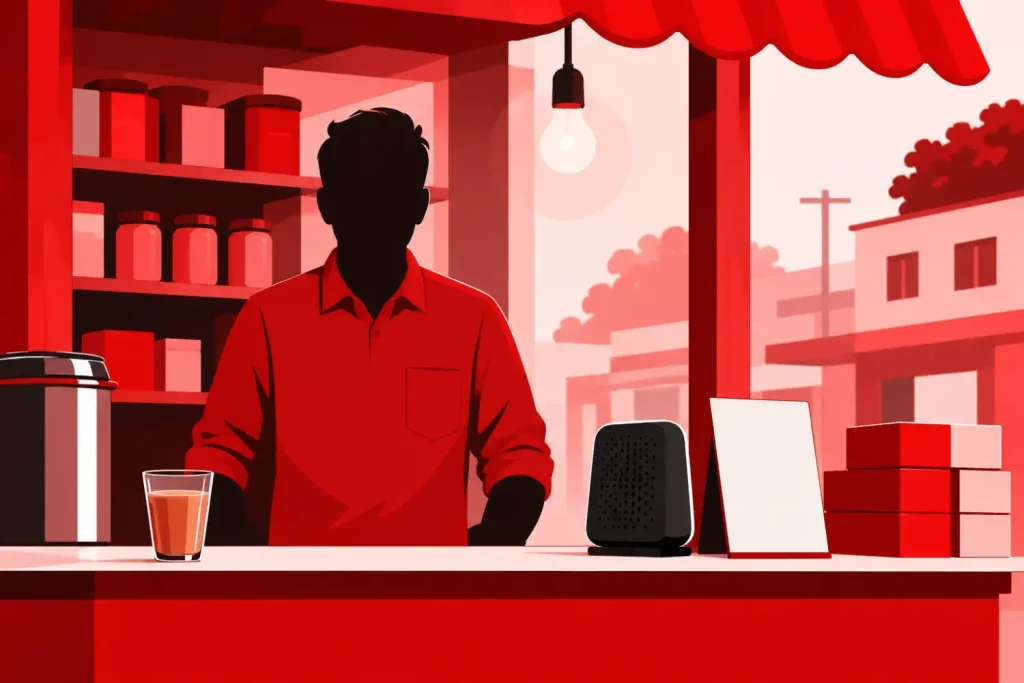
Rivals include PhonePe, owned by Walmart, and Google Pay, Bloomberg reported. UBS put Paytm’s share of the person-to-merchant market at 21.2% in Q1 FY27, as reported by Free Press Journal.
The turn came in FY26, Paytm’s first full profitable year: ₹552 crore ($57 million) on revenue of ₹8,437 crore ($872 million), against a ₹663 crore loss in FY25. Marketing spend fell 18.7% to ₹536 crore ($55 million), exchange4media reported in May 2026.
“We should not recklessly spend money on acquiring consumers.”
Vijay Shekhar Sharma, Q1 FY27 earnings call, as reported by Free Press Journal, September 2026
Revenue climbed from ₹1,918 crore ($198 million) in Q1 FY26 to ₹2,648 crore ($274 million) in Q2 FY27. EBITDA hit a record ₹270 crore ($28 million) in the latest quarter, a 10% margin and the first double-digit reading. Monthly transacting users rose by 1 crore to 8.5 crore, and cash stood at ₹13,617 crore ($1.4 billion) as of September 2026.
The tenfold profit jump needs context. Q2 FY26 carried a ₹190 crore ($20 million) exceptional expense tied to a loan to its real-money gaming subsidiary. Before exceptional items, profit rose about 9%, from ₹211 crore to ₹229 crore ($22 million to $24 million), according to results summaries. The business grew. The headline multiple overstates it.
The Resilient headline: a founder sale that was not a founder sale
On 17 August 2026 One97 told exchanges that Resilient Asset Management B.V. planned to sell up to 4.98% of the company in a block trade. Headlines read like a founder cashing out. The filings said otherwise.
Resilient is wholly owned by Sharma, but it received about 10.2% of Paytm from Antfin in August 2023 through optionally convertible debentures. Resilient holds the voting rights and Antfin kept the economic interest, so the proceeds go to Antfin. PTI reported the transfer at a total valuation of $628 million. Paytm said it was not a party and that Sharma’s direct 9.03% holding, as of June 2026, would not change.
On 18 August a block of about 2.95% of equity changed hands for roughly ₹2,949 crore ($305 million) at a floor price of ₹1,535.10, below the previous close. Exchange data did not name the seller, so the link to Resilient is reported, not confirmed.
Paytm Pi: the AI bet after the bank
Paytm unveiled Paytm Intelligence, or Pi, at Global Fintech Fest in September 2026. It offers AI agents for sales, customer service and operations to banks, lenders and insurers, starting in India and the UAE. Bloomberg reported that its core is a financial services AI model Paytm has built over about two years.
Sharma told shareholders at the 26th AGM: “We have called it Paytm Intelligence, that is Pi.” Bloomberg also reported that Paytm’s internal AI use had cut support costs by more than $11 million a year. On the Q4 FY26 call in May 2026, Sharma said any new investments over the next 12 months would be limited to AI.
What is Vijay Shekhar Sharma worth? The figures and their limits
No verified current figure exists. Reuters cited Forbes at $2.4 billion in November 2021. MarketScreener listed $279 million as of 30 March 2024. NewsX estimated $600 million to $800 million for 2025. A 2026 Goodreturns page shows $1.57 billion. Each is a third-party estimate, and StartupIndiaX has not verified any of them.
What is on the record is shareholding. Exchange data showed Sharma held 9.03% of One97 directly as of June 2026. The Resilient holding sits on top of that, but Antfin keeps its economics.
Read More: Startup Valuation Calculator
Beyond the business
UNEP lists Sharma as a business leader and clean air advocate, and Inc42 has described him as its Patron for Clean Air. Inc42 also reported a $150 million fund, Massive, with venture capitalist Shailesh Vickram Singh for startups working on the environment, and that he joined Roots Ventures as an anchor limited partner. Reuters reported in 2021 that he is married with a son.
Lessons for founders from the rebuild
Editorial analysis, tied to moments in the story.
Treat the regulator as a customer. The RBI acted against the bank in March 2022, October 2023 and January 2024 before the final order. Compliance is part of the product when a licence is your foundation.
Do not let one licensed entity carry the company. In October 2025 Paytm moved its offline merchant payments into Paytm Payments Services to meet RBI payment aggregator rules, and the unit gained RBI approval to operate as a payment aggregator in November 2025.
Cut growth spend before you cut ambition. Paytm trimmed marketing 18.7% in FY26 and still grew revenue 22%.
Explain your cap table before the headline does. The Resilient confusion came from a structure few readers could see. The Funding Round Dilution Calculator helps founders model what each holder actually keeps.
Turn operations into a product. AI cut Paytm’s own costs first, then became Pi.
Where the story stands
The RBI has said it will approach the High Court to wind up the bank, and two regulatory matters show no public outcome. Paytm’s profit now comes from payments, loan distribution and tight cost control. The next test is whether margins keep widening in the Q3 FY27 results.
Have a correction or a question about Sharma’s story? Tell us in the comments, share this with a founder facing a regulator, or read more Founder Stories on StartupIndiaX.
FAQs
Who is Vijay Shekhar Sharma?
Vijay Shekhar Sharma is the founder and CEO of One97 Communications, the parent of Paytm. Born in Aligarh, Uttar Pradesh, in 1978, he studied electronics and communications engineering at Delhi College of Engineering and launched Paytm in 2010 as a prepaid mobile recharge platform.
How much of Paytm does Vijay Shekhar Sharma own?
As of June 2026, exchange data showed Sharma held 9.03% of One97 directly. A separate entity he owns, Resilient Asset Management, held about 10.2%, but Antfin keeps the economic interest in that stake under a 2023 arrangement.
Did Vijay Shekhar Sharma sell Paytm shares in August 2026?
Resilient Asset Management, which Sharma owns, proposed selling up to 4.98% of Paytm in August 2026. Paytm and PTI said proceeds go to Antfin, not Sharma, and his direct 9.03% stake stayed unchanged. Exchange data did not name the block’s seller.
Why did the RBI act against Paytm Payments Bank?
The RBI cited persistent non-compliance and material supervisory concerns in January 2024. In April 2026 it cancelled the licence, saying operations were detrimental to the bank and its depositors. Paytm said the bank had enough liquidity to repay all customer deposits.
Is Paytm profitable now?
Yes, on a reported basis. Paytm posted ₹225 crore profit after tax for Q2 FY27, its sixth straight profitable quarter, after ₹552 crore for FY26, its first full profitable year. Before exceptional items, quarterly profit rose about 9%.
What is Vijay Shekhar Sharma’s net worth?
No verified current figure exists. Forbes was cited at $2.4 billion in November 2021, MarketScreener listed $279 million in March 2024, and a 2026 aggregator shows $1.57 billion. These are third-party estimates that StartupIndiaX has not verified.
What is Paytm Pi?
Paytm Intelligence, or Pi, is an enterprise AI service unveiled in September 2026. It offers AI agents for sales, customer service and operations to banks, lenders and insurers, starting in India and the UAE.
What was the SEBI case against Vijay Shekhar Sharma?
SEBI’s February 2024 notice questioned stock options granted to Sharma before Paytm’s IPO. In May 2025 he, his brother and One97 settled without admitting or denying findings. Terms included cancelled options and a three-year bar on ESOPs from listed companies.
Sources, disclosure and byline
Story type: Public-source profile. Figures dated as of 31 October 2026 unless stated.
Sources
- Business Today (Reuters), “Paytm’s Sharma goes from ‘ineligible’ bachelor to billionaire,” 18 Nov 2021. https://www.businesstoday.in/latest/corporate/story/paytms-sharma-goes-from-ineligible-bachelor-to-billionaire-312594-2021-11-18
- ANI, “Paytm Q2 FY27 profit rises over 10-fold to ₹225 crore; revenue grows 28% to ₹2,648 crore,” 27 Oct 2026. https://aninews.in/news/business/paytm-q2-fy27-profit-rises-over-10-fold-to-8377225-crore-revenue-grows-28-to-83772648-crore20261027083352/
- Business Standard, “Paytm Q2FY27 net profit jumps 10-fold to ₹225 crore, revenue up 28%,” 26 Oct 2026. https://www.business-standard.com/companies/quarterly-results/paytm-q2fy27-net-profit-jumps-10-fold-to-225-crore-revenue-up-28-126102601539_1.html
- Lapaas Voice, “Paytm’s Q2 FY27 profit jumps 10-fold,” 27 Oct 2026. https://lapaasvoice.com/paytms-q2-fy27-profit-jumps-10-fold-to-%E2%82%B9225-crore-as-revenue-rises-28/
- Free Press Journal, “The Wartime CEO: How Vijay Shekhar Sharma Drove Paytm To Record Profits,” 30 Sep 2026. https://www.freepressjournal.in/focused-view/the-wartime-ceo-how-vijay-shekhar-sharma-drove-paytm-to-record-profits
- Free Press Journal, “Paytm Intelligence: Vijay Shekhar Sharma’s Plan To Turn Payments Scale Into An AI Business,” 7 Oct 2026. https://www.freepressjournal.in/focused-view/paytm-intelligence-vijay-shekhar-sharmas-plan-to-turn-payments-scale-into-an-ai-business
- Free Press Journal (Bloomberg report), “Paytm Bets Big On AI,” 9 Sep 2026. https://www.freepressjournal.in/business/paytm-bets-big-on-ai-plans-to-offer-ai-agents-to-banks-and-insurers-in-india-and-uae
- Business Standard (Reuters), “Vijay Shekhar Sharma-controlled Resilient may sell up to 4.98% Paytm stake,” 17 Aug 2026. https://www.business-standard.com/companies/news/vijay-shekhar-sharma-controlled-resilient-may-sell-up-to-4-98-paytm-stake-126081701397_1.html
- PTI via HDFC Sky, “Resilient sell Paytm stake, proceeds to Antfin,” 18 Aug 2026. https://hdfcsky.com/news/resilient-sell-paytm-stake-proceeds-antfin
- India Infoline, “Block Deal Alert: Resilient Asset Management Sells Stake Worth Up to ₹4,895 Crore in PayTM,” 18 Aug 2026. https://www.indiainfoline.com/news/companies/block-deal-alert-resilient-asset-management-sells-stake-worth-up-to-4895-crore-in-paytm-what-investors-should-know
- 5paisa, “Paytm Sees ₹2,949 Crore Block Deal As 2.95% Equity Changes Hands,” Aug 2026. https://www.5paisa.com/news/paytm-sees-rs2949-crore-block-deal-as-295-equity-changes-hands
- MediaNama, “Explained: Why did the RBI cancel Paytm’s banking licence?,” 27 Apr 2026. https://www.medianama.com/2026/04/223-explained-rbi-cancel-paytms-banking-licence/
- Outlook Business, “RBI Cancels Paytm Payments Bank Licence.” https://www.outlookbusiness.com/corporate/rbi-cancels-paytm-payments-bank-licence-what-happens-to-your-account
- Deccan Herald (Reuters), “Paytm Payments Bank board is independent: CEO Vijay Shekhar Sharma,” 22 Apr 2024. https://deccanherald.com/amp/story/business%2Fpaytm-payments-bank-board-is-independent-ceo-vijay-shekhar-sharma-2989539
- Business Today, “Paytm crisis: ‘Don’t fall for any rumour,'” 16 Feb 2024. https://www.businesstoday.in/amp/industry/banks/story/paytm-crisis-paytm-qr-soundbox-card-machines-to-continue-to-work-even-after-march-15-vijay-shekhar-sharma-clarifies-417865-2024-02-16
- Business Standard, “Paytm posts net profit of Rs 184 crore in Q4, revenue rises 18.4%,” 6 May 2026. https://www.business-standard.com/companies/quarterly-results/paytm-posts-net-profit-of-rs-184-crore-in-q4-revenue-rises-18-4-126050601498_1.html
- Paytm, “Paytm FY 2026 Results,” 7 May 2026. https://paytm.com/blog/investor-relations/paytm-fy-2026-results-full-year-profitability-with-pat-at-552-cr-revenue-grows-to-8437-cr/
- exchange4media, “Paytm marketing spends down nearly 19% YoY,” 7 May 2026. https://www.exchange4media.com/marketing-news/paytm-marketing-spends-down-nearly-19-yoy-154458.html
- Business Standard, Paytm Q1 FY26 and Q2 FY26 results coverage. https://www.business-standard.com/companies/quarterly-results/one-97-communications-q1-fy26-result-paytm-profit-revenue-dividend-shares-125072200953_1.html and https://www.business-standard.com/companies/quarterly-results/paytm-posts-21-crore-profit-revenue-from-ops-grows-24-in-q2fy26-125110401912_1.html
- Global Venturing, “Paytm puts together $2.5bn IPO,” Nov 2021. https://globalventuring.com/corporate/paytm-puts-together-2-5bn-ipo
- Deccan Herald, “Warren Buffet’s conglomerate sells entire stake in Paytm at a loss,” 25 Nov 2023. https://www.deccanherald.com/amp/story/business%2Fwarren-buffet-s-conglomerate-sells-entire-stake-in-paytm-at-a-loss-2784253
- Business Today, “Warren Buffett’s Berkshire Hathaway exits Paytm,” 24 Nov 2023. https://businesstoday.in/markets/stocks/story/warren-buffetts-berkshire-hathaway-exits-paytm-books-loss-of-rs-830-cr-report-407057-2023-11-24
- Outlook Business, “SoftBank exits Paytm at loss of around USD 150 million.” https://www.outlookbusiness.com/corporate/softbank-exits-paytm-at-loss-of-around-usd-150-million
- Business Standard (Reuters), “China’s Ant Group plans exit from Paytm with ₹3,800 cr share sale,” Aug 2025. https://www.business-standard.com/companies/news/ant-group-exits-paytm-sells-stake-digital-payment-citigroup-goldman-sachs-125080401129_1.html
- Moneylife, “Paytm’s Vijay Shekhar Sharma Barred from Receiving ESOPs for 3 Years,” 8 May 2025. https://moneylife.in/article/paytms-vijay-shekhar-sharma-barred-from-receiving-esops-for-3-years-in-sebi-settlement-order/77082.html
- DealStreetAsia, “Indian regulator pulls up Paytm founder, director for alleged IPO breaches: report,” Aug 2024. https://dealstreetasia.com/stories/indian-regulator-pulls-up-paytm-founder-director-for-alleged-ipo-breaches-report-409994
- UNEP, “Vijay Shekhar Sharma.” https://www.unep.org/zh-hans/node/20118
- TRIF, India Rural Colloquy 2023 speaker profile. https://www.trif.in/india-rural-colloquy-2023/?p=6507
- MediaNama, “Paytm gets final nod from RBI to operate as online payment aggregator,” Nov 2025. https://www.medianama.com/2025/11/223-paytm-rbi-approval-online-payment-aggregator/
- Baijing, Chinese-language relay of a Bloomberg report on Paytm Pi, Sep 2026. https://www.baijing.cn/article/56643
- Business Standard, “Rupee closes at 96.78 per dollar,” 7 Oct 2026 (conversion basis). https://www.business-standard.com/finance/news/rupee-closes-at-96-78-per-dollar-as-rbi-policy-fails-to-boost-sentiment-126100701050_1.html
AI-assistance note: This article was drafted with AI assistance and reviewed and fact-checked by StartupIndiaX Editorial Team.
Corrections: Spotted an error? Email corrections@startupindiax.com and we will review and update the article.
Written by StartupIndiaX Editorial Team, StartupIndiaX writer covering Indian startups, founders, and entrepreneurship.