SUMMARY
- Pre-money is a company’s value before the cheque; post-money adds the investment. The investor’s stake is always investment divided by post-money.
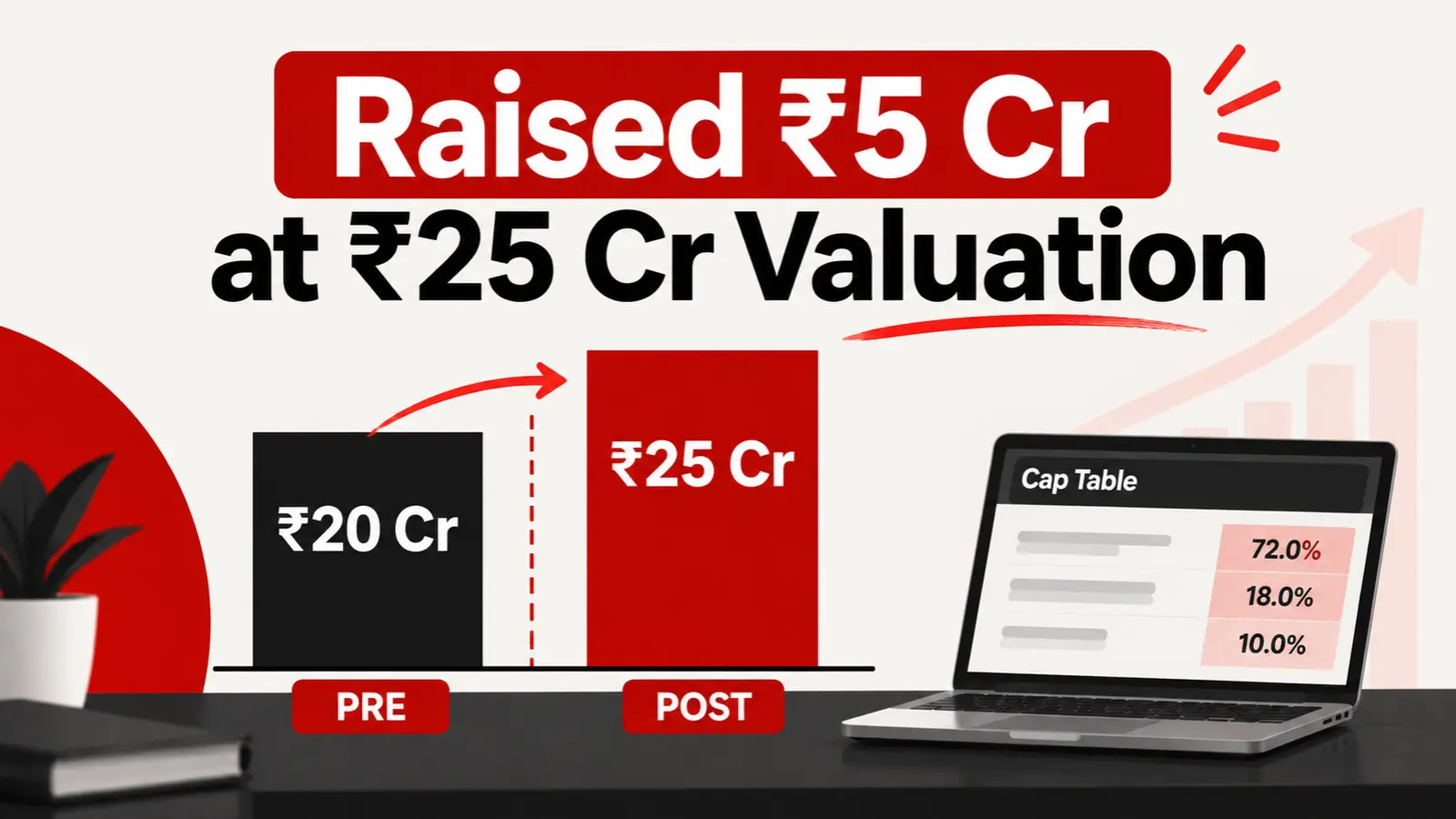
- A headline like “raised ₹5 Cr at ₹25 Cr” means a 20% stake if ₹25 Cr is post-money, but only 16.7% if it’s pre-money.
- Ask whether a quoted valuation is pre or post, and whether the option pool sits inside it, before you compare offers.
Picture two founders reading the same headline: a startup has raised ₹5 crore at a ₹25 crore valuation. The first assumes the investor now owns 20%. The second figures it’s closer to 17%.
Both can be right. The difference sits in two small words that funding headlines often leave out: pre-money and post-money. That’s why pre money and post money valuation is the first thing to check in any funding story, and the first thing to settle on any term sheet that lands in your inbox.
This piece shows how to read the number, with ₹ examples, one real Indian round from this year, and an option pool detail that quietly changes the math.
Same headline, two different stakes
Start with the words. Pre-money valuation is what the company is valued at before the new cash arrives. Post-money valuation is that figure plus the investment. Indian law firm JoyceLaw spells out the same split and adds the part founders miss: the investor’s ownership percentage is worked out on the post-money number.
Now run the headline both ways.
| If ₹25 Cr is… | Pre-money | Post-money | Investor stake | Founders keep* |
|---|---|---|---|---|
| Post-money | ₹20 Cr | ₹25 Cr | 20% | 80% |
| Pre-money | ₹25 Cr | ₹30 Cr | 16.7% | 83.3% |
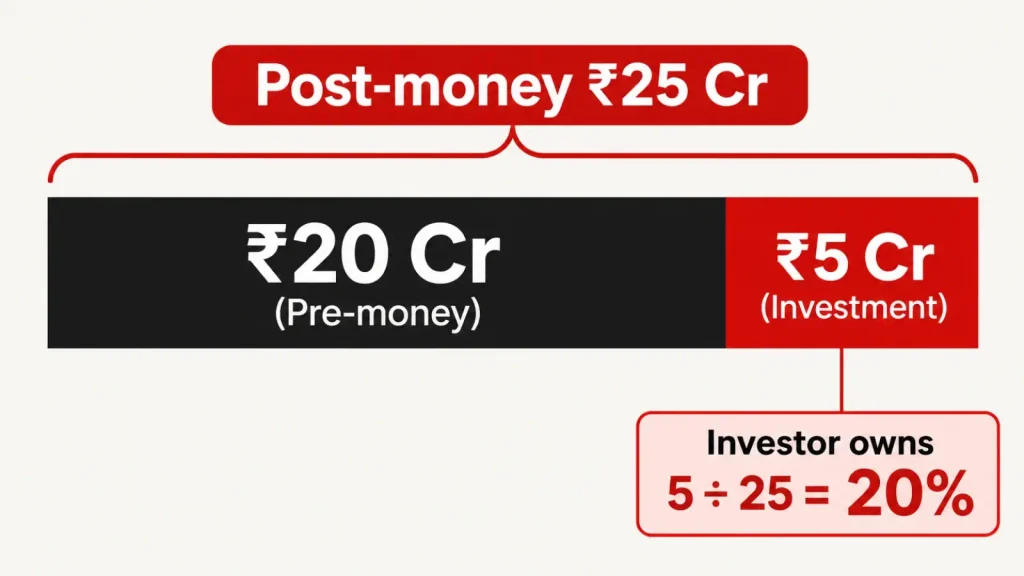
That’s a gap of 3.3 percentage points on a ₹5 crore round. It looks small. It stops looking small once later rounds stack on top of it.
Most funding coverage won’t settle this in the headline. When a number is called a “valuation” with no label, check the body of the story, the company’s own statement, or the term sheet.
The formulas, and how a share price falls out of them
Three lines cover almost everything:
- Post-money = pre-money + investment
- Investor stake = investment ÷ post-money
- Pre-money = post-money – investment
Here’s the same round with real share counts. Say the company has 10,00,000 shares before the round and a pre-money of ₹20 crore. The price per share is ₹20 crore ÷ 10,00,000, which is ₹200.
A ₹5 crore cheque buys 2,50,000 new shares. Total shares become 12,50,000, and 12,50,000 × ₹200 gives the ₹25 crore post-money. The investor holds 2,50,000 of 12,50,000 shares, which is exactly 20%.
One detail from the same JoyceLaw note matters in a few paragraphs: the share price is based on the pre-money valuation spread across every share on the cap table before the investment, and that count includes the option pool.
If you want a starting range for your own pre-money before you talk to anyone, the Startup Valuation Calculator estimates one using the VC method, revenue multiple and scorecard method, all in ₹ crore.
A real headline: Sarvam’s $1.5 billion
In June 2026, DealStreetAsia ran the headline that Sarvam raised $234 million in the first close of a Series B “at $1.5b valuation”. Look closely and the word “post-money” shows up in the story’s description, not the headline. Inc42’s report is explicit too: $1.5 billion post-money, on a planned $300 million round, with HCLTech putting in $150 million as lead strategic investor.
So what did HCLTech get? Reports citing Dealroom put its stake at 10.46%, for about ₹1,427 crore. Divide $150 million by $1.5 billion and you’d expect a clean 10%.
The gap is a useful lesson. Work it backwards: a $1.5 billion post-money on a $300 million round implies a pre-money of roughly $1.2 billion. Count only the $234 million first close and the post-money at that moment is about $1.434 billion. And $150 million divided by $1.434 billion is 10.46%.
It fits the reported stake. To be clear, that’s our own arithmetic, not a pre-money figure Sarvam has disclosed. The takeaway holds either way: a stake depends on which cheques are actually in the cap table when you calculate it. If the remaining $66 million closes on the same terms, HCLTech’s percentage would drift toward 10%.
The option pool is where founders quietly pay
Back to the ESOP detail. JoyceLaw notes that investors usually ask for the pool to be created or expanded pre-money. That puts the dilution entirely on existing shareholders. If the pool is created post-money, the investor shares the hit.
Take our ₹20 crore pre-money, ₹5 crore round. The investor wants a 10% pool, measured on the post-round cap table. Assume the founders owned everything before.
| Pool treatment | Investor | Option pool | Founders |
|---|---|---|---|
| No pool | 20% | 0% | 80% |
| Pool created pre-money | 20% | 10% | 70% |
| Pool created post-money | 18% | 10% | 72% |
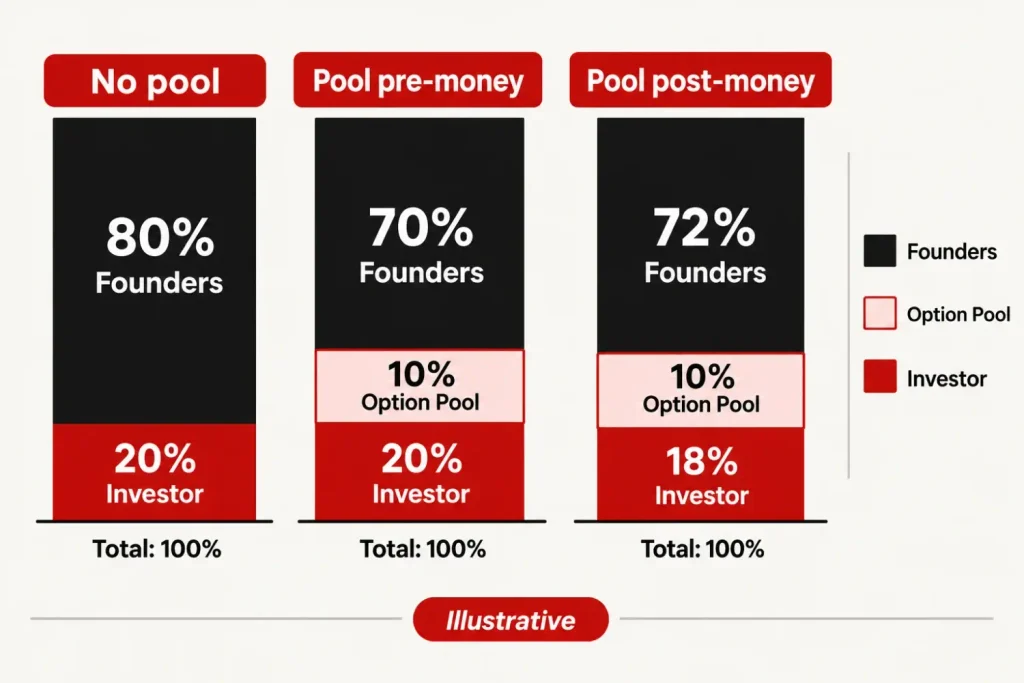
In the pre-money case, the pool is worth ₹2.5 crore (10% of ₹25 crore) and it comes out of the founders’ side. The “₹20 crore pre-money” is effectively ₹17.5 crore for the people who hold shares today.
Investors aren’t wrong to ask. Hiring plans are real, and a pool is part of how a company recruits. But the headline pre-money is no longer the number your ownership is priced on. JoyceLaw also points out that adding option shares doesn’t raise the company’s valuation the way new investment does. Read that clause with your lawyer before you agree to it.
Round after round, the next cheque shrinks everyone
Valuation labels matter even more across rounds. Say a startup raises ₹2 crore at ₹8 crore pre-money. Post-money is ₹10 crore, and the seed investor holds 20%.
A year later, a Series A investor puts in ₹10 crore at ₹40 crore pre-money. Post-money is ₹50 crore, so the new investor gets 20%. Everyone who was already on the cap table gets diluted by that same 20%. The seed investor drops to 16%, and the founders, who held 80% after seed, fall to 64%. (We’ve left the option pool out to keep it clean.)
Notice what stays fixed: every new investor still gets investment divided by post-money. What changes is how much is left for everyone else. The Funding Round Dilution Calculator lets you run this across Seed, Series A and Series B before a term sheet forces the issue.
Read More: How to Raise Pre-Seed Funding in India: What Investors Ask in the First 10 Minutes
What to ask before you celebrate, or sign
When an offer arrives, four questions do most of the work:
- Is the valuation pre-money or post-money?
- Is the option pool inside that number or on top of it?
- How many fully diluted shares exist before the round?
- Do any notes or convertible instruments convert in this round?
Our take: pre-money is the number founders negotiate, and post-money is the number investors price their stake on. Founders who track only the first one tend to get surprised by the second. Clear labelling helps everyone. Investors get fewer cap table arguments, founders can compare offers fairly, and readers of funding news can tell one round from another. Sarvam’s coverage was a decent model, even if the headline itself left the label out.
This is educational, not legal advice. Your term sheet and shareholder agreement are what actually bind you.
Three things to carry out of this:
- Confirm whether a valuation is pre-money or post-money; the investor’s stake is investment divided by post-money.
- Check whether the option pool is created before the round, because then founders absorb the dilution.
- Compare offers on ownership after the round, not on the headline valuation alone.
Run your own numbers in the Startup Valuation Calculator, then see what the round does to your cap table in the Dilution Calculator. And if you’ve signed a term sheet where the pre or post label was unclear, tell us in the comments (without anything confidential) which part tripped you up.
FAQs
What is the difference between pre-money and post-money valuation?
Pre-money is the company’s value before an investor’s cash goes in. Post-money is pre-money plus the investment. Investors calculate their ownership on post-money, so the two labels give different stakes for the same headline number.
How do I calculate an investor’s stake?
Divide the investment by the post-money valuation. A ₹5 crore cheque at ₹25 crore post-money is 20%. If ₹25 crore is pre-money instead, post-money is ₹30 crore and the stake falls to 16.7%.
Is the valuation in a funding headline pre-money or post-money?
Often the headline doesn’t say. Check the body of the story, the company’s announcement or the term sheet. Sarvam’s Series B coverage, for example, labelled the $1.5 billion as post-money in the story text rather than the headline.
Does the ESOP pool change founders’ ownership?
Yes. If the pool is created before the investment, existing shareholders absorb the dilution and the effective pre-money falls. If it’s created after, the investor shares the dilution. Investors usually prefer the pre-money approach.
How is a startup’s pre-money valuation decided?
It’s negotiated. Investors look at comparable rounds, revenue multiples and methods like the VC method, then settle on a number with the founders. The Startup Valuation Calculator can give you a range to anchor that conversation.