Table of Contents
Summary
- SunCharge Motors, founded in 2024 by 24-year-old Sanskar Modi, began delivering India’s first solar-powered commercial electric three-wheelers to fleet operators in 2026.
- The startup closed a seed round led by JIIF in May 2026; the vehicle offers ~120 km range and charges continuously via rooftop solar panels while driving.
- Priced at Rs 4.5 lakh, the cargo auto targets last-mile delivery operators and MSMEs in Tier-2 and Tier-3 cities where charging infrastructure remains limited.
Most EV startups in India are waiting for the charging network to grow. Sanskar Modi decided that was the wrong bet.
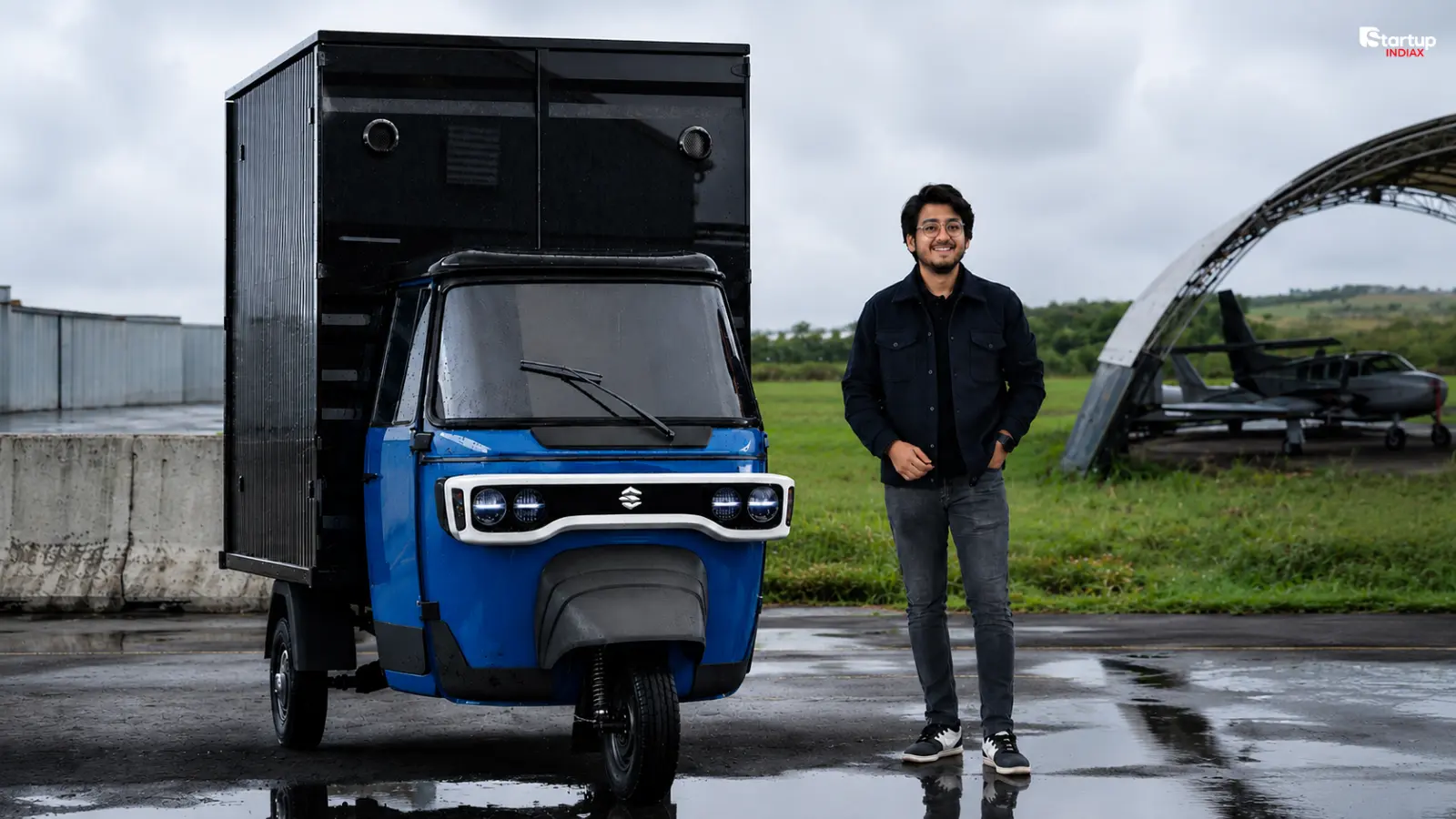
The 24-year-old founder of Pune-based SunCharge Motors has spent the last two years building a solar-powered electric three-wheeler that generates power while it drives, making charging stations largely beside the point. This June, with seed funding closed and the first Solar Autos rolling out to fleet operators, his startup has staked a claim most didn’t see coming: India’s first solar-powered commercial electric vehicle company.
The Problem He Went Looking For
Before SunCharge Motors existed, Modi spent time doing something most EV founders skip: talking to auto drivers.
What he heard was consistent. The vehicle wasn’t the problem. The charging was. For commercial drivers who earn by the kilometre, time spent at a charging station is money lost. And in smaller cities and rural areas, reliable charging infrastructure doesn’t really exist yet.
India has around 40 million three-wheelers on its roads, and nearly 90% of last-mile deliveries run through them. The electric alternatives coming to market had a real gap: certified load capacity often didn’t match real-world performance, and range anxiety was compounded by the absence of charging points outside major urban centres.
Modi’s read on the situation was blunt. India took decades to build its petrol and diesel network. CNG still has significant gaps. Betting EV adoption on a charging rollout of similar scale, especially for Tier-2, Tier-3, and rural operators, felt like the wrong plan.
So he didn’t wait for the network. He built around it.
Read More : Honda’s eQuad: 5 Powerful Reasons It’s Revolutionizing Urban Deliveries
Building the Technology Before Anything Else
When Modi founded SunCharge Motors in September 2024, he was working alone.
He made a deliberate choice early on: focus on the core technology first, not the vehicle’s appearance. He personally developed a production controller designed to transfer 30% more electrical charge from the solar panels to the battery while cutting electrical and heat losses. The first prototype looked rough. The underlying systems worked.
“I knew that before raising external funding, we needed to prove that the technology actually worked,” Modi told Startup Pedia. The strategy was product-first, investor-second, in a funding environment where that’s genuinely the harder path.
It paid off. By 2025, SunCharge Motors’ first Solar Auto prototype had clocked 180 km of real-world range with a solar roof operating at over 25% efficiency. The prototype-to-production-ready timeline: four months.
How the Solar System Actually Works
The vehicle uses proprietary solar cells mounted on the roof to generate electricity continuously during daylight operation. That power runs through a custom-built controller, into the Battery Management System, and charges the battery while the vehicle is moving.
On a full charge, the battery provides around 120 kilometres of range – closely matching the average daily distance commercial auto drivers cover in India. A backup onboard charger and standard 3-pin socket handle the rest.
The most common objection Modi gets is obvious: what happens when it rains? His answer is data-driven. India doesn’t experience heavy rainfall year-round. Even accounting for roughly 30 days of significant rain annually, the vehicle remains economically practical for the other 335. The solar cells also continue to generate power under partial cloud cover through what the company calls photonic ionization, at reduced efficiency but not zero output.
Read More : From India to Europe: Ultraviolette F77’s Historic 10-Country Launch
From Prototype to Actual Deliveries
In 2026, deliveries began. The first Solar Autos were rolled out to fleet operators, with a connected driver app shipping alongside the vehicles.
On social media, Modi marked the moment plainly: “2 years ago this vehicle existed only in my head. Then it existed as a rough sketch. Then as a prototype that broke down more times than I can count, in more ways than I expected. But every failure taught me something the lab never would have.”
The commercial cargo auto is priced at Rs 4.5 lakh. SunCharge Motors is working with banks and financial institutions to offer vehicle financing, with fleet operators and MSMEs as key target customers.
The Funding Picture
In May 2026, SunCharge Motors closed a seed funding round led by JITO Incubation and Innovation Foundation (JIIF), alongside a group of strategic angel investors. The company has not disclosed the size of the round, but confirmed the capital will go toward technology development, infrastructure research, and scaling its solar-assisted mobility systems.
The startup now operates with a core team of 12 – a mix of full-time employees and freelancers covering engineering, design, procurement, finance, and operations.
Read More : Aircela’s Air-to-Fuel Technology: The Future of Fossil-Free Energy?
Why Solar Over Battery Swapping?
Modi has a clear view on the debate. Battery swapping works in specific contexts: Tier-1 cities, predictable logistics routes, vehicles operating between fixed supply hubs. For the large number of auto drivers and small operators in Tier-2, Tier-3, and Tier-4 cities, the model is harder to rely on. The economics don’t hold without the infrastructure density, and building that density takes time.
Solar charging, in SunCharge Motors’ model, doesn’t need a network to exist before it can be useful. The vehicle is the infrastructure.
SunCharge Motors’ competitors in the electric three-wheeler space include funded players like ETO Motors, TI Clean Mobility, and Atul Greentech. None have taken the solar-integrated commercial route that SunCharge is pursuing.
The Founder Behind It
Modi isn’t a first-timer. He’s been building businesses since he was 16.
Growing up in Ratlam, Madhya Pradesh, he launched BooksForYou at 16, a book distribution venture for students that turned a profit of around Rs 10 lakh before closing after a year. In 2018, he built Solar NXT, a tech-driven solar marketplace, which was later acquired by a real estate developer for over Rs 50 lakh. A third venture, Exzellens Motors, focused on vehicle prototyping before winding down at breakeven.
He graduated from MIT World Peace University, Pune, with a B.Tech in 2024. A few months later, SunCharge Motors was registered.
Startup INDIAX Take
What SunCharge Motors represents isn’t just an interesting product – it’s a specific kind of founder thesis. Modi didn’t start with a market deck. He started by talking to auto drivers, identified the actual constraint (not range, but charging dependency), and built directly at that constraint. He went product-first in a year when investors were pulling back, and he validated the tech before asking for money.
That sequence matters. A lot of EV startups have raised funding on slides and timelines. SunCharge went from prototype to delivery in under two years with a lean team, a bootstrapped start, and a first-principles approach to a problem that better-funded competitors are still working around. For founders in deep-tech or mobility, that’s the more instructive story here.
Why This Matters
The electric three-wheeler market is genuinely large. Last-mile logistics, passenger auto, and fleet operations together represent millions of vehicles and billions in annual fuel spend. The transition to EVs in this segment has stalled partly because of charging infrastructure gaps in Tier-2 and smaller cities, and partly because the vehicles haven’t always performed as advertised under real commercial loads.
A solar-integrated vehicle that reduces charging dependency doesn’t just solve a convenience problem – it changes the business case for operators in places where a charging point simply doesn’t exist nearby. If the technology proves out at scale, SunCharge’s approach could be more relevant for rural and semi-urban India than most current EV offerings.
The Bigger Picture
India’s electric three-wheeler segment has been growing fast, but it remains dominated by players betting on battery swapping, fast-charging networks, or financing innovation rather than fundamental energy-source innovation. SunCharge is an outlier in that field.
The company is targeting 30-35% market share in its segment within five years, with revenue projections above Rs 110 crore in its first year of commercial operations and sales of 2,500 to 3,000 vehicles. Those are ambitious numbers for a team of 12. But the product is now real, the deliveries have started, and the funding is in. The next 12 months will show whether a solar-first thesis can hold up under actual commercial conditions – and whether the market will catch up to where Modi built.
If you’re building in deep-tech, mobility, or clean energy – or investing in those spaces – SunCharge Motors is a story worth watching closely. What do you think: is solar-integrated charging the missing piece for EV adoption in smaller Indian cities? Share your take in the comments, and pass this along to a founder who needs to read it.
FAQs
Who is Sanskar Modi and what did he build before SunCharge Motors?
Sanskar Modi is a 24-year-old entrepreneur from Ratlam, Madhya Pradesh. Before SunCharge Motors, he built a book distribution venture, a solar marketplace that was acquired for over Rs 50 lakh, and an EV prototyping company – all before graduating from college in 2024.
How does SunCharge Motors’ solar charging actually work?
The vehicle’s rooftop solar cells generate electricity continuously during the day. That power runs through a custom controller into the battery management system, charging the battery while the vehicle is in motion. A backup 3-pin wall charger is also included for overnight or cloudy-day top-ups.
What happens to SunCharge Motors’ vehicles during the rainy season?
The company’s solar cells continue generating power even under partial cloud cover. Modi’s case is based on usage data: India sees roughly 30 days of heavy rain annually, leaving the vehicle highly practical for the remaining period. Full charging via wall socket is always available as a backup.
Who has invested in SunCharge Motors?
The company closed a seed funding round in May 2026, led by JITO Incubation and Innovation Foundation (JIIF) alongside strategic angel investors. The funding amount has not been publicly disclosed.
How does SunCharge Motors compare to battery-swapping EV startups?
Battery swapping works well in Tier-1 cities with predictable routes and dense swap-station networks. SunCharge Motors argues it’s far less practical for smaller cities and rural operators who lack that infrastructure. Their solar model makes the vehicle self-sufficient, removing dependency on any external network.
What is the price of SunCharge Motors’ electric three-wheeler?
The commercial cargo auto is priced at Rs 4.5 lakh. The company is working with financial institutions to offer vehicle financing for fleet operators and individual drivers.