Table of Contents
Summary
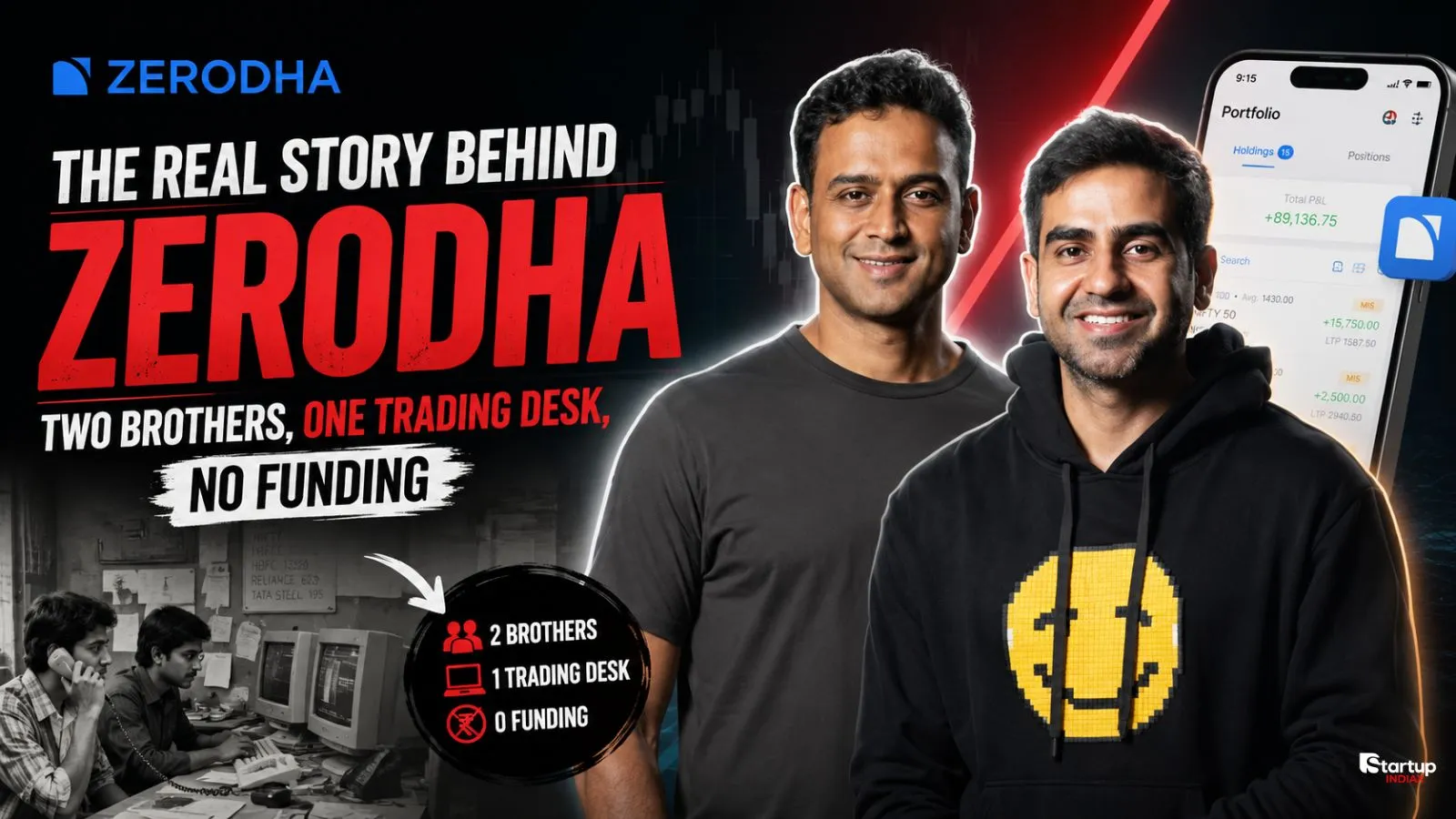
- Nithin Kamath went broke trading, worked a call-center job, then spent nearly a decade as a sub-broker before co-founding Zerodha with brother Nikhil in August 2010.
- Zerodha has never raised external funding and remains 100% owned by the Kamath family, disrupting Indian broking with a flat ₹20-per-trade fee.
- FY25 revenue was around ₹8,868 crore with profit near ₹4,237 crore. Combined, Nithin and Nikhil Kamath are worth roughly $7.8 billion per Forbes, as of July 2026.
Nithin Kamath didn’t plan to build India’s largest stockbroking company. He planned to survive as a trader. He wasn’t even good at it, at first.
That’s the real starting point of the Zerodha story.
He took a night job at a call center. Traded during the day.
Kamath got into markets at 17. He traded through college. In 2001-02, the crash wiped him out. He lost around ₹5 lakh and went broke.
His younger brother Nikhil had a rougher start of his own. Nikhil dropped out of school after 10th grade, and at 17 he faked his birth certificate to land a call-center job paying ₹8,000 a month. He worked nights, traded mornings, same as Nithin.
By 2004, an American client trusted Nithin to manage money. That led to Kamath & Associates, a sub-broking outfit under Reliance Money. Portfolio advisory by day, proprietary trading on the side, for the better part of a decade.
Read More: Pawan Kumar Chandana: Vizag to Rocket Factory
The Pivot
By 2008-09, something became obvious. Nikhil, seven years junior, was simply better at trading.
Nithin made a call. Nikhil keeps trading. Nithin builds the broking business.
On August 15, 2010, they launched Zerodha. No investors. No loan. Just savings from their own trading. The name combines “zero” with the Sanskrit word “rodha,” meaning barrier.
What They Built
Zerodha’s whole pitch: flat ₹20 per trade, instead of a percentage cut on every order. That one change broke the old broking model in India.
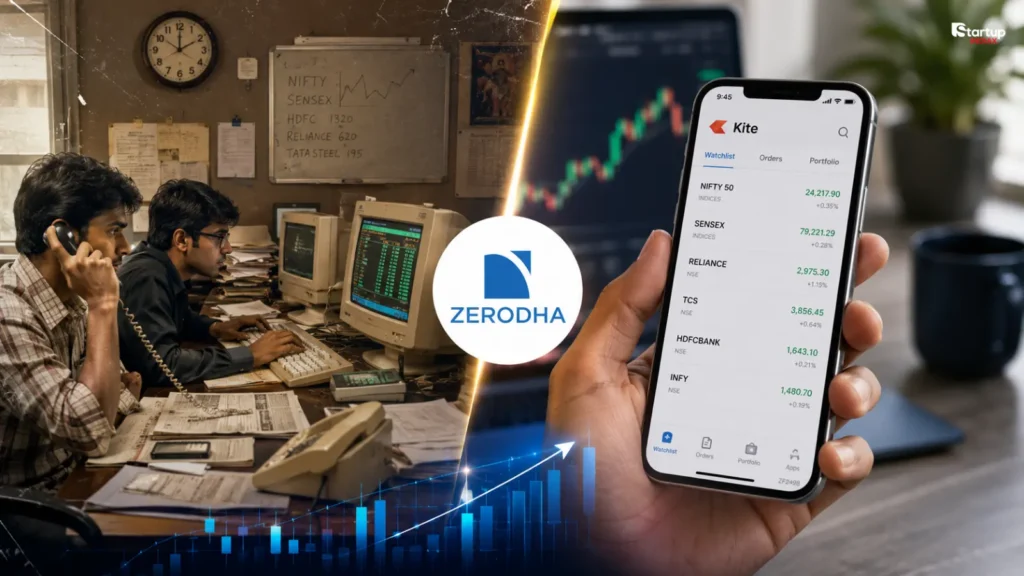
They built their own tech instead of licensing it:
- Kite — the trading app
- Coin — direct mutual fund investing
- Console — the back-office dashboard
- Varsity — free trading and investing education
- Rainmatter — Zerodha’s fintech fund and incubator
- True Beacon — a zero-fee asset management firm for ultra-high-net-worth investors, launched by Nikhil in 2020
Read More: Aman Sanger Story: Cursor AI Founder Journey 2025
Does Zerodha Have Investors?
No. This is the part that surprises people.
Zerodha has never raised outside capital. No seed round, no Series A, no PE check, sixteen years in. The Kamath family owns 100% of the company.
What the brothers do have is a long personal investing track record, just not into their own company. Nikhil has personally backed Licious, Third Wave Coffee, Pee Safe, Nourish You, and Radico Khaitan (a ₹400 crore stake for roughly 1.6-1.7%). Through Gruhas, his real estate and prop-tech fund, he’s also backed Emoha Elder Care and Ossus Biorenewables. Rainmatter, run out of Zerodha itself, has backed fintech names like Smallcase and WealthDesk.
So: zero investors in Zerodha. Two very active investors from Zerodha’s profits.
Valuation & Net Worth (Verified, Real-Time Figures)
These numbers come from Forbes’ live billionaire tracker, not the SEO net-worth sites that disagree with each other by billions.
| Person | Net Worth (Jul 2026) | Forbes World Rank | Forbes India Billionaires Rank |
|---|---|---|---|
| Nithin Kamath | $4.7 billion | #896 | #852 |
| Nikhil Kamath | $3.1 billion | #1355 | #1285 |
| Combined | ~$7.8 billion | — | — |
For context, Forbes put their combined wealth at $3.45 billion back in October 2022. It has roughly doubled since, alongside Zerodha’s own profit growth.
Zerodha itself has no official valuation, since it’s never raised funding or gone public. The Hurun India Report 2024 pegged it at roughly ₹64,800 crore (about $7.7 billion), ranking the Kamath brothers 8th among India’s self-made entrepreneurs. Treat that as an estimate, not a market-tested number.
Zerodha: Revenue vs Net Profit (FY23-FY25)
Figures in ₹ Crore | Source: Business Standard, BW Disrupt, company disclosures
Growth & Financials
| Metric | FY23 | FY24 | FY25 |
|---|---|---|---|
| Revenue | ₹6,875 Cr | ~₹9,995 Cr | ₹8,868 Cr |
| Net Profit | ₹2,907 Cr | ~₹4,700 Cr | ₹4,237 Cr |
FY25 was the first year both lines fell, mainly because SEBI’s tighter derivatives rules, effective November 2024, cut into futures and options volumes, which are the bulk of Zerodha’s revenue. Zerodha still stayed the most profitable broker in the country by a wide margin.
Zerodha: Active NSE Clients Over Time
Figures in millions | Source: NSE data, Business Standard, Entrackr
On clients: Zerodha had over 7 million clients per Forbes’ most recent profile, with roughly 8.1 million active NSE clients in late 2025, easing to about 68.5 lakh (6.85 million) by May 2026, around 15% of the exchange’s active base. Groww passed Zerodha on raw client count back in 2023.
Kamath Brothers: Combined Net Worth (Forbes Estimates)
Figures in USD Billion | Source: Forbes Real-Time Billionaires, as of Jul 2026
Culture, By Design
Kamath has said Zerodha deliberately never grew past roughly 1,000 employees. He calls it central to how the company functions, not a cost-saving move.
He’s also drawn a hard line on user data. On X, he’s argued that “free” platforms usually mean the user is the product, and that Zerodha avoids that model.
Nikhil, meanwhile, has taken his platform in a different direction. His podcast “WTF is” has hosted Elon Musk and, in January 2025, Prime Minister Narendra Modi for a two-hour episode, his first-ever podcast appearance.
Read More: Shark Tank Bonkers Corner: From Broke to Rs 300 Cr Valuation
The Human Side
Not everything here is a clean success story.
Nithin disclosed on social media that he had a mild stroke in January 2024, citing over-exercising, exhaustion, and his father’s death as contributing factors. It’s a rare moment of a billionaire founder being candid about burnout.
Nikhil, separately, has been divorced since his marriage to Amanda Puravankara, a Bengaluru real estate executive, ended within about a year. And in 2021, he faced backlash after winning a charity chess match against five-time world champion Viswanathan Anand with help from computer analysis. He publicly apologized afterward.
On the philanthropy side, Nikhil became the youngest Indian signatory of the Giving Pledge in 2023, committing to give away half his wealth. He also created the Young India Philanthropic Pledge, which asks signatories under 45 to donate at least 25% of their fortune annually.
Read More: How to Apply for Startup India Certificate in 5 Easy Steps
Startup INDIAX Take
The headline lesson people take from Zerodha is “flat fees disrupt an industry.” That’s not the real story.
The real story is Nithin Kamath admitting he wasn’t the better trader, and building the company around that fact instead of his ego. Bootstrapped, profitable, zero external investors, sixteen years in. For founders chasing funding as a scoreboard, that’s worth sitting with.
Why This Matters
Zerodha’s story matters to Indian founders because it’s one of the clearest proof points that a bootstrapped, profitable business can out-earn venture-funded competitors over a long enough timeline. While rivals raised hundreds of millions of dollars to chase user growth, Zerodha grew profitably without diluting ownership, and still leads the industry on profitability even as it has lost ground on raw client count.
For everyday investors, the flat-fee model permanently changed what brokerage costs look like in India. For the broader fintech ecosystem, Rainmatter has quietly become a source of early capital for other Indian fintech startups.
The Bigger Picture
India’s retail trading boom, accelerated by the pandemic and a since-cooled bull run, brought over 11 crore unique investors into the market. That surge reshaped the competitive landscape, with venture-backed apps like Groww and Angel One competing aggressively on user acquisition while Zerodha held back.
The next phase for Zerodha looks less about winning back the client-count race and more about diversifying revenue beyond futures and options, an area where regulatory tightening has already squeezed margins across the industry. Zerodha Capital, its lending arm, and its mutual fund business through Zerodha Fund House suggest where that diversification is headed.
Got a founder story you think deserves the same kind of dig-deeper treatment? Drop the name in the comments, or explore more Startup INDIAX founder journeys to see how other Indian entrepreneurs built without shortcuts.
FAQs
Who founded Zerodha, and when was it founded?
Zerodha was founded by brothers Nithin Kamath and Nikhil Kamath on August 15, 2010, in Bengaluru. Nithin serves as CEO, while Nikhil focuses on trading, True Beacon, and Gruhas.
Does Zerodha have any investors or funding rounds?
No. Zerodha has never raised external funding, not a seed round, not a Series A, nothing. It remains 100% owned by the Kamath family.
What is Zerodha’s revenue and profit?
In FY25, Zerodha reported revenue of approximately ₹8,868 crore and net profit of around ₹4,237 crore, both down from FY24 due to SEBI’s tighter derivatives rules affecting the whole industry.
What are Nithin and Nikhil Kamath’s net worth?
Per Forbes’ real-time billionaire tracker (July 2026), Nithin Kamath is worth $4.7 billion and Nikhil Kamath is worth $3.1 billion, a combined total of roughly $7.8 billion.
What is Zerodha’s valuation?
Zerodha has no official valuation since it has never raised funding or gone public. The Hurun India Report 2024 estimated it at around ₹64,800 crore (about $7.7 billion), though this is an unofficial estimate, not a market-tested figure.
Which other companies have the Kamath brothers invested in?
Nikhil Kamath has personally invested in companies like Licious, Third Wave Coffee, Pee Safe, and Radico Khaitan, and has backed additional startups through his fund Gruhas. Rainmatter, run out of Zerodha, invests in Indian fintech startups.
Is Zerodha still India’s largest brokerage?
By active client count, no, Groww overtook Zerodha in 2023. By profitability, yes, Zerodha remains the clear industry leader.