Summary
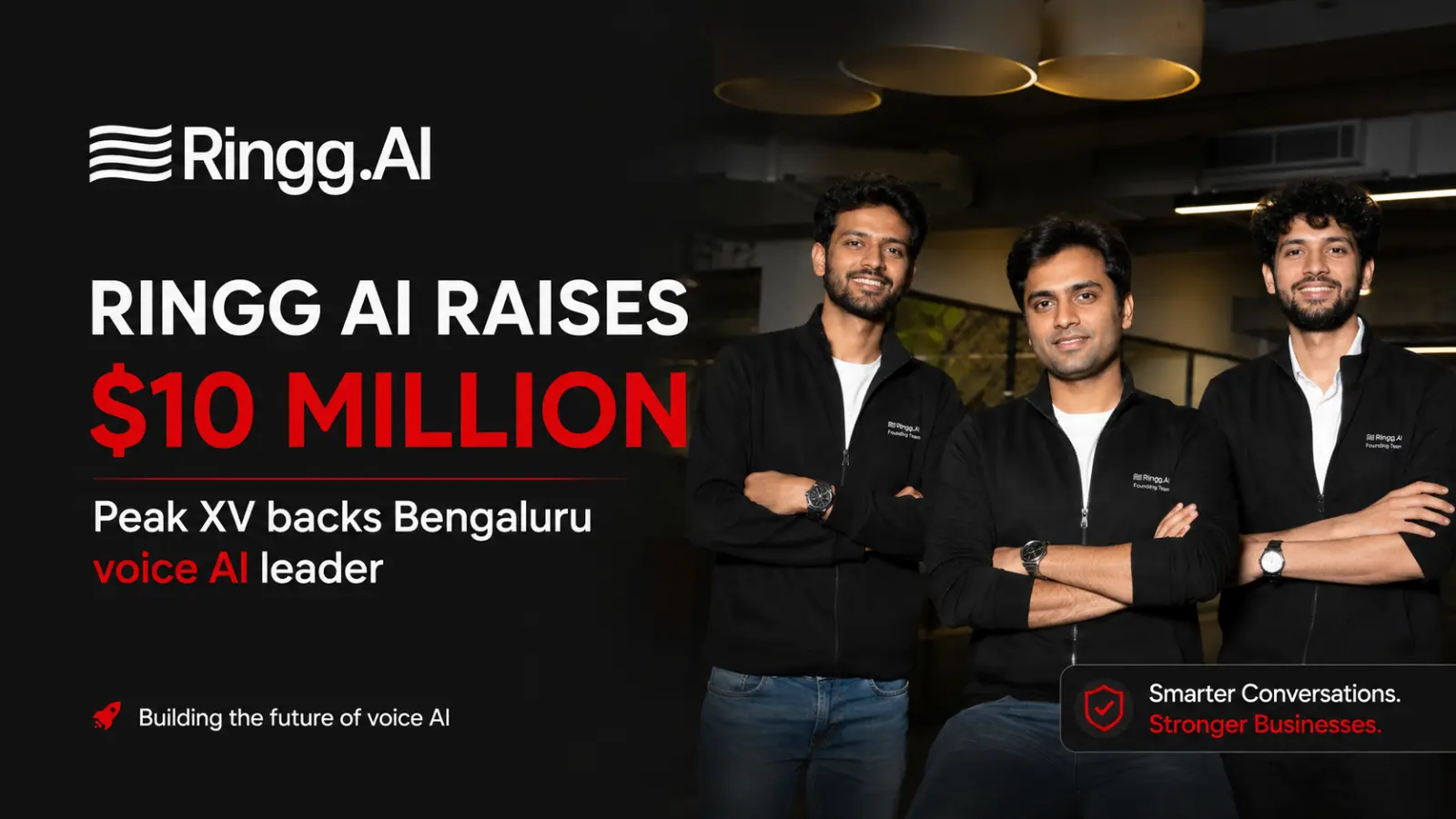
- Ringg AI raised $10 million in a Series A extension led by Peak XV Partners, taking its total round to $15.5 million.
- The Bengaluru startup now processes around 20 million call attempts a month for clients including Flipkart, Practo, Groww and PolicyBazaar.
- Ringg pivoted from a failed text-to-speech venture called DesiVocal to building enterprise voice, WhatsApp and browser AI agents.
Ringg AI has raised $10 million in an extended Series A round led by Peak XV Partners, with existing backers Arkam Ventures and Capital 2b also writing checks. The firm had previously raised $5.5 million in Series A funding in January this year, taking the total size of the round to $15.5 million.
That’s a real number for a startup most people outside enterprise AI circles have never heard of. But the story behind it is the more interesting part.
Ringg didn’t start as a voice AI company at all. The startup began as a text-to-speech company called DesiVocal before shifting towards enterprise AI agents after finding the cost of developing its own speech models difficult to sustain. That’s a polite way of saying the original bet didn’t work, and the founders, Siddharth Tripathi, Utkarsh Shukla and Kali Charan Vemuru, had to rebuild around something that actually paid.
What they rebuilt is now handling meaningful volume. Ringg currently processes around 20 million call attempts every month and counts companies including Flipkart, Practo, Groww, Supernova, Goodscore and PolicyBazaar among its customers. It also works with CRED and Tabby, spanning marketplaces, healthcare, banking and fintech.
From Cheap Volume to Hard Workflows
Early enterprise voice AI in India has largely meant one thing: cheap, high-volume calling for outbound sales and collections. Ringg started there too, and co-founder Siddharth Tripathi has been direct about why that’s not where the company wants to stay.
“Nobody buys us because the demo sounds good,” Tripathi said, framing the pitch around outcomes rather than novelty.
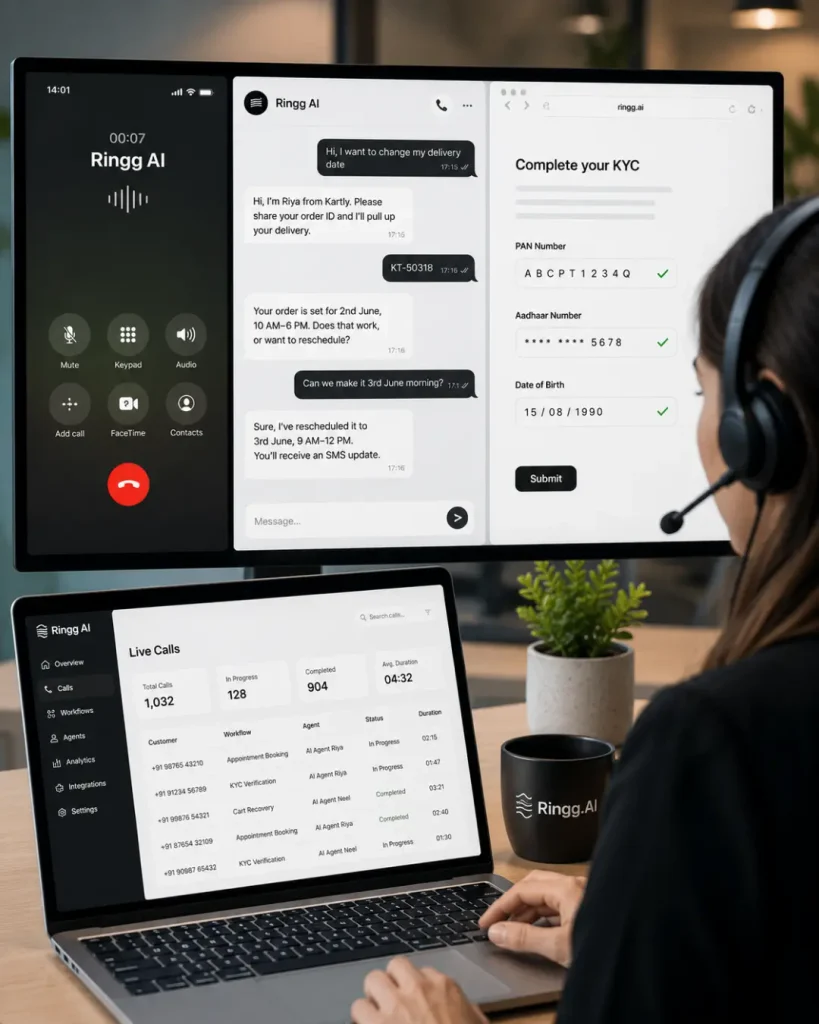
Its voice agents are used for applications such as outbound calling, lead qualification and loan collection. The company is now moving into more complex workflows, including healthcare appointment booking, e-commerce cart recovery, and fintech onboarding and KYC. That’s a meaningfully harder problem set. Loan collection calls and lead qualification are volume games where price wins. Appointment booking, KYC and cart recovery need the agent to actually complete a task correctly, inside a regulated or transaction-sensitive flow, without a human stepping in to fix it.
Its voice agents are deployed across 1,200 Practo clinics, where they help patients book appointments and follow up after visits. That’s the kind of deployment that doesn’t forgive a bad call.
Read More: An AI Startup, Rillet, Just Raised $100M in 48 Hours. Here’s What It Says About the Future of Hiring
Why Peak XV Extended Instead of Waiting
Extension rounds inside an existing Series A, rather than a fresh priced round, usually signal one of two things: either the company needed a bridge, or the lead investor liked what it saw enough to add capital on the same terms before outsiders could bid up the price. For founders trying to work out what a structure like this actually does to their own cap table, it’s worth running the numbers rather than guessing.
Read More: Funding Round Dilution Calculator
Rishen Kapoor, a principal at Peak XV, pointed to Ringg’s technical depth as the reason the fund went back in, noting that the startup’s own models let it take on harder, higher-value enterprise tasks rather than simple call scripts.
That technical bet includes owning more of the stack than most voice AI startups attempt. Co-founder and CTO Kali Charan Vemuru has said the team deliberately went after the hardest version of the problem first, reasoning that an agent built to survive noisy calls and mid-conversation language switching would generalize to easier environments too. The platform has been built for enterprise environments that typically expose the limitations of AI agents, including noisy calls, customers switching languages mid-conversation, asynchronous WhatsApp interactions, browser workflows spanning multiple enterprise applications, strict latency requirements and regulated data environments. The startup supports in-region deployments across India, the GCC, the US and Europe, as well as on-premise deployments.
Ringg hasn’t disclosed a valuation for this round, and neither Peak XV nor the company has said whether this closes out the Series A entirely or leaves room for further extension. Founders modelling a similar structure for their own raise can get a rough sense of where a round like this might land using a valuation model.
Read More: Startup Valuation Calculator
That regulated-data, on-premise piece matters more in India than it might elsewhere. Fintech and healthcare clients here can’t always send customer conversations to a third-party cloud, and startups that can’t offer on-premise or in-region hosting get quietly excluded from enterprise RFPs before pricing even comes up.
Voice Still Leads, But the Company Is Widening
While voice calls account for more than 70% of Ringg’s business, the startup is expanding into chat, WhatsApp and browser-based support. For clients like Shell, it automates browser-based support requests, a signal the company wants to be read as an AI agent platform rather than a voice-only vendor.
That framing matters for the next fundraise too. Voice AI is a crowded, price-sensitive category globally. An “AI agent platform that completes business tasks” is a different, stickier pitch to enterprise buyers, and a different story to tell investors.
The team backing that ambition is growing fast. Ringg has 40 employees, with more than 15 joining in the past three months. That’s a company scaling headcount roughly as fast as it’s scaling call volume, which is its own kind of bet on near-term demand.
For Indian founders watching the enterprise AI space, Ringg’s arc is a useful data point. The company’s first product idea, cheaper text-to-speech, didn’t survive contact with the market. What did survive was the underlying speech and language infrastructure, redirected at a problem enterprises would actually pay to solve repeatedly. It’s a familiar pivot story in Indian SaaS, applied here to voice.
Read More : Peak XV, Together Fund Join $280M Round as Wispr Flow Hits $2B Voice AI Valuation
Ringg hasn’t disclosed a valuation for this round, and neither Peak XV nor the company has said whether this closes out the Series A entirely or leaves room for further extension. That detail remains unconfirmed.
FAQs
What did Ringg AI raise, and who led the round?
Ringg AI raised $10 million in an extension to its Series A round, led by Peak XV Partners, with Arkam Ventures and Capital 2b also participating. This takes the total Series A round to $15.5 million.
Who founded Ringg AI?
Ringg AI was founded by Siddharth Tripathi, Utkarsh Shukla and Kali Charan Vemuru. The company originally launched as DesiVocal, a text-to-speech startup, before pivoting to enterprise voice AI agents.
What does Ringg AI actually do?
Ringg builds AI voice, WhatsApp and browser agents for enterprises, handling tasks like outbound calling, lead qualification, loan collection, healthcare appointment booking, e-commerce cart recovery and fintech onboarding and KYC.
Who are Ringg AI’s customers?
Ringg works with Flipkart, Practo, Groww, PolicyBazaar, CRED, Tabby, SuperNova, GoodScore and Shell, among others, across healthcare, banking, fintech and marketplace use cases.
How big is Ringg’s business right now?
The company processes around 20 million call attempts every month and has grown to 40 employees, with more than 15 hired in the past three months.
Why did Ringg pivot away from text-to-speech?
The founders found the cost of building and maintaining their own speech models under the original DesiVocal model difficult to sustain, and moved up the stack into enterprise voice agents instead.