Summary
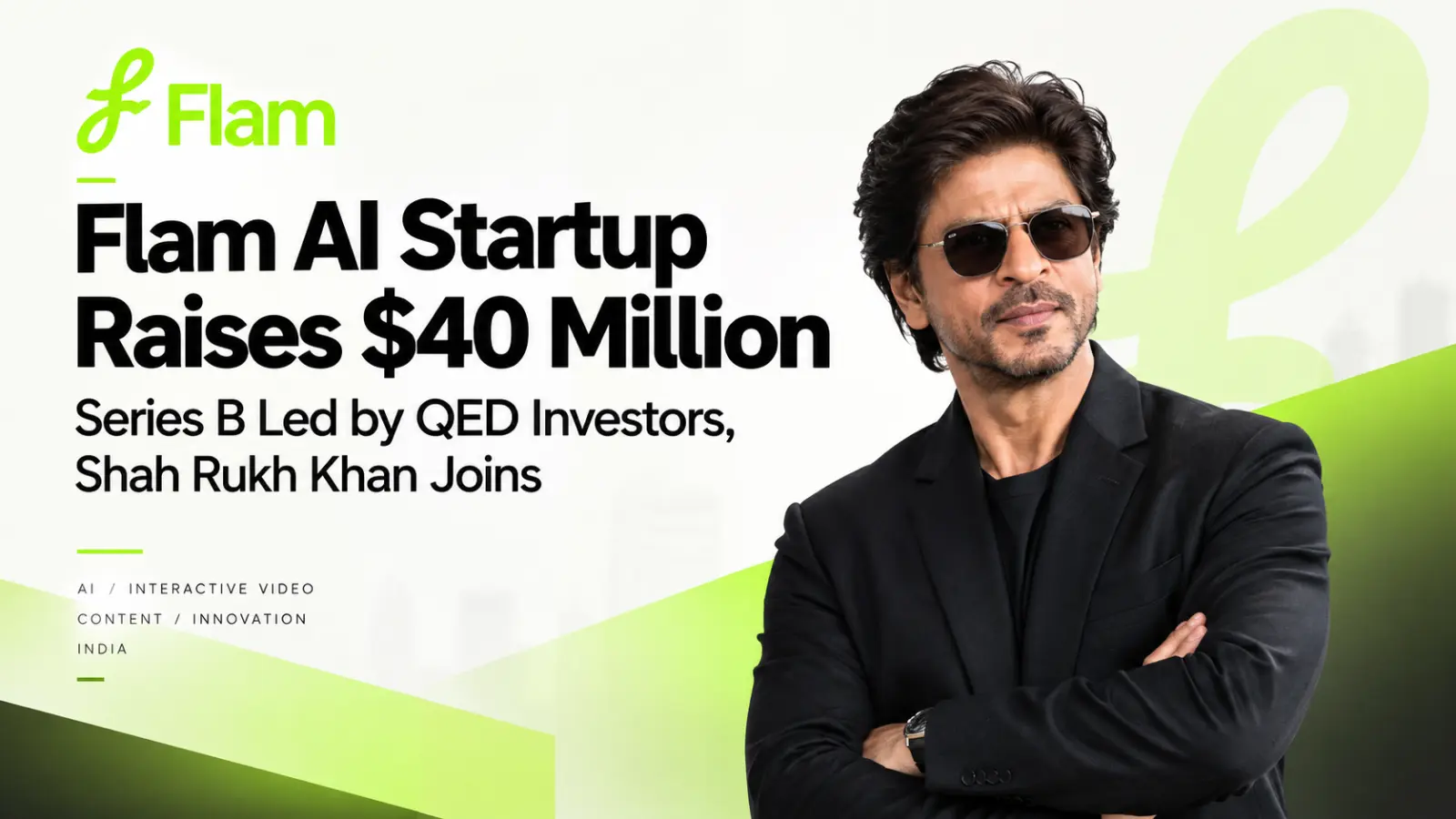
- Flam raised $40 million in Series B funding led by QED Investors, with Shah Rukh Khan joining as an investor.
- The startup runs five proprietary AI models, including a 26-billion-parameter language model called Falcon.
- Flam has signed over 100 enterprise clients in six quarters, including Google, and plans to scale sales globally.
Shah Rukh Khan just backed an AI startup, and it’s not the kind of headline that usually needs a second look. Except this one does.
Flam, an AI interactive content company built out of Bengaluru with a San Francisco base, has closed a $40 million Series B round led by QED Investors. The round also pulled in Claypond Capital, Martin Chavez, Olivier Pomel, Venky Harinarayan, and Shah Rukh Khan, alongside existing backers RTP Global and Dovetail, who doubled down. It’s a big jump from Flam’s $14 million Series A, closed in May 2025, and it comes just 16 months later.
The SRK name will get the clicks. What’s actually interesting is what Flam has built underneath it.
What Flam Actually Does
Founded in 2021 by BITS Pilani alumni Shourya Agarwal, Malhar Patil, and Amit Gaiki, Flam started out building mixed-reality experiences for brands. It’s since pivoted hard into AI-powered interactive content, and it now runs a genuinely deep product stack rather than a single app wrapped around someone else’s model.
Its flagship format, Flicks, is interactive video that swaps a person, product, or entire scene mid-playback using a patented compression algorithm, reportedly delivering the switch in 50 milliseconds. Airboards brings 3D content into a camera interface with touch, voice, and haptic interaction, no app download needed. Forge edits a single specified element in an image without touching the rest. Fable generates native alpha-channel video assets. And Visual Agents are conversational, human-like characters meant to feel closer to a video call than a chatbot window.

Behind all of it sits Flam’s own AI stack: Falcon, a 26-billion-parameter mixture-of-experts language model built for near-instant responses, Finesse for multilingual voice, and Fantom for facial expression and identity-preserving motion transfer. The company says its full pipeline returns a response in under two seconds. Flam also holds over 15 patents, which is not a small claim for a five-year-old company.
Why QED, and Why Now
QED’s Nigel Morris framed the bet as a gap-in-the-market call rather than a hype call. Most AI content companies, he said, are polishing formats that already exist; Flam, he added, is the first team we’ve seen with the infrastructure to go after it.
That’s a reasonable read of Flam’s trajectory so far. According to Agarwal, the company has been growing 70-80% quarter on quarter, starting with an FMCG customer and expanding into entertainment, retail, and enterprise sales more broadly. Flam now counts more than 100 enterprise clients signed over the past six quarters, with Google named as a customer across multiple reports, alongside brands using the platform for marketing, product visualisation, training, customer support, and fan engagement. The company has also struck a partnership with Indonesia’s Emtek Group to push into Southeast Asia.
What’s notably absent from every version of this story, including the official release, is a disclosed valuation. Given the size of the jump from Series A to Series B, that’s a fair thing for readers to keep an eye on as more reporting comes in. Consider this developing until a number surfaces.
Read More: India’s First Homegrown Sovereign AI Model, Sarvam AI
The Bigger Signal for Indian AI Startups
Flam’s round lands at a moment when a lot of Indian AI companies are getting called out, fairly or not, for being thin layers on top of someone else’s foundation model. Flam’s pitch is the opposite: it’s spent five years building its own compression tech, its own MoE model, and its own patent portfolio, and only now is it leaning into the AI wave with venture capital behind it.
It’s a pattern Sarvam AI has followed too, building sovereign language models with backing from Lightspeed and Peak XV rather than reselling access to someone else’s API. Bengaluru deep-tech has also shown up this way in space, with Pixxel building its own hyperspectral satellite stack from scratch instead of outsourcing the hard engineering. Flam fits that same lineage: infrastructure first, celebrity investor second.
For founders watching this round, the takeaway isn’t really the Shah Rukh Khan headline. It’s that QED backed technical depth over a flashy demo, at a moment when a lot of “AI startups” in India are still figuring out their moat. That’s worth paying attention to if you’re raising a Series A or B in this space right now.
Read More: Awais Ahmed Pixxel: Karnataka Village to ₹900 Cr Space Firm
Flam’s next real test isn’t the funding announcement, it’s whether that 70-80% quarterly growth rate holds as it scales past 100 clients and tries to compete for enterprise budgets against much bigger, much better-funded AI companies globally. The $40 million buys runway, not certainty.
If you’re building in the AI content space, or watching how Indian-origin founders are pairing celebrity capital with real technical infrastructure, this is a round worth bookmarking. Drop your take in the comments, or check out more funding coverage on StartupIndiaX.
Read More: Aman Sanger Story: Cursor AI Founder Journey 2025
Founders mapping out their own raise can run the numbers first: try the Startup Valuation Calculator or browse the Indian VC & Investor Database before pitching investors like the ones backing Flam.
FAQs
What does Flam actually do?
Flam builds AI-powered interactive content, including videos that change mid-playback, 3D content viewable through a phone camera, and conversational AI characters, aimed at enterprise marketing and customer engagement.
Who invested in Flam’s Series B round?
The round was led by QED Investors, with participation from Claypond Capital, Martin Chavez, Olivier Pomel, Venky Harinarayan, Shah Rukh Khan, and existing investors RTP Global and Dovetail.
Why did Shah Rukh Khan invest in Flam?
Neither Khan nor Flam has publicly detailed the reasoning behind the investment; his involvement was confirmed as part of the funding round announcement, without further comment from either party.
Is Flam’s valuation known?
No, Flam has not disclosed its post-Series B valuation. This remains unconfirmed and worth tracking as more coverage emerges.
Where is Flam based?
Flam is headquartered in San Francisco with teams operating in India (Bengaluru) and Japan, and it’s expanding further into Southeast Asia through a partnership with Indonesia’s Emtek Group.