SUMMARY
- Muse beat ChatGPT’s launch downloads and lifted Meta’s value by about $200 billion in one day, but the stock has since given back roughly 8%.
- The $14.3 billion bought a 49% nonvoting stake in Scale AI plus Alexandr Wang, not a payout to Wang himself.
- Downloads aren’t revenue. Watch Meta’s next earnings for the first hard Muse numbers before calling this bet a win.
When Meta wrote a $14.3 billion cheque in June 2025, investor Adam Khoo recalled on X, the price looked outrageous. Fifteen months later, the person it brought in is running the AI app sitting at the top of Apple’s US chart.
The Alexandr Wang Meta Muse story is really three stories stacked together: a talent deal, a launch that beat ChatGPT’s early numbers, and a stock that ran hard and then slipped. So did the bet pay off? Partly. Here’s the scorecard.
What the $14.3 billion actually bought
Start with what the money was. In June 2025, Meta paid $14.3 billion for a 49% nonvoting stake in Scale AI, and Scale’s cofounder and CEO became Meta’s first chief AI officer. The cheque bought into a company. It wasn’t a pay packet.
Wang now leads Meta Superintelligence Labs. His CV explains the noise. He started Scale AI in 2016 while at MIT, left the university, and in 2021 became the world’s youngest self-made billionaire at 24. He’s 29 today.
His first big release wasn’t a knockout. Muse Spark, Meta’s home-built model, arrived in April 2026, and a Meta executive told Axios it didn’t set a new state of the art. In coding, the company admitted a gap remained.
Muse the agent, launched on September 8, is a different kind of product. It doesn’t just answer questions. It schedules meetings, updates calendars, sends emails and makes purchases for you.
Read More: Meta Muse Charm: The Keychain AI Gadget That Could Change How India Uses Apps
Twelve days that changed the mood
The numbers came fast. Sensor Tower counted 2.8 million Muse downloads in the first 12 days across the US and Canadian app stores. In the like-for-like comparison reported by Yahoo Finance, Muse’s 1.8 million beat ChatGPT’s 1.3 million over the same stretch.
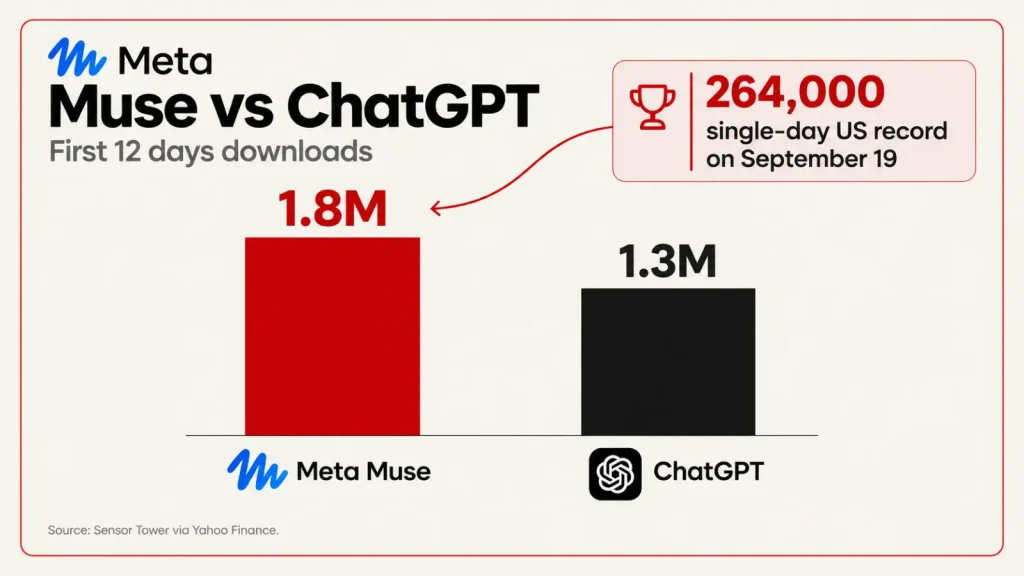
Muse reached No. 1 on Apple’s US free chart on September 18. A day later it set a US single-day record of 264,000 downloads, its third straight day above 200,000. TechCrunch, citing Sensor Tower, has since put the total above 3.4 million.
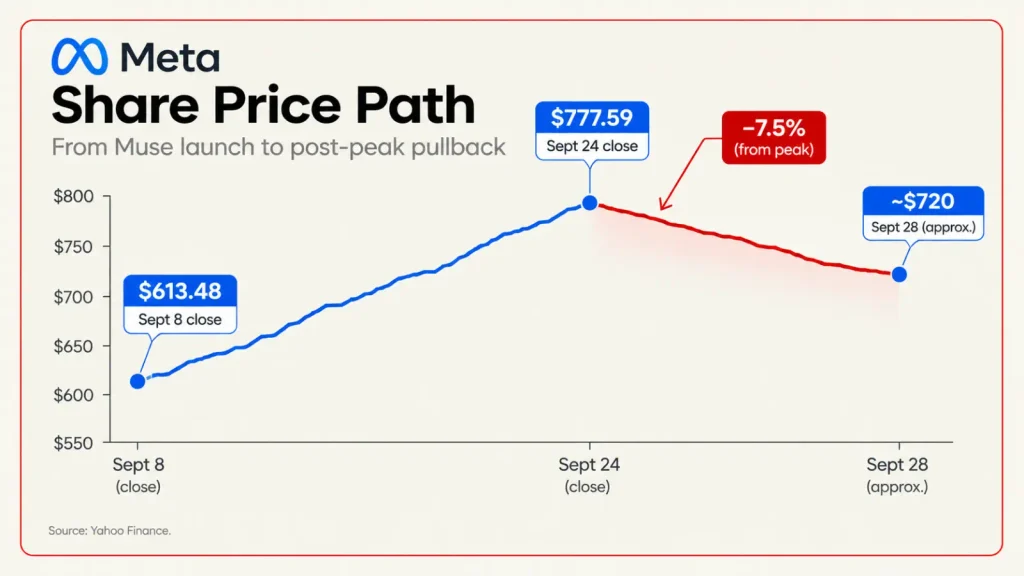
Wall Street noticed. On Monday, September 21, Meta closed at $741.25, up 11.43%, adding roughly $200 billion in market value in a single session. Yahoo Finance counted about $234 billion added over five days. The stock closed at $613.48 on launch day and $777.59 on September 24.
That’s a sharp turn. On March 27, Meta had hit its 52-week low of $520.26 as investors worried that heavy AI spending had no product to show for it.
One correction to the version circulating on social media: the “$200 billion in three weeks” line blurs things. Most of it landed in one session, and it’s market value, not cash. Market value moves both ways.
Read More: Meta Muse Spark AI Launches – 5 Things That Make It Different
Then the stock slipped
Meta touched an intraday high of $779.82 on September 24, the day after Connect. Then it faded. Shares fell more than 3% on Friday, September 25, and were down about 8% within two sessions of the high. By Monday, one market outlook had them near $720.
The reasons aren’t mysterious.
Connect gave Muse a bigger stage, with plans for AI glasses and the pocket-sized Muse Charm. But Meta gave no Muse-specific revenue or profit figures. Meanwhile the bills are real: Meta’s 2026 capex guidance is $130 billion to $145 billion, and market reports point to strain on computing capacity as users pile in.
Rivals haven’t slowed down either. OpenAI held a developer event this week, after reports that it was preparing a rival consumer agent.
Then there’s the revenue math. Muse has paid tiers at $20 and $100 a month. Jefferies has modelled $10.8 billion in annual revenue if Muse reaches a billion users and 3% of them pay. That’s a scenario, not something Meta has committed to.
The social proof also needs a pinch of salt. Wang’s #MuseMoneyChallenge filled X with savings stories, but Business Insider reported that many replies came from Meta’s own staff. None of the posts came with independent before-and-after figures.
What founders should take from it (and what they shouldn’t)
Here’s the part the viral posts get right. Zuckerberg handed the AI product to someone else and let him run it. Wang has posted more than 300 times on X since launch, according to Inc, so this isn’t a figurehead. The founder lesson is simple: hire the person who’s better than you at the job, then stop trying to win every call.
But don’t copy the story too literally.
Meta could push Muse into apps used by more than three billion people, started promoting it a day after launch, and later bought national TV. Forbes notes that Muse can be promoted across Instagram and Facebook without Meta paying to acquire each customer. Wang didn’t build that distribution. Delegation works best when the company already owns the audience.
The Indian version of this test is already running. Bhavish Aggarwal’s Krutrim launched Kruti, an agent meant to get things done rather than just talk back, and the early debate was about trust and integrations as much as features.
Read More: Krutrim’s Bold Leap: Unveiling Its Agentic AI Assistant Kruti in 2025
Muse faces the same question at far bigger scale. Wang has pitched it as “the first AI for the AI skeptics out there,” but Inc points out that nobody has measured whether people trust Meta with their credentials. Downloads can’t separate curiosity from confidence.
There’s a second route too. Sarvam AI is building a sovereign model from scratch for Indian languages, betting that owning the model comes first and users follow.
Read More: India’s First Homegrown Sovereign AI Model, Sarvam AI To Build
So, did it justify the price?
Halfway.
On demand, the bet looks good. Muse topped the charts, out-downloaded ChatGPT’s launch window in the like-for-like data, and turned Meta from an AI worry into an AI story. Against $14.3 billion, a $200 billion one-day move looks like a bargain.
On money, the jury is out. There’s no Muse revenue figure, spending is heavy, and the stock has already handed back part of its gain. Our read: the deal looks cheaper than it did in June 2025, but “cheap” is a verdict you reach with revenue and retention, not app rankings.
The first real checkpoint is Meta’s next earnings report, which one market outlook expects on October 27. That’s the date to circle.
Three things worth carrying away:
- Judge a big bet on revenue and retention, not downloads or a single day’s market-cap jump.
- Delegate the product, but check whether the person is borrowing distribution, capital or trust that you can’t replicate.
- Watch Meta’s next earnings for the first hard Muse numbers before calling this a win.
Have you handed off a core part of your startup to someone else? Tell us in the comments how you decided, and share this with a founder who’s still the smartest person on every call. More on the AI race is waiting in our AI & DeepTech coverage on StartupIndiaX.
FAQs
What is Meta Muse?
Muse is Meta’s personal AI agent, launched on September 8, 2026. It can schedule meetings, update calendars, send emails and make purchases for users, and it now connects with tools like Notion, GitHub and Box.
Who is Alexandr Wang?
Wang is Meta’s chief AI officer and the cofounder and former CEO of Scale AI. He started Scale in 2016 while at MIT, dropped out, and became the world’s youngest self-made billionaire at 24 in 2021.
What did Meta’s $14.3 billion actually buy?
In June 2025, Meta bought a 49% nonvoting stake in Scale AI for $14.3 billion and brought Wang in as its first chief AI officer. It wasn’t a payment to Wang personally.
How many downloads has Muse had?
Sensor Tower counted 2.8 million in the first 12 days across US and Canadian app stores, with 1.8 million set against ChatGPT’s 1.3 million in the comparison. Later estimates cited by TechCrunch pass 3.4 million.
Why did Meta’s stock fall after the Muse rally?
Investors are weighing missing Muse revenue figures, Meta’s $130 billion to $145 billion capex guidance and computing strain. Shares closed at $777.59 on September 24 and were down about 8% within two sessions.
When will we know if Muse makes money?
Meta hasn’t shared Muse-specific revenue. Its next earnings report is the first real checkpoint, and one market outlook expects it on October 27. Muse’s paid plans start at $20 a month.