
SUMMARY
- Equal splits feel fair but leave no tiebreaker, so match the split to roles, risk and full-time commitment instead.
- Put every founder’s shares on four-year vesting with a one-year cliff, so an early exit doesn’t leave a permanent stake behind.
- Agree the split, the option pool and any founder cash before you raise, and write all three into a founders’ agreement.
Two friends, one idea, and an unspoken rule: split it 50:50 and don’t make it awkward.
It feels fair. It’s also how plenty of founding teams end up with no tiebreaker and, a year later, a departed co-founder who still owns a big slice of the company.
A co-founder equity split is the first real money decision a founding team makes together, and usually the one they make with the least information. The percentages matter, but the structure around them matters more. This guide covers how the split works in India, three scenarios with three different answers, and what vesting does to the numbers. You can test your own split on our free Co-founder Equity Split Calculator as you read.
Why 50:50 is a habit, not an answer
Gust, which built its own split tool, puts it bluntly: “Splitting equity 50/50 is rarely the right answer.” Its reasoning is that most ventures hinge on one founder, usually the CEO, who breaks tie votes and makes the hardest calls.
The practical problem is simple. An equal split means no founder can break a tie on a contested decision, as Equitylist’s India guide points out. Two people who disagree on pricing, hiring or a pivot have nowhere to go.
Founders also don’t behave the way the 50:50 instinct suggests. A 2021 Carta analysis of 7,764 companies and 18,228 founders found that only 41% of two-founder teams split equity equally. Across team sizes, there was typically a lead founder, often the CEO, holding an outsized share. Carta’s data comes from companies on its platform, so treat it as a benchmark, not a rule.
None of this means equal is wrong. An eChai founder guide makes the fair counterpoint: for most early teams, a near-equal split signals real partnership, and haggling over 55/45 versus 50/50 can cost more in resentment than it saves in ownership.
So the lesson isn’t “never split equally.” It’s don’t split equally by default.
Four questions before any number goes on paper
Skip the percentages for ten minutes and answer these first.
- Who is working full-time, and who isn’t?
- Who is carrying the financial risk?
- Who leads the company, and who drives revenue?
- Who built what before the company existed?
The first three come straight from how IncorpX suggests weighing a split. The last matters more than founders expect. Equitylist notes that a founder who built the product for six months before a co-founder joined isn’t on equal footing with someone who arrived at incorporation.
Three scenarios, three different answers
These are illustrations, not rules. Your team will sit somewhere between them.
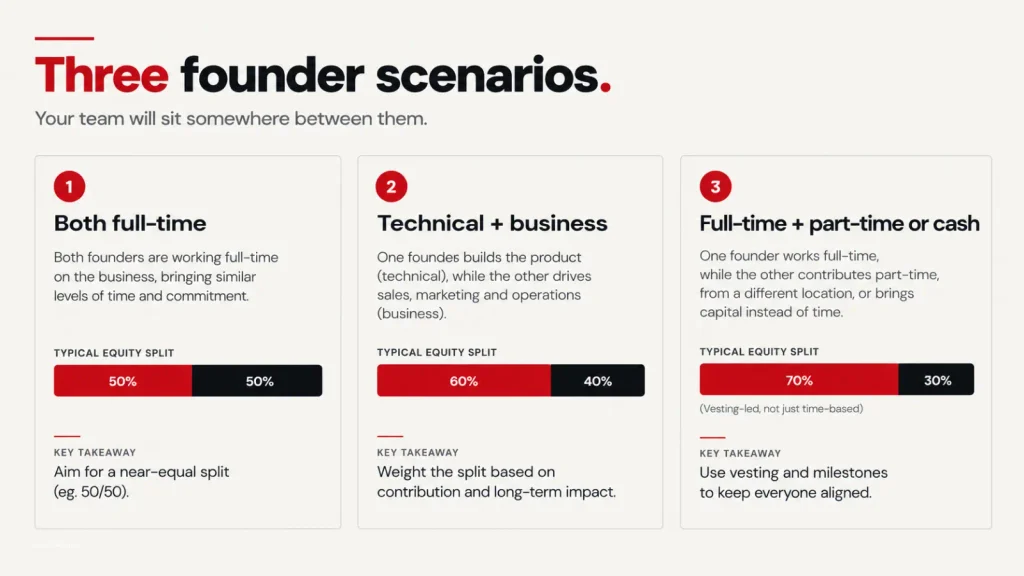
Two founders, both full-time, same start date. Near-equal is defensible here. The more useful decision is who has the final call on product and who has it on money, because the split itself won’t settle a deadlock.
A technical founder and a business founder. Weighted splits like 60:40, 65:35 or 70:30 are common when contributions genuinely differ, according to Treelife. One India guide puts a product-building technical co-founder at roughly 45% to 55%, with the business co-founder taking the rest. What tips it is usually who built what before incorporation, and whether that work gets formally assigned to the company.
One founder full-time, the other part-time or putting in cash. This is where equal splits go wrong. A part-time founder given full-time equity on day one is a bet that it’ll even out later, and it often doesn’t.
Two cleaner options exist. The dynamic approach, popularised by Slicing Pie, allocates equity by actual contributions (time, money, ideas, relationships) instead of day-one guesses. eChai describes it as best used before funding, then converted into fixed equity plus vesting at incorporation.
Cash needs separate handling. The same eChai guide advises papering a founder’s money as a director’s loan or priced convertible, so that a ₹5 lakh cheque doesn’t quietly become a 30% stake.
Vesting is what makes the split real
Agreeing on 60:40 is the easy part. Making each founder earn their share is what protects the company.
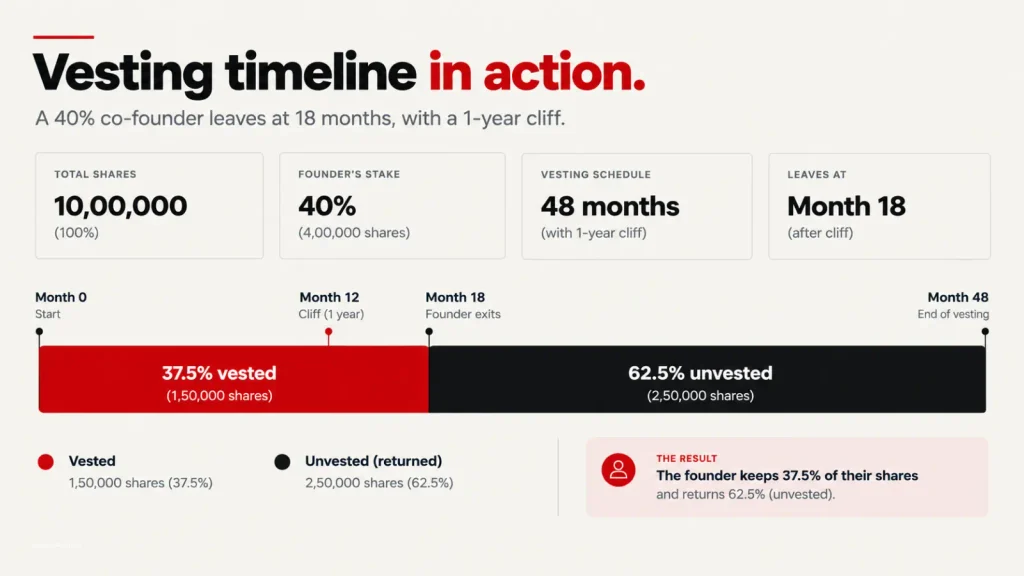
The common setup in India is four years with a one-year cliff, as both Treelife and IncorpX describe. Nothing vests in year one. After the cliff, 25% vests, and the rest follows over the remaining period. If a founder leaves, unvested shares go back to the company.
Here’s what that does to real numbers. This is an illustration, assuming monthly vesting after the cliff and no new shares issued.
Say your company has 10,00,000 shares, split 60:40. The 40% founder holds 4,00,000 shares. They leave after 18 months, which means 37.5% of their shares have vested.
- They keep 1,50,000 shares, about 15% of the company.
- 2,50,000 shares return to the company.
- Without vesting, they’d walk away with all 4,00,000.
Treelife’s work on co-founder disputes in Indian startups says the same thing from the other direction: without vesting, the exiting founder keeps full equity and the company can’t dilute their stake without consent.
Exits happen more often than founders plan for. A 2014 YourStory legal explainer looked at Housing.com, which had twelve co-founders but only two directors, after reports that three co-founders had quit. It also cited RedBus co-founder Phanindra Sama saying three of the seven initial co-founding members left within a year of inception. Those are exit stories, and exits are exactly what vesting is built for.
One catch. IncorpX points out there’s no statutory minimum vesting period in India, so it only exists if you write it into a founders’ or shareholders’ agreement.
The paperwork Indian founders skip
Once you’ve agreed the numbers, the split has to be recorded properly. Founder shares are issued per the allocation, reflected in the Memorandum of Association and Form PAS-3, per IncorpX. Ownership then sits in the register of members under Section 88 of the Companies Act, 2013, as Treelife notes.
Timing matters too. The eChai guide recommends issuing founder shares at incorporation, when face value is ₹10 and fair market value is nominal. Its argument is that waiting raises the FMV and your immediate tax exposure. That’s one guide’s view, so check it with a chartered accountant.
Three more things belong in the founders’ agreement:
- The split itself, the vesting schedule, and assignment of any pre-incorporation IP to the company (Equitylist).
- The option pool. IncorpX points to 10 to 15 percent for employee options, though some calculators suggest up to 20. Decide it before you finalise the founder split, not after.
- Transfer restrictions, so a departing co-founder can’t sell to an outsider.
Fundraising comes next, and it shrinks everyone. The ratio between co-founders typically holds through dilution, per Equitylist, but each founder’s absolute stake falls as investors and the pool come in. Model that before you sign. Our Funding Round Dilution Calculator is built for exactly this step.
None of this replaces a lawyer or a CA, especially on tax.
What we’d do on day one
Our view at StartupIndiaX: the percentage is the least important part of a co-founder equity split. A split you can explain to each other in one sentence, backed by vesting and a written agreement, beats a “perfect” number nobody has documented.
Use the calculator as a conversation starter, not a verdict. Put the scores or percentages on a screen, disagree out loud, and adjust until both of you can live with it for four years.
If you remember three things:
- Match the split to full-time commitment, risk and role, not to friendship or habit.
- Put every founder on vesting, written into a founders’ or shareholders’ agreement.
- Settle the split, the option pool and founder cash before the first investor shows up.
Run your numbers on the Co-founder Equity Split Calculator, then tell us in the comments how your team split it and what you’d do differently. And send this to the co-founder you’ve been putting this conversation off with.
FAQs
What is a co-founder equity split?
It’s the agreed division of ownership among a company’s founders, recorded when shares are issued. In an Indian private limited company, it shows up in the register of members, and it can change later if a founder exits or the company restructures.
Is a 50:50 co-founder split a bad idea?
Not automatically. It works when both founders are full-time, equally skilled and equally committed. The risk is that nobody can break a tie, so agree up front who decides what, and put vesting behind the split.
How does vesting work for co-founders?
Shares are earned over time. The common setup is four years with a one-year cliff: nothing vests in year one, then a quarter vests, and the rest vests over the remaining period. Unvested shares return to the company if you leave.
How much should we reserve for an ESOP pool?
Guides for Indian startups commonly point to 10 to 15 percent, and some calculators suggest up to 20. Agree the pool size before you finalise the founder split, so hiring later doesn’t force an awkward re-cut of everyone’s stake.
What if one co-founder puts in cash?
Treat it separately from founder equity. One Indian founder guide suggests papering it as a director’s loan or priced convertible, so a ₹5 lakh cheque doesn’t quietly turn into a large share of the cap table.
When should co-founders decide the split?
Before you raise money, and ideally at incorporation. The company is worth little then, so the conversation is cheaper and the tax exposure on founder shares is lower. Waiting tends to raise both the stakes and the bill.