Summary
- Shashank Kumar and Amrendra Singh are two of five founders behind DeHaat, a Patna-born business selling farm inputs, buying produce and exporting.
- FY26 operating revenue fell 9.8% to ₹2,715 crore ($290 million) as DeHaat leaned into own brands; net loss widened to ₹224 crore ($24 million).
- FY25’s ₹369 crore ($39 million) profit rested on a non-cash gain, so founders should check which profit figure a company reports.
Shashank Kumar says he stopped counting investor pitches after 82 or 83. He told a Prime Venture Partners podcast in September 2022 that DeHaat’s first institutional round came in April 2019, seven years after the company began.
In FY26, DeHaat reported ₹2,715 crore (about $290 million at ₹93.70 per US dollar, the 11 November 2026 close) in operating revenue. That was 9.8% less than the year before. It is the DeHaat founder story in two numbers: a slow, patient start, and a company now testing what kind of business it wants to be.
In this story (about 10 minutes)
Table of Contents
Five Names on the Door, and Two to Know
DeHaat, registered as Green Agrevolution, was founded in 2012 and works out of Patna and Gurugram, according to a 2021 YourStory profile. Who counts as a founder depends on the source.
Inc42 lists five: Shashank Kumar, Shyam Sundar Singh, Amrendra Singh, Adarsh Srivastava and Abhishek Dokania. YourStory’s 2021 profile also names Manish Kumar, an IIT Kharagpur alumnus who co-founded the company in 2012 and is no longer part of it. Kumar himself told the podcast that the group was five at the start and that one member left around 2015 or 2016, a moment he found very hard to accept.
Two names carry most of the public record.
Shashank Kumar is co-founder and CEO. He studied at IIT Delhi and was working at the consultancy Beacon Advisory Services when DeHaat began, YourStory reported in 2021. He had no direct experience of farming, but says he knew the community.
“I hail from a farming community in Bihar”
Shashank Kumar, YourStory, February 2021
Amrendra Singh is co-founder and director. YourStory described him in 2016 as a computer engineer from NIT Jamshedpur, and The Better India has reported that he leads agri-input and crop-advisory work. AgFunder’s portfolio profile adds that he co-founded FarmsNFarmers, a not-for-profit farmer-support platform it describes as the inspiration for the DeHaat model.
Read More: Kuku FM Founder Story: How a Farmer’s Son Built a ₹1,484 Crore Audio and Microdrama Business
What a Consultant Saw on Both Sides of the Supply Chain
Kumar’s consulting work put him in front of clients in supply chains, retail and FMCG. YourStory reported that this showed him how hard it was for institutional buyers to source farm produce directly from farmers. On visits home to Bihar, he saw the other half of the problem: farmers who were unhappy with what farming paid.
His conclusion was that the gap ran in both directions, and the team decided to build a company in it. He gave the Prime Venture Partners podcast a plain version of the pitch in 2022. Small farms cannot build scale one household at a time, so DeHaat would sit between farmers and the businesses that buy from them, sell to them, lend to them and insure them. Kumar put the average income of an Indian farm household at about ₹70,000 to ₹80,000 a year in that conversation.
Seven Years of Preparation Before the Growth
By Kumar’s account, DeHaat did not grow in its first seven years. He described them as a period of preparing for scale, and he treats that as a founder’s claim rather than an audited fact.
“we started when agric-tech was agriculture”
Shashank Kumar, Prime Venture Partners podcast, September 2022
The first obstacle was the farmers themselves. Kumar recalled that early on, the team arrived in Bihar villages after leaving what he called cushy jobs, and many farmers stuck to what they already did. The team registered farmers with paper and pen. Farmers were reluctant to share mobile numbers, which made the free crop advisory harder to deliver. DeHaat spent its first few years building advisory content and began building technology from 2015, as feature phones and then 3G and 4G spread, he said.
One story from 2013 or 2014 shows the lesson. DeHaat trained farmers in Bihar to grow baby corn and promised to buy the harvest. Kumar recalled that at around 2:30 or 3:00 am before the first harvest, a farmer phoned to ask whether he really had to cut plants that still looked small. The team concluded that it should first work with the crops farmers already grew, win trust, and only then suggest new ones. The same thinking shapes the advisory, which Kumar said is tailored down to districts and blocks because the same pest can carry different names within a single district.

Fundraising was slow too. When the team went to investors in 2018, Kumar said, nobody had built a full-stack model spanning inputs and outputs for every crop, which made it hard to explain. The company had raised a couple of angel rounds and taken on a lot of debt before the April 2019 institutional round. A month earlier, as of 31 March 2019, DeHaat had 38 centres in three districts. By the 2022 podcast, Kumar put the network at about 10,000 centres in close to 180 districts.
Read More: Who Built GreenCell Mobility? The Founder Story Behind NueGo
How DeHaat Makes Money
Kumar says DeHaat is inventory-led rather than a marketplace. It buys agri inputs and sells them to farmers, and it buys produce, packs it and sells it to institutions. Crop advisory is free and works as the way farmers are brought in, he said in 2022.
Inc42 describes the model slightly differently. Reporting in September 2025, it said DeHaat earns commissions on produce it sources for institutional buyers, traders, exporters and processors. It also charges for soil testing, customised farm planning and pest management, and partners with financial institutions for credit and crop insurance.
The size of each side shows in the filings. According to FY25 MCA filings reported by Inc42, DeHaat booked ₹606.7 crore ($65 million) from agricultural inputs and ₹2,392.7 crore ($255 million) from agricultural outputs. By StartupIndiaX’s calculation, outputs were about four-fifths of that total.
Entrackr’s FY26 review shows input sales of ₹517 crore ($55 million), about 19% of operating revenue. The rest came from output products such as staples and chillies, and from consumer brands including Farm Plus and Honest Farms. India contributed 83% of FY26 revenue. The remainder came from markets including the UK, Europe, the Middle East, Thailand and Russia. Kumar told Inc42 in July 2025 that exports in FY25 were worth ₹430 crore ($46 million) across 32 markets.
Business Today’s July 2026 deep dive quotes Kumar describing a “crop-agnostic and service-agnostic platform” that covers inputs, market access, warehousing, financing and insurance. Amrendra Singh used similar language when DeHaat bought Maharashtra-based Helicrofter in January 2022:
“crop and service agnostic, farmer-first model”
Amrendra Singh, Analytics India Magazine, January 2022
The Cheques: Funding and Backers
DeHaat’s disclosed rounds run in this order. A $30 million Series C led by Prosus Ventures was reported in February 2021. A $115 million Series D followed on 27 October 2021, which TechCrunch called the largest agritech round in India. Entrepreneur India named Sofina, Lightrock and Temasek among its investors. A $60 million Series E arrived in late 2022. In April 2025, DeHaat raised ₹200 crore ($23.4 million, per Inc42) in venture debt from Trifecta Capital. Inc42 describes the company as Peak XV Partners-backed.
Reports at the time put the valuation around the Series E at $700 million to $800 million, citing an unnamed source. That is a media report, not a confirmed valuation, and StartupIndiaX found no newer valuation from a named source.
Acquisitions added capabilities. FarmGuide, bought in 2021, brought satellite-based crop advisory. Helicrofter, acquired in January 2022 as DeHaat’s third deal, had more than 2,000 agri-input retailers and 30 sellers across Maharashtra, per Business Today. TheCompanyCheck also lists AgriCentral, an advisory app, among six acquisitions.
Read More: Top 10 Government Schemes Boosting AgriTech and Rural Startups
The FY25 Profit That Needs an Asterisk
On paper, FY25 looked like a turnaround. Inc42 reported on 27 September 2025 that DeHaat posted a consolidated net profit of ₹369 crore ($39 million), against a loss of ₹1,133.1 crore ($121 million) in FY24. The swing came from a non-cash gain of ₹576.1 crore ($61 million) tied to the change in fair value of convertible preference shares. Without it, Inc42 calculated a loss of about ₹207 crore ($22 million).
Operating revenue rose 11% to ₹3,009.9 crore ($321 million) from ₹2,674.8 crore ($285 million). Kumar attributed the growth to high-margin private-label sales, exclusive input-distribution partnerships and a push into exports, storage and food processing. He said private labels made up nearly 25% of FY25 revenue.
Unnamed sources told Inc42 that DeHaat reached an EBITDA of ₹5 crore to ₹10 crore ($0.5 million to $1.1 million) in the June 2025 quarter and was eyeing full-year profitability. That is a media report, and DeHaat’s own statement of the figure was not in the sources StartupIndiaX reviewed.
Why DeHaat Started Selling Its Own Brands
Kumar explained the logic to the Prime Venture Partners podcast in 2022. Farmers, he said, buy everything at retail and sell everything at wholesale, with no say over the price of what they grow. He also said that in fruit and vegetables, less than 15% of the market sits with modern retail and e-commerce players, leaving the rest with conventional channels. Both are his claims. His conclusion was that DeHaat might eventually need captive demand to serve the farmers it onboards.
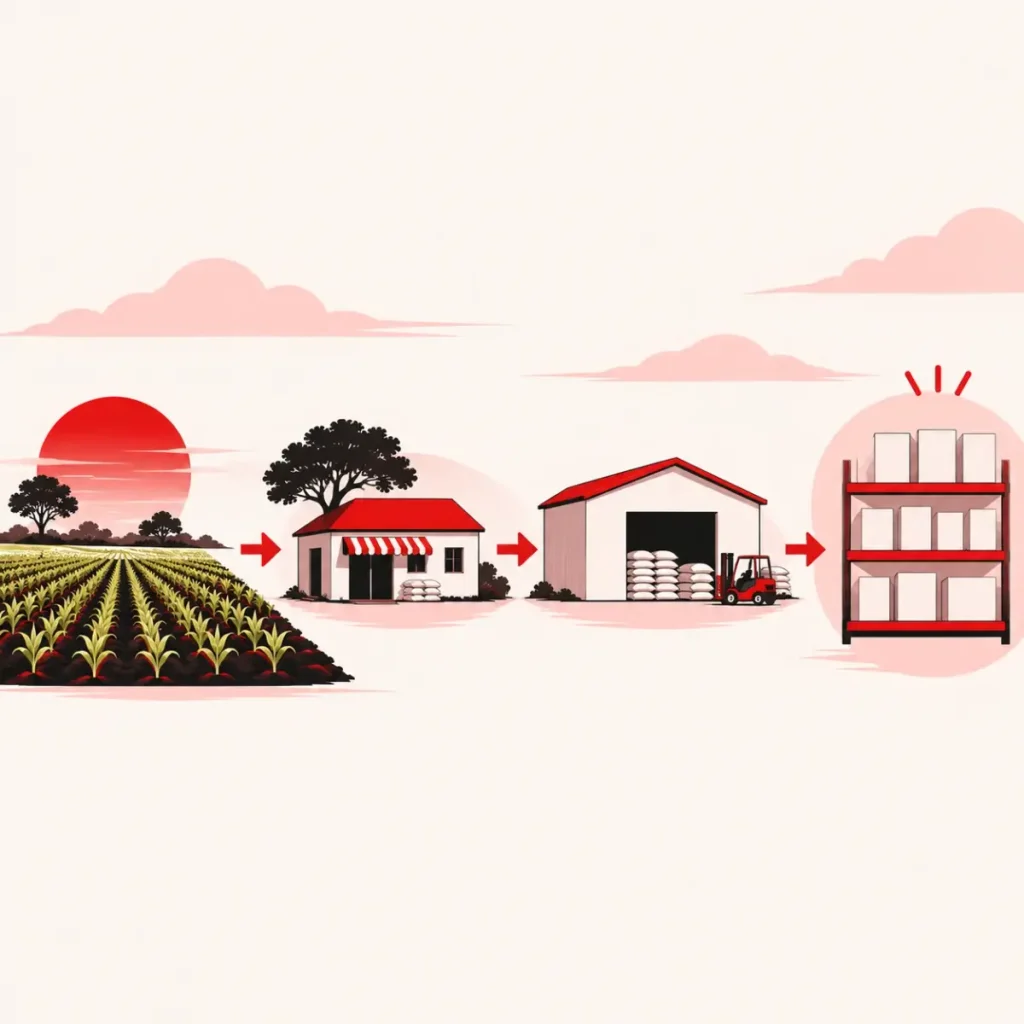
Honest Farms, a consumer food brand, launched in 2024. Business Today reported in July 2026 that Kumar framed it as a way to give farmers access to premium consumer markets. Entrackr notes that several agritech companies that began as marketplaces are now building their own brands to improve margins, control pricing and depend less on third-party products.
FY26: Revenue Down, Losses Wider
Entrackr’s review of DeHaat’s consolidated FY26 statements, published on 2 November 2026, shows the cost of that shift. Operating revenue fell 9.8% to ₹2,715 crore ($290 million) from ₹3,010 crore ($321 million). The net loss widened 11.4% to ₹224 crore ($24 million) from ₹201 crore ($21 million). Entrackr left out a ₹578 crore ($62 million) fair-value gain to give a cleaner view of operating performance.
Procurement, DeHaat’s largest cost, fell 11.7%, and employee costs fell 9.1%. Entrackr put the EBITDA margin at 6% and the return on capital employed at minus 53.9%. DeHaat spent ₹1.09 to earn each rupee of operating revenue. We found no public comment from DeHaat on these figures, and StartupIndiaX has not independently verified them.
This is editorial analysis rather than reported fact. A positive EBITDA margin and a net loss can sit side by side, because EBITDA is measured before interest, depreciation and tax. The question for the next filing is whether own-brand sales grow fast enough to refill the revenue gap.
Business Today’s July 2026 deep dive frames the wider market. It says investors are backing proven models, citing Arya.ag’s $80 million raise and AgroStar’s $30 million round. It also cites an Omnivore estimate of 13 million farmers worked with by DeHaat, against about one million for Arya.ag. Scale, on that evidence, is not DeHaat’s problem. Margin is.
The DeHaat Founder Story on One Timeline
Where the Numbers Disagree
While researching this story, StartupIndiaX found published figures that do not match. We show them side by side instead of choosing one. In most cases the gap comes from different bases, dates or definitions, not from an error. Total income and operating revenue, for example, differ by the ₹30.9 crore ($3.3 million) of other income that Inc42 reports for FY25.
Net Worth: What Can Be Said, and What Cannot
StartupIndiaX did not find a verified net worth for Shashank Kumar or Amrendra Singh. DeHaat is a private company, founder shareholdings are not disclosed in the sources we reviewed, and data-platform estimates do not disclose their method.
Two things are easy to confuse. Company valuation is what investors pay for the business. Personal net worth depends on how much of it each founder owns after years of funding rounds, and none of that is public here. The only valuation figure we found is the unnamed-source report of $700 million to $800 million from late 2022.
Five Lessons From the DeHaat Story
1. Start with the crop farmers already grow. The baby corn episode in 2013 or 2014 taught the team to build trust on familiar crops first.
2. Give away the thing that builds trust. Kumar said free, localised advisory was how DeHaat brought farmers in, with revenue coming from commerce.
3. Plan for the long middle. By Kumar’s account, seven years passed before the first institutional round, and one of five founders left along the way.
4. Read the profit line carefully. FY25’s ₹369 crore ($39 million) profit rested on a non-cash gain, and Inc42’s own calculation showed a loss of about ₹207 crore ($22 million) without it.
5. Decide when to own the brand. Private labels reached nearly 25% of FY25 revenue, and Entrackr links the FY26 revenue dip to that same shift.
What to Watch Next
DeHaat’s next filing will show whether the own-brand bet pays. For founders, the story is less about the ₹2,715 crore ($290 million) than about the order of operations: trust first, scale second, margin third. Whether margin arrives on schedule is the open chapter.
Do you think a farm-services platform should own consumer brands, or stay a neutral channel? Tell us in the comments and share this with a founder who is weighing the same call. Founders sizing their own raise can also try StartupIndiaX’s Funding Round Dilution Calculator or the Co-founder Equity Split Calculator.
FAQs
Who founded DeHaat?
DeHaat was founded in 2012 in Patna. Inc42 lists five founders: Shashank Kumar, Shyam Sundar Singh, Amrendra Singh, Adarsh Srivastava and Abhishek Dokania. YourStory also names Manish Kumar as an early co-founder who has since left. Founder lists vary by outlet.
What does DeHaat do?
DeHaat is a full-stack agritech company that sells farm inputs, offers free crop advisory, buys produce from farmers and sells it to institutions and exporters, and works with lenders and insurers. Shashank Kumar described it in 2022 as an inventory-led model rather than a marketplace.
How much revenue did DeHaat report in FY26?
Entrackr reported on 2 November 2026 that operating revenue fell 9.8% to ₹2,715 crore ($290 million) in FY26 from ₹3,010 crore ($321 million). The net loss widened to ₹224 crore ($24 million), excluding a fair-value gain. StartupIndiaX has not verified these figures.
Is DeHaat profitable?
It depends on the measure. Inc42 said FY25’s ₹369 crore ($39 million) profit came from a non-cash gain, and the loss without it was about ₹207 crore ($22 million). Entrackr reported a ₹224 crore ($24 million) net loss for FY26.
How much has DeHaat raised?
Trackers disagree. TheCompanyCheck lists $222.04 million across 11 rounds, while Premier Alts shows a higher total. Reported rounds include a $115 million Series D in October 2021 and ₹200 crore ($23.4 million) of venture debt in April 2025.
What is DeHaat’s valuation?
Reports around the late-2022 Series E put the valuation at $700 million to $800 million, citing an unnamed source. That figure is not confirmed by DeHaat, and StartupIndiaX found no newer valuation from a named source. Treat it as a dated media estimate.
What is Shashank Kumar’s net worth?
StartupIndiaX did not find a verified net worth for Shashank Kumar or Amrendra Singh. DeHaat is private, founder shareholdings are not disclosed in the sources reviewed, and data-platform estimates cite no method. Company valuation and personal net worth are different things.
Sources and disclosure
Story type: public-source profile.
Sources
- Entrackr, “DeHaat posts Rs 2,715 Cr revenue in FY26”, 2 November 2026: https://entrackr.com/fintrackr/dehaat-posts-rs-2715-cr-revenue-in-fy26-12776587
- Business Today, “How improving profitability is reviving investor interest in agritech”, 23 July 2026: https://www.businesstoday.in/magazine/deep-dive/story/how-improving-profitability-is-reviving-investor-interest-in-agritech-544742-2026-07-23
- Inc42, “DeHaat Posts INR 369 Cr Profit In FY25 On Back Of Non-Cash Gains”, 27 September 2025: https://inc42.com/buzz/dehaat-posts-inr-369-cr-profit-in-fy25-on-back-of-non-cash-gains/
- Prime Venture Partners, podcast transcript with Shashank Kumar, 30 September 2022: https://www.primevp.in/content/podcast/how-agritech-evolving-india-shashank-kumar-co-founder-ceo-dehaat
- YourStory, “[The Turning Point] Conversations with farmers in Bihar led IIT alum to found agritech startup DeHaat”, February 2021: https://yourstory.com/2021/02/turning-point-farmers-iit-alum-agritech-startup-dehaat
- YourStory, “[Startup of the day] How this Patna-based startup is helping farmers save 10-15 pc on agri inputs”, August 2016: https://yourstory.com/2016/08/green-agrevolution-dehaat
- TechCrunch, “DeHaat raises $115 million in the largest agritech round in India”, 26 October 2021: https://techcrunch.com/2021/10/26/dehaat-raises-115-million-in-the-largest-agritech-round-in-india/
- Entrepreneur India, “Full-stack agritech platform DeHaat raises $115 Mn Series D”: https://india.entrepreneur.com/finance/full-stack-agritech-platform-dehaat-raises-115-mn-series-d/393591
- Techloy, “DeHaat bags $60 million at valuation of $700 million”: https://www.techloy.com/dehaat-bags-60-million-at-valuation-of-700-million.md
- Business Today, “DeHaat acquires agri marketplace Helicrofter”, 17 January 2022: https://www.businesstoday.in/latest/corporate/story/dehaat-acquires-agri-marketplace-helicrofter-319324-2022-01-17
- Analytics India Magazine, “Agri startup DeHaat acquires Helicrofter”: https://analyticsindiamag.com/agri-startup-dehaat-acquires-helicrofter/
- The Better India, DeHaat profile: https://thebetterindia.com/178742/bihar-farmer-iit-delhi-innovation-dehaat-startup-india
- AgFunder, DeHaat portfolio profile: https://agfunder.com/portfolio/DeHaat
- TheCompanyCheck, DeHaat company profile: https://www.thecompanycheck.com/company/b/dehaat/7ah3akqjuq6t6b7jb
Rupee conversions use ₹93.70 per US dollar, the interbank close of 11 November 2026 as reported by PTI, unless a source gives its own conversion. Figures from Entrackr, Inc42 and trackers are media reports or estimates that StartupIndiaX has not independently verified.
Corrections: Spotted an error? Email corrections@startupindiax.com and we will review and update the article.
Written by the StartupIndiaX Editorial Team, covering Indian startups, founders, and entrepreneurship.