Summary
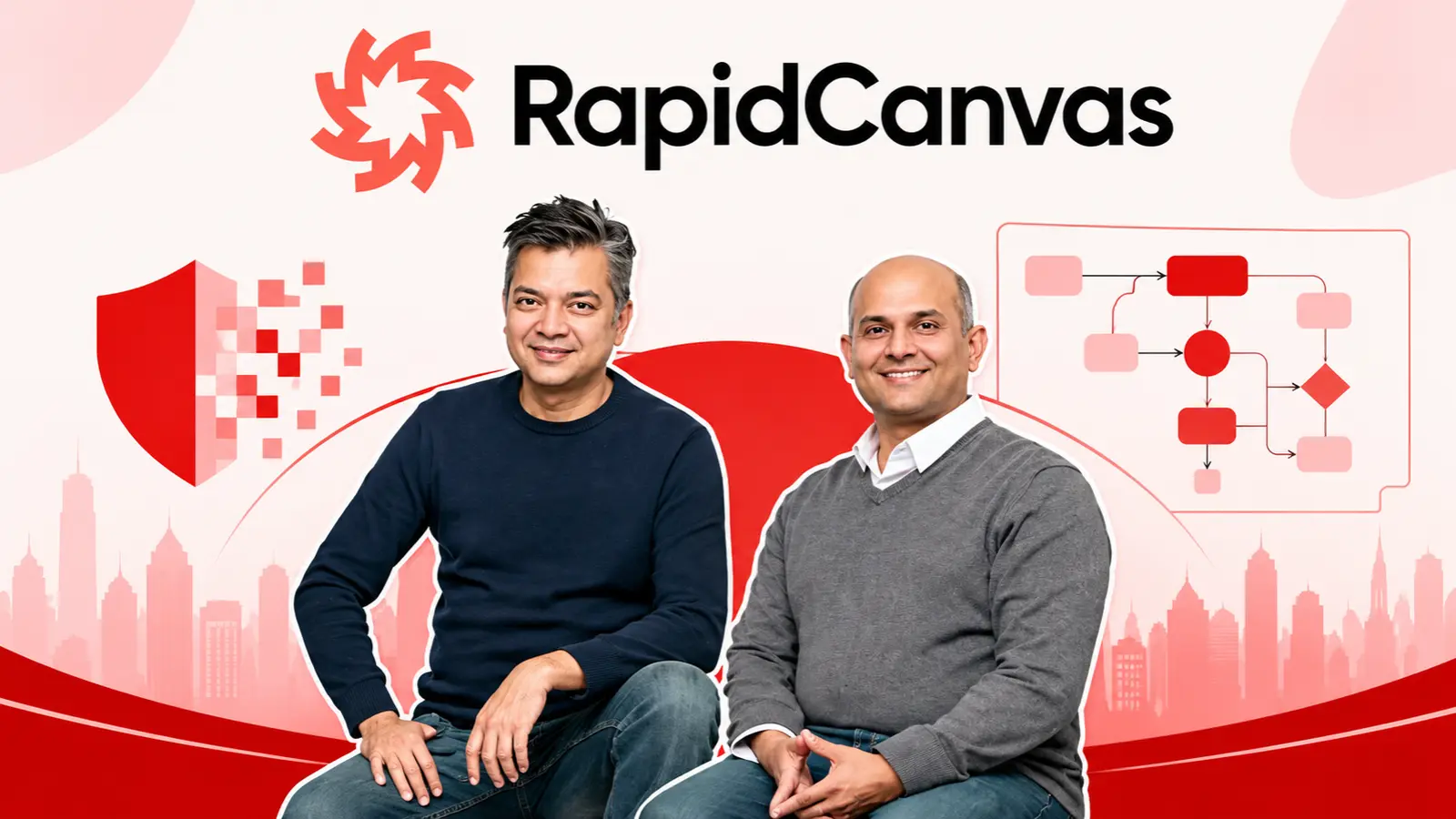
- Rahul Pangam and Uttam Phalnikar, who co-founded Simility in 2014 and sold it to PayPal in 2018, started RapidCanvas in 2021.
- RapidCanvas has raised $52.5 million across three rounds, including a $29 million Series B led by Vertex Ventures SEA & India in October 2026.
- Its model pairs a software platform with field AI engineers on subscription pricing. It reports 8x ARR growth but discloses no revenue or valuation.
In June 2018, PayPal announced it would buy Simility, the fraud-detection startup that Rahul Pangam, Uttam Phalnikar and Kedar Samant started in 2014. Two of those three founders are now the RapidCanvas founders. On 16 October 2026 their Austin-based company announced a $29 million Series B, taking total funding to $52.5 million. Twelve days later it announced an acquisition.
This profile covers who the founders are, how the business works, who has backed it and what is still not public.
In short: RapidCanvas was founded in 2021 by Rahul Pangam (CEO) and Uttam Phalnikar (CTO), is headquartered in Austin, Texas, and has raised $52.5 million (about ₹507 crore) as of October 2026. Rupee figures in this article use about ₹96.5 per US dollar, the rate implied by Inc42’s October 2026 conversion of the Series B. They are approximations.
In this article (reading time: about 11 minutes)
Table of Contents
The Google problem behind two companies
Pangam’s career before Simility, as set out in biographies from the Simility years, began at GE, where he was a lead engineer on smart grid software. He then moved to Google. Those biographies say he led a global team of 200 that reduced ads fraud by 90 percent. That is a self-reported claim, and StartupIndiaX has not independently verified it.
RapidCanvas’s 2024 launch announcement says its team first met the underlying problem at Google, where Pangam built and led analyst teams that used AI platforms heavily without writing code. In a December 2024 interview with AIM Research, he recalled being asked to support the growing number of fraud experts Google was hiring.
StartupIndiaX’s reading: both Simility and RapidCanvas try to close the same gap, between the people who understand a business problem and the people who can write software for it. That is an editorial interpretation, not a statement from the founders.
Simility: four years, a PayPal deal and two different prices
Simility began in 2014. Early coverage described Pangam building the company with fellow former Google engineers, and an early biography lists dual headquarters in Palo Alto and Hyderabad. By 2019, YourStory reported that Simility had raised $24.7 million from Accel India, Trinity Ventures, The Valley Fund and PayPal.
PayPal announced the acquisition on 21 June 2018. Fintech Futures reported the all-cash price as $120 million (about ₹1,160 crore at October 2026 rates, for scale). PayPal’s own quarterly filing records the Simility purchase price as $107 million in cash, with the deal completed in July 2018 (about ₹1,033 crore on the same basis).
StartupIndiaX could not find a source that reconciles the two numbers. Both are given here, and the SEC filing is the primary document.
After the deal, the Simility team joined PayPal, and PayPal said the purchase would give it an office in Hyderabad. Looking back in 2019, Pangam described a company already spread across Palo Alto, Hyderabad, London, Amsterdam and São Paulo.
“the smallest global office in the world”
Rahul Pangam on Simility’s four-year footprint, YourStory, February 2019

Read More: Gramophone Agritech Startup Story: Tauseef Khan, Nishant Mahatre and the Unnati Deal
2021: RapidCanvas starts with a familiar problem
RapidCanvas was founded in 2021, according to the company’s own page and Entrepreneur India’s coverage of its first funding. A few third-party profiles give 2022. StartupIndiaX uses the company’s date.
Phalnikar is the CTO. RapidCanvas’s 2024 launch announcement says he has a record of building systems from scratch at startups, including Saba and Jive, that went on to IPOs. CB Insights lists his work history as Saba Software, Jive Software, Simility and PayPal. The IPO claim is the company’s, and StartupIndiaX has not verified it.
One clarification for readers who have seen other profiles: Kedar Samant, the third Simility co-founder, is named as a RapidCanvas founder on a few third-party sites. RapidCanvas’s own company page and its funding announcements list only Pangam and Phalnikar, and this article follows the company.
The company stayed quiet until March 2024, when it announced a $7.5 million seed round (about ₹72 crore) led by Accel. At launch, Pangam described a guided, expert-verified approach that would let business experts build AI solutions themselves rather than wait for a data science team.
The RapidCanvas founders’ path in dates
The key dates run from Simility in 2014 and the PayPal deal in June 2018, to RapidCanvas in 2021, a seed in March 2024, a Series A in December 2024, the Series B on 16 October 2026 and the Entytle deal on 28 October 2026.
From a platform for business users to engineers on the job
The way RapidCanvas describes itself has changed between its 2024 launch and its 2026 Series B.
In 2024, the pitch centred on software. Pangam told VentureBeat that AI agents could handle up to 70 percent of data tasks, and that a team which once needed 10 expert engineers might need one or two, with a human expert checking the work. Those are company claims. The same VentureBeat piece named DataRobot, Dataiku, Palantir and Alteryx as the established players RapidCanvas was taking on.
By October 2026, the company sells managed AI execution. Its field AI engineers learn a customer’s processes, build custom applications and stay accountable for outcomes after delivery. The platform exists to make that work faster and repeatable, and the company says it gives each new solution a 60 percent head start from benchmarked code.
StartupIndiaX’s reading: the weight has moved from the software toward the people and process around it, with the platform meant to make that work repeatable. Radhika Ananth of Hitachi Ventures framed the bet as a shift from services economics toward software economics. Whether that holds at scale is the open question, because the company has not published margins, retention or revenue.
Read More: PlayBlue Founders Satyam Trivedi and Jayam Vora: From GMR Sports and Cult.fit to a Sports Store
How RapidCanvas makes money
RapidCanvas sells subscriptions. The company says it offers its Hybrid Approach at subscription pricing, and the sources reviewed do not publish a price list.
The platform has three products, as the company describes them:
- Enterprise Context Engine: captures how a business process runs, from requirements to data schemas and decision history. The customer owns that context.
- Visual Development Canvas: the workspace where engineers build solutions, backed by a library of reusable, benchmarked code.
- Operational Harness: manages and governs AI applications once they are live.
The target customer is an enterprise with $100 million to $10 billion in annual revenue that has an AI budget and a board-level mandate but no proven route to results. The company says these buyers sit between services firms that charge millions and take months, and do-it-yourself platforms that need specialist talent they lack. It adds that in conversations with more than 400 business leaders, most executives expected a return on AI within six to 12 months, while few had moved beyond pilots.
The numbers below are all company-reported and unaudited:
- Annual recurring revenue grew 8x over six quarters, with no absolute figure disclosed.
- More than 75 enterprises used applications built on the platform in 2026, making about 1.4 million AI-led decisions.
- More than 40 percent of customers run multiple AI use cases in production.
Inc42 reported that RapidCanvas says its platform is used by companies including PayPal, TresVista, Yale Appliances, Orion and Treetech. StartupIndiaX has not verified those customer claims.
Read More: Kunal Shah Story: Freecharge, CRED and the WhatsApp Appointment
Three rounds, $52.5 million, and who wrote the cheques
RapidCanvas has raised three disclosed rounds. The seed was $7.5 million (about ₹72 crore), led by Accel in March 2024. The Series A was $16 million (about ₹154 crore), led by Peak XV Partners in December 2024, with Titanium Ventures, Accel and Valley Capital Partners. The Series B was $29 million, which Inc42 put at about ₹280 crore, announced on 16 October 2026. It was led by Vertex Ventures SEA & India, with Hitachi Ventures joining and all four existing investors returning.
Total funding is $52.5 million, about ₹507 crore. RapidCanvas has not disclosed a valuation.
The money has named uses: growing go-to-market teams, building a partner network of private equity and advisory firms, and adding field AI engineers across the US, Brazil and India. The company will also invest in all three products.
“Getting AI into production reliably and safely still remains the biggest gap.”
Rahul Pangam, RapidCanvas funding announcement, 16 October 2026
Piyush Kharbanda of Vertex Ventures SEA & India said the firm was backing a team that had built and scaled this kind of playbook before. Axios Pro reported on 15 October 2026 that Pangam said the company could look to raise a Series C by late next year, which means late 2027. StartupIndiaX has seen only the preview of that report.
Read More: DeHaat Founders: How Shashank Kumar and Amrendra Singh Built a ₹2,715 Crore Agritech
Entytle: an acquisition 12 days after the round
On 28 October 2026, 12 days after the Series B, RapidCanvas announced it had acquired Entytle, which sells aftermarket intelligence software to industrial equipment makers. Financial terms were not disclosed. Startup Researcher listed Entytle’s customers as including Peerless Pump, Baker Hughes, GEA and Veolia.

“Aftermarket” means the parts, maintenance and service revenue that follows an equipment sale. Entytle’s CEO, Vivek Joshi, becomes general manager of RapidCanvas’s Aftermarket division, and the Insyghts product name stays. Pangam said the bottleneck to unlocking aftermarket revenue has been execution, not only insight.
StartupIndiaX’s reading: the deal gives a horizontal platform a specific industry use case and a team that already knows it. It also matches what Indian investors told Inc42 they prefer. In Inc42’s survey of more than 85 institutional investors, 39 percent expected vertical AI applications to capture the most value over the next five years.
Where RapidCanvas sits in a crowded field
RapidCanvas frames its rivals as two groups: services firms and do-it-yourself platforms. VentureBeat’s 2024 coverage named four established vendors, DataRobot, Dataiku, Palantir and Alteryx. Its pitch against all of them is the hybrid of platform and engineers.
At an earlier stage, Inc42 covered two Indian-ecosystem enterprise AI startups in the same week as the Series B. Shamrock AI raised a $5 million seed round led by Endiya Partners to help enterprises deploy AI agents reliably. Parallel Loop raised $6.6 million in a seed round led by 3one4 Capital to bring AI into enterprise workflows. The stage differs. The problem, getting AI to work inside a real company, is the same one RapidCanvas is selling against.
The India thread
RapidCanvas is headquartered in Austin, Texas, so this is a story with Indian connections rather than an Indian startup in the strict sense. The connections are real.
The company page lists offices in Hyderabad. The Series B funds will grow a field AI engineering team across India, the US and Brazil. The round’s lead, Vertex Ventures SEA & India, is an India-focused fund, and Hitachi Ventures’ Radhika Ananth is its head of India. Simility itself had Hyderabad as a headquarters.
For context, Inc42 reported that Indian AI startup funding rose 265 percent year on year to $438 million in the September 2026 quarter. In the same coverage, 63 percent of surveyed investors saw some froth in Indian AI valuations. This profile does not classify the founders by national origin, because the sources reviewed do not establish it.
Net worth and valuation: what is on record
No credible source gives a net worth for Rahul Pangam or Uttam Phalnikar, and StartupIndiaX will not print an estimate without one. RapidCanvas has not disclosed a valuation after the Series B.
What is known is limited. PayPal’s filing puts the Simility purchase price at $107 million, but that was for all outstanding shares, and Simility had outside investors who had put in $24.7 million. The price therefore says little about what any founder received.
What other founders can take from this
Start from the problem you have already lived with. Pangam traces his thinking to supporting fraud experts at Google, and both companies he has built since respond to it.
Test the pitch against what buyers need to be true. RapidCanvas moved from selling mainly software in 2024 to selling software plus engineers who own the result in 2026. The market the company describes, executives who want returns in 6 to 12 months, shaped that shift.
Buy depth when you need an industry fast. The Entytle deal came 12 days after the round. It added an industrial use case and a team, rather than waiting to build both.
Look at how long a founding pair has worked together. Pangam and Phalnikar are on their second company together. Founders choosing co-founders can ask for that kind of track record, as investors do.
Pangam spoke about the swings of founding on Accel’s Insights podcast in 2019.
“the highs can be really high, and the lows can be super low”
Rahul Pangam, Accel Insights podcast, 2019
Read More: Find the funds behind rounds like this in the Indian VC & Investor Database
The next test for RapidCanvas
RapidCanvas now has fresh capital, an industrial division and an open question: can engineer-led delivery behave like software? The company reports strong growth but has not shown revenue, margins or valuation. A Series C, if it comes by late 2027 as Axios Pro reported, will force more of those numbers into view.
Read More: Run the dilution maths for your own round in the Funding Round Dilution Calculator
StartupIndiaX will update this profile if the company discloses them. If you have a view on whether hybrid delivery can scale, tell us in the comments, share this with a founder building enterprise AI, or read more founder stories on StartupIndiaX.
FAQs
Who are the RapidCanvas founders?
RapidCanvas was founded in 2021 by Rahul Pangam, the CEO, and Uttam Phalnikar, the CTO. Both previously co-founded Simility, a fraud-detection company that PayPal acquired in 2018. Some third-party profiles also name Kedar Samant, but the company lists only Pangam and Phalnikar.
Who is Uttam Phalnikar?
Uttam Phalnikar is RapidCanvas’s co-founder and chief technology officer. He co-founded Simility with Rahul Pangam. According to RapidCanvas’s 2024 launch announcement, he has built systems from the ground up at startups including Saba and Jive that later reached IPOs. StartupIndiaX has not verified that claim.
How much funding has RapidCanvas raised?
RapidCanvas has raised $52.5 million in total, as of October 2026. That covers a $7.5 million seed led by Accel, a $16 million Series A led by Peak XV Partners, and a $29 million Series B led by Vertex Ventures SEA & India.
What is RapidCanvas’s valuation and revenue?
RapidCanvas has not disclosed its valuation or absolute revenue. The company says its annual recurring revenue grew eightfold over six quarters, a company-reported figure that StartupIndiaX has not verified, and that more than 75 enterprises used its applications in 2026.
What is RapidCanvas’s Hybrid Approach?
RapidCanvas pairs its AI platform with field AI engineers who learn a customer’s processes, build custom applications and stay accountable for results after delivery. It sells this on subscription pricing to enterprises with $100 million to $10 billion in annual revenue, according to the company.
Does RapidCanvas have an India presence?
RapidCanvas is headquartered in Austin, Texas, and its company page lists offices in Hyderabad. The company plans to expand its field AI engineering team across India, the US and Brazil with the Series B funds. Its lead investor is Vertex Ventures SEA & India.
What did RapidCanvas acquire after its Series B?
On 28 October 2026, RapidCanvas announced it had acquired Entytle, which sells aftermarket intelligence software to industrial equipment makers. Financial terms were not disclosed. Entytle CEO Vivek Joshi becomes general manager of RapidCanvas’s Aftermarket division, and the Insyghts product name stays.
What is Rahul Pangam’s net worth?
No credible source gives a net worth for Rahul Pangam or Uttam Phalnikar, and RapidCanvas has not disclosed its valuation. PayPal’s SEC filing puts the Simility purchase price at $107 million, but that covered all outstanding shares, not only the founders’ stake.
Sources
- RapidCanvas, “RapidCanvas Raises $29M Series B to Bring Fortune 100-Grade AI to Every Enterprise,” GlobeNewswire via Yahoo Finance, 16 October 2026. https://finance.yahoo.com/technology/ai/articles/rapidcanvas-raises-29m-series-b-130000860.html
- Inc42, “Enterprise AI Startup RapidCanvas Nets $29 Mn To Expand GTM Teams,” 16 October 2026. https://inc42.com/buzz/enterprise-ai-startup-rapidcanvas-nets-29-mn-to-expand-gtm-teams/
- Business Standard, “RapidCanvas raises $29 million in Series B round led by Vertex Ventures,” 16 October 2026. https://www.business-standard.com/companies/news/rapidcanvas-raises-29-million-in-series-b-round-led-by-vertex-ventures-126101601235_1.html
- Axios Pro, “RapidCanvas raises $29M to build custom AI,” 15 October 2026 (preview only). https://www.axios.com/pro/enterprise-software-deals/2026/10/15/agentic-enterprise-rapidcanvas-vertex
- Startup Researcher, “RapidCanvas Acquires Entytle for Industrial Aftermarket,” 28 October 2026. https://www.startupresearcher.com/news/rapidcanvas-acquires-entytle-for-industrial-aftermarket
- The Next Web, “RapidCanvas buys Entytle to sell AI agents to industrial manufacturers,” October 2026. https://thenextweb.com/news/rapidcanvas-acquires-entytle-industrial-aftermarket-ai
- YourStory, “AI startup RapidCanvas bags $16M in Series A funding led by Peak XV,” December 2024. https://yourstory.com/2024/12/ai-startup-rapidcanvas-16-million-funding-peak-xv
- Entrepreneur India, “AI Platform RapidCanvas Secures USD 7.5 Mn Funding Led by Accel,” 2024. https://entrepreneur.com/en-in/news-and-trends/ai-platform-rapidcanvas-secures-usd-75-mn-funding-led-by/471139
- CityBiz, RapidCanvas launch announcement, 2024. https://www.citybiz.co/?p=531520
- VentureBeat, “How RapidCanvas automates 70% of data tasks for gen AI projects,” 2024. https://venturebeat.com/ai/how-rapidcanvas-automates-70-of-data-tasks-for-gen-ai-projects
- AIM Research, “RapidCanvas Secured $16 Million to Simplify AI for Businesses Everywhere,” December 2024. https://aimresearch.co/?p=12977
- YourStory, “How fraud detection firm Simility became the star of PayPal’s India plans,” February 2019. https://yourstory.com/2019/02/simility-paypal-india-fraud-detection-4890hho1b
- Fintech Futures, “PayPal gets anti-fraud ability with $120m acquisition of Simility,” 22 June 2018. https://www.fintechfutures.com/m-a/paypal-gets-anti-fraud-ability-with-120m-acquisition-of-simility
- PayPal Holdings, Form 10-Q for the quarter ended September 2018, SEC. https://www.sec.gov/Archives/edgar/data/0001633917/000163391718000203/pypl10-qq32018.htm
- Accel SeedToScale, Rahul Pangam profile and Insights podcast #29, 2019. https://seedtoscale.com/people/rahul-pangam
- RapidCanvas company page. https://es.rapidcanvas.ai/company
- CB Insights, RapidCanvas management team. https://www.cbinsights.com/company/rapid-canvas/people
Story type: public-source profile, with no interview and no founder review.
Disclosure: This article was drafted with AI assistance and reviewed and fact-checked by the StartupIndiaX Editorial Team. Figures marked company-reported come from RapidCanvas and have not been independently verified by StartupIndiaX.
Spotted an error? Email corrections@startupindiax.com and we will review and update the article.
Written by StartupIndiaX Editorial Team, StartupIndiaX writer covering Indian startups, founders, and entrepreneurship.