Summary
- Vidit Aatrey and Sanjeev Barnwal quit their jobs in July 2015, moved on from a hyperlocal fashion app, and rebuilt around WhatsApp resellers.
- Meesho listed on December 10, 2025. Its Q2 FY27 loss narrowed to ₹132.45 crore ($14.2 million) on revenue of ₹4,131.58 crore ($443 million).
- Before the IPO the two founders held 18.51% together. Online net worth figures conflict, so this story uses filing-based reports and dated sources.
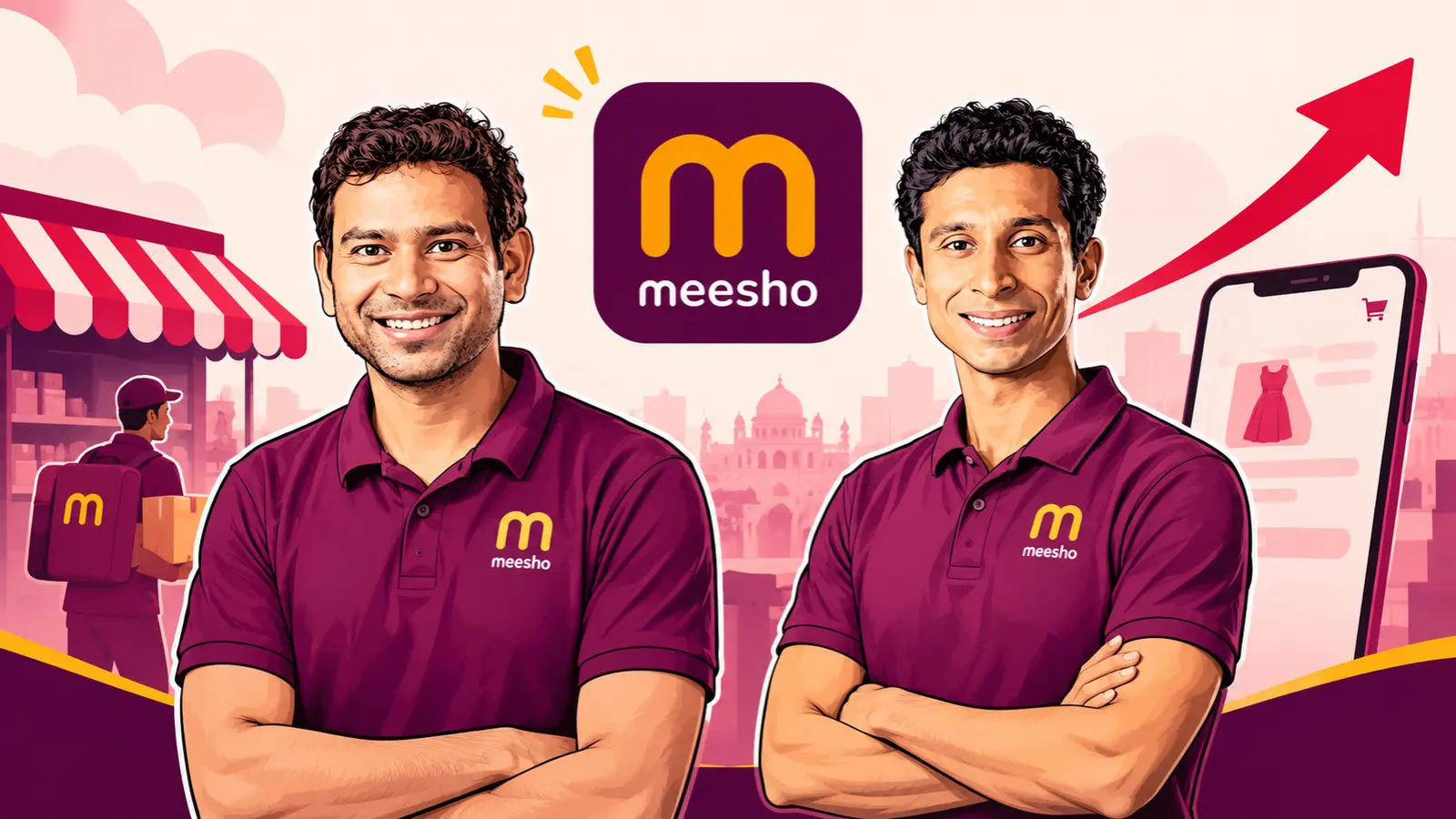
In 2015, Vidit Aatrey was delivering fashion orders in Bengaluru himself. He wanted to hear customers’ feedback first-hand, he later wrote. The Meesho founders story starts there, with a delivery bag and a business model that did not work. It ends on the NSE and BSE, where Meesho listed on December 10, 2025.
Reading time: about 10 minutes
Table of Contents
Two roommates and a call from Tokyo
Vidit Aatrey was born in Meerut, Uttar Pradesh. Sanjeev Barnwal grew up in Hazaribagh, Jharkhand. Aatrey told McKinsey in October 2026 that Barnwal was his college roommate, and public profiles show both studied electrical engineering at IIT Delhi. Barnwal’s alumni-award page lists his B.Tech year as 2012.
Their first jobs were very different. According to media profiles, Aatrey worked at ITC and then InMobi. Barnwal moved to Tokyo and worked at Sony on camera software, as listed on his Crunchbase profile.
In 2015, Barnwal phoned Aatrey from Tokyo, bored of corporate life. Aatrey says he suggested they build something together, and Barnwal resigned the next day. McKinsey’s introduction describes the pair as 24-year-olds at the time. Neither had run a company, and they had no fixed idea yet.
“We started with a hyperlocal fashion marketplace.”
Sanjeev Barnwal, speaking at Entrepreneur India’s Startup Summit in Bengaluru, August 2019
A Swiggy for fashion that shoppers did not need
The first idea was Fashnear. Aatrey describes it as the fashion equivalent of what Swiggy did for food. The founders signed up shops in a neighbourhood, starting with Koramangala and HSR in Bengaluru. A customer picked three items from local stores, a delivery person brought them home, and the shopper paid for what they kept and returned the rest.
There was no shortcut. Aatrey and Barnwal photographed every product in every shop and catalogued it themselves. Aatrey also did deliveries, because he wanted direct customer feedback.
The model did not hold. Aatrey wrote in a 2020 company blog post that shoppers cared less about products being local and more about sales. Offline shops could only run end-of-season discounts, while online stores ran them all year. Wikipedia, citing News18, describes the venture as one that failed. Outlook Business reported that the founders restructured it into Meesho.
The useful part of the failure was the shop visits. A shop owner in Koramangala told them he already sold online. He posted new products in WhatsApp and Facebook groups, customers ordered, and an employee delivered and collected payment. The founders built software to take that behaviour “to 10X,” as Aatrey puts it, and named it Meesho, short for Meri Shop.
Dates differ by source. Aatrey dates the start to July 2015. Company data profiles, including MarketScreener and YourStory’s company page, list December 2015 as the founding date.
Read More: Samir Vasavada Story: He Started Vise at 16 and Reached $160B in Platform Assets
Meri Shop, 10,000 shops and a summer at Y Combinator
The new product let a shopkeeper log in with a Facebook account and get a web page for the business. Aatrey wrote that about 10,000 shops signed up in roughly six months. Y Combinator’s company page says it selected Meesho for the summer 2016 programme. Media reports, including Social Samosa, put the seed cheque at $120,000, and put a $3.4 million round led by SAIF Partners, now Elevation Capital, in October 2017.
The users changed the product. Most shops on the app were run by women who sold from home and called themselves resellers. They held no stock. They collected product photos from suppliers, listed them on Meesho, and bought only when a customer ordered. Aatrey describes one early reseller who travelled to Surat every month, came back with the cards of about 100 suppliers, and sold through WhatsApp.

That gave the founders a gap to fill. Small sellers in different cities could not trust each other enough to offer cash on delivery or returns. Meesho became the bridge. It launched a second app, Meesho Supply, with cash on delivery, returns and support handled for sellers. For nine months it ran both apps. Then it started charging commission, and revenue began.
Aatrey told McKinsey the two made a pact early: no option to shut down for the first two years. He says the period before 2017 was a daily fight for survival.
“For us, trust was the survival mechanism.”
Vidit Aatrey, McKinsey interview, October 12, 2026
The 2021 bet: closing a business that was growing fivefold
By 2020, Aatrey says, Meesho had ten million WhatsApp groups running across India. Then the ground moved. Mobile data got cheaper with Jio, and the pandemic pushed shoppers towards direct shopping apps. Aatrey describes this as an existential crisis. In his account, the company had just raised money around the old reseller model.
He says Meesho shut down a business that was growing fivefold year on year to build a new one. The Meesho app launched in July 2021, with zero commission for sellers, which Aatrey calls a first in India. He says it became the top app on the Google Play Store and drew more than a million active sellers. These are the founder’s own claims. StartupIndiaX has not independently verified them.
Money followed. Global Venturing reported a $570 million round at a $4.9 billion valuation, with Meta, SoftBank and Prosus among the investors. The same period was harder than the headline. Aatrey says revenue fell to zero for three months during the lockdown, and that the post-pandemic correction forced a shift from growth at any cost to profitability, including the company’s only layoff.
Rivals noticed too. Entrackr reported that Flipkart launched Shopsy, its own social commerce app, in July 2021.
How a zero-commission marketplace earns
Meesho does not take a cut of each sale from sellers. So where does the money come from? Inc42’s analysis puts FY26 revenue from the marketplace segment at ₹12,614 crore ($1.35 billion), or 99.9% of operating revenue. The earnings sit in services around the sale.
Entrepreneur India’s breakdown names two streams. Sellers pay for shipping through Meesho, and if Meesho delivers more cheaply than the fee it charges, it keeps the margin. Sellers also pay for advertising, which Inc42 calls critical for bringing sellers back to a no-commission platform.
Barnwal explained the logic before the listing. The point of zero commission, he said, is to let low-margin products sell.
Meesho wants “every seller, even those with low-margin products” to join.
Sanjeev Barnwal, Outlook Business interview before the December 2025 listing
The numbers are moving the right way, with a catch. In Q2 FY27, Meesho’s contribution margin was 6.0% of net merchandise value (NMV), up from 4.6% in the previous quarter, according to Upstox. NMV grew 23% to ₹12,911 crore ($1.38 billion), based on the company’s results. The catch is order growth. INDmoney flagged a moderation in order growth as the main concern in the quarter’s results.
Revenue rose from ₹3,073.67 crore ($329 million) in Q2 FY26 to ₹4,131.58 crore ($443 million) in Q2 FY27, a rise of 34.4%.
What the founders own, and why net worth numbers disagree
Ownership is where most founder profiles get loose. The best public snapshot comes from the updated draft prospectus filed in October 2025, as analysed by Inc42. It shows the two founders together holding 78.8 crore shares, or 18.51%, before the offer. Aatrey held 11.10% and Barnwal, whose legal name in the filing is Sanjeev Kumar, held 7.41%. Elevation Capital led the institutions at 13.61%, ahead of Peak XV Partners at 12.81% and Naspers Ventures at 12.34%.
The draft planned for Aatrey and Barnwal to sell 1.2 crore shares each in the offer for sale. Inc42 reported that the founders’ shares, along with those of Peak XV, Elevation, Prosus and SoftBank, would be locked in for 18 months from allotment. Fyers reported that the offer for sale was cut by nearly 40%, so the founders’ actual sale should be checked against the final prospectus.
Net worth is a separate question. Storyboard18 reported in December 2025 that Aatrey’s 47.25 crore shares, about 11.1% of the company, were worth ₹8,599.5 crore (about $1 billion, per Storyboard18), and that Barnwal’s 31.6 crore shares were worth ₹5,751.2 crore. Business Today reported that Aatrey’s net worth crossed $1 billion after the IPO. Both are estimates based on that day’s share price. StartupIndiaX has not verified them, and they will have moved since.
Other pages give wildly different numbers. One profile site lists Barnwal at about $2.1 billion without a stated basis. IIT Delhi’s alumni page gives $2.1 billion as Meesho’s valuation. StartupIndiaX could not trace a basis for the personal figure, so it is not used here. A net worth page that calls Meesho privately held in 2026 is simply out of date.
Read more: Best City for a Startup in India? We Compared 5 on Funding, Rent and Talent
The listing, and the losses around it
Meesho’s IPO opened on December 3 and closed on December 5, 2025. It raised ₹5,421.2 crore ($603 million, per McKinsey) at a price band of ₹105 to ₹111 per share, and was subscribed 79.02 times. The stock listed at ₹161.20 on the BSE, a 45.23% premium to the ₹111 issue price. Y Combinator noted that Meesho was the second YC company to list in India.
The loss figures need context. Inc42 reported that Meesho’s FY25 net loss, close to ₹3,900 crore, included a one-time reverse flip tax of ₹3,883 crore ($416 million), the tax cost of moving the company’s base back to India. Without that charge and other one-time costs tied to the IPO process, Inc42 said, the loss would have been ₹108 crore. In FY26, the loss narrowed 66% to ₹1,357.7 crore ($145 million), according to a results notice published by the company.
The latest quarter continues the trend. Meesho reported a Q2 FY27 net loss of ₹132.45 crore ($14.2 million), against ₹411.36 crore ($44.1 million) a year earlier. Annual transacting users reached 284 million and the seller base 1.13 million, according to YourStory’s coverage of the results. Upstox reported cash of ₹7,048 crore ($755 million) on September 30, 2026. The company is still loss-making.
On the market side, MSCI said on November 11 that it would add Meesho to its India Standard Index, effective November 30, 2026, Business Standard reported.
Read More: Funding Round Dilution Calculator to see how each new round changes what founders hold.
Rivals on the same road
Meesho’s low-price model now has imitators. Inc42 reports that Flipkart’s Shopsy, Amazon Bazaar and Reliance’s JioMart have all begun copying its low-cost, seller-friendly approach. Business Standard reported that Nomura gave the stock a “Reduce” rating in September 2026, citing valuation and the likelihood that Amazon and Flipkart push harder into value commerce.
Analysts disagree. Axis Capital argued in April 2026 that Bazaar and Shopsy are held back by the seller base, catalogue and fulfilment costs they inherited from higher-priced models. Barnwal has said Meesho is not optimising for quick commerce, the 10-minute delivery race Amazon, Flipkart and others are running.
The CEO and the CTO
The two founders split the work along familiar lines. Aatrey is chairman, managing director and CEO, and sets strategy. Barnwal is a whole-time director and CTO. Inc42 reported their FY25 pay at ₹5.4 crore ($0.58 million) and ₹4.9 crore ($0.52 million) respectively, according to the draft filing.
Barnwal’s side of the business has been the AI push. In August 2024 he told Business Standard that generative AI had automated about 95% of customer support chats. With its Q2 FY27 results, the company said engineering productivity rose 171% between March and September 2026.
Aatrey says that after the IPO he started a five-year planning exercise. He spends time on the ground, and told McKinsey he recently visited Bihar to see what he calls the consumer frontier.
Read More: Co-founder Equity Split Calculator to test how two founders might divide ownership before they raise.
The founders’ year-by-year record
The record below pulls the milestones into one place. Where sources disagree, both versions are shown.
What other founders can take from this
A failed first model is research. Fashnear did not work, but the shop visits led to the WhatsApp insight that became Meesho.
Agree the hard rules early. The founders’ pact not to shut down for two years gave them room to fail every day, in Aatrey’s words, without blaming each other.
Be ready to dismantle what works. In 2021, by Aatrey’s account, they closed a business growing fivefold because customer behaviour had changed.
Price around the customer’s constraint. Zero commission let low-margin goods find buyers, and the earnings came from services around the sale.
Read the filing before you repeat the wealth headline. The founders’ stakes are on record. The net worth numbers floating online mostly are not.
What the story still has to prove
Profit is the open question. Revenue is up 34.4% year on year, the loss is narrowing, and Meesho has cash. Order growth is slowing, and bigger rivals are copying the model.
Aatrey told McKinsey the IPO itself was not the milestone for him. That is the right test. Which would you rather read next: how Meesho reaches profit, or how its imitators fare? Tell us in the comments, share this story with a co-founder, and keep reading the founder stories on StartupIndiaX.
FAQs
Who founded Meesho?
Meesho was founded by Vidit Aatrey, the CEO, and Sanjeev Barnwal, the CTO. Aatrey describes Barnwal as his college roommate at IIT Delhi. They left their jobs in July 2015 to start Fashnear, a hyperlocal fashion app, which became Meesho, short for Meri Shop.
What does Meesho mean?
Meesho is short for “Meri Shop,” which means “my shop.” The founders chose the name after moving from Fashnear to a platform for shopkeepers and resellers who sold through WhatsApp and Facebook. The name reflects that each reseller runs a personal shop.
When was Meesho founded?
Vidit Aatrey dates the start to July 2015, when he and Sanjeev Barnwal left their jobs to start Fashnear. Company data profiles list December 2015 as the founding date. Y Combinator selected the company for its summer 2016 programme.
How much of Meesho do the founders own?
Before the IPO, Inc42’s analysis of the October 2025 draft prospectus showed Vidit Aatrey with 11.10% and Sanjeev Barnwal with 7.41%, or 18.51% together. The draft planned for each to sell 1.2 crore shares. Check the latest exchange filing for current holdings.
What is the net worth of Meesho’s founders?
StartupIndiaX has no verified figure. Storyboard18 reported in December 2025 that Vidit Aatrey’s shares were worth ₹8,599.5 crore (about $1 billion), and Business Today reported his net worth crossed $1 billion. These are share-price estimates and change daily.
How does Meesho make money without charging sellers commission?
Meesho earns from services around each sale, mainly logistics and seller advertising. Inc42 reported FY26 marketplace revenue of ₹12,614 crore ($1.35 billion), which was 99.9% of operating revenue. Sellers do not pay a commission on order value.
Is Meesho profitable?
Not yet at the net level. In Q2 FY27, Meesho reported a net loss of ₹132.45 crore ($14.2 million), down from ₹411.36 crore ($44.1 million) a year earlier, with revenue of ₹4,131.58 crore ($443 million). Contribution margin was 6.0% of NMV.
Sources
- McKinsey & Company, “Meesho: Making e-commerce everyone’s business,” interview with Vidit Aatrey, October 12, 2026. https://www.mckinsey.com/featured-insights/future-of-asia/meesho-making-e-commerce-everyones-business
- Meesho blog, “Meesho turns 5,” July 2020. https://meesho.io/blog/meesho-turns-5
- Inc42, “Meesho DRHP: A Look At Shareholding Pattern & Key Executives,” October 24, 2025. https://inc42.com/buzz/meesho-drhp-a-look-at-shareholding-pattern-key-executives/
- Inc42, “Decoding Meesho’s Zero-Commission Model & Seller-Centric Revenue Engine,” 2026. https://inc42.com/features/decoding-meesho-business-model-seller-centric-revenue-engine/
- Inc42, “Meesho’s Next Monetisation Engines,” 2026. https://inc42.com/features/meeshos-next-monetisation-engines/
- Business Standard, “Meesho Q2 net loss narrows 68% to ₹132 crore as revenue rises 34%,” October 28, 2026. https://www.business-standard.com/companies/quarterly-results/meesho-q2-net-loss-narrows-68-to-132-crore-as-revenue-rises-34-126102801811_1.html
- YourStory, “Meesho narrows loss by 68% while revenue rises 34% in Q2 of FY27,” October 2026. https://yourstory.com/2026/10/meesho-reduces-losses-by-68-while-revenues-rises-34-in-q2-of-fy27
- Kotak Neo, “Meesho Q2 FY27 Results: Revenue Grows 34.4%,” October 28, 2026. https://www.kotakneo.com/news/stocks/meesho-q2-fy27-results-share-in-focus/
- Investywise, “Meesho: Q2 FY27 NMV Surges 23% to ₹12,911 Cr,” October 28, 2026 (citing BSE). https://www.investywise.com/?p=124738
- Fyers, “Meesho IPO: OFS Cut, Valuation Reset,” December 5, 2025. https://fyers.in/blog/meesho-ipo
- Upstox, “Meesho Q2 FY27 results: Net loss narrows to ₹132 crore YoY,” October 28, 2026. https://upstox.com/news/market-news/earnings/meesho-q2-fy-27-results-net-loss-narrows-to-132-crore-yo-y-net-merchandise-value-grows-23/article-202569/
- INDmoney, “Meesho Q2 Results: Loss Narrows 68%, Is Growth Slowing?” 2026. https://www.indmoney.com/blog/stocks/meesho-loss-narrows-growth-slows
- Business Standard, “Meesho shares close 53% above issue price on debut,” December 10, 2025. https://www.business-standard.com/markets/ipo/meesho-closes-53-percent-above-issue-price-on-debut-125121001096_1.html
- Business Standard, “Meesho IPO listing brings windfall gain,” December 10, 2025. https://www.business-standard.com/markets/news/meesho-ipo-listing-brings-windfall-gain-shares-debut-with-46-premium-125121000217_1.html
- Free Press Journal / PTI, “Meesho’s Shares Make Remarkable Market Debut,” December 10, 2025. https://www.freepressjournal.in/tech/meeshos-shares-make-remarkable-market-debut-by-listing-with-a-premium-of-46-against-issue-price-of-111
- Y Combinator, “Meesho Goes Public,” December 10, 2025. https://www.ycombinator.com/blog/meesho-goes-public/
- Y Combinator, Meesho company page. https://ycombinator.com/companies/meesho
- Storyboard18, “Meesho’s blockbuster IPO pushes founder Vidit Aatrey past $1 billion,” December 2025. https://www.storyboard18.com/brand-makers/meeshos-blockbuster-ipo-pushes-founder-vidit-aatrey-past-1-billion-85949.htm
- Business Today, “Meesho founder Vidit Aatrey joins billionaire club,” December 16, 2025. https://www.businesstoday.in/markets/stocks/story/meesho-founder-vidit-aatrey-joins-billionaire-club-506795-2025-12-16
- Business Standard, “LIC, Meesho, Coforge stocks on radar amid MSCI Nov rejig,” November 13, 2026. https://www.business-standard.com/markets/news/lic-meesho-coforge-stocks-amid-msci-nov-rejig-what-charts-say-technical-analysis-126111300450_1.html
- Business Standard, “Meesho’s valuation woes prompt Nomura to assign ‘Reduce’ tag,” September 25, 2026. https://www.business-standard.com/markets/news/meesho-s-valuation-woes-prompt-nomura-to-assign-reduce-tag-stock-down-5-126092500311_1.html
- Business Today, “Meesho shares at Rs 195? Ecomm player better placed than Amazon Bazaar & Shopsy, says Axis Capital,” April 2, 2026. https://www.businesstoday.in/markets/stocks/story/meesho-share-price-target-rs-195-ecomm-player-amazon-bazaar-shopsy-axis-capital-523786-2026-04-02
- Inc42, “From Burn To Break-Even: Meesho Shows Signs Of Turnaround.” https://inc42.com/?p=536095
- Outlook Business, “Why IPO-Bound Meesho Is Opting Out of Quick Commerce Race: Cofounder Sanjeev Barnwal Explains,” 2025. https://www.outlookbusiness.com/interviews/why-ipo-bound-meesho-is-opting-out-of-quick-commerce-race-cofounder-sanjeev-barnwal-explains
- Outlook Business, “Taking Bharat’s Business To India.” https://www.outlookbusiness.com/the-big-story/lead-story/taking-bharats-business-to-india-6594
- Entrepreneur India, “Raising Capital is a Long-term Game: Meesho Founder and CTO,” August 14, 2019. https://india.entrepreneur.com/?p=49080
- Entrepreneur India, “Inside Meesho: Insights from India’s most misunderstood unicorn.” https://india.entrepreneur.com/news-and-trends/inside-meesho-insights-from-indias-most-misunderstood/502064
- Business Standard, “GenAI helped reduce customer support chat costs by 90%: Meesho CTO Barnwal,” August 7, 2024. https://business-standard.com/companies/start-ups/genai-helped-reduce-customer-support-chat-costs-by-90-meesho-cto-barnwal-124080701028_1.html
- Trendlyne, “Q2FY27 quarterly result announced for Meesho Ltd,” 2026. https://trendlyne.com/posts/5915029/q2fy27-quarterly-result-announced-for-meesho-ltd
- Social Samosa, “Brand Saga: Meesho’s journey to redefine affordable shopping.” https://www.socialsamosa.com/brand-saga/brand-saga-meesho-8646722
- Global Venturing, “Analysis: Meesho raises a $570m round.” https://globalventuring.com/corporate/analysis-meesho-raises-a-570m-round/?format=md
- Entrackr, Meesho competition coverage. https://entrackr.com/?p=128221
- Inc42 Datalabs, Meesho funding table. https://inc42.com/company/meesho/funding/
- YourStory, “Ecomm startup Meesho raises $275M as part of larger round,” May 2024. https://yourstory.com/2024/05/ecomm-startup-meesho-raises-275m-as-part-of-larger-round
- IIT Delhi Alumni, Graduates of Last Decade (GOLD) Award, Sanjeev Barnwal. https://alumni.iitd.ac.in/Graduates-of-Last-Decade-(GOLD)-Awards/95
- Crunchbase, Sanjeev Barnwal profile. https://www.crunchbase.com/person/sanjeev-barnwal
- MarketScreener, Vidit Aatrey profile. https://in.marketscreener.com/insider/VIDIT-AATREY-A24VCR/
- Wikipedia, “Meesho.” https://en.wikipedia.org/wiki/Meesho
- PTI via HDFC Sky, “Rupee rallies for 4th session to close 5 paise higher at 93.36 against US dollar,” November 19, 2026. https://hdfcsky.com/news/rupee-rallies-for-4th-session-to-close-5-paise-higher-at-93-36-against-us-dollar