Table of Contents
Summary
- The tool runs three methods, VC Method, Revenue Multiple, and Scorecard, so you’re never relying on a single number.
- Pre-revenue founders should start with Scorecard; anyone with ARR should check Revenue Multiple first.
- Treat the output as a planning range, not a certified valuation. FEMA and ESOP pricing still need a registered valuer.
Most founders find out their startup’s valuation the hard way: in a term sheet, after the investor has already anchored the number. A startup company valuation calculator flips that. You get the range before the meeting, not during it.
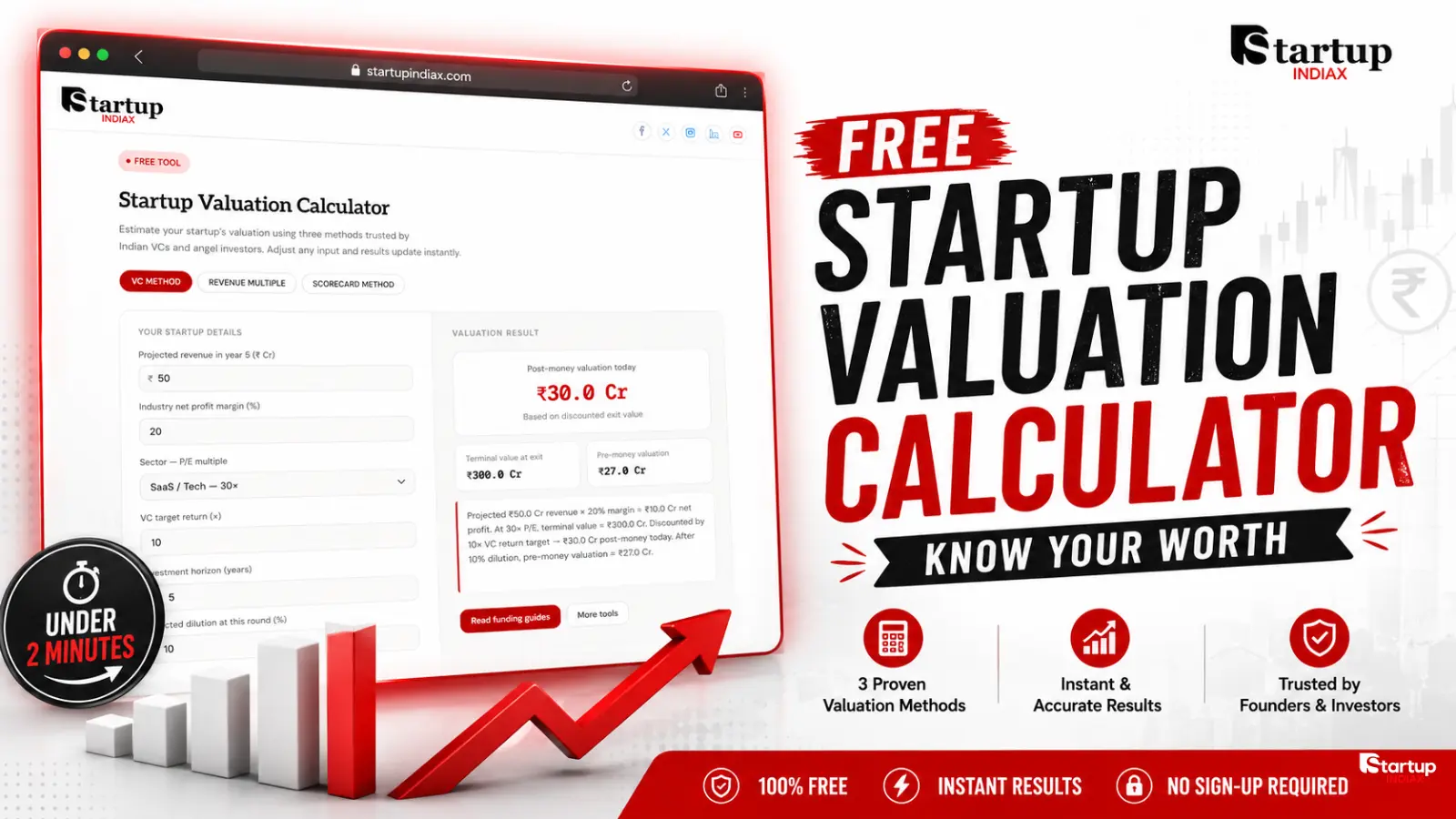
Startup INDIAX built a free tool that runs three methods Indian VCs and angel investors actually rely on, side by side, with your own numbers. No email gate, no call booking. Here’s how to use it, and why the range it gives you matters more than any single figure.
What the Tool Actually Does (Startup Company Valuation Calculator)
The Startup Valuation Calculator runs three separate models, because no single method fits every stage.
VC Method. You enter projected year-5 revenue, an industry profit margin, and a sector P/E multiple (SaaS and tech sit at 30x, fintech at 25x, healthtech at 20x, D2C and e-commerce lower at 15x). The tool works backwards from a terminal exit value, applies your investor’s target return multiple and investment horizon, and lands on a post-money and pre-money figure. Best for startups with a visible path to an exit, not idea-stage teams.
Revenue Multiple. This one’s built for anyone already generating ARR. Pick your business model (SaaS multiples typically run 8-12x, marketplaces 5-8x, D2C 3-6x, fintech 6-10x), factor in your growth rate and gross margin, and get a conservative-to-optimistic valuation range rather than one number.
Scorecard Method. For pre-revenue founders, this compares your startup against a benchmark valuation and adjusts it based on five weighted factors: team strength (30%), market size (25%), product moat (20%), traction (15%), and competitive landscape (10%). You rate yourself 1-5 on each, and the tool shows exactly what percentage of the benchmark your score lands you at.
Each tab updates live as you adjust inputs, so you can see how sensitive your valuation is to a single assumption, like what happens to your number if your growth rate drops five points, or your P/E multiple assumption was too aggressive.
Why a Range Beats a Single Number
Here’s the thing most calculators don’t say out loud: the value isn’t the final figure; it’s seeing three methods disagree.
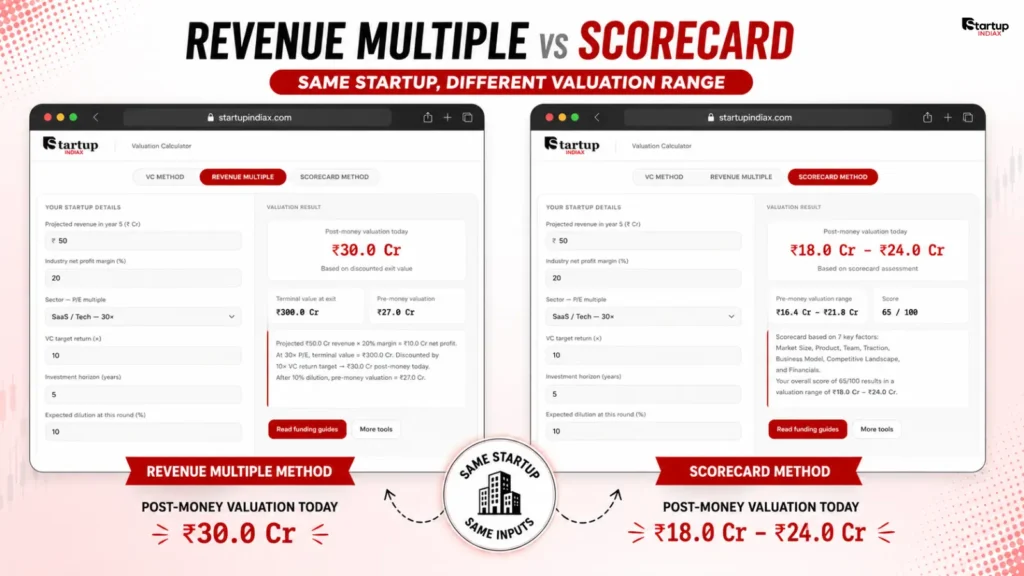
If your VC Method output says ₹30 crore and your Scorecard says ₹18 crore, that gap is information. It tells you your growth story is priced ahead of your current traction, which is exactly the kind of thing an investor will flag in diligence. Better to find that out from a free tool than from a term sheet renegotiation three weeks in.
This is also why the tool is genuinely free and doesn’t ask for your financials to be emailed anywhere first. You should be able to stress-test your own assumptions before you’re in a room defending them.
Who Should Use Which Tab
Pre-revenue and idea-stage founders should start with Scorecard. It’s the only method of the three that doesn’t require revenue projections to mean anything.
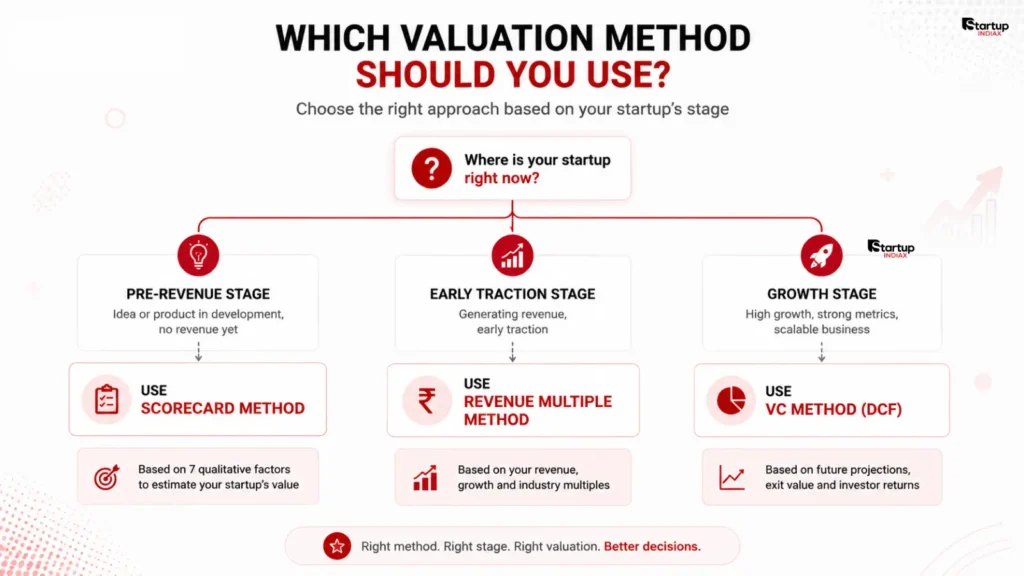
Founders with early ARR, even just a few months of it, should run the revenue multiple first, since it’s the method most seed and Series A investors will reach for anyway.
Founders further along, with a real growth trajectory and a plausible exit story, should use VC method as their primary number and the other two as a sanity check.
What the Tool Won’t Tell You
Be upfront about this with your readers, because your competitors mostly aren’t. A free calculator gives you a planning range, not a certified valuation. It can’t replace a registered valuer’s report, and it isn’t a substitute for the DCF-based fair market value report required under FEMA when a foreign investor is in your round. If you’ve gone through DPIIT recognition, that status doesn’t change the number either, though it does strengthen your position at the table.
Use the output to walk into a fundraising conversation informed, not to skip the professional step entirely.
Startup INDIAX Take
We built this because most valuation calculators online are lead-generation funnels dressed up as free tools. Ours isn’t trying to book you a consulting call. It’s trying to make sure a first-time founder doesn’t walk into a term sheet negotiation with a number they can’t defend.
The real skill a tool like this teaches isn’t reading one output. It’s noticing when your three methods disagree, and asking yourself why. That instinct is worth more in a negotiation than any single figure the tool spits out.
Why This Matters
For founders, a two-minute check before a pitch meeting means fewer moments where an investor’s number catches you off guard. For investors, a founder who shows up already having triangulated their own range is easier to negotiate with in good faith. For the ecosystem, tools like this quietly push back against the inflated seed pricing that leads to painful down rounds eighteen months later.
The Bigger Picture
Free valuation tools have multiplied across Indian fintech and advisory sites over the past year, most of them built by CA firms and consultancies using the calculator as a lead magnet for paid valuation reports. That’s a reasonable business model, but it means the tool’s incentive is to nudge you toward booking a call, not necessarily toward the most useful range.
A media-first tool doesn’t have that conflict. The incentive here is simply getting founders to a more informed starting point, and back to reading the funding and policy coverage that explains what the number actually means for their next raise.
Run your numbers through the calculator and see how much your three methods agree. If you’re mapping out your next raise, our dilution calculator and equity split calculator are good next stops.
FAQs
Is the Startup INDIAX valuation calculator really free?
Yes, all three methods (VC Method, Revenue Multiple, Scorecard) are free with no signup or email required to see your results.
Which method should a pre-revenue startup use?
Start with the Scorecard Method. It’s built specifically for startups without revenue, using weighted qualitative factors instead of financial projections.
Can I use this calculator instead of hiring a valuer?
No. It’s an educational planning tool. Any round involving a foreign investor still legally requires a certified fair value report under FEMA from a SEBI-registered merchant banker or chartered accountant.
What revenue multiple does the tool use for SaaS startups?
The Revenue Multiple tab applies an 8-12x ARR range for SaaS businesses, adjusted for your growth rate and gross margin.
Why do the three methods give different numbers for the same startup?
Each method weighs different things. VC Method prices off a future exit, Revenue Multiple prices off current ARR, and Scorecard prices off qualitative benchmarking. A gap between them usually means your growth story and current traction aren’t yet aligned.