SUMMARY
- Semicon 2.0 targets at least 200 chip design startups and companies, up from 105 that tried chip design in phase one.
- The DLI scheme already offers shared EDA tools, up to 50% reimbursement of eligible design costs, and sales-linked incentives for five years.
- Rupee-for-rupee co-investment with VCs is planned, but guidelines weren’t public yet, so don’t build a fundraising plan around it.
India has put a number on its chip design ambitions, and it’s a big one.
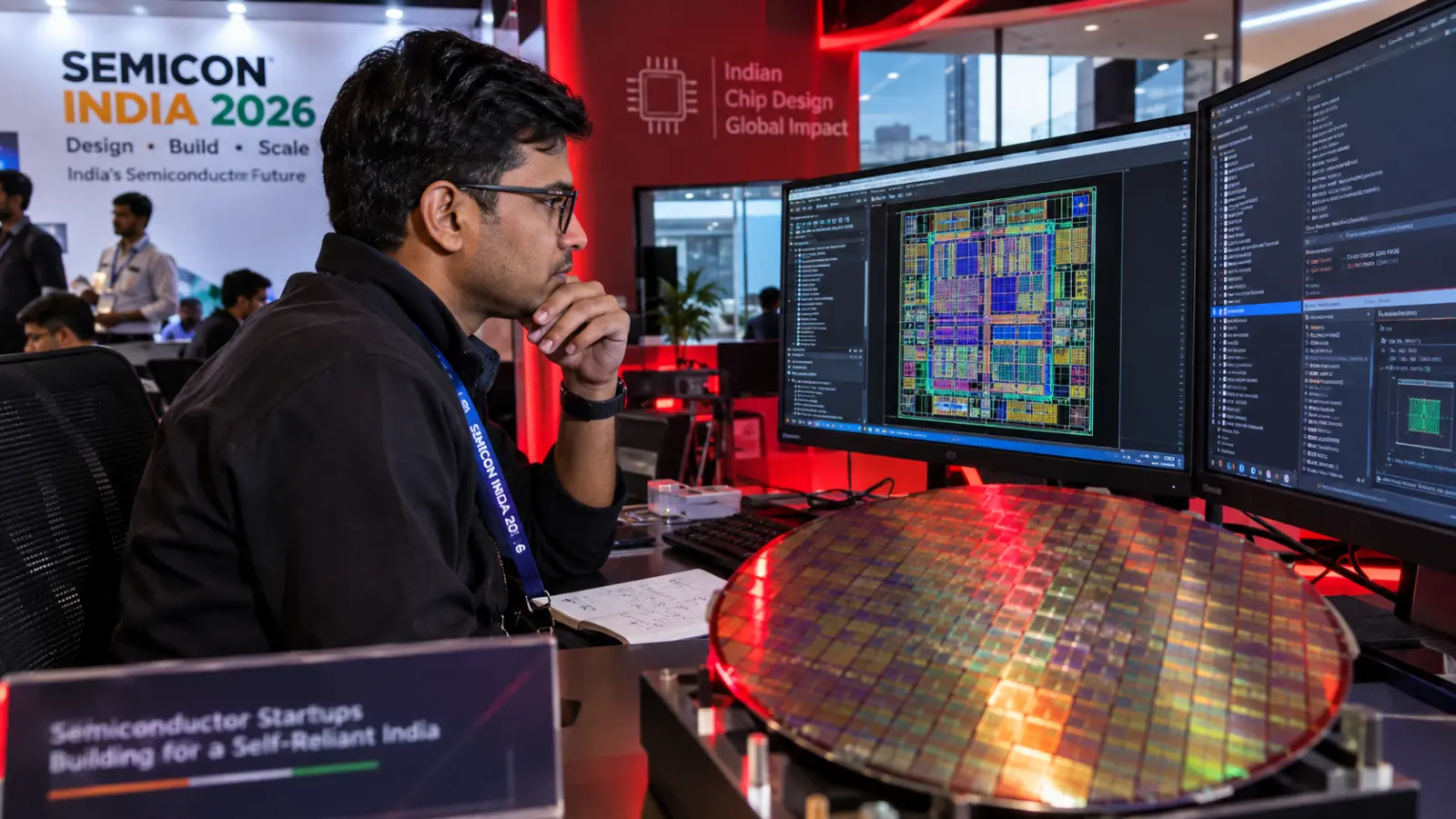
At SEMICON India 2026 on September 17, Union Minister Ashwini Vaishnaw said the government will target at least 200 startups and companies designing chips under Semicon 2.0. In the first phase, more than 105 startups attempted chip design and about 20 raised venture capital worth roughly ₹800 crore. Vaishnaw’s own verdict on that: “That was just the beginning.”
If you’re building one of the semiconductor startups India is counting on, the target isn’t the useful part. What you can apply for, and when, is.
A bigger target, and a smaller starting line than it sounds
Semicon 2.0 was approved in July 2026 with an outlay of ₹1,27,500 crore. Semicon 1.0, approved in December 2021, had ₹76,000 crore. Chip design is the first of six pillars, alongside equipment and materials, fabs, advanced packaging, R&D and talent.
Read the numbers the other way and the picture is less dramatic. Roughly one in five of those 105 design startups went on to raise VC. Doubling the target to 200 means the system has to move a lot more companies from “attempted a chip” to “funded and shipping.”
That’s the gap the government is trying to close, and it’s why the support on offer matters more than the headline.
What the DLI scheme gives a chip startup today
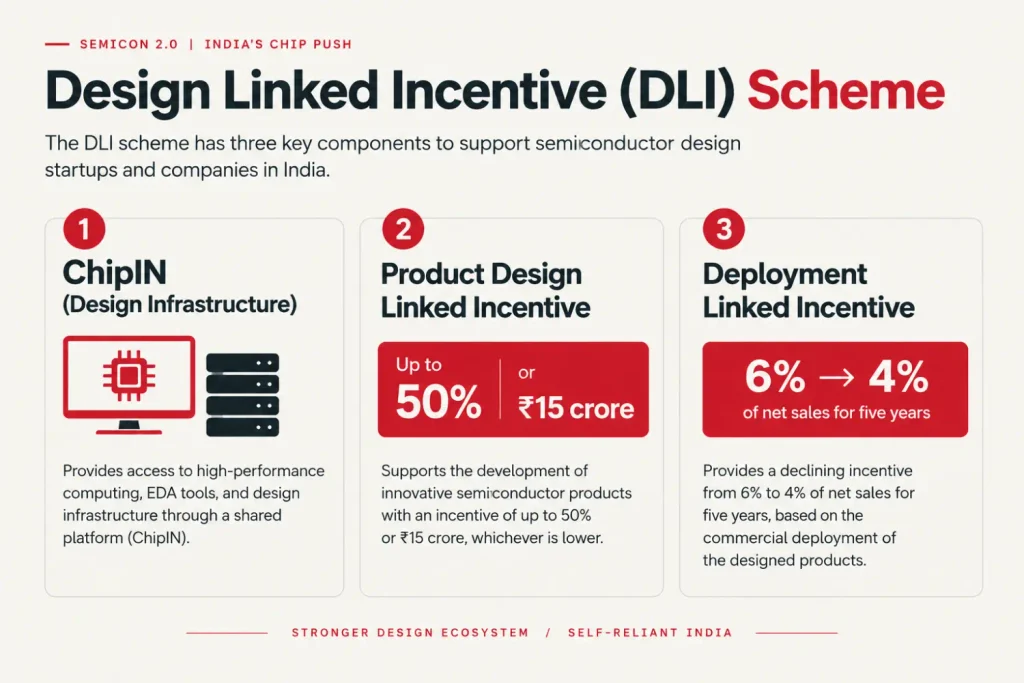
The Design Linked Incentive (DLI) scheme, run through C-DAC under MeitY, is the machinery that’s already working. It has three parts.
Design infrastructure. C-DAC’s ChipIN Centre gives approved startups and MSMEs remote access to a National EDA Tool Grid, a repository of IP cores, and support for multi-project wafer prototyping and post-silicon validation.
Product Design Linked Incentive. Reimbursement of up to 50% of eligible expenditure, capped at ₹15 crore per application.
Deployment Linked Incentive. Between 6% and 4% of net sales turnover, for five years, once your design is actually deployed in products.
Eligible applicants are domestic companies, startups and MSMEs working on semiconductor design or semiconductor-linked design, covering ICs, chipsets, SoCs, systems and IP cores. Applications go through the DLI portal at chips-dli.gov.in.
Why start with design software? Vaishnaw said the first phase focused on the high cost of EDA tools, and more than 105 startups got access to them. For a seed-stage chip company, licence costs for that software can eat into the first round before there’s a single tape-out. Access through ChipIN takes that cost off the table.
One more number worth having: in January, Vaishnaw said 24 startups were part of the DLI programme and had attracted nearly ₹430 crore in venture funding. Note that this is a different cohort from the 105 startups with tool access, which is why the figures don’t match.
The promise founders should watch: rupee-for-rupee
Semicon 2.0 adds something new. ISM CEO Amitesh Kumar Sinha told YourStory the government plans to match VC investments in approved startups rupee for rupee, on the same terms as the private investor.
If that lands as described, a ₹10 crore VC cheque could effectively become ₹20 crore. For a deeptech founder who needs capital for multiple tape-outs, that changes the math of a seed or Series A.
But two words in that sentence carry weight: “plans” and “approved.” We couldn’t find final guidelines for the design pillar of Semicon 2.0 in the sources we checked, and nobody has published what approval will require. Until they do, treat co-investment as upside, not as a line in your runway model.
Read More: 25 Indian DeepTech Startups to Watch in 2026: Space, Semiconductors, Robotics and Defence
The private money is arriving, and it’s picky
Here’s where the funding data gets messy, and we’d rather show you the mess than pick a winner.
Speciale Invest and the Startup Policy Forum say Indian semiconductor startups raised about $206 million across 51 rounds since 2022. Of that, $61.9 million came in H1 2026, which is already 81% of the $76.6 million raised in all of 2025. But the number of rounds has dropped from 16 in 2024 to 13 in 2025 and just seven in the first half of this year. Fewer rounds, bigger cheques.
Seven recent Series A rounds add up to $73.7 million, about a third of everything raised since 2022. Zoho and TDK Ventures have anchored rounds, and global chip companies are taking equity in Indian startups instead of only running captive R&D centres here.
Venture Intelligence counts differently. It put funding at $92 million across 12 deals in just the first five months of 2026, with Constelli, C2i Semiconductors, HrdWyr and VerveSemi each raising more than $10 million. And Tracxn’s wider semiconductor tracker shows $1.4 billion in cumulative equity funding, but it follows 3,557 companies across the whole ecosystem, not just design startups.
Three trackers, three answers, and none of them explains the gap with the others. Use them as lenses, not as one number.
What they agree on is the direction. Capital is concentrating in startups that have already hit milestones. Speciale’s report links that to public programmes, reading it as early evidence that government-funded design, tooling and tape-outs help startups reach the point where institutions will write cheques. Arjun Rao, one of its authors, adds that the next wave of investable companies “will not come from chip design alone”.
Where the gaps are
Speciale sees the biggest white spaces in equipment and materials, design IP and EDA, and analog and RF. Industry voices quoted by Venture Intelligence say India still needs more domestic semiconductor testing companies. At least six startups have already completed tape-outs and sent designs to foundries, so someone has to test and package what comes back.
Many of the people starting these companies aren’t fresh graduates either. Executives from AMD, Intel and Texas Instruments have launched chip design startups over the past two years.
What to do if you’re building a chip startup
A rough order of operations, based on what’s actually confirmed:
- Check you qualify. DLI eligibility follows the DPIIT definition of a startup, or MSME status. Sort the recognition before you sort anything else.
- Get on the EDA grid first. Use ChipIN access before you buy your own licences.
- Plan around reimbursement. The 50% is reimbursement against eligible spend, which means you spend first and claim later. Cash planning matters.
- Watch the Semicon 2.0 design pillar. Application rules and co-investment criteria aren’t clear yet. Check the DLI portal and ISM channels before building a timeline around them.
- Look beyond chips. The Startup India portal also lists the Credit Guarantee Scheme for Startups and Fund of Funds 2.0, which any eligible founder can look at on the Startup India government schemes page.
Our read
The target of 200 is the easy part to announce. The hard part is the funnel: 105 startups tried, about 20 got venture money, and the private capital that did arrive is going to fewer, further-along companies.
For founders, that means the government support is most valuable early, before you have the traction VCs want. For investors, public tooling and reimbursement lower the cost of finding out whether a team can tape out. For the ecosystem, the real test is whether testing, packaging and materials startups appear alongside the design houses.
Here’s what to take with you:
- Use DLI’s tools and reimbursement now, because that’s the part that’s confirmed.
- Treat rupee-for-rupee co-investment as upside until the guidelines are public.
- Don’t compete only in chip design. The gaps are in testing, packaging, materials and EDA.
Want to see which schemes fit your startup? Try the Government Scheme Finder in the StartupIndiaX Founder Toolkit, then tell us in the comments: are you building in chip design, or in the gaps around it?
FAQs
What is Semicon 2.0 and how many chip design companies does it target?
Semicon 2.0 is India’s second-phase semiconductor programme, approved in July 2026 with a ₹1,27,500 crore outlay. It targets at least 200 startups and companies designing chips, across six pillars including design, equipment, fabs, packaging, R&D and talent.
What is the DLI scheme for chip startups?
The Design Linked Incentive scheme, run by C-DAC under MeitY, supports domestic chip design startups and MSMEs. It offers shared EDA tools through the ChipIN Centre, reimbursement of eligible design costs, and sales-linked incentives once designs are deployed in products.
How much money can a startup get under DLI?
Product Design Linked Incentive reimburses up to 50% of eligible expenditure, capped at ₹15 crore per application. Deployment Linked Incentive pays 6% to 4% of net sales turnover for five years. Terms for Semicon 2.0 may differ once guidelines are published.
Where do semiconductor startups apply for DLI support?
Applications go through the official DLI portal at chips-dli.gov.in, with C-DAC as the nodal agency. Check the portal for current application windows, since Semicon 2.0 design-pillar guidelines hadn’t been published in the sources we reviewed.
Will the government match VC investment in chip startups?
ISM CEO Amitesh Kumar Sinha told YourStory the government plans to match VC investments in approved startups rupee for rupee, on the same terms. Final guidelines and approval criteria haven’t been confirmed, so founders shouldn’t count on it yet.
How much have semiconductor startups in India raised?
It depends on the tracker. Speciale Invest counts about $206 million across 51 rounds since 2022, Venture Intelligence counted $92 million in five months of 2026, and Tracxn reports $1.4 billion across a wider ecosystem. Definitions differ.