SUMMARY
- Start with people who already trust you, then move every early buyer onto WhatsApp, where open rates far outrun email.
- Show up in niche communities and pitch last. Helping first earns the trust that turns a stranger into customer number one.
- Price for Indian buyers, collect proof early, and turn your first 20 customers into referrers. In one reported case, 20 customers brought 60 more.
Search “first 100 customers startup India” and most of what comes up is imported advice. Cold email sequences, Product Hunt launches, paid funnels built for a US buyer.
Then look at what Indian founder guides and operators actually describe, and the picture changes. Your first orders rarely come from ads. They come from your own network, their network, and anyone who already trusts you.
One India-focused D2C resource from eChai Ventures frames it well: treat each of your first 100 customers as a relationship, not a transaction. Here are ten playbooks built on that idea, each with something you can try this week.
1. Sell to the people who already trust you
Old colleagues, college WhatsApp groups, local community pages, family friends. That’s your first list, and it’s a better one than you think.
The eChai guidance is to message them personally, then ask what almost stopped them from buying. Fix that before you spend a rupee on Meta. YourStory made a similar point years ago: your first ten customers will more than likely come through friends, contacts and alumni.
One trap to watch. Friends who buy to be kind tell you very little about demand. Count them, thank them, and then look at who bought without knowing you.
Before you pick any playbook, pick a buyer. If you’re unsure how big your reachable segment really is, the TAM SAM SOM Calculator is a quick way to size it.
2. Make WhatsApp your first storefront
Put a WhatsApp number in your Instagram bio from post one and answer every DM yourself. According to eChai, that single habit turns curiosity into your first 50 to 100 warm contacts faster than any ad.
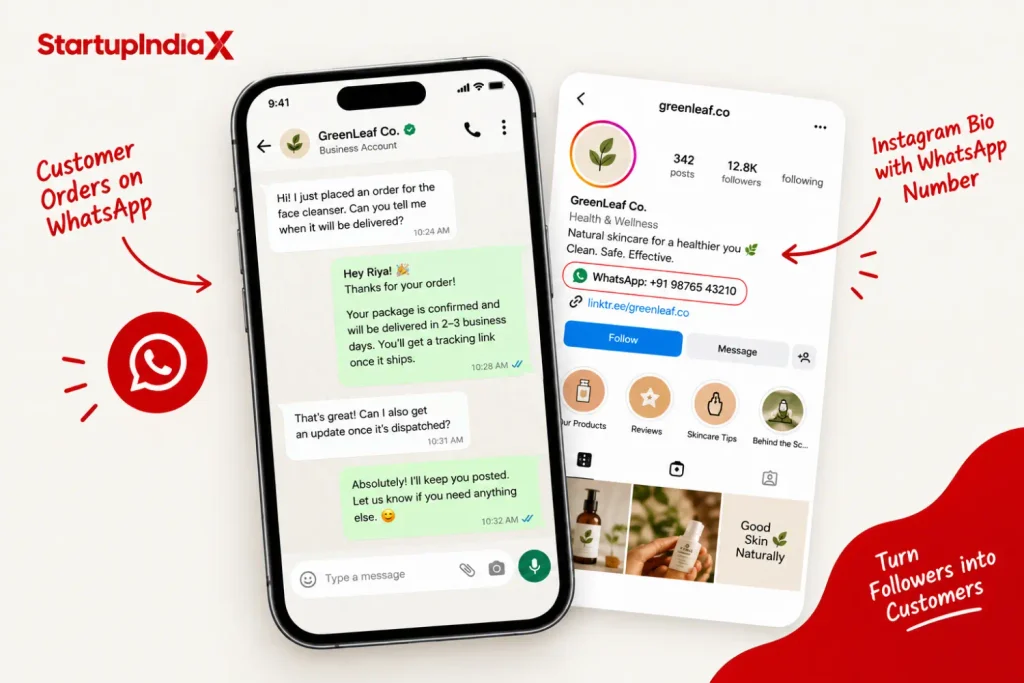
The scale explains why. India is WhatsApp’s largest market, with more than half a billion users based on 2021 government figures cited by AFP. And in June 2026, Meta named CRED founder Kunal Shah the new head of WhatsApp, as reported by the BBC. Indian founders are building on a platform that’s now led by one of their own.
A practical note: the WhatsApp Business API needs Meta business verification and pre-approved message templates, so budget a few days of setup before your first outbound message.
3. Show up in niche communities before you pitch
Join the Telegram group, the subreddit, the Facebook community or the industry WhatsApp circle where your buyers already talk. Answer questions. Share useful things. Pitch last.
A report in Pune Pulse on zero-budget tactics for Indian founders describes exactly this: contribute meaningfully first, and let people come to you. The same report mentions one founder whose honest, relatable content brought in 100-plus orders in three weeks.
It’s slow at first. It also builds the kind of trust no paid ad can fake.
4. Test demand before you build inventory
Here’s the one place a small ad budget earns its keep. eChai’s D2C guidance points to a tiny Meta ad spend sent straight to a WhatsApp number, to see whether real people raise their hands before you order stock.
That’s not advertising for growth. It’s a cheap poll with a phone number attached.
5. Invite creators to a room, not to a rate card
When Bulbul was starting out, its team reportedly invited Delhi-NCR influencers to a free meet-and-greet at Lord of the Drinks in Connaught Place, then added them all to a WhatsApp group to plan next steps. That account comes from a founder-research newsletter, Inside Startups, and we haven’t verified it against the company.
The tactic holds up either way. Creators respond to being treated like collaborators. A shared room and a group chat cost almost nothing next to a paid campaign.
6. Seed groups with content people want to forward
In its early days, ShareChat reportedly got users by sharing greetings, quotes and similar content in WhatsApp groups, per the same newsletter. The product spread because the content was worth forwarding.
Don’t copy the blast approach. WhatsApp’s business rules are stricter now, and unwanted messages burn trust fast. Copy the principle: make something people want to pass along, and let the share do the selling.
7. Price for the Indian buyer
A session by NSRCEL mentor Ajay Rungta at IIM Bangalore’s incubator stressed that many Indian consumers are price-sensitive. His suggestion was competitive pricing or value-added incentives for your first set of customers, plus support staff who understand local context.
The same session recommends taking part in local festivals and community events, which makes startups feel more relatable and trustworthy. With the festive season in full swing, that’s a live option right now. A small festive bundle or a founder-signed thank-you note costs little and gets remembered.
8. In B2B, you are the sales team
If you sell to businesses, the first 100 customers will probably need your voice on the call. Guidance drawn from Indian enterprise operators, including Haptik’s Aakrit Vaish, says buying here is trust-first, so founder-led selling runs longer than in many Western playbooks, roughly to your first 100 customers.
The same advice says your first sales hire should be a strong account executive who joins your meetings, not a VP of Sales hired to build a department. And the way in is still warm intros, conference conversations and mutual connections, not cold outbound.
9. Turn customer #20 into a sales channel
Pune Pulse’s report includes one case where 20 customers brought in 60 new ones at zero marketing cost, and 15 out of 100 users chose paid custom designs. The founder isn’t named, so treat the numbers as an illustration, not a benchmark.
What you can act on is eChai’s advice: move every early buyer onto a WhatsApp broadcast list from day one, and give the first 100 something the next 1,000 won’t get. A founder thank-you note. Early access to the next drop. A discount code that’s theirs to share.
A broadcast list is still a megaphone, though. A community starts when members talk to each other. Start with your 50 to 100 most engaged buyers and show up yourself, daily, for the first few months.
10. Collect proof while they’re happy
The moment a customer hits value, ask for one specific result and a two-line quote. Then get written permission to use their name and logo. A verbal yes tends to evaporate once their marketing team hears about it.
You don’t need statistical significance for your first case study. One clear before-and-after story with a real name and role attached is enough to make customer #101 feel safe.
What the first 100 can turn into
Tanvi Pathania is a good reminder that small starts compound. Ascendants reports she built two self-funded D2C brands, Frenesi Fashion and Tawi Jewels, from a scrappy operation that began around 2021 and now serves more than 50,000 customers across India, with no outside funding.
We don’t know from that report how she landed her first 100. The point is the shape: personal effort first, systems later.
How long can you keep hustling?
Everything above costs time more than money. But time is a budget too, and it runs out.
Before you move from hustle to paid growth, check how many months of cash you actually have. The Startup Runway Calculator gives you the number in a minute. If your first 100 are coming in and the runway is thin, that’s the moment to start thinking about outside capital.
Read More: How to raise startup funding in India in 2026
Our read: investors tend to trust a first 100 built on repeat purchases and referrals more than a first 100 bought with ads. Paid users can disappear the moment the budget does. Customers who found you through a friend usually come back.
So here’s the short version. Start with trust. Make WhatsApp your front door. Be useful in communities before you sell. Price for the person in front of you. Turn your happiest customers into your loudest ones, and write down what they say.
Which playbook worked for you, or failed badly? Tell us in the comments, share this with a founder who’s stuck at customer #12, and explore more founder guides on StartupIndiaX.
FAQs
How do startups in India get their first 100 customers?
Mostly through trusted networks, WhatsApp conversations and niche communities rather than ads. Founders message early buyers personally, ask for feedback, and turn happy customers into referrers.
Do you need ads to get your first 100 customers?
Not usually. Indian founder guides point to personal networks, DMs and community word of mouth as the main sources. A small ad test sent to WhatsApp can check demand, but it isn’t a growth engine at this stage.
Why is WhatsApp so important for early customers in India?
India is WhatsApp’s largest market, and Indian D2C guides cite open rates of 80 to 90 percent, well above email. It lets founders reply personally, announce restocks and seed referrals without a CRM.
How long should founders sell B2B themselves in India?
Guidance drawn from Indian enterprise operators suggests founder-led sales can run to roughly the first 100 customers, because buying is trust-first. Your first sales hire should be a strong account executive.
What should I do once I reach 100 customers?
Keep them close. Move buyers onto a WhatsApp broadcast list or small community, collect case studies with written permission, and check your cash runway before you start spending on paid growth.