SUMMARY
- Track ten numbers before pitching: runway, burn multiple, margins, CAC payback, LTV:CAC, retention, growth, concentration, and consistency across every document.
- Benchmarks differ by model: SaaS leans on NRR and burn multiple, D2C on contribution margin and repeat rate, deeptech on TRL and paid pilots.
- Start raising with 12 to 18 months of runway and clean financials, since inconsistent numbers and short runway kill deals faster than slow growth.
Most founders prepare for an investor meeting by polishing the deck. Investors prepare by testing the numbers inside it. That’s why startup metrics for founders deserve as much rehearsal as the pitch itself.
That gap is where good businesses stall in diligence. One 2026 Series A guide from Burkland & Associates argues that inconsistent metrics, revenue concentration and short runway kill more deals than weak growth does. If you’re about to start a raise, that should change what you do this month. Slow growth is survivable. Not being able to state the same burn figure twice isn’t.
So here are ten numbers to know cold before you pitch, and how the benchmarks shift if you’re building SaaS, a D2C brand or deeptech. Treat every figure as a rule of thumb, not a rulebook. The sources we checked don’t agree on exact thresholds, so where they differ we’ve shown the range.
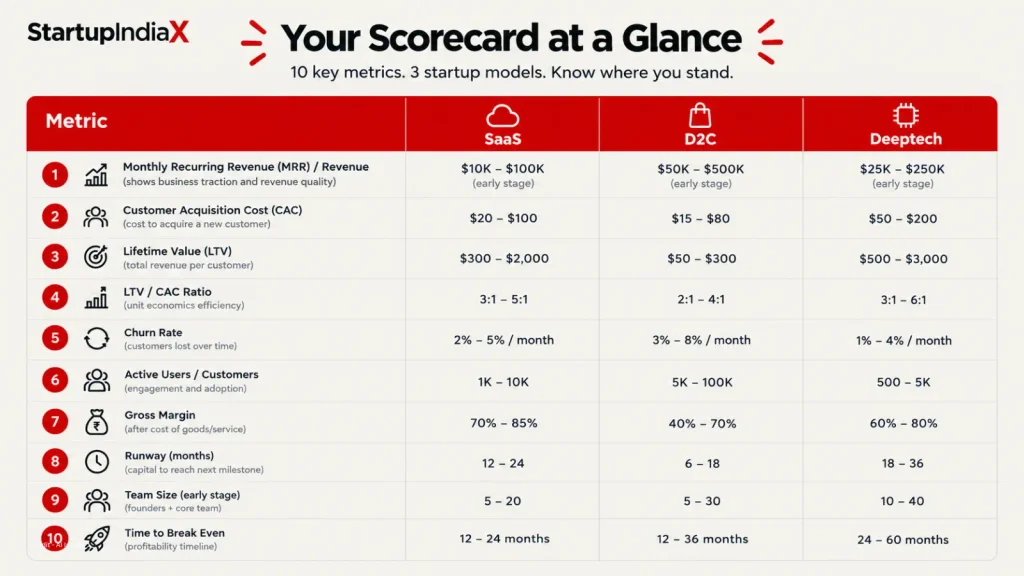
Startup metrics for founders: your scorecard at a glance
| # | Metric | SaaS / B2B | D2C | Deeptech |
|---|---|---|---|---|
| 1 | Runway | Start raising with 12 to 18 months | Same | Tie to technical milestones, not months |
| 2 | Burn multiple | Under 2x; under 1.5x is competitive at Series A | Less useful; use contribution margin | Not the early test |
| 3 | Gross margin | Quoted from 60% to 75%+ | 50%+; below about 55% squeezes contribution | Matters once commercial |
| 4 | Contribution margin | Not the focus | 25% to 40% of revenue is the zone cited | Not the focus |
| 5 | CAC payback | Under 12 months is common; some Indian guides cite 12 to 18 | 3 to 6 months | Not the early test |
| 6 | LTV:CAC | 3x or better | 3x or better; under 2x is weak | Not the early test |
| 7 | Retention | NRR 100%+; 110%+ for enterprise SaaS | 25% to 40% repeat within 60 to 90 days (consumables) | Pilot renewals and extensions |
| 8 | Growth | 10% to 15% month on month at seed | Cohort growth with margins intact | Technical milestones hit on schedule |
| 9 | Concentration | No single customer carrying the business | Marketplace vs own-site margin gap | Dependence on one pilot or grant (our view) |
| 10 | Consistency | One definition across deck, data room and calls | Same | Same |
Ranges drawn from the sources listed in the content audit. Benchmarks vary by source, stage and category.
Start with cash: runway and burn
Of all the startup metrics for founders, runway is the one you can’t afford to get wrong. It’s your cash divided by monthly net burn. Net burn is what you spend minus what you actually collect. Treelife’s India guide gives a clean example: ₹23.6 lakh of gross burn against ₹8 lakh of collections leaves net burn of ₹15.6 lakh, with collections covering about 34% of costs.
Two practical rules from the same guide. Use bank statements, not your P&L, and use a three-month trailing average. Then subtract statutory dues you owe in the next 30 days from your cash before dividing, or you’ll overstate your runway.
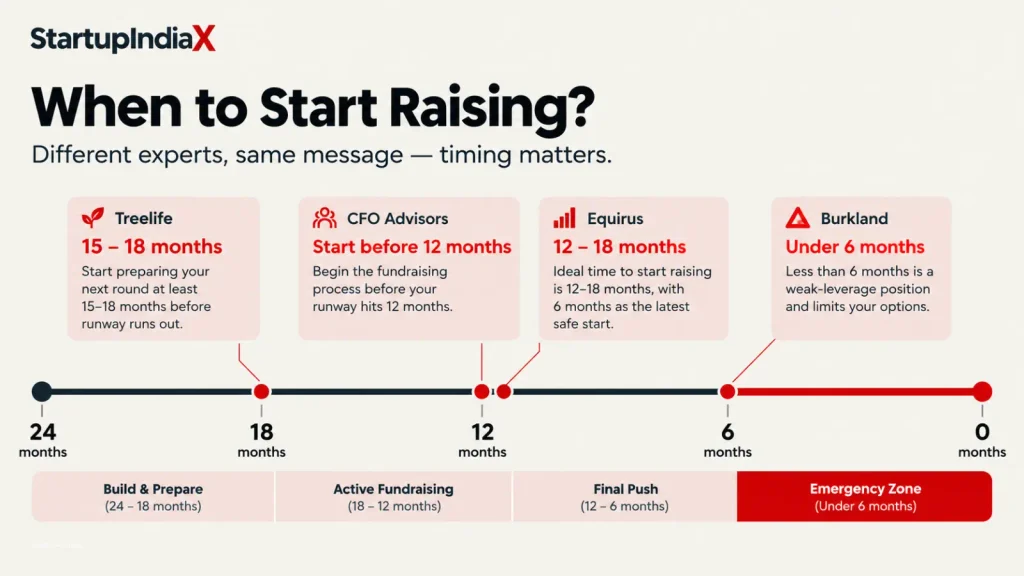
How much runway is enough? The sources disagree, so here’s the spread.
| Source | What it says |
|---|---|
| Treelife (India guide) | Begin raising with 15 to 18 months left; aim to close with 18+ months after the round |
| CFO Advisors (citing YC and a16z) | Raise from 18 to 24 months of runway; start before 12 months remain |
| Equirus (glossary) | Indian startups typically raise for 12 to 18 months of runway; start at least 6 months before cash ends |
| Burkland & Associates | Entering a raise with under 6 months signals desperation and weakens your leverage |
A sensible reading: begin the process with 12 to 18 months in the bank, and treat anything under six as an emergency. For scale, StartupGrantsIndia’s example is ₹60 lakh in the bank at ₹10 lakh a month, which is six months. If you don’t know your own number yet, the free Startup Runway Calculator takes about two minutes.
Next comes the burn multiple: net burn divided by net new ARR (annual recurring revenue). David Sacks of Craft Ventures popularised it. Burkland’s example is burning $300,000 a month while adding $150,000 of new ARR a month, which gives you 2.0x. For SaaS, under 2x is generally called good, and one Indian guide puts under 1.5x as competitive at Series A.
It suits recurring-revenue businesses best. If you sell physical products, lean on contribution margin instead.
Margins: the number behind the number
Gross margin tells investors whether each sale leaves anything behind. Quoted targets run from above 60% to above 75% for software, and above 50% for D2C. One Indian D2C playbook warns that if gross margin sits below about 55%, contribution gets squeezed.
For consumer brands, contribution margin is the one that matters most. It’s the revenue left after the variable costs of delivering an order, usually including marketing. An eChai-listed guide for Indian D2C founders says investors check for 25% to 40% of revenue. Base’s D2C investor guide says investors now prioritise contribution margin over vanity GMV.
Channel mix matters here too. The same Base guide gives an example of a 35% contribution margin on your own website against 8% on marketplaces, and says investors will question scalability when the gap is that wide.
What a customer costs, and what they return
CAC payback is how many months it takes to earn back what you spent to win a customer. D2C sources quote 3 to 6 months, with one guide saying under four. SaaS guides commonly quote under 12 months, while another Indian benchmark sheet cites 12 to 18. Check which yardstick your investor uses before you quote yours.
LTV:CAC compares what a customer is worth with what they cost to acquire. Three to one is the usual benchmark, and under two is weak. One rule worth stealing from the eChai guide: calculate LTV on contribution profit, not revenue, or the ratio will flatter you.
Do customers stay?
Retention is the proof that growth is real. In SaaS, net revenue retention (NRR) measures revenue from existing customers after churn and upgrades. A CFO advisory benchmark puts 100% or more as the Series A target. One Indian checklist asks for 110%+ in enterprise SaaS and 85%+ for SME-focused products. For India seed rounds, Backrr’s guide looks for monthly churn under 5%.
For D2C, the equivalent is repeat purchase. An Indian D2C playbook says consumables brands at the ₹0 to 5 crore stage should see repeat purchase cross 25% within 60 to 90 days, and cites 30% to 40% within 60 days for stronger repeat systems. Industry estimates quoted by Slay Media’s founder suggest only about 20% of first-time D2C customers return within three months.
Whatever your number, show it as cohort charts, not one blended average. A flat cohort curve says more than ten impressive aggregates.
Growth, with a catch
Seed investors in India look for 10% to 15% monthly growth in SaaS, per Backrr. Series A guides cite 10% to 20% a month, and one Indian checklist asks for 2.5x to 3x year on year.
But growth alone doesn’t carry a pitch. Lucid’s traction guide says a company growing 12% monthly at a 1.5x burn multiple can look better than one growing 25% at 5x. Zetwerk shows the same tension at scale: its FY26 revenue rose 40.4% to ₹15,913 crore, according to its filings, yet it also reported a pre-tax loss of about ₹916 crore tied to one-off charges.
Growth gets you the meeting. Margins and cash discipline decide the cheque.
The two metrics founders forget
Concentration means too much of your money comes from one customer, one channel or one platform. Burkland names it as a deal-killing red flag. For a D2C founder it usually means one marketplace. For a SaaS founder it means one client paying for most of the bills.
Consistency is the unglamorous one. Burkland flags metrics that change definition between the deck, the data room and diligence calls. An Indian Series A checklist adds a local layer: messy ledgers, incomplete FEMA filings or no edit logs in your accounting software can delay or end rounds, and it suggests starting financial cleanup at least two months before outreach.
Pick one definition per metric. Write it down. Use it everywhere.
If you’re deeptech, change the scoreboard
A SaaS scorecard will mislead you if you’re building hardware or frontier tech. A recent Telangana Today opinion piece argues deeptech needs different metrics and a longer view, with technology readiness levels (TRLs) tracked first and revenue metrics gaining weight once the technology is commercially proven.
Investors are behaving accordingly. The IVCA’s Bharat DeepTech Report 2026 found that only 15% of surveyed funds are willing to back projects at the earliest stages, TRL 1 to 3.
So the startup metrics for founders in deeptech look different: your current TRL and the date of the next one, paid pilots signed and converted, development contracts or advance purchase commitments, and grant eligibility. Analytics Insight’s guide on India’s long funding cycles says to plan funding around technical and commercial milestones, not time alone.
Numbers you can stop leading with
Standalone ROAS, CTR and CPC are curiosities to investors rather than diligence signals, according to the eChai-listed D2C guide. GMV matters less than contribution margin. Raw signups can hide a leaky product. Lead with retention and unit economics instead.
How we’d use this list
Pick the column of the scorecard that matches your business. Fill every cell with your own number and the date you calculated it. Any cell you can’t fill is your work for the next month.
Then run the Dilution Calculator to see what the round will cost you in ownership. Our guide on how to raise startup funding in India covers what happens once the numbers are ready.
Three things to do before your first investor meeting:
- Fill every cell of your scorecard column with a dated number, and chase the blanks first.
- Use one definition for each metric across your deck, data room and investor calls.
- Begin the raise with 12 to 18 months of runway, and treat under six as an emergency.
Which of the ten numbers do you least want to calculate? Tell us in the comments, and share this with the co-founder who owns the spreadsheet. More free founder tools and guides are waiting on StartupIndiaX.
FAQs
What metrics do investors check before a Series A in India?
Burn multiple, retention (NRR or repeat rate), CAC payback, LTV:CAC, margins and growth rate, plus clean financials. Thresholds vary, so benchmark against your own model: SaaS, D2C or deeptech.
What is a good burn multiple for a startup?
For SaaS, under 2x is generally called good, and under 1.5x is competitive at Series A in India. Burn multiple is net burn divided by net new ARR, so lower means more efficient growth.
How much runway should I have before raising?
Sources range from starting with 12 to 18 months left to 18 to 24 months in US guidance. Entering a raise with under six months weakens your leverage, so treat that as the emergency line.
What is contribution margin and why do D2C investors care?
It’s the revenue left after the variable costs of delivering an order, usually including marketing. Indian D2C guides cite 25% to 40% of revenue as the range investors check, ahead of vanity GMV.
What should a deeptech startup track instead of SaaS metrics?
Track technology readiness level, paid pilots and their conversion, development contracts or advance purchase commitments, and grant eligibility. Margin and CAC matter more once the technology is commercially proven.
When should I start preparing financials for a raise?
One Indian Series A checklist says at least two months before investor outreach. Clean ledgers, complete FEMA filings and edit logs in your accounting software prevent avoidable delays in diligence.