
SUMMARY
- Tata Communications will spend up to $450 Mn (about ₹4,350 Cr) on 10,000 km of AI-ready fibre, funded from operating cash flows.
- The rollout starts with the Mumbai-Pune-Hyderabad-Chennai corridor and adds about 6 Pbps between FY30 and FY36, so it’s a long game.
- AI founders should watch the network layer too. E2E Networks is adding GPUs, Tata is adding fibre, and both chase the same demand.
Everyone in India’s AI race talks about GPUs. On Monday, Tata Communications made the case that GPUs need roads too.
The company said it plans to invest up to $450 Mn (about ₹4,350 Cr) to lay roughly 10,000 km of new long-haul fibre linking India’s AI data centres, as Inc42 reported. The network is meant to move huge volumes of data between data centres, cloud regions and international cable landing stations with very little delay.
It’s a big number. It’s also a slow one, and that’s the part worth reading twice.
Where the fibre goes first
The first phase covers the Mumbai-Pune-Hyderabad-Chennai corridor, which the company describes as one of India’s most important AI and hyperscale growth routes, according to Daily Excelsior. Later phases will reach emerging data centre clusters in other parts of the country.
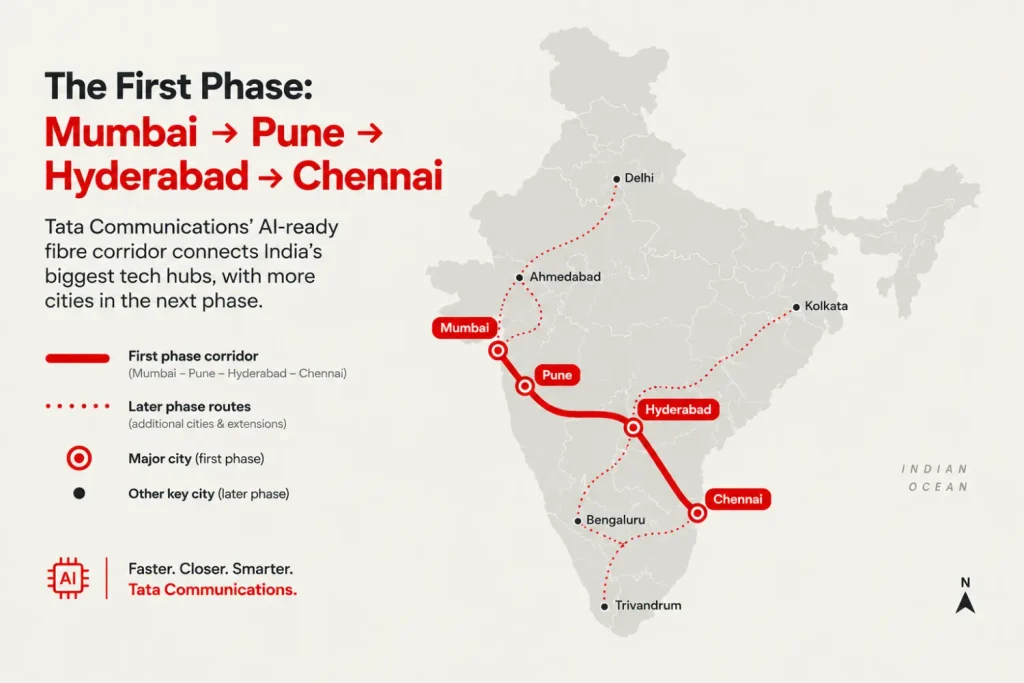
The new routes will connect to Tata Communications’ existing global network. They will also link to cable landing stations, which is how Indian data centres talk to AI hubs abroad.
Tata is aiming at hyperscalers, AI platforms, cloud providers, global capability centres (GCCs), enterprises and digital-native businesses. That list matters, and we’ll come back to it.
Fibre route map concept
The numbers, and the timeline
The build adds about 6 petabits per second (Pbps) of capacity. That takes Tata’s India network to roughly 7.25 Pbps, up from about 1.25 Pbps today, The Next Web reported. Inc42 adds that existing capacity runs at around 70-80% utilisation.
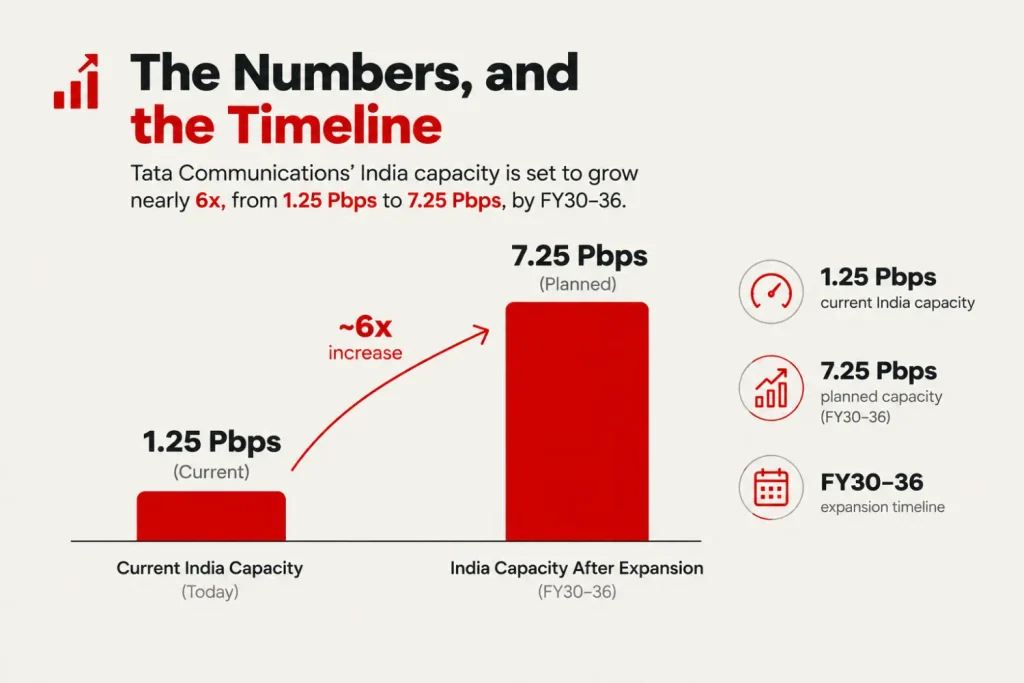
The new capacity is scheduled between FY30 and FY36 and will be financed through operating cash flows.
Read that again. Most of this capacity lands years from now.
It’s also not Tata’s first move. In July 2025 it announced an 18,000 km network for AWS linking Mumbai, Hyderabad and Chennai, reportedly due by the end of 2026. In July 2026 it followed with subsea investments on the India-Singapore corridor. Put together, it looks like a company steadily assembling the pipes of India’s AI economy.
Read More: India Wants 200 Chip Design Startups. Here’s the Government Support You Can Actually Apply For
Compute is growing fast, and the pipes have to keep up
The same day, E2E Networks said it will expand its AI factory capacity by nearly 59%, adding around 5.4 MW through NVIDIA HGX B300 systems and other Blackwell GPUs. That takes it to about 14.6 MW.
E2E is a listed AI cloud company founded in 2009, not a seed-stage startup. But it’s a good read on what Indian AI builders are buying. Its operating revenue jumped 411% to ₹223.8 Cr in Q2 FY27, and it swung to a ₹72.7 Cr net profit from a ₹13.5 Cr loss a year earlier. It also signed a multi-year cloud GPU contract worth roughly ₹1,000 Cr. Founder Tarun Dua said builders are now consuming AI tokens in production at “previously unheard of scales.”
Then there’s the capital going into data centres themselves. HCLTech said in July it would invest ₹14,257 Cr ($1.48 Bn) in an AI data centre in Odisha alongside homegrown startup Sarvam AI. More facilities in more cities means more traffic between them.
Tata’s chief product and technology officer, Rupesh Chokshi, framed it simply: “Connectivity is as critical as compute and energy.”
Read More: Adani and Jabil Just Signed a 50:50 Deal to Build India’s AI Servers
What founders should actually take from this
Most startups will never buy a kilometre of long-haul fibre. So here’s our read.
Tata’s own customer list leads with hyperscalers, cloud providers and GCCs. For a seed-stage AI startup, the benefit will be indirect, and it may take years to show up. Nobody has announced pricing or customer commitments, so we won’t pretend this lowers your cloud bill next quarter.
There are still practical takeaways:
- If you sell AI to banks, insurers or healthcare firms, expect more questions about where data lives and how it moves. E2E itself says demand for India-hosted AI infrastructure is growing among regulated and data-sensitive organisations.
- Don’t build your plan around FY30-36 capacity. Plan around what your GPU or cloud provider can deliver now.
- Ask your infrastructure vendor about the network between their sites, not just the GPU count. Distributed training and inference both depend on it.
The bigger bet
An announcement is not a delivered network. Timelines move and costs shift, and the real test will be how quickly Tata fills the new capacity once it exists. Still, a company spending ₹4,350 Cr on fibre is betting that India’s AI demand won’t cool off.
Here’s what to carry away:
- Tata Communications plans up to $450 Mn for 10,000 km of AI-ready fibre, starting with Mumbai, Pune, Hyderabad and Chennai.
- About 6 Pbps arrives between FY30 and FY36, so treat this as a long-term signal, not a near-term fix.
- Compute and connectivity are scaling together. Founders in regulated sectors should start asking infrastructure questions early.
Are you building on Indian GPU clouds, or still on global ones? Tell us in the comments, and explore more AI infrastructure coverage on StartupIndiaX.
FAQs
How much is Tata Communications investing in AI connectivity infrastructure?
Tata Communications plans to invest $400-450 Mn, around ₹4,350 Cr, in about 10,000 km of AI-ready fibre across India. The spend will be financed through operating cash flows.
Where will the network be built first?
The first phase covers the Mumbai-Pune-Hyderabad-Chennai corridor, a key AI and hyperscale growth route. Later phases will extend to other emerging data centre clusters across India.
When will the new capacity be available?
Tata Communications plans to add about 6 Pbps between FY30 and FY36, taking total capacity to roughly 7.25 Pbps. Most of the new capacity is therefore several years away.
Who is the network meant for?
The company is targeting hyperscalers, AI platforms, cloud providers, GCCs, enterprises and digital-native businesses that need high-capacity, reliable, low-latency links between data centres.
How is E2E Networks connected to this news?
E2E Networks announced a separate 59% expansion of its AI factory capacity the same day, adding about 5.4 MW to reach roughly 14.6 MW. Both moves respond to rising AI infrastructure demand.