
SUMMARY
- Investors in India check legal, financial, IP, cap table, tax, HR and licence records, and a term sheet is conditional on them passing.
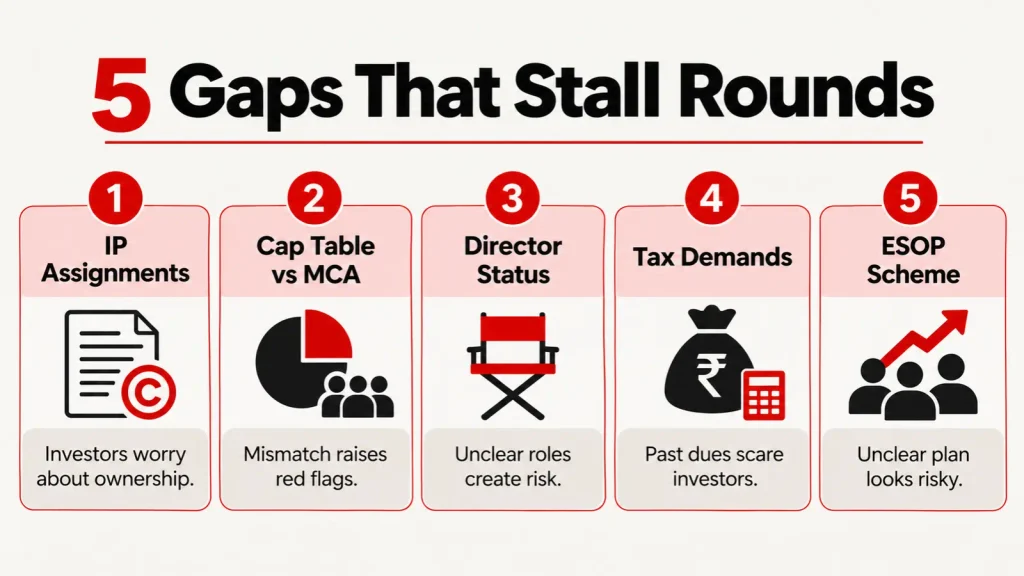
- Five gaps stall the most deals: missing IP assignments, cap tables that don’t match MCA, disqualified directors, tax demands and informal ESOPs.
- Build the data room before you need it, run a mock review with a lawyer and CA, and fix deal-killer rows first.
A term sheet feels like the finish line. It isn’t. In India it is usually non-binding on the commercial terms and conditional on diligence, which means the investor’s lawyers and accountants are about to read everything you’ve ever filed.
Most founders find out what’s wrong with their paperwork at that point, with the clock running. This is the checklist to run first.
If you want the working version, a tick-sheet you can fill in, we’ve built a free startup due diligence checklist India founders can download alongside this piece. Here’s what’s in it and why.
What investors actually go through
Different firms group the work differently. Kanakkupillai files most legal diligence into seven folders: corporate, cap table and ESOPs, financials, tax and regulatory, IP, HR and commercial. IncorpX counts eight areas and treats DPIIT status and licences as their own. The exact count matters less than the idea: every claim in your pitch gets matched to a document.
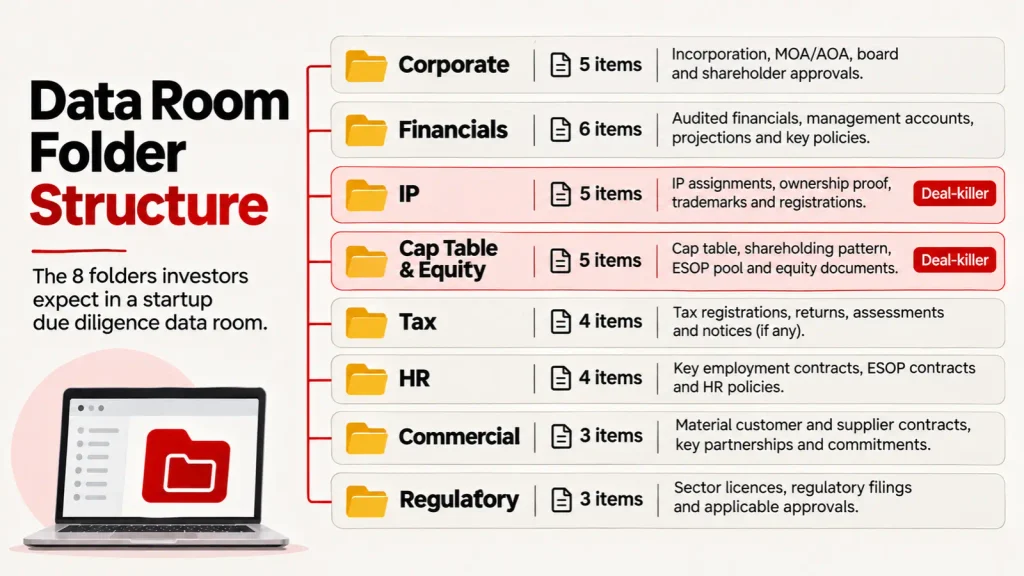
The checklist below follows the eight-folder version, because it maps cleanly to a data room.
The five gaps that stall rounds
Several Indian legal and compliance firms, among them IncorpX and Treelife, name the same short list of problems. Fix these before anything else.
1. Missing IP assignments. If a co-founder, early engineer or freelancer built part of the product without a signed assignment, the company may not own it. IncorpX says investors have walked away from large deals over this, including when co-founders had since left. It includes people who’ve moved on, so chase them early.
2. A cap table that doesn’t match MCA. Investors compare your cap table with the Register of Members and your annual return. Treelife says that if these don’t reconcile for every shareholder, the round can’t close until they do. Every allotment of shares, CCPS, CCDs or SAFEs needs its own filing.
3. A disqualified director. Director disqualification is public on the MCA portal. IncorpX says a flagged director has to be removed and replaced before fresh equity can go in, which can add weeks.
4. Unresolved tax demands. A pending GST or income tax notice becomes the investor’s problem once the deal closes. Expect an escrow, a smaller cheque or a walk-away.
5. ESOPs that exist only in emails. IncorpX warns that grants made without an approved scheme create phantom equity claims. A scheme needs board and shareholder approval before the first grant, which is why our ESOP guide is worth a read before you raise.
Download the free Startup Data Room Checklist (Excel)
The folder-by-folder list
Here’s the short version of what sits in each folder. The full line-by-line version, with owner and status columns, is in the downloadable sheet.
Corporate. Incorporation documents, MoA and AoA, resolutions, registers, three years of MGT-7 and AOC-4, and every director’s DIN and KYC status.
Financials. Three years of audited statements, current management accounts, 12 months of bank statements and GST returns, receivables ageing and your unit economics.
IP. Assignment agreements from everyone who touched the product, trademark certificates or application numbers, any patent filings, an open-source audit and domain ownership in the company’s name.
Cap table and equity. A fully diluted cap table, the founders’ agreement with vesting terms, the ESOP scheme, earlier term sheets and shareholder agreements, and allotment and FEMA filings. If you haven’t set up founder vesting yet, read that guide first.
Tax. Three years of returns, TDS records, any notices with replies, your DPIIT certificate and valuation reports for earlier share issues.
HR. Employment and contractor agreement templates with NDA and IP clauses, an anonymised employee list, and PF and ESI registrations where they apply.
Commercial. Your top customer contracts, key vendor and partner agreements, and a plain list of any litigation, or a clear statement that there is none.
Regulatory. Sector licences and renewals, privacy policy and any regulator correspondence.
Read More: Term Sheet Explained for Indian Founders: 12 Clauses That Decide Who Controls the Company
How long it takes
Treat any timeline as a range. Treelife puts seed diligence at two to four weeks and Series A at four to six. IncorpX says Series A can run eight to sixteen. StartupGrants India gives three to six weeks for seed and Series A together. The difference mostly comes down to how organised the company is and how big the round is.
What the sources agree on is this: founders who start collecting documents after the term sheet lose weeks, while those with a tidy data room move faster.
Our take: build the room before you need it
Diligence isn’t an exam you pass on the day. It’s a test of whether the company runs the way the founders say it does.
The cheapest time to fix an IP assignment is when your co-founder is still on speaking terms with you. The cheapest time to clean up a cap table is before another investor is on it. Treat the checklist as a monthly habit, not a fundraising sprint.
Three things to do this week. First, download the checklist and mark every deal-killer row Ready, In progress or Not started. Second, put a date on each Not started item. Third, book an hour with a startup lawyer and a CA to look at the five gaps above.
This article is general information, not legal advice. Requirements differ by investor, sector and round.
Working out how much of the company a round will cost you? Try our free Funding Round Dilution Calculator, and when you’re ready to find the right cheque, browse the Indian VC & Investor Database. Which folder is your weakest one? Tell us in the comments, and send this to the co-founder who keeps the documents.
FAQs
What is startup due diligence in India?
It’s the investor’s verification of your legal, financial, tax, IP, HR and cap table records before money moves. No single law governs it, so scope and depth vary by investor, sector and round size.
What documents do investors ask for?
Expect incorporation documents, MoA and AoA, annual filings, audited financials, GST and tax records, a cap table that matches MCA, IP assignments, employment agreements, key contracts and licences.
How long does investor due diligence take?
Sources differ. Treelife cites two to four weeks at seed and four to six at Series A, while IncorpX says Series A can take eight to sixteen. Round size and data room quality drive the difference.
What is a data room?
It’s a secure, organised online folder of every document an investor may request, usually grouped by corporate, financial, IP, cap table, tax, HR, commercial and regulatory. A tidy one saves weeks.
Can a deal fall apart after the term sheet?
Yes. A term sheet is generally non-binding on commercial terms and conditional on diligence, so investors can renegotiate or withdraw if serious issues such as IP gaps or cap table errors come up.
What are the most common red flags?
Missing IP assignments, a cap table that doesn’t match MCA records, disqualified directors, unresolved tax demands, and ESOP grants made without an approved scheme under company law.