SUMMARY
- Exercising ESOPs in India triggers salary tax on the gap between market value and strike price, even if you can’t sell the shares.
- Only startups with DPIIT recognition and the Section 80-IAC certificate can defer that tax, and only until 48 months pass, you leave or you sell.
- Founders face no legal pool-size limit, but a one-year gap before vesting is mandatory. Size the pool from your 18 to 24 month hiring plan.
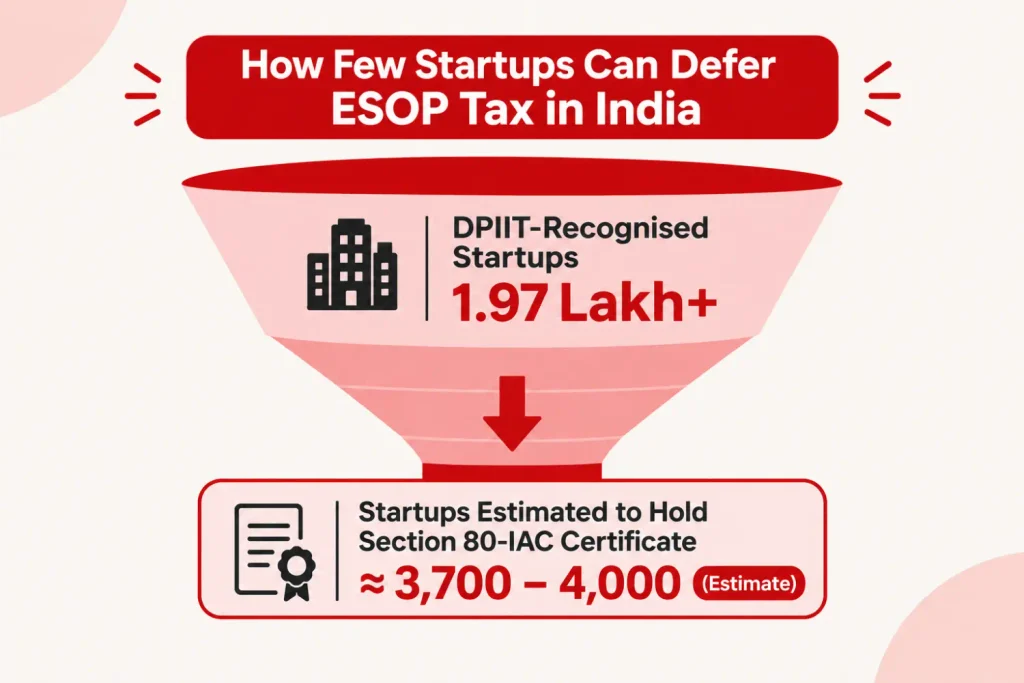
Here’s the part most offer letters skip. ESOPs in India can come with a tax bill that lands before you’ve seen a single rupee from the shares. The law does offer relief, but only to a narrow group: startups that are DPIIT-recognised and also hold the Section 80-IAC certificate. Advisory firm estimates put that group at fewer than 4,000, against more than 1.97 lakh recognised startups.
So whether you’re a founder drafting a plan or an employee holding a grant letter, “how many options do I get?” is the wrong first question. Ask when you’ll pay tax, and whether your company can help you delay it.
What an ESOP gives you, and what it doesn’t
An employee stock option plan gives you the right to buy company shares at a fixed price, called the exercise or strike price, once your options vest. At grant, you own nothing. You own shares only after you exercise.
Most Indian startups use four-year vesting with a one-year cliff. Nothing vests in year one, 25 percent vests at the cliff, and the rest follows monthly or quarterly. That pattern isn’t only habit. Rule 12 of the Companies (Share Capital and Debentures) Rules, 2014 requires at least one year between grant and first vesting, and the plan needs a special resolution from shareholders under Section 62(1)(b) of the Companies Act. Treelife has a detailed walkthrough of ESOP scheme design if your team is drafting one.
Two tax bills, not one
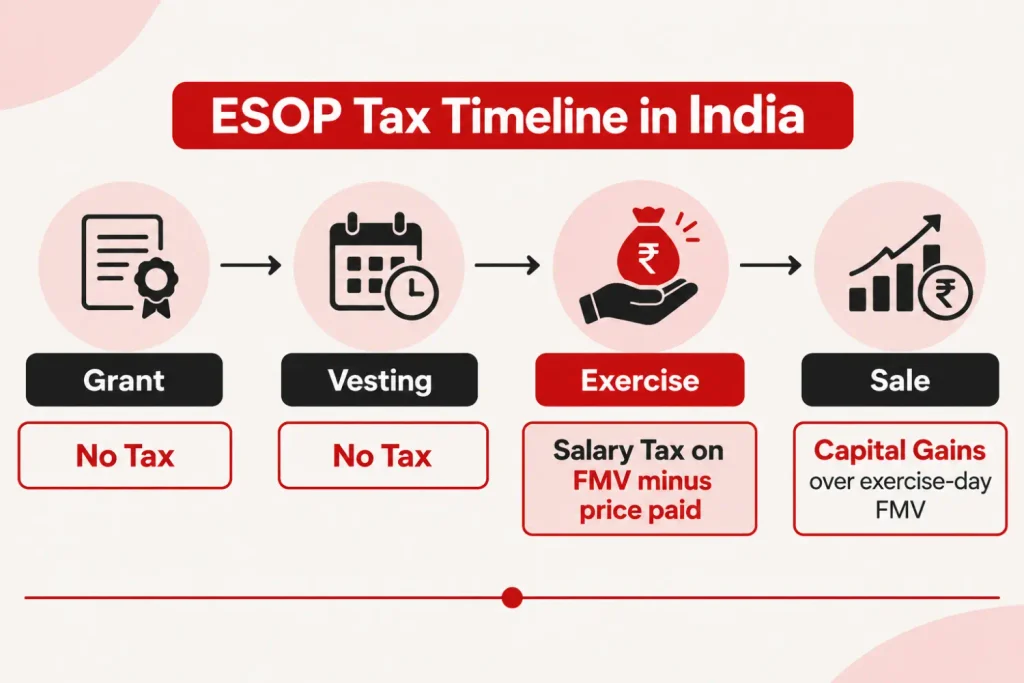
Grant and vesting don’t trigger ESOP tax on their own. Exercise does. The gap between the fair market value (FMV) on the day you exercise and the price you paid counts as a salary perquisite. When you later sell, the gain above that same FMV is taxed as capital gains. You aren’t taxed twice on the same appreciation, because the FMV already taxed at exercise becomes your cost for the capital gains calculation, as law firm King Stubb & Kasiva explains.
| Stage | Taxed? | What’s taxed |
|---|---|---|
| Grant | No | Nothing |
| Vesting | No | Nothing |
| Exercise | Yes, as salary | FMV on exercise day minus the price you paid |
| Sale | Yes, as capital gains | Sale price minus the FMV used at exercise |
For unlisted shares, holding them for 24 months from allotment generally makes the gain long-term.
Here’s what that looks like in rupees. Say you hold 5,000 options with a ₹10 strike, and the company’s FMV is ₹200 per share when you exercise. You pay ₹50,000 for shares worth ₹10 lakh. Your taxable perquisite is ₹9.5 lakh. If that income lands in the 30 percent bracket, the tax is roughly ₹2.85 lakh before cess and surcharge. And there’s no open market where you can sell private company shares to raise that cash. (Illustrative numbers, not advice.)
The FMV isn’t the founder’s pick, either. For unlisted shares it follows prescribed valuation rules, which usually means a merchant banker’s report.
ESOP tax timeline from grant to sale
The relief almost nobody gets
Budget 2020 brought in a deferral for employees of eligible startups. Instead of tax being deducted at exercise, it’s postponed until the earliest of three events: 48 months from the end of the assessment year in which the shares were allotted, the employee leaving, or the employee selling the shares. The employer then deducts the tax within 14 days. You’ll still see “five years” in older coverage, but the Income Tax Department’s current guidance, as summarised by King Stubb & Kasiva, uses 48 months.
There are two catches.
First, it’s a deferral, not an exemption. The tax still arrives, and even an employee who stays and holds the shares owes it when the 48 months run out.
Second, DPIIT recognition alone isn’t enough. Advisers say the startup also needs the Section 80-IAC certificate, and the Income Tax Department has said DPIIT recognition doesn’t automatically bring that benefit. Patron Accounting’s breakdown of the deferral estimates roughly 3,700 to 4,000 startups hold the certificate, which is a sliver of the 1.97 lakh-plus recognised startups.
Leaving the job is a trigger too. If you’re planning to quit, exercising shortly before you go can bring the deferred tax due almost at once.
Funnel from DPIIT-recognised startups to those that can defer ESOP tax
Budget 2026 left it alone
Before the Budget, Nasscom pushed for ESOP tax relief for tech firms, and Inc42 reported the Centre was weighing a wider deferral for DPIIT startups. Treelife’s Budget 2026 synopsis for startups lists no ESOP deferral changes.
One thing did change. The Income-tax Act, 2025 took effect on 1 April 2026 and renumbered the provisions. The perquisite rule now sits in Section 17, but the two-stage structure is the same. If a guide cites old section numbers, it’s written for the 1961 Act.
How big should the pool be?
The Companies Act sets no minimum or maximum. It’s a commercial call, and published benchmarks disagree. Most guides for Indian startups land between 5 and 15 percent in the early rounds, and Treelife’s guide runs as high as 15 to 20 percent for late-stage companies.
A better method than copying a benchmark: work backwards from the hires you’ll make in the next 18 to 24 months, then test that number with your investors. Expect them to ask for any top-up to be created before their money comes in, which means existing holders, mostly founders, absorb the dilution. We broke down how much equity investors typically take, and you can model a pool top-up in the Funding Round Dilution Calculator on our Founder Toolkit.
Read More: How Much Equity Should You Give an Investor? The Real Numbers for Indian Founders
Founders can also hold options, with limits. Under the Companies Act, promoters and directors holding more than 10 percent are normally excluded, but DPIIT-recognised startups can grant ESOPs to them for ten years from incorporation, as the Startup India ESOP note explains. If you’re still dividing shares between co-founders, start with the Co-founder Equity Split Calculator in the same toolkit.
Do ESOPs ever pay out?
Sometimes, and mostly through the company. Inc42 counted 12 Indian startups running ESOP buybacks in 2025, letting more than 9,200 employees cash out about ₹1,409 crore. That’s fewer startups than the 23 in 2024, but more employees. PhonePe’s ₹700 to 800 crore buyback for roughly 1,000 employees was among the biggest, per Inc42’s 2025 review. Closer to the early-stage end, Dezerv completed a ₹46 crore buyback for current and former employees.
Those are the exceptions that show how much depends on the company. A buyback, a secondary sale or an IPO is what turns exercised shares into cash, and no ESOP letter promises any of them.
What to ask before you sign or exercise
Our view: founders should explain the tax before the grant, not at exercise. An employee who learns about a ₹2.85 lakh bill after exercising doesn’t blame the tax code. They blame the company.
If you’re an employee, ask five things. What’s the strike price? What’s the latest FMV? Does the company hold the Section 80-IAC certificate? Has it run a buyback before? What happens to vested options if you leave, and how long do you have to exercise?
If you’re a founder, put a plain-English tax explainer in the grant pack, and have a chartered accountant confirm eligibility before you promise deferral to anyone. If you’re also working through your funding documents, our guide to raising pre-seed funding in India covers what investors ask first.
This article is general information, not tax or legal advice. Rules and thresholds change, so confirm your numbers with a chartered accountant. Last updated 10 November 2026.
Three things to keep:
- Grant and vesting don’t trigger ESOP tax. Exercise does, and a later sale adds capital gains on top.
- Deferral needs both DPIIT recognition and the 80-IAC certificate, and it ends at 48 months, exit or sale.
- Size your pool from your 18 to 24 month hiring plan, and model the dilution before you sign a term sheet.
Working on your own cap table? Run the numbers in the Funding Round Dilution Calculator on StartupIndiaX Tools, and tell us in the comments: did your company explain ESOP tax before the grant?
FAQs
What does ESOP mean in India?
ESOP stands for employee stock option plan. It gives employees the right to buy company shares at a fixed exercise price after the options vest. You own shares only after you exercise those options.
When is ESOP taxed in India?
Twice. At exercise, the difference between the fair market value and your exercise price is taxed as salary. At sale, the gain above the exercise-day fair market value is taxed as capital gains.
Can employees defer ESOP tax in India?
Yes, but only at eligible startups, which advisers say need both DPIIT recognition and the Section 80-IAC certificate. Tax is deferred until the earliest of 48 months, leaving the job or selling. It isn’t an exemption.
What is a typical ESOP pool size for a startup?
The law sets no limit. Guides for Indian startups mostly cite 5 to 15 percent in early rounds, rising in later ones. Size it from the hires you plan over the next 18 to 24 months.
What is the minimum vesting period for ESOPs?
Rule 12 of the Companies (Share Capital and Debentures) Rules, 2014 requires at least one year between grant and first vesting. Most Indian startups use four-year vesting with a one-year cliff.
Can founders get ESOPs in India?
Normally promoters and directors holding more than 10 percent can’t. DPIIT-recognised startups are an exception and can grant ESOPs to them for ten years from incorporation.