
SUMMARY
- The new Income-tax Act is live, so TDS returns now use Forms 138, 140 and 144 instead of 24Q, 26Q and 27Q.
- Still ahead: MGT-7 (29 November for a 30 September AGM), advance tax (15 December), GSTR-9 and GSTR-9C (31 December), plus monthly GST and TDS dates.
- ROC late fees run Rs 100 a day per form with no cap. Put every date in a shared calendar with a one-week reminder.
This startup compliance calendar India 2026-27 guide does two jobs. It lists what’s still due between now and the year-end, and it spells out what each miss costs. The penalties are where founders usually get surprised.
Over half of FY 2026-27 is already behind us, and for plenty of Indian startups the compliance calendar is still a half-remembered list in one person’s head.
That list got harder to trust this year. India’s new Income-tax Act came into force on 1 April 2026, replacing the 1961 law, and FY 2026-27 is the first year that runs under it. Income tax now talks about a “Tax Year”, and TDS returns have new form numbers.
What the new Income-tax Act changed, and what it didn’t
Forms and section numbers changed far more than the calendar did.
TDS statements moved to new numbers: Form 138 replaces 24Q (salary), Form 140 replaces 26Q (non-salary, residents) and Form 144 replaces 27Q (non-residents). TCS returns now sit under Form 143. The quarterly return dates are the same as before: 31 July, 31 October, 31 January and 31 May.
The late fee for TDS and TCS returns moved from section 234E to section 427. The amount is unchanged at Rs 200 a day, capped at the tax deducted. If you collect TCS, check the Form 143 date on the portal yourself, because published calendars don’t fully agree.
Some income tax dates did shift. ITR-3 and ITR-4 filers without an audit now get 31 August, while ITR-1 and ITR-2 stay at 31 July. Audit cases stay at 31 October.
The dates that come around every month
Most startups get hurt by the routine dates, not the annual ones.
- TDS deposit: by the 7th of the following month. March deductions get until 30 April. Late deposit attracts interest at 1.5 percent a month from the deduction date.
- GSTR-7 and GSTR-8: by the 10th.
- GSTR-1: by the 11th for monthly filers (turnover above Rs 5 crore, or those who opted out of QRMP).
- GSTR-3B: by the 20th.
- QRMP filers: GSTR-1 or the invoice facility by the 13th, GSTR-3B on the 22nd or 24th depending on your state, and the PMT-06 tax payment by the 25th in the first two months of a quarter.
- PF and ESIC: contributions by the 15th.
None of these are hard. They’re just relentless, which is why they slip during a funding round or a product launch.
What’s left between now and the year-end
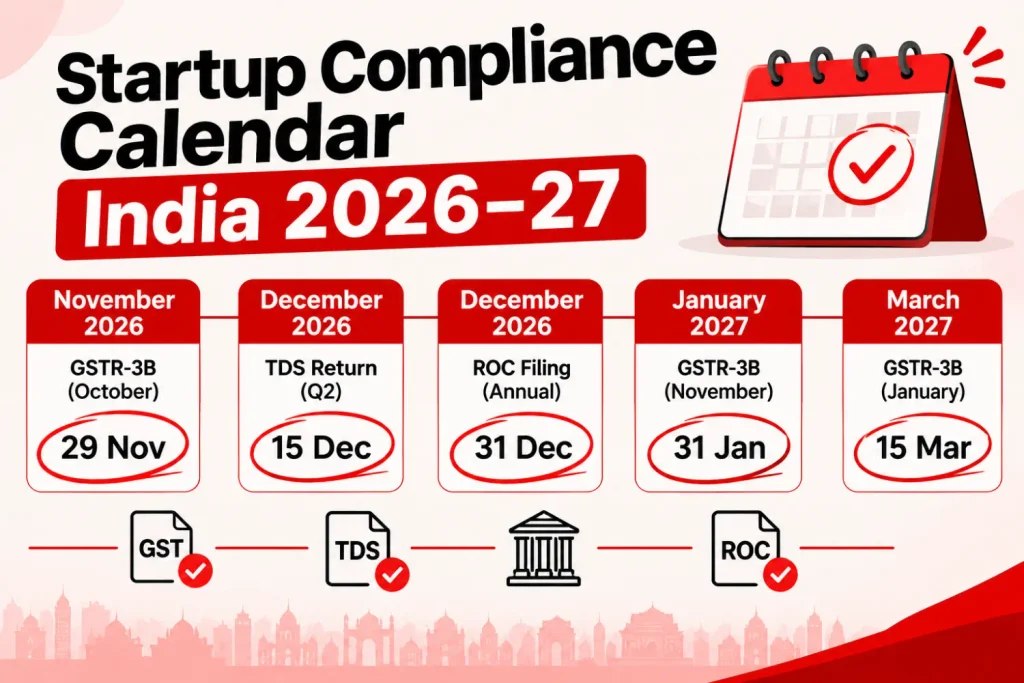
Here’s the stretch from today to the tail of FY 2026-27. ROC dates assume an AGM held on 30 September 2026.
| Date | What’s due | Applies to |
|---|---|---|
| 10 Nov | GSTR-7 and GSTR-8 (October) | GST TDS deductors, e-commerce operators |
| 11 Nov | GSTR-1 (October) | Monthly filers |
| 20 Nov | GSTR-3B (October) | Monthly filers |
| 25 Nov | PMT-06, October tax payment | QRMP filers |
| 29 Nov | MGT-7 or MGT-7A annual return | Companies, if the AGM was on 30 Sep |
| 30 Nov | Last date to claim input tax credit on FY 2025-26 invoices; ITR for transfer pricing cases | GST-registered businesses; relevant taxpayers |
| 7 Dec | TDS and TCS deposit (November) | Deductors and collectors |
| 11 Dec | GSTR-1 (November) | Monthly filers |
| 13 Dec | Invoice facility (IFF) for November | QRMP filers |
| 15 Dec | Advance tax, third instalment | Taxpayers liable for advance tax |
| 20 Dec | GSTR-3B (November) | Monthly filers |
| 25 Dec | PMT-06 (November) | QRMP filers |
| 31 Dec | GSTR-9 and GSTR-9C for FY 2025-26; last date for belated or revised ITR (AY 2026-27) | GSTR-9 above Rs 2 crore turnover, GSTR-9C above Rs 5 crore |
| 31 Jan 2027 | Q3 TDS returns (Oct to Dec), Forms 138, 140, 144 | Deductors |
| 15 Mar 2027 | Advance tax, final instalment | Taxpayers liable for advance tax |
| 31 Mar 2027 | Financial year ends | Everyone |
| 30 Apr 2027 | TDS deposit for March; MSME-1 for October to March | Deductors; companies with MSME dues |
| 31 May 2027 | Q4 TDS returns (Jan to Mar) | Deductors |
A few of those need a closer look. GSTR-9 is optional for businesses with turnover up to Rs 2 crore, and the late fee for those who must file is Rs 200 a day (Rs 100 each under CGST and SGST), capped by turnover slab.
Read More: GST Registration for Startups Can Now Take Just 3 Days. Here’s How to Apply
The ROC filings that don’t forgive
Company law is where small delays get expensive, because the late fee has no ceiling.
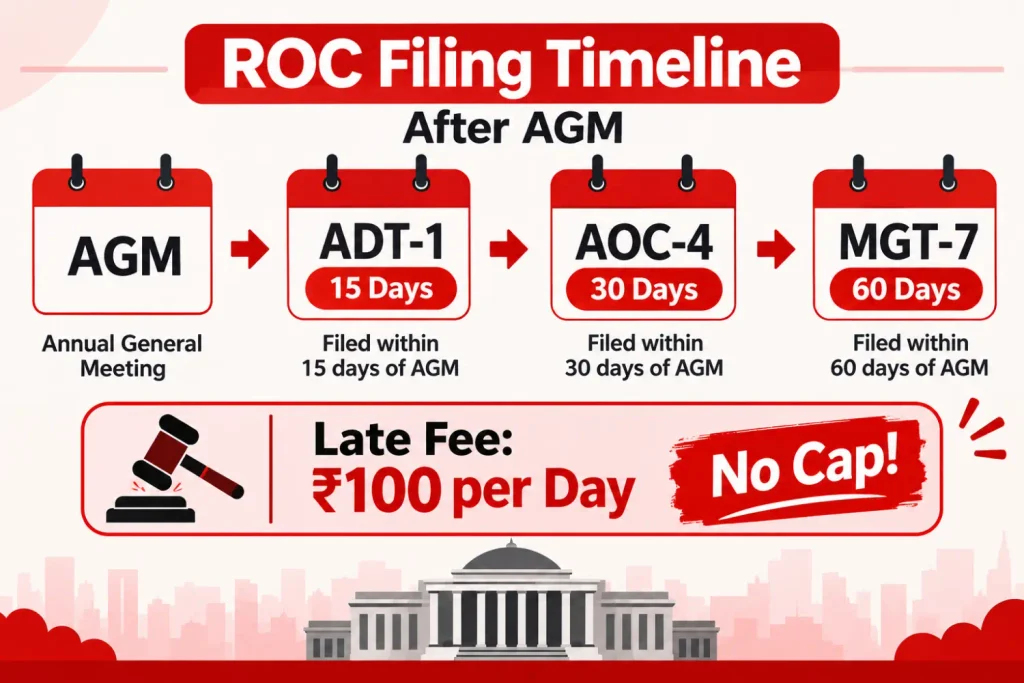
For a private limited company, the annual chain starts with the AGM, which should happen by 30 September. ADT-1 follows within 15 days of the AGM, AOC-4 (financial statements) within 30 days and MGT-7 or MGT-7A (annual return) within 60 days. With a 30 September AGM, that’s 15 October, 30 October and 29 November. An earlier AGM pulls every date forward.
The other fixed dates are DIR-3 KYC on 30 September, DPT-3 on 30 June and MSME-1 twice a year, on 30 April and 31 October by most calendars. LLPs file Form 11 within 60 days of the year-end (around 30 May) and Form 8 by 30 October.
Now the cost. Late AOC-4 and MGT-7 each attract Rs 100 a day per form, with no upper cap. Miss both for a year and that’s roughly Rs 73,000, before anything else. Picture a seed-stage D2C brand that held its AGM on time but never got the accounts signed off. The fee clock starts the next day, and nothing stops it.
The bigger risks aren’t the fees. A director who misses DIR-3 KYC loses an active DIN and pays Rs 5,000 to get it back, and a deactivated DIN blocks MCA filings until it’s restored. Skip filings for three straight years and directors can be disqualified for five. Companies that stay silent for two years can face strike-off.
In our view, this is also the section investors read most closely in due diligence. A clean ROC history won’t win you a round, but a messy one can slow it down.
Income tax: more dates are behind you than ahead
If your books are audited, the 31 October ITR date has passed. What’s left this year is the transfer pricing deadline on 30 November, advance tax on 15 December and again in March, and the belated or revised return window that closes on 31 December.
Looking ahead, the first returns under the new Act arrive in mid-2027: 31 July for ITR-1 and ITR-2, and 31 August for non-audit business filers on ITR-3 and ITR-4. The extra month is the one real date change worth planning around.
Make it somebody’s job
The pattern with missed filings is rarely that nobody knew the date. It’s that nobody owned it.
Three things to do this week:
- Name one person as owner of the full calendar, and give them a backup.
- Add every date above to a shared calendar, with a reminder a week ahead of each.
- Ask your CA to confirm your AGM date, so your ROC deadlines are based on facts, not assumptions.
Which filing trips your team up the most? Tell us in the comments, share this with whoever handles your books, and explore the free tools at startupindiax.com/tools for the rest of your founder checklist.
FAQs
What is a startup compliance calendar?
It’s a dated list of every recurring filing and payment your company owes: GST returns, TDS deposits and returns, ROC forms and income tax. The point is to see deadlines and penalties in advance, not after a notice arrives.
Did the new Income-tax Act change TDS return due dates?
No. Quarterly TDS returns are still due on 31 July, 31 October, 31 January and 31 May. What changed are the forms: 138, 140 and 144 replace 24Q, 26Q and 27Q for tax deducted from 1 April 2026.
When is MGT-7 due for FY 2025-26?
Within 60 days of the AGM. If your AGM was on 30 September 2026, that’s 29 November 2026. An earlier AGM pulls the date forward, and late fees run at Rs 100 a day with no cap.
What is the late fee for filing a TDS return late?
Rs 200 a day under section 427 of the new Act (earlier 234E), capped at the TDS deducted for that quarter. A separate penalty of Rs 10,000 to Rs 1 lakh can apply for incorrect filing.
When is GSTR-9 due for FY 2025-26?
31 December 2026, for regular taxpayers with turnover above Rs 2 crore. GSTR-9C, the reconciliation statement, is due the same day for businesses above Rs 5 crore. Filing is optional at Rs 2 crore or below.
What happens if a director misses DIR-3 KYC?
The DIN gets deactivated, and reactivation costs Rs 5,000. A deactivated DIN blocks MCA filings until it’s restored. The annual deadline is 30 September.