Summary
- Bharat Semi raised a $24 million seed round led by Info Edge, South Park Commons and Indus Bridge Ventures, reported on November 15, 2026.
- The company is pre-revenue and fabless, building programmable image sensors with AI on the chip. Its earlier fab plan remains separate.
- Sources disagree on when it started (2018 to 2021) and how Bharat Semi relates to 3rdiTech. This profile shows both versions.
On November 15, 2026, TechCrunch reported that a pre-revenue chip startup had raised $24 million in seed funding. The Bharat Semi founders, Vrinda Kapoor and Vinayak Dalmia, say they want to build the sensor layer for machines: image sensors that run AI on the chip itself, so less data has to travel anywhere else.
It is an ambitious pitch from a company whose own history is told in several different ways. This profile sets out what is confirmed, what the founders claim, and where the sources disagree.
In this article (about 10 minutes)
Table of Contents
A $24 million seed round with no revenue behind it
TechCrunch reported on November 15, 2026 that Bharat Semi raised $24 million in an all-equity seed round. Business Standard, carrying the company’s announcement, reported the next morning that Info Edge Group, South Park Commons and Indus Bridge Ventures led the round. Micromax, Valour Capital, New York-based Gaingels and angel investors Mukul Agarwal and Karthik Sundar Iyer also took part.
That is roughly ₹228 crore ($24 million). StartupIndiaX worked this out at ₹94.93 per dollar, the rupee’s close on October 30, 2026 as reported by PTI. It is our arithmetic, not a company figure.
TechCrunch describes Bharat Semi as nearly five years old and pre-revenue. The company told Business Standard the money will go towards a new family of products, a larger engineering team in the US and its push to win global customers. No coverage we found discloses a valuation.
The team is small and spread across continents. TechCrunch reported about 75 employees, with 10 to 12 in the US, a plan to reach around 20 US staff by mid-2027, and early hiring in Europe.
Two founders, two very different résumés
Dalmia comes from strategy and finance. Business Standard’s November 2026 report says he worked in strategy at McKinsey and in private equity, holds an MPhil from the University of Cambridge and was a visiting fellow at the University of Oxford. TechCrunch refers to him as managing director.
Kapoor’s route runs through policy and the startup community. The same Business Standard report describes her as a South Park Commons Fellow who has worked on India’s semiconductor initiatives with NITI Aayog’s Frontier Technology Hub.
The bios in the November reports are about strategy and policy rather than chip design. That is where the third name matters. TechCrunch lists Boyd Fowler, a former chief technology officer of OmniVision, as Bharat Semi’s CTO. OmniVision makes image sensors, so the company has put someone with that background in charge of the technology.
Dalmia’s pitch is about who the customer is becoming. He told Business Standard that growth in the sensor market will come from capturing data for machines, data humans may never see, and that sensing, processing and software must be designed together.
“an opportunity for India to build a globally relevant product company”
Vrinda Kapoor, co-founder, Business Standard, November 16, 2026
Read More: RapidCanvas Founders: Rahul Pangam and Uttam Phalnikar’s Story, Funding and Business Model
Which start date is right? 2018, 2019 and 2021 all appear
Ask when Bharat Semi began and you get several answers.
TechCrunch and DealStreetAsia date the company to late 2021. eeNews Europe and The Machine Maker, writing about the 2024 fab announcement, point to 2018. YourStory’s May 2023 segment on the then-stealth startup and Business Standard’s September 2024 profile say 2019, with the idea taking shape at IIT Delhi. Business Standard adds that the founders launched Bharat Semi itself in 2023.
These need not all be wrong. A research effort, a design company and a holding company can each have a different birthday. But no outlet we found explains which date belongs to which entity, and StartupIndiaX has not seen company filings that settle it. Figure 1 shows each version with its source.
Bharat Semi, 3rdiTech and the names missing from 2026
The relationship between the two names is just as unsettled. PTI described Bharat Semi as the holding company of 3rdiTech in May 2025. Other 2024 coverage treated 3rdiTech as the design side and Bharat Semi as the vehicle for manufacturing ambitions. The November 2026 reports talk only about Bharat Semi.
There is also a gap in the founder list. Business Standard’s September 2024 profile and other 2024 coverage named Mukul Sarkar as a co-founder and chief technology officer. The November 2026 reports name two co-founders, Kapoor and Dalmia, and list Fowler as CTO. None of the sources we found explains the change, and StartupIndiaX has not spoken to Sarkar or the company. We draw no conclusion from the absence.
Read More: Kunal Shah Story: Freecharge, CRED and the WhatsApp Appointment
From a chip fab announcement to a sensor pitch
In September 2024, Bharat Semi was best known for something it has not yet built. Reports from eeNews Europe, WION and Business Standard tied the company, 3rdiTech and the US Space Force to an Indo-US plan for India’s first national-security semiconductor fab, announced around the Modi and Biden meeting that month.

3rdiTech’s chief executive told Business Standard at the time that the company hoped to break ground by the first quarter of the following year. We found no report of groundbreaking since. TechCrunch’s November 2026 story says the fab remains in development, and it is not funded by the new seed round.
That sets up a two-track company. One track is the long, capital-heavy fab effort backed by government-level partnerships. The other, the one investors just paid for, is a fabless sensor business that does not need a factory of its own.
What the sensor is supposed to do
A conventional camera sensor captures light and sends the raw data to a separate processor, where AI models work on it. Bharat Semi says its chips combine sensing, processing and AI on a single device, so inference happens where the image is captured.
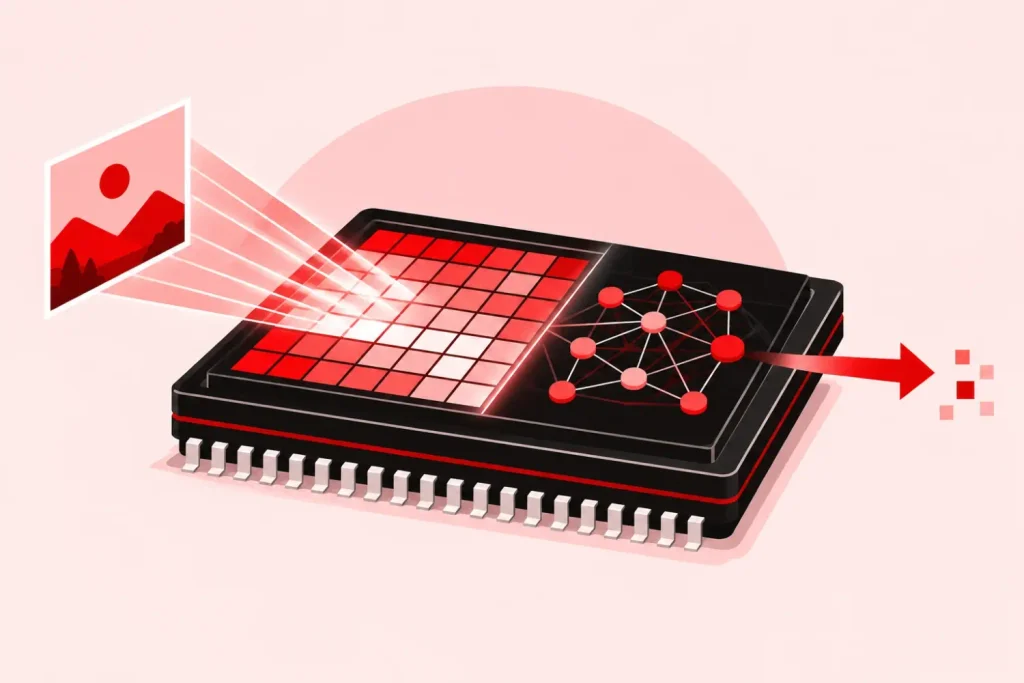
The company claims this can cut data movement between components by up to 99 per cent and system costs by up to 10 times compared with conventional multi-chip modules (Business Standard, November 2026). Kapoor gave TechCrunch a lower figure, saying the design can cut system costs by at least 70 per cent. Both are company claims, and neither has been independently verified. The sensors are meant to be fully configurable for different applications and AI models.
TechCrunch reported that first-generation sensors are in prototyping, with a second-generation prototype planned for mid-2027, customer delivery by the end of 2027 and initial commercial production in 2027. The company also says it has design wins with General Atomics and Kaynes Semicon. Those too are the company’s claims.
The first targets are consumer electronics and surveillance, where Business Standard says cost, power and latency decide who wins. The longer goal is one sensor architecture for robotics, vehicles and drones.
Read More: Anjali Sardana Physical AI Bet: Provision Labs Acquires Basilisk Industries
How the company plans to earn, and what it hasn’t said
Here the record is thin, and it is better to say so. Bharat Semi is pre-revenue and has not disclosed pricing, margins, customer contracts or unit economics.
What is known: the company is fabless, meaning it designs chips and relies on others to manufacture them, and it sells into device makers rather than to consumers. A fabless chip company typically earns from selling chips or licensing designs. Bharat Semi has not said which route it will take, so that part is editorial analysis, not reporting.
In our analysis, the fabless choice also frames the size of the round. A design company needs far less capital than a fab, so a $24 million seed is aimed at getting to customer delivery, not at building a factory.
Who backed it, and who else is building edge AI silicon in India
Figure 2 lists the investors. Redstart, Info Edge’s deep-tech arm, is a notable name: its founding partner Vibhore Sharma, a former CTO of Info Edge, said in the company’s announcement that Bharat Semi is tackling a limitation of Physical AI at the level of the silicon (Business Standard).
On competition, Bharat Semi is not alone in Indian chip design. Kerala’s Netrasemi makes edge AI chips and, YourStory reported in August 2025, raised ₹107 crore (about $12 million at roughly ₹87 per dollar, the 2025 average, a StartupIndiaX estimate) in a round led by Zoho and Unicorn India Ventures. The bets differ. Netrasemi puts AI on a chip that sits next to a sensor. Bharat Semi wants the AI inside the sensor. By dollar value, Bharat Semi’s seed is about twice that Netrasemi round, though the two are at different stages and the comparison is only a sense of scale.
Valuation and net worth: what the searches turn up
Readers search for both, so the honest answer is short. No valuation has been disclosed for Bharat Semi, and StartupIndiaX will not estimate one from a seed round.
We found no credible net worth figure for either founder. Searches for it return unrelated people with similar names. If a reputable outlet publishes an estimate, we will add it with its source and date, and label it as an estimate.
What other founders can take from this
State the stage plainly. TechCrunch reports the company as pre-revenue. Founders who say so early are easier to trust when they later announce a design win.
Give investors dated milestones. The company’s mid-2027 and end-2027 targets can be checked, which is more useful to an investor than “soon”.
Keep the moonshot separate from the product. The fab plan carries national-security weight, but the seed round funds a fabless sensor. Keeping the two apart protects the product timeline if the fab slips.
Hire the person who has done it. Bringing in Fowler, who held the CTO role at an image sensor company, answers the obvious question about technical depth.
Say what the sources can’t. The conflicting dates and the missing co-founder are open questions. For a founder-led brand, an unexplained gap is a reputational risk worth closing with a short public note.
Where the story goes next
The next tests are concrete. Does the second-generation prototype arrive by mid-2027? Do General Atomics and Kaynes Semicon turn design wins into orders? Does the Shakti fab break ground? Each has a date or a counterparty attached, so each can be checked.
Do you think a fabless route is the right one for an Indian chip startup, or does India still need the fab? Tell us in the comments, and share this with a founder building hardware. More profiles are in StartupIndiaX’s Founder Stories.
FAQs
Who founded Bharat Semi?
Bharat Semi’s co-founders, per November 2026 reports, are Vrinda Kapoor and Vinayak Dalmia. Business Standard’s 2024 coverage also named Mukul Sarkar as a co-founder and chief technology officer. The 2026 coverage does not mention him, and no source explains the change.
What does Bharat Semi do?
Bharat Semi is developing programmable image sensors that combine capture, processing and AI on a single chip. The company says this lets inference happen at the point of capture, targeting consumer electronics and surveillance first, and robotics, vehicles and drones later.
How much has Bharat Semi raised?
Bharat Semi raised a $24 million seed round, reported on November 15, 2026. It was led by Info Edge Group, South Park Commons and Indus Bridge Ventures. At ₹94.93 per dollar, that is about ₹228 crore, a StartupIndiaX estimate.
Is Bharat Semi the same as 3rdiTech?
Sources differ. PTI described Bharat Semi as 3rdiTech’s holding company in May 2025, while other 2024 coverage treated them as arms of one effort. StartupIndiaX has not seen company filings that settle the relationship between the two.
Is Bharat Semi building a chip fab?
Bharat Semi plans to be fabless for its sensors. The 2024 plan for a national-security fab with the US Space Force remains in development, according to TechCrunch in November 2026, and the new seed round does not fund it.
What is Bharat Semi’s valuation?
No valuation has been disclosed in the coverage StartupIndiaX found as of November 17, 2026. The company announced a $24 million seed round but did not state the valuation it was raised at. We have not estimated one.
When will Bharat Semi’s sensors be available?
TechCrunch reported in November 2026 that first-generation sensors are in prototyping. The company targets a second-generation prototype by mid-2027 and customer delivery by the end of 2027. These are company targets, not delivered milestones.
What is Vrinda Kapoor’s net worth?
No credible source gives a net worth for Vrinda Kapoor or Vinayak Dalmia, and StartupIndiaX does not estimate one. The only financial figure tied to the company is the $24 million seed round announced in November 2026.
Sources
- TechCrunch, “Indian chip startup Bharat Semi lands $24M seed round as it eyes global AI sensor market”, Nov 15, 2026: https://techcrunch.com/2026/11/15/indian-chip-startup-bharat-semi-lands-24m-seed-round-as-it-eyes-global-ai-sensor-market/
- Business Standard (Peerzada Abrar), “Bharat Semi raises $24 million to develop intelligent sensors for AI”, Nov 16, 2026: https://www.business-standard.com/companies/start-ups/bharat-semi-raises-24-million-to-develop-intelligent-sensors-for-ai-126111500449_1.html
- DealStreetAsia, “India: Bharat Semi raises $24m led by Info Edge, South Park Commons, others”, Nov 2026: https://www.dealstreetasia.com/stories/bharat-semi-info-edge-south-park-501168
- Business Standard, “Meet Bharat Semi, startup behind Indo-US partnership”, Sept 2024: https://business-standard.com/companies/start-ups/bharat-semi-startup-behind-indo-us-partnership-in-semiconductor-fab-124092301132_1.html
- Business Standard, “Hope to break ground for chip plant by Q1 of next year: 3rdiTech CEO”, Sept 2024: https://www.business-standard.com/companies/interviews/hope-to-break-ground-for-chip-plant-by-q1-of-next-year-3rditech-ceo-124092900566_1.html
- YourStory, “Starting Up with Shradha Sharma” (3rdiTech segment), May 2023: https://nextjs-prod.yourstory.com/2023/05/starting-up-with-shradha-sharma-vecros-codemate-3rditech-trestle-labs
- PTI via The Week, “India is the only country with enough skilled talent to rival China in semiconductors: 3rdiTech CEO”, May 29, 2025: https://www.theweek.in/wire-updates/business/2025/05/29/dcm70-biz-cii-semiconductors.html
- eeNews Europe, “Biden, Modi announce Indian wafer fab to supply US defence”, Sept 2024: https://www.eenewseurope.com/en/biden-modi-announce-indian-wafer-fab-to-supply-us-defence
- WION, “US Space Force to help India build semiconductor plant”, Sept 2024: https://www.wionews.com/india-news/us-space-force-to-help-india-build-semiconductor-plant-761033
- The Machine Maker, “3rdiTech CEO Aims to Start Chip Plant Construction by Q1 Next Year”, Sept 2024: https://themachinemaker.com/?p=57838
- YourStory, “Rs 107 Cr boost for Netrasemi’s vision to make cool edge AI chips in India”, Aug 2025: https://yourstory.com/2025/08/netrasemi-semiconductor-startup-edge-ai-chips
- PTI via HDFC Sky, “INR vs USD Rate, October 30, 2026: Rupee Rises 33 Paise To Close at 94.93”: https://hdfcsky.com/news/rupee-rises-33-paise-to-close-at-94-93-against-us-dollar
- currencyconvert.online, USD/INR yearly averages (2025 average about 87.16): https://currencyconvert.online/usd/inr