Summary
- Majety and Reddy, BITS Pilani friends, closed their logistics startup Bundl in June 2014 and began Swiggy in Bengaluru two months later.
- Swiggy listed on 13 November 2024 via a ₹11,327 crore IPO (US$1.35 billion at the time). Nandan Reddy left the board in April 2026.
- Majety is the only original co-founder still at Swiggy; Q2 FY27 showed a ₹922 crore loss (about US$99 million) as Instamart losses widened.
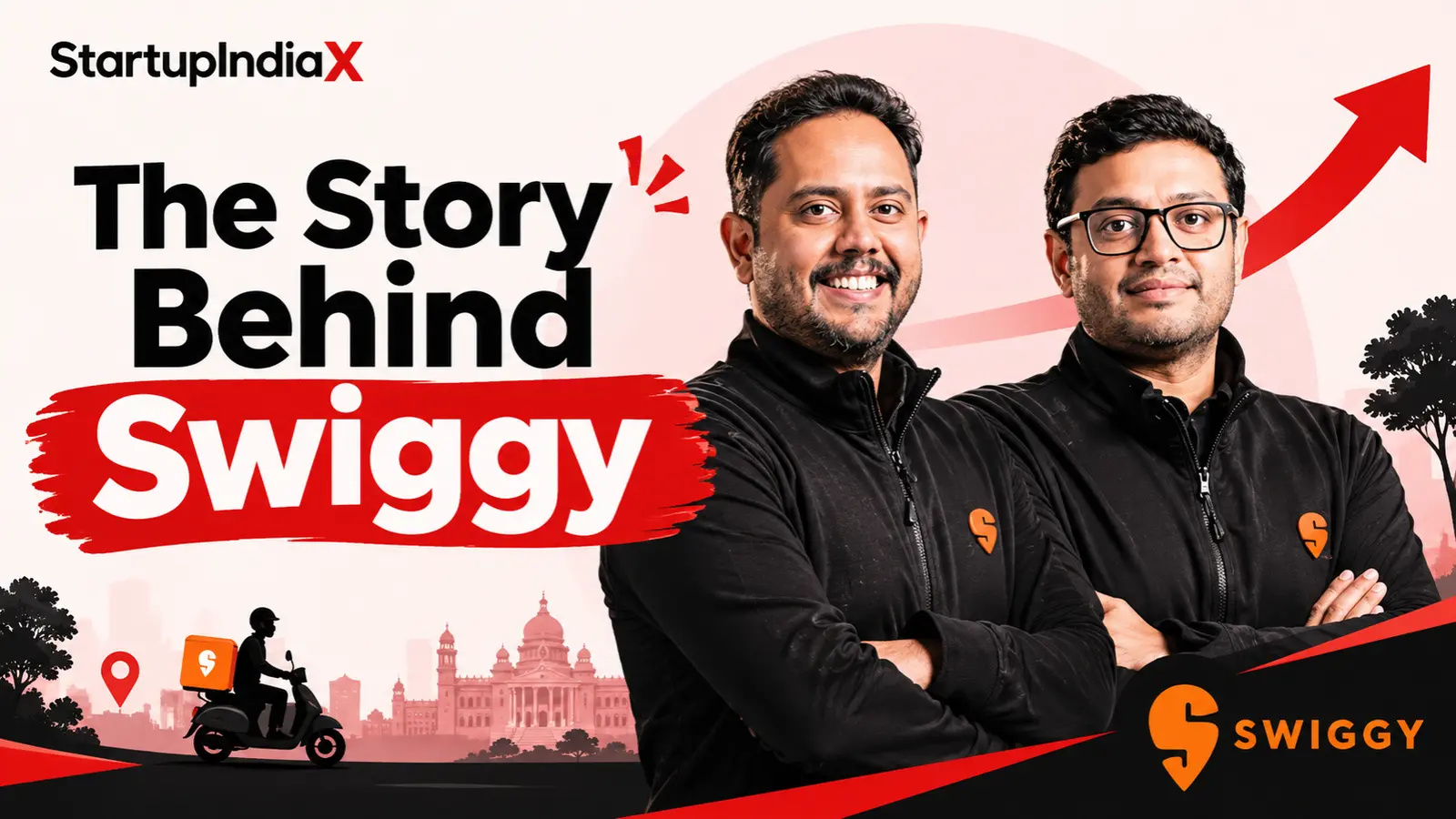
In June 2014, Sriharsha Majety and Nandan Reddy closed the logistics startup they had spent about a year building. Two months later they were back in Koramangala, Bengaluru, running a food delivery service with five or six delivery partners.
That second company was Swiggy. The story of the Swiggy founders is mostly about what they carried out of the first failure, and, since April 2026, about who is still around to tell it.
Reading time: about 10 minutes
Table of Contents
Currency note: ₹ figures from 2026 are converted at about ₹93.5 per US$ (PTI, 19 November 2026) and rounded. IPO and QIP dollar values are as reported at the time.
Two friends from a BITS Pilani photography club
Majety and Reddy met at BITS Pilani. According to a YourStory podcast with Majety, he was two years senior to Reddy, and the two already worked together in the campus photography club.
Majety finished a BE and an MSc at BITS, took a year off instead of campus placements, and cleared CFA Level 2 before joining IIM Calcutta, according to a DNA India profile. Zee News reports that his father ran a restaurant in Vijayawada and his mother is a doctor. YourStory’s profile of Reddy says he worked as a consultant and built a startup around a tablet-based point-of-sale system for restaurants.
The photography link turns up again in Swiggy’s earliest days. Reddy described the first food work at an Accel Seed To Scale session, as reported by Inc42:
“We were roaming around with cameras in Koramangala, clicking photos of food in restaurants.”
Nandan Reddy, Accel Seed To Scale session, as reported by Inc42
The report in our sources carries no date, so treat the exact timing of that remark as unconfirmed.
Read More: Deepinder Goyal Story: How a Bain Canteen Menu Became Zomato, Then Eternal
Bundl: a year of B2B logistics that went nowhere
Bundl came first. Most accounts, including Qz and the founders’ own telling on the YourStory podcast, put its start in August 2013. Wikipedia’s company page says 2011. Qz describes it as a logistics and shipping service for small sellers on platforms such as Flipkart and Amazon India. Business Standard wrote in 2015 that Bundl shut in June 2014 because traction in that sector was low.
YourStory’s podcast write-up says the B2B work was a bitter experience and that the founders decided they would be better off serving consumers. A 2018 YourStory retelling adds that watching Ola and Uber made hyperlocal delivery look possible, and that the pair realised they needed a technology co-founder.
One date needs care. Wikipedia and MarketScreener list 26 December 2013 as Swiggy’s founding date, while most press accounts say Swiggy began operating in August 2014. StartupTalky says Swiggy’s parent company is still named Bundl Technologies, so the 2013 date may trace to that original entity. That reading is StartupIndiaX’s inference, not something Swiggy has stated.

Koramangala, five delivery partners and a third co-founder
Swiggy began operations in August 2014 from Koramangala, which YourStory’s April 2015 report calls the city’s startup hub. In the founder podcast account, the team started with five or six delivery partners and 15 to 20 restaurants. Other profiles, including StartupTalky, say six delivery partners and 25 restaurants. We use the podcast version and flag the difference.
Rahul Jaimini, who had been at Myntra, became the third co-founder. YourStory’s podcast write-up says he was excited enough to leave that job for the new venture. Phani Kishan, who joined in 2015, was named a co-founder in July 2021, YourStory reported.
The first outside money arrived quickly. YourStory reported in April 2015 that Swiggy had raised US$2 million from Accel Partners and SAIF Partners within eight months of launch.
Twelve milestones, 2013 to 2026
The timeline below collects the dated, sourced milestones in one place.
The money: a US$2 million seed to a listed company
After the seed, Norwest Venture Partners led a US$16.5 million Series B in June 2015, TechCrunch reported. A US$35 million Series C from Harmony Partners and RB Investments followed in January 2016, and Naspers led a US$80 million round in May 2017, according to Medianama’s 2018 funding recap. Inc42 named the Series C investors.
The larger cheques came later. In July 2021, Swiggy closed a US$1.25 billion round led by SoftBank Vision Fund 2 and Prosus, Bloomberg reported. In January 2022, an Invesco-led US$700 million round valued the company at US$10.7 billion, Business Standard recorded in 2024.
The IPO opened on 6 November 2024. Swiggy raised ₹5,085 crore (about US$605 million at the time) from anchor investors at ₹390 a share, Entrepreneur India reported. The full issue was ₹11,327 crore (US$1.35 billion at the time), of which ₹4,500 crore was a fresh issue, Business Today reported. Business Standard reported the book was subscribed 3.59 times.
On 13 November 2024 the shares listed at ₹420 on the NSE and ₹412 on the BSE, against the ₹390 issue price. Reuters, via DealStreetAsia, reported that the stock ended the day near ₹464, valuing the company at US$12.1 billion. Majety, who rarely appears in public, attended the listing, Business Standard noted.
Barely a year later, in December 2025, Swiggy raised ₹10,000 crore (about US$1.1 billion) through a QIP at ₹375 a share, a 4 per cent discount to the floor price, according to the company’s release.
How Swiggy earns, and where it loses money
Inc42 describes Swiggy’s food delivery revenue as a mix of pre-agreed restaurant commissions, restaurant advertising, user platform fees and subscriptions. The per-order platform fee started in 2023 at ₹1 and had reached ₹6 by Q2 FY25, Inc42 reported.
The group is now wider than food. A summary of Swiggy’s FY2025 annual report lists five segments: Food Delivery, Instamart, out-of-home consumption through Dineout and Scenes, supply chain and distribution through Lynk, and platform innovations. Inc42 noted that supply chain and distribution was the largest revenue line in Q1 FY27 at ₹3,195 crore (about US$342 million), but that it also carries the matching cost of buying the products it distributes.
The Q2 FY27 results, announced on 22 October 2026, show the tension. Revenue from operations was ₹7,571 crore (about US$810 million), against ₹5,561 crore (about US$595 million) in Q2 FY26, according to Quartr. Net loss narrowed 16 per cent year on year to ₹922 crore (about US$99 million) but widened from ₹791 crore (about US$85 million) in the preceding quarter, Inc42 reported.
Food Delivery was the stronger arm. Finology Ticker’s analysis put its gross order value at ₹10,054 crore (about US$1.08 billion), with adjusted EBITDA of ₹341 crore (about US$36 million), or 3.4 per cent of GOV. Instamart’s GOV rose 31 per cent year on year to ₹9,230 crore (about US$987 million), NewsBytes reported, while its losses widened.
Swiggy has told investors it believes Instamart’s adjusted EBITDA losses peaked in Q2 FY27, and it expects double-digit sequential net order value growth in Q3 FY27, Inc42 reported. That is company guidance, not a result. Majety’s shareholder letter said Instamart hit its break-even contribution target in May 2026, with overall contribution for the quarter at minus 0.2 per cent of GOV, the Pioneer reported.
Developing: Q3 FY27 results are the next test of the guidance above.
Read More: Unit Economics for Startups: The ₹ Math That Shows If Growth Is Worth It
Three founders, then two, then one
Jaimini left in May 2020 and started Pesto Tech, StartupTalky and YourStory reported. Reddy followed on 10 April 2026. Swiggy told exchanges that Lakshmi Nandan Reddy Obul had resigned as whole-time director and head of innovation, effective 10 April, to pursue other professional interests, Business Standard reported. Other outlets, including Entrepreneur India, said he would pursue independent ventures. OfficeChai reported that he most recently led the concierge app Crew.
The same filing announced that co-founder and chief growth officer Phani Kishan Addepalli and Group CFO Rahul Bothra would join the board as additional directors from 1 June 2026, subject to shareholder approval. Majety called Reddy a “visionary force” in the company’s statement, Free Press Journal reported.
Swiggy has given no reason beyond that wording, and StartupIndiaX has found none elsewhere. The shares fell more than 4 per cent in trade after the news, Business Standard reported. OfficeChai reported that Reddy holds roughly 1 per cent of Swiggy; we have not found a second source for that figure.
The effect is simple. Majety is now the only original co-founder still at Swiggy, as NewsBytes put it, with Phani Kishan the other co-founder in the executive team.
The Instamart team has also changed. Business Standard reported that Instamart CEO Amitesh Jha resigned and Nandita Sinha took charge. This leadership change is developing; the date should be confirmed against Swiggy’s filing.
Quick commerce, a falling share price and Majety’s choice
Instamart sits in a three-way fight. A report cited on Business Standard’s online grocery page in October 2026 put Blinkit at 45 per cent, Instamart at 25 per cent and Zepto at 23 per cent of quick commerce, together about 90 per cent of the market. We could not trace the original publisher of that estimate, so treat it as indicative.
Eternal’s FY26 shareholder letter, reported by Outlook Business, gives harder numbers. Blinkit processed 916.6 million orders, Zepto 640.2 million and Instamart 412.2 million. Blinkit posted an adjusted EBITDA profit of ₹37 crore (about US$4 million) in the March 2026 quarter, while Instamart recorded a loss of ₹1,009 crore (about US$108 million).
Amazon and Flipkart have added pressure. The Next Web reported on 29 June 2026 that the push had helped erase more than US$15 billion of combined market value from Eternal and Swiggy. After the Q2 results, Swiggy shares fell as much as 17 per cent to a 52-week low of ₹174.90 on the BSE, Inc42 reported. Business Standard noted the stock had lost more than half its value from the ₹390 offer price.
Majety’s response, in a May 2026 Bloomberg interview carried by Business Standard, was to say he would not match the spending of Amazon and Flipkart. He said Swiggy was willing to lose some users in the short run to keep more loyal, more profitable ones. Majety has long avoided the spotlight too. He told Forbes India in 2024:
“I don’t need to be relevant.”
Sriharsha Majety, Forbes India interview, 2024
Whether restraint beats scale in this market is not settled. The Q2 numbers show Swiggy still losing money while its larger rival earns it.
Read More: Pitch Deck Mistakes in India: 15 Reasons Investors Pass and How to Fix Them
Delivery partners and the ten-minute question
On 25 and 31 December 2025, delivery workers on several platforms, including Swiggy, Zomato, Zepto, Blinkit, Amazon and Flipkart, went on strike, Deccan Herald and Business Today reported. The unions behind it, the Telangana Gig and Platform Workers Union and the Indian Federation of App-Based Transport Workers, cited falling pay, safety risks and the pressure of ten-minute delivery.
Swiggy and Zomato announced higher year-end incentives, Deccan Herald reported, while Goodreturns reported that the companies declined to comment on the allegations. This is an open issue for the whole sector, and not one StartupIndiaX can attribute to Swiggy alone.
What can and cannot be said about Majety’s wealth
Searches for Majety’s net worth return wildly different numbers, and some pages carry wrong biographies, so this section is cautious by design.
An older estimate of ₹1,400 crore (about US$150 million at ₹93.5 per US$, November 2026) rests on an assumed 5 per cent holding, according to Accel’s Seed To Scale site. MarketScreener lists his holding at 4.57 per cent, or 126,113,201 shares as of 30 December 2025, and valued it at about US$319 million on 29 June 2026. Wikipedia’s infobox gives 4.9 per cent.
Those are stake valuations, which move with Swiggy’s share price, not a verified net worth. StartupIndiaX has not verified any of these figures. Company value is a separate matter: Swiggy sought about US$11.3 billion at its IPO, Built In reported, citing Entrackr.
What other founders can take from Swiggy
Treat a closed company as research. Bundl failed in June 2014, yet the hyperlocal insight from it fed straight into Swiggy.
Pick your customer on purpose. The founders left B2B logistics after finding it a poor fit, and chose consumers instead.
Add the missing skill early. YourStory’s account says the pair needed a technology co-founder; Jaimini joined as the third co-founder.
Let roles change. Jaimini left in 2020 and Reddy in 2026. Swiggy named Phani Kishan a co-founder in 2021 and put him and the CFO on the board in 2026. That is editorial analysis, but it suggests a company planning for founders to move on.
Decide your limit in a price war. Majety has said he will not match deeper-pocketed rivals’ spending. The Q2 FY27 loss shows the cost of that choice, and the next results will show whether it pays.
The open questions now are Reddy’s next venture, Instamart’s leadership and whether Q3 FY27 delivers what Swiggy has guided. If you follow Indian founders, tell us in the comments which part of the Swiggy story you want us to dig into next, and share this with a founder who has a closed company behind them.
FAQs
Who founded Swiggy?
Swiggy was founded by Sriharsha Majety, Nandan Reddy and Rahul Jaimini. Majety and Reddy, both BITS Pilani graduates, started Bundl Technologies first. Jaimini, previously at Myntra, joined as the third co-founder. Swiggy began operating in Bengaluru in August 2014.
Who is the CEO of Swiggy?
Sriharsha Majety is Swiggy’s co-founder, Managing Director and Group CEO, as of November 2026. He studied at BITS Pilani and IIM Calcutta. He keeps a low public profile and told Forbes India in 2024 that he never built Swiggy to be a public figure.
What was Bundl?
Bundl was a logistics startup that Sriharsha Majety and Nandan Reddy launched in 2013, by most accounts, to connect small online sellers with courier services. It shut down in June 2014 after traction stayed low. The founders then used what they learned about hyperlocal delivery to start Swiggy.
Why did Nandan Reddy leave Swiggy?
Swiggy said Nandan Reddy resigned as whole-time director and head of innovation, effective 10 April 2026, to pursue other professional interests. Reports say he plans independent ventures. The company has not given further reasons, and StartupIndiaX has not found any beyond these statements.
Which Swiggy founders still work at the company?
As of November 2026, Sriharsha Majety leads Swiggy as Group CEO, and Phani Kishan Addepalli is co-founder and chief growth officer. Nandan Reddy left in April 2026, and Rahul Jaimini left in 2020 to start Pesto Tech.
What is Sriharsha Majety’s net worth?
Older reports estimated ₹1,400 crore (about US$150 million at ₹93.5 per US$, November 2026) from an assumed 5% stake. MarketScreener valued his 4.57% holding at about $319 million in June 2026. Neither is verified net worth, and stake values move with Swiggy’s share price.
How much did Swiggy raise in its IPO?
Swiggy’s November 2024 IPO was sized at ₹11,327 crore (about US$1.35 billion at the time), of which ₹4,500 crore was fresh issue. Anchor investors put in ₹5,085 crore at ₹390 a share. Shares listed on 13 November 2024. A ₹10,000 crore QIP followed in December 2025.
Sources
- Business Standard, “Swiggy co-founder Nandan Reddy steps down as board sees key changes,” 10 April 2026. https://www.business-standard.com/companies/people/swiggy-co-founder-nandan-reddy-steps-down-as-board-sees-key-changes-126041001086_1.html
- Business Standard, “Swiggy share price falls over 4% after co-founder Nandan Reddy resigns,” April 2026. https://www.business-standard.com/markets/news/swiggy-share-price-falls-over-4-after-co-founder-nandan-reddy-resigns-126041300255_1.html
- YourStory, “Swiggy co-founder Nandan Reddy steps down from board,” April 2026. https://yourstory.com/2026/04/swiggy-co-founder-nandan-reddy-steps-down-from-board
- Entrepreneur India, “Swiggy Names New Executive Directors, Co-founder Reddy Steps Down,” 13 April 2026. https://india.entrepreneur.com/business-news/swiggy-names-new-executive-directors-co-founder-reddy-steps-down
- Free Press Journal, “Swiggy Co-founder Nandan Reddy Steps Down From Board,” 10 April 2026. https://www.freepressjournal.in/business/swiggy-co-founder-nandan-reddy-steps-down-from-board-swiggy-names-phani-kishan-rahul-bothra-as-executive-directors
- OfficeChai, “Swiggy Co-founder Nandan Reddy Quits Company,” April 2026. https://officechai.com/ai/swiggy-co-founder-nandan-reddy-quits-company
- NewsBytes, “Swiggy co-founder Nandan Reddy quits to start new venture,” 10 April 2026. https://www.newsbytesapp.com/news/business/nandan-reddy-exits-swiggy-to-launch-new-venture/story
- YourStory, “[Podcast] Koramangala diaries: Exploring the first 500 days of Swiggy,” November 2020. https://yourstory.com/2020/11/podcast-swiggy-sriharsha-majety-foodtech-bengaluru-startup
- YourStory, “Learning from a failure: the making of Swiggy,” April 2018. https://yourstory.com/2018/04/learnings-failure-making-swiggy
- YourStory, “Bengaluru-based Swiggy takes food ordering and delivery hyperlocal, secures $2 million funding,” April 2015. https://yourstory.com/2015/04/swiggy/
- YourStory, “Swiggy names Phani Kishan co-founder,” July 2021. https://yourstory.com/2021/07/swiggy-elevates-phani-kishan-to-co-founder-sriharsha-majety/amp
- Inc42, “Learnings & Insights From Swiggy’s Rise To Power” (date not shown). https://inc42.com/?p=369506
- Qz, “Timeline: How late-entrant Swiggy became India’s most valued food-tech startup.” https://qz.com/india/1504128/how-bits-pilani-iit-alumni-built-indian-food-tech-unicorn-swiggy
- Business Standard, “Order food really fast,” July 2015. https://www.business-standard.com/article/companies/order-food-really-fast-115070600034_1.html
- TechCrunch, “Swiggy Scoops Up $16.5M To Reinvent Food Delivery In India,” 9 June 2015. https://techcrunch.com/2015/06/09/swiggy-scoops-up-16-5m-to-reinvent-food-delivery-in-india
- Medianama, “Swiggy raises Series G funding of $210M from Naspers and DST Global,” June 2018. https://www.medianama.com/2018/06/223-swiggy-raises-series-g-funding-of-210m-from-naspers-and-dst-global/
- Bloomberg via Yahoo Finance, “SoftBank Backs Food Delivery App Swiggy’s $1.25 Billion Funding,” July 2021. https://finance.yahoo.com/news/softbank-backs-food-delivery-app-073000763.html
- Business Standard, “Swiggy gets another valuation hike to over $12.7 billion from Invesco,” April 2024. https://www.business-standard.com/companies/news/swiggy-gets-another-valuation-hike-to-over-12-7-billion-from-invesco-124040900648_1.html
- Entrepreneur India, “Swiggy Secures INR 5,085 Cr from Anchor Investors Ahead of IPO,” November 2024. https://www.entrepreneur.com/en-in/news-and-trends/swiggy-secures-inr-5085-cr-from-anchor-investors-ahead-of/482433
- Business Today, “Swiggy starts Rs 10,000-cr fundraising via QIP,” 9 December 2025. https://www.businesstoday.in/markets/stocks/story/swiggy-starts-rs-10000-cr-fundraising-via-qip-floor-price-set-at-rs-39051-per-share-505897-2025-12-09
- Business Standard, “Swiggy shares make positive debut on bourses,” 13 November 2024. https://www.business-standard.com/amp/markets/news/swiggy-shares-make-positive-debut-on-bourses-list-at-8-premium-on-nse-124111300474_1.html
- DealStreetAsia (Reuters), “Swiggy makes strong debut,” November 2024. https://dealstreetasia.com/?p=419447
- Swiggy, “Swiggy successfully completes INR 10,000 Crore Qualified Institutions Placement,” December 2025. https://www.swiggy.com/corporate/?p=16577
- Outlook Business, “Swiggy Raises ₹10,000 Cr via QIP; Instamart Expansion In Focus,” December 2025. https://www.outlookbusiness.com/amp/story/markets/swiggy-raises-10000-cr-via-qip-instamart-expansion-in-focus
- Inc42, “Swiggy’s Money Map,” 2026. https://inc42.com/features/swiggys-money-map-the-verticals-built-around-food-delivery-core/
- Inc42, “Swiggy’s Litmus Test.” https://inc42.com/features/swiggy-litmus-test-ipo-food-delivery-quick-commerce
- Inc42, “Swiggy Q2: Loss Narrows 16% YoY To ₹922 Cr, Revenue Jumps 36%,” October 2026. https://inc42.com/buzz/swiggy-q2-loss-narrows-16-yoy-to-%e2%82%b9922-cr-revenue-jumps-36/
- Inc42, “Swiggy Shares Plunge 17% To 52-Week Low After Q2,” October 2026. https://inc42.com/buzz/swiggy-shares-plunge-17-to-52-week-low-after-q2-brokerages-cut-price-targets/
- Quartr, “Swiggy Q2 26/27 earnings summary.” https://quartr.com/events/swiggy-limited-swiggy-q2-26-27_FYScmAos
- Business Standard, “Swiggy slumps 15% to new low as Q2 below expectations,” 23 October 2026. https://www.business-standard.com/markets/news/swiggy-slumps-10-to-new-low-as-q2-below-expectations-analysts-cut-targets-126102300185_1.html
- Finology Ticker, “Swiggy Q2 FY27 Results Analysis.” https://ticker.finology.in/discover/market-update/swiggy-q2-fy27-results-analysis
- NewsBytes, “Swiggy posts ₹922cr loss in Q2.” https://www.newsbytesapp.com/news/business/swiggy-q2-loss-narrows-nearly-16-to-922cr/story
- Multibagg, “Swiggy Q2 FY27 Results: Loss Narrows, Revenue +36%.” https://www.multibagg.ai/market-pulse/articles/swiggy-q2-fy27-results-revenue-cmvkxn717001n2ls0tj2z8a6a
- Daily Pioneer, “Swiggy Q1 FY27 Loss Narrows to Rs 791 Crore.” https://dailypioneer.com/news/swiggy-q1-loss-narrows-to-rs-791-crore
- Business Standard (Bloomberg), “Swiggy CEO Majety vows to stay out of Amazon-Walmart spending war in India,” 28 May 2026. https://www.business-standard.com/companies/news/swiggy-ceo-majety-vows-to-stay-out-of-amazon-walmart-spending-war-in-india-126052800084_1.html
- Storyboard18, “Never built it to be a public figure: Swiggy co-founder Sriharsha Majety” (Forbes India interview, 2024). https://www.storyboard18.com/amp/brand-makers/never-built-it-to-be-a-public-figure-swiggy-co-founder-sriharsha-majety-54044.htm
- Outlook Business, “Blinkit Widens Q-Commerce Lead.” https://www.outlookbusiness.com/corporate/blinkit-widens-quick-commerce-lead-matches-rivals-zepto-and-instamart-combined-in-scale
- Kotak Neo, “Amazon, Flipkart’s Quick Commerce Push.” https://www.kotakneo.com/news/sectors/amazon-flipkart-quick-commerce-eternal-swiggy-competition/
- ThePrint, “Amazon’s rapid delivery push triggers $15 billion rout for Eternal, Swiggy,” June 2026. https://theprint.in/world/amazons-rapid-delivery-push-triggers-15-billion-rout-for-eternal-swiggy/2972497/
- The Next Web, “Amazon’s rapid-delivery push wipes $15bn off India’s Eternal and Swiggy,” 29 June 2026. https://thenextweb.com/news/amazons-rapid-delivery-push-wipes-15bn-off-indias-eternal-and-swiggy
- Built In, “Swiggy Pulls in ₹5085 Crore From Anchor Investors,” 6 November 2024. https://builtin.com/articles/swiggy-pulls-in-5085-crore-from-anchor-investors-20241106
- Inc42, “Swiggy Secures $15 Mn From Bessemer Venture Partners And Others” (Series D recap listing Series C). https://inc42.com/flash-feed/swiggy-series-d-funding/
- Business Standard, online grocery topic page, October 2026. https://www.business-standard.com/topic/online-grocery
- Business Standard, “Swiggy Instamart CEO Amitesh Jha resigns, Nandita Sinha to take charge.” https://www.business-standard.com/companies/news/swiggy-instamart-ceo-amitesh-jha-resigns-nandita-sinha-appointed-126072800594_1.html
- Deccan Herald, “10 minute delivery a bane, say many as gig workers strike has limited effect,” 1 January 2026. https://www.deccanherald.com/amp/story/business%2F10-minute-delivery-a-bane-say-many-as-gig-workers-strike-has-limited-effect-3848313
- Business Today, “Ordering food this Christmas and New Year?” 25 December 2025. https://www.businesstoday.in/india/story/ordering-food-this-christmas-and-new-year-delivery-disruptions-loom-as-gig-workers-plan-strike-508135-2025-12-25
- Goodreturns, “Delivery Workers’ Strike Today on 31st December.” https://www.goodreturns.in/news/zomato-swiggy-blinkit-zepto-amazon-other-platforms-delivery-workers-strike-today-on-31stdecember-new-1478918.html
- The Quint, “Gig Workers Demand Fair Pay and Conditions in Massive New Year’s Eve Strike.” https://www.thequint.com/amp/story/news/breaking-news/gig-workers-nationwide-strike-disrupts-delivery-services
- DNA India, “Meet Sriharsha Majety.” https://www.dnaindia.com/business/report-meet-sriharsha-majety-iim-alumnus-founder-and-ceo-of-rs-87500-crore-company-swiggy-bits-pilani-bundle-3027698
- Zee News, “Meet startup founder who completed 3,500-kilometre journey.” https://embed2.zeenews.com/photos/business/meet-startup-founder-who-completed-3500-kilometre-journey-from-portugal-to-greece-on-bicycle-his-net-worth-is-rs-1400-crore-2821739
- Seed To Scale (Accel), Sriharsha Majety profile. https://seedtoscale.com/people/sriharsha-majety
- MarketScreener, Sriharsha Majety insider profile, June 2026. https://uk.marketscreener.com/insider/SRIHARSHA-MAJETY-A1TLT1/
- Wikipedia, “Swiggy.” https://en.wikipedia.org/wiki/Swiggy
- StartupTalky, “Swiggy: How is it Delivering Happiness at the Doorstep?” https://startuptalky.com/swiggy-food-delivery-services/
- Entrepreneur India, “Swiggy Maintains Investor Confidence as Shares List at 8% premium,” November 2024. https://india.entrepreneur.com/news-and-trends/swiggy-maintains-investor-confidence-as-shares-list-at-8/482832
- PTI via Deccan Herald, “Rupee slides 8 paise to 93.49 against US dollar in early trade,” 19 November 2026. https://www.deccanherald.com/business/rupee-slides-8-paise-to-9349-against-us-dollar-in-early-trade-4223624
AI-assistance note: This article was drafted with AI assistance and reviewed and fact-checked by StartupIndiaX Editorial Team.
Corrections: Spotted an error? Email corrections@startupindiax.com and we will review and update the article.
Written by StartupIndiaX Editorial Team, StartupIndiaX writer covering Indian startups, founders, and entrepreneurship.