SUMMARY
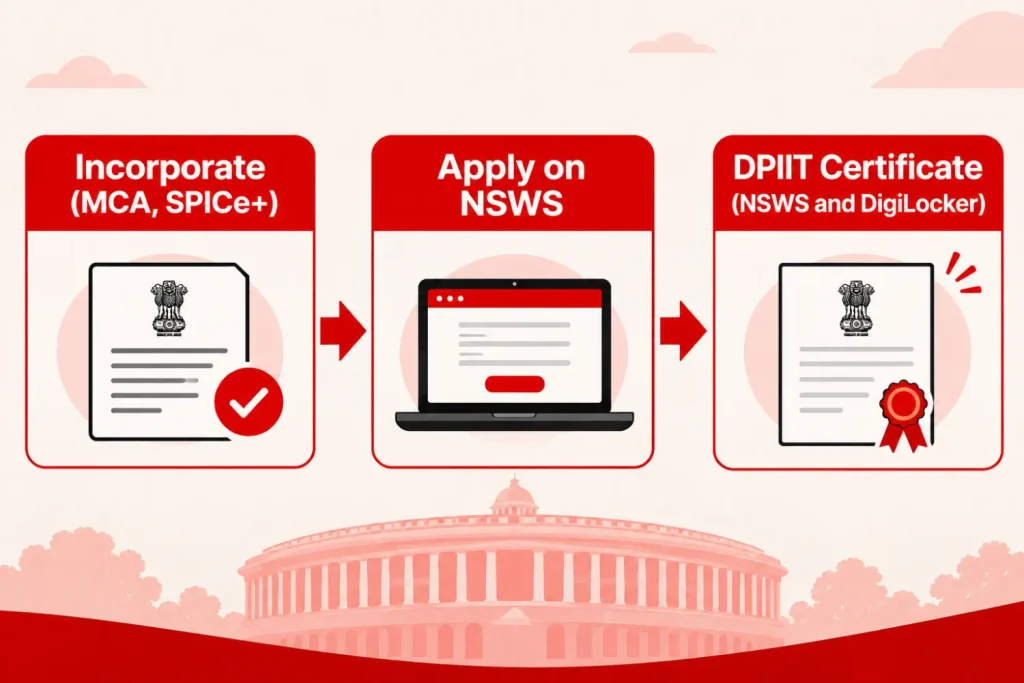
- Incorporate first, then apply for DPIIT recognition on NSWS. They’re two separate steps, and the recognition itself carries no government fee.
- The 2026 notification raised the turnover cap for a regular startup from ₹100 crore to ₹200 crore. The age limit stays at ten years.
- Keep PAN, Aadhaar, DSC, address proof and a short innovation write-up ready before you start. Missing paperwork is a frequent reason applications stall.
If you’re searching for how to register a startup in India, here’s the short answer. You incorporate a legal entity, then you apply for DPIIT recognition on the government’s National Single Window System (NSWS). The first step makes you a company. The second makes you a recognised startup.
Most guides blur the two together, and plenty of older ones still describe a process that has since moved. This one keeps them apart, in the order you’ll actually do them.
Last updated: November 2, 2026
Founder Toolkit: Once you’re recognised, find out which schemes you qualify for with the Government Scheme Finder, and sanity-check your numbers with the Startup Valuation Calculator.
Two jobs, not one
Incorporation is the legal bit. A company gets its certificate of incorporation through the Ministry of Corporate Affairs (MCA), and that’s what lets you sign contracts and take investment. DPIIT recognition is a status the Department for Promotion of Industry and Internal Trade gives to an entity that already exists. Skip the first and you can’t get the second. Advisory firms say it plainly: you need both for full startup benefits.
| Incorporation | DPIIT recognition | |
|---|---|---|
| Who handles it | MCA (companies) or the Registrar (LLPs, firms) | DPIIT, applied for on NSWS |
| What you get | A legal entity and a certificate of incorporation | Startup status and eligibility for benefits |
| Government fee | Yes, varies by state and capital | None for the certificate |
| Order | First | Only after incorporation |
Recognition also isn’t funding. It’s a status certificate that opens the door to benefits, which is why it works best as step zero for anything government-related.
Step 1: Pick a structure, because it decides who can recognise you
DPIIT recognises companies, LLPs, registered partnership firms and, under the 2026 framework, cooperative societies. A sole proprietorship generally doesn’t make the cut.
If you plan to raise angel or venture money, a private limited company is the usual pick, because it’s the structure most investors expect. An LLP can suit a service business that won’t raise equity, but it’s a tougher fit for equity rounds. Not sure what a first cheque looks like?
Read More: How to raise startup funding in India in 2026
Step 2: Get the paperwork together before you open a single form
Applications stall on gaps, not on the forms themselves. For a company, expect to need:
- PAN and Aadhaar of the directors and subscribers
- Digital Signature Certificates (DSC) for the directors
- The Memorandum and Articles of Association (MOA and AOA)
- Proof of your registered office
The address proof is where people trip. A utility bill can’t be older than two months, and if you rent, you’ll need the rent agreement plus the landlord’s NOC. LLPs and partnerships have their own paperwork, so check the Registrar’s requirements.
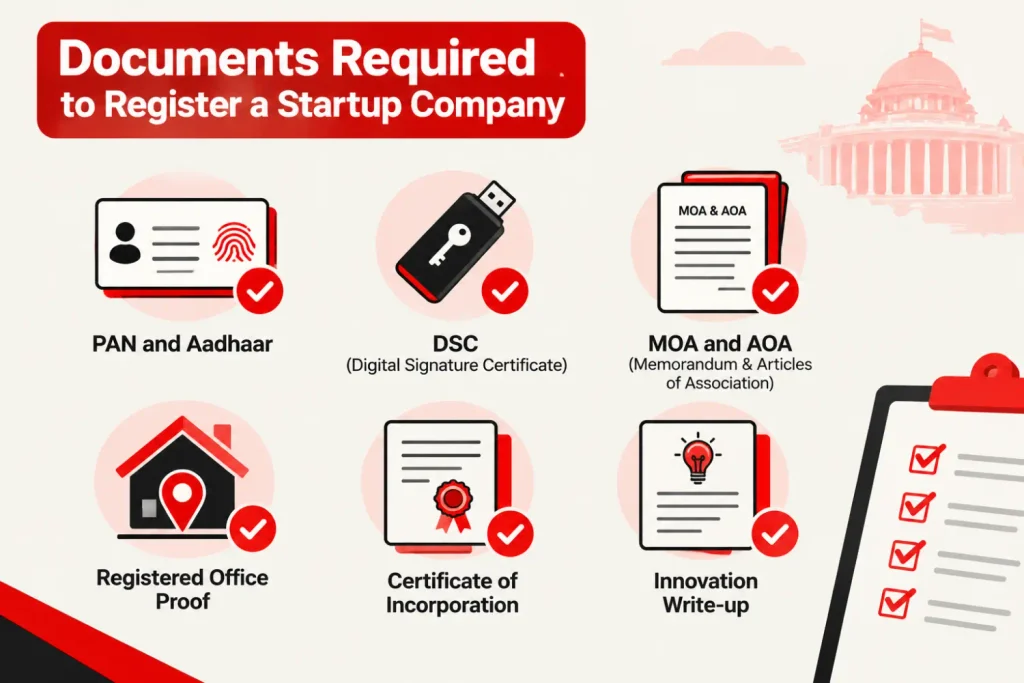
For DPIIT later, add your certificate of incorporation and a short write-up of what’s innovative about your business. Keep that write-up plain. Which problem are you solving, what’s new about how you solve it, and why can it grow beyond one city or one customer?
Step 3: Reserve a name and incorporate through SPICe+
SPICe+ is the MCA’s integrated incorporation form. Part A reserves your company name and Part B carries the incorporation itself. You can file Part A on its own first or combine both in one go.
Pick the name carefully. Avoid anything identical or too close to an existing company or trademark, and steer clear of restricted words like “National” or “Bank”, which need government approval.
This step isn’t free. Fees depend on authorised capital and state stamp duty, so check the current MCA fee schedule or ask a CA or company secretary for a written quote before you pay anyone. When the filing clears, you’ll have your certificate of incorporation. That’s your ticket to the next step.
Step 4: Apply for DPIIT recognition on NSWS
This is the part older blogs get wrong. The Startup India portal now sends you to nsws.gov.in to apply. You create an account on NSWS, add the “Registration as a Startup” form, fill in your entity details, upload the documents and submit.
One rule on the official page matters. The startup has to file the application itself, using its own details, mobile number and email. You can still hire a CA to help, but the Ministry charges nothing for the certificate, so know exactly what you’re paying for.
If approved, the certificate is issued digitally. You can pull it from NSWS or search for “startup certificate” on DigiLocker. The official pages don’t promise a turnaround. Advisory firms report anything from a couple of working days to a couple of weeks, and the gap usually comes down to how complete your documents and innovation write-up are.
The 2026 rule change most guides still get wrong
Plenty of pages still quote the old limits. In February 2026, DPIIT notified a revised startup definition (G.S.R. 108(E), dated 4 February 2026). Here’s what changed.
- The turnover ceiling for a regular startup rose from ₹100 crore to ₹200 crore, and it applies to every financial year since incorporation, not just the latest one.
- The age limit for a regular startup stays at ten years from incorporation.
- Deep tech startups get a 20-year window and a ₹300 crore turnover cap.
- Cooperative societies now sit inside the framework.
So if a guide tells you the cap is ₹100 crore, check its date. A scaled-up D2C brand that thought it had outgrown eligibility may now still qualify. Verify against the official notification before you decide either way.
What recognition gets you, and what it doesn’t
Recognition unlocks access to a bundle of benefits: fee rebates on patents and trademarks, self-certification under certain labour and environmental laws, and eligibility for programmes like the Startup India Seed Fund Scheme, which runs through incubators.
The big tax benefit, the Section 80-IAC income tax holiday, is a separate application. It goes through the Inter-Ministerial Board on the Startup India portal, needs your DPIIT certificate first, and has its own approval timeline. Don’t assume the certificate alone saves you tax.
And recognition won’t raise a rupee for you. It’s a credential. Investors will still ask about traction, unit economics and the team. If you’re working out what to ask for, our Startup Valuation Calculator is a good place to start.
Mistakes that cost founders weeks
- Applying before incorporating. There’s nothing to recognise yet.
- Choosing a sole proprietorship, then wanting startup status. You’ll have to incorporate anyway.
- Following an old guide. If it tells you to file recognition directly on the Startup India portal, it’s out of date.
- Writing a vague innovation note. “We sell clothes online” tells a reviewer nothing. Say what’s different.
- Mismatched details. Names, addresses and director details should match your incorporation records exactly across every portal.
- Paying for what’s free. The certificate is free. Fees you pay a professional are for their time, not the government’s.
Where this leaves you
Think of the certificate as step zero, not a trophy. Once you have it, the real work is deciding which schemes and programmes are worth your hours, and the Government Scheme Finder can help you sort that out.
If you remember three things:
- Incorporate first, then apply for DPIIT recognition on NSWS. Two steps, in that order.
- Check the 2026 limits: ₹200 crore turnover, ten years of age, with longer windows for deep tech.
- Prepare documents and a clear innovation note early, and file the application yourself.
Got stuck on a step, or found a form that doesn’t match this guide? Tell us in the comments and we’ll update the piece. For more practical founder guides, explore the Founder Toolkit on StartupIndiaX.
This is general information, not legal or tax advice. Check current requirements on the MCA, NSWS and Startup India portals, or with a CA or company secretary, before you file.
FAQs
What’s the difference between registering a company and Startup India registration?
Registering a company makes your business a legal entity through the MCA. Startup India registration, formally DPIIT recognition, is a separate status you apply for afterwards. It unlocks startup benefits but doesn’t replace incorporation.
Is there a government fee for DPIIT recognition?
No. The Ministry of Commerce and Industry doesn’t charge a fee for the DPIIT Certificate of Recognition. You’ll still pay normal incorporation costs, and any professional you hire will charge their own fees.
Who is eligible for DPIIT recognition in 2026?
Eligible entities are companies, LLPs, registered partnerships and cooperative societies, up to ten years old, with turnover not above ₹200 crore in any year. Deep tech startups get 20 years and a ₹300 crore cap. The business must also be innovative or scalable.
How long does DPIIT recognition take?
The official pages don’t promise a timeline. Advisory firms report anything from a couple of working days to around two weeks, depending on how complete your documents and innovation write-up are.
Where do I apply for DPIIT recognition?
File on the National Single Window System at nsws.gov.in. The Startup India portal redirects recognition applications there, and you use the Startup India portal afterwards for items like tax exemption applications.
Can a sole proprietorship get DPIIT recognition?
Generally no. Recognition is for companies, LLPs, registered partnerships and cooperative societies. A sole proprietor who wants startup status would need to incorporate first.