Table of Contents
Summary
- Joseph Nguthiru founded HyaPak in 2022 after getting his boat trapped in water hyacinth on Lake Naivasha. His startup converts the invasive weed into biodegradable packaging bags, seedling wrappers, and carton linings that perform like plastic but break down naturally.
- HyaPak has cleared over 20 hectares of hyacinth from Lake Naivasha, created 45 green jobs for local fishermen, and won Kenya’s Presidential Innovation Award, the COP28 Prototypes for Humanity Award, and the 2025 UNEP Young Champion of the Earth title.
- HyaPak’s partnership with Kenya’s national Jaza Miti tree-planting programme and export deals into the US and Germany signal a model ready to scale, and one that Indian founders dealing with identical invasive species problems should study closely.
In 2021, a group of Egerton University engineering students got their boat stuck on Kenya’s Lake Naivasha.
For five hours, they couldn’t move. Dense mats of water hyacinth had closed in from every direction.
For most people, it would have been a frustrating afternoon. For Joseph Nguthiru, it became the idea that changed everything.
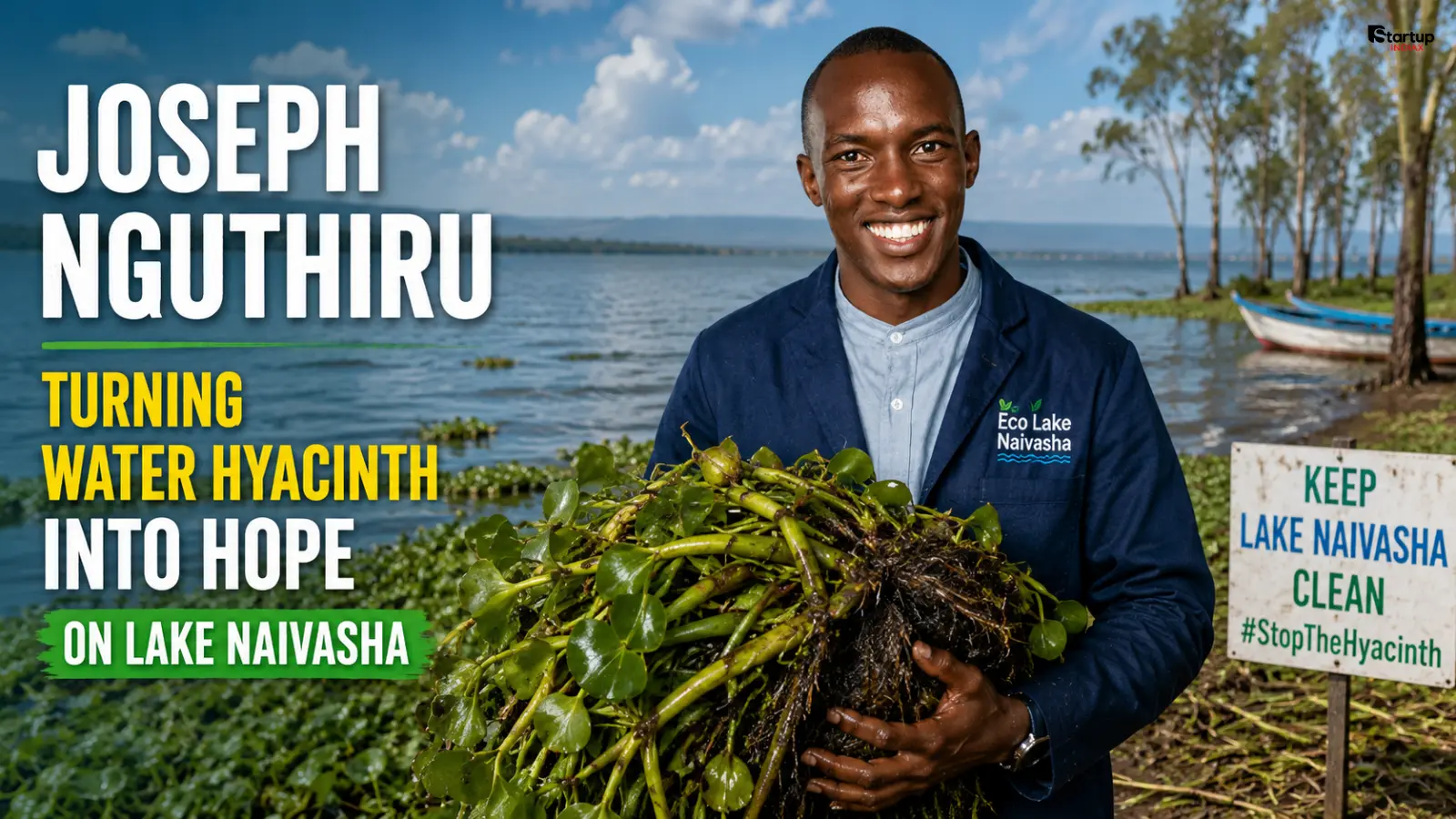
Nguthiru, now 27, is the founder and CEO of HyaPak Ecotech Limited. His Kenyan startup converts water hyacinth into biodegradable alternatives to single-use plastic. In 2025, the United Nations Environment Programme named him a Young Champion of the Earth, its highest recognition for young environmental innovators.
He was one of three selected globally from over 5,000 applicants.
The Weed Nobody Wanted
Water hyacinth originally comes from South America. Today it’s classified by the Intergovernmental Platform on Biodiversity and Ecosystem Services as one of the world’s most widespread invasive species.
It covers vast stretches of Lake Naivasha, Lake Victoria, and dozens of other African water bodies.
The damage is well-documented.
The plant floats on the surface, blocking sunlight and cutting off oxygen from below. Fish die. Boats can’t pass. Irrigation systems clog. Stagnant hyacinth-covered water creates ideal breeding conditions for malaria-carrying mosquitoes.
In Kenya alone, losses linked to water hyacinth across fisheries, transport, and tourism run into hundreds of millions of dollars every year.
Fishermen hated it. Governments funded removal drives that couldn’t keep pace. The hyacinth grew back faster than anyone could clear it.
Nguthiru saw a raw material.
A Final-Year Project That Became a Business
After the boat incident, Nguthiru and his classmates brought the problem back to campus.
Their lecturers suggested it as a final-year engineering project. Funding was tight at the public university, so they started with samples from the campus botanical garden before eventually working with hyacinth harvested directly from the lake.
The core idea was straightforward but took real engineering to execute.
Dried water hyacinth is combined with binders and additives, then shaped into products that feel and perform like conventional plastic. The difference is they biodegrade in a short time.
HyaPak was formally founded in 2022.
What HyaPak Actually Makes
The product line that emerged solves problems most green packaging companies in richer markets don’t even think about.
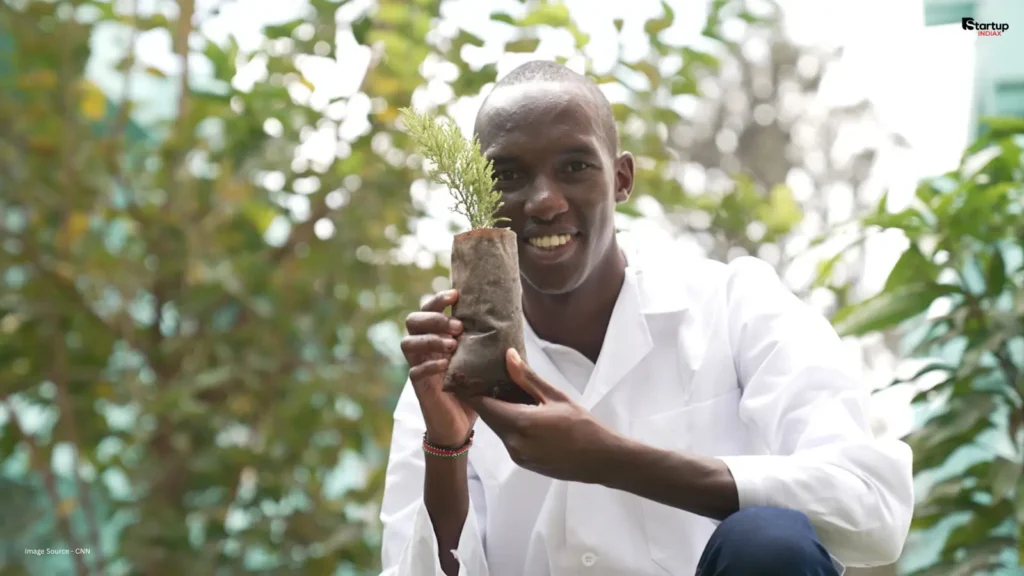
Biodegradable seedling bags. Farmers plant these directly into the soil alongside the seedling. As the bag decomposes, it releases nutrients that accelerate plant growth. No plastic waste left behind. No bag to remove before planting.
Courier packaging bags. Replaces single-use plastic mailers for parcel delivery services.
Carton linings. Keeps fresh produce cool during transport without refrigeration. Cold storage infrastructure is expensive and patchy across much of sub-Saharan Africa. A biodegradable lining that extends shelf life over long distances without electricity is genuinely useful here.
HyaPak’s seedling bags were presented directly to Kenya’s President William Ruto as part of the country’s Jaza Miti reforestation programme, which targets 15 billion trees by 2032.
That’s not a pilot relationship. It’s a national government deployment.
Three Problems. One Business Model.
What makes HyaPak worth paying attention to isn’t just the product. It’s the logic of the supply chain.
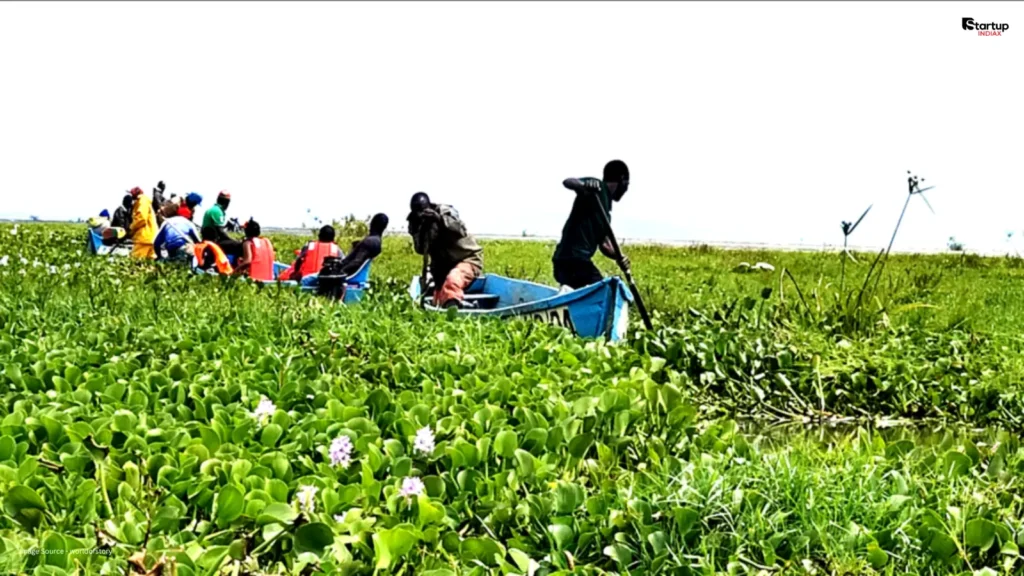
Communities around Lake Naivasha, fishermen and locals whose livelihoods were being damaged by the weed, are now paid to harvest it.
The people who suffered most from the invasion are earning from its removal.
HyaPak has cleared over 20 hectares of hyacinth from Lake Naivasha and created 45 green jobs directly tied to that removal.
Three problems closed by one model: invasive species control, plastic waste reduction, and community income generation.
“Our solution at HyaPak is to use one problem of water hyacinth to solve yet another problem of plastic waste pollution while creating green jobs for the local communities,” Nguthiru told UNEP.
It’s a circular economy argument that actually closes the loop.
The Awards Keep Coming
HyaPak’s recognition has moved fast.
At COP28 in Dubai, it won the Prototypes for Humanity Award in the Nature, Food, and Water Systems category. The selection came from 2,800 submissions across more than 200 research fields.
The Yale Africa Startup Review listed HyaPak among the top 30 startups on the continent.
Kenya’s East Africa Science and Technology Commission gave Nguthiru the Presidential Award for Best Innovator in 2022.
The 2025 UNEP Young Champions of the Earth award came with seed funding, mentorship, and global communications support. It also included entry into the first Planet A pitch competition, which offered a US$100,000 business growth grant and the chance at a potential US$1 million investment in a future fundraising round.
HyaPak’s products have started reaching international markets including the United States and Germany.
Nguthiru has also co-founded M-Situ AI, which uses satellite imagery to detect deforestation and illegal charcoal burning in Kenyan forests, and AfroClimate, a non-profit backing African climate entrepreneurs.
He’s building an ecosystem, not just a single company.
Startup INDIAX Take
HyaPak matters to Indian readers for reasons that go beyond inspiration.
India faces the same water hyacinth problem. Dal Lake in Kashmir, Loktak Lake in Manipur, Kerala’s backwaters, and parts of the Krishna and Godavari river systems all deal with invasive hyacinth infestations. The same ecological damage plays out here too: blocked waterways, oxygen depletion, declining fisheries, and mosquito breeding.
India also banned single-use plastic bags and still doesn’t have enough affordable, locally produced alternatives at scale.
The HyaPak model is, in principle, replicable. Nguthiru himself has said he hopes the solution can be adopted across countries facing similar problems.
For Indian founders working in sustainable packaging or circular economy models, the bigger lesson isn’t the product. It’s the supply chain logic.
When your raw material is someone else’s problem, and your workforce is the community most affected by it, your business case becomes almost self-evident.
That’s a template worth studying.
Why This Matters
Kenya banned single-use plastic bags in 2020. But enforcement hit a practical wall: there weren’t enough affordable alternatives being produced locally.
People smuggled plastic bags in from neighbouring countries because the substitute didn’t exist at the right price point.
HyaPak is one of the startups filling that gap. Its products don’t just replace plastic. They come from a supply chain that actively repairs an ecological problem while doing so.
That’s a different value proposition from conventional bioplastics, which typically still require agricultural inputs, energy-intensive processing, and clean raw material sources.
The invasive species angle also matters for climate economics. Removing water hyacinth manually is expensive and temporary. The weed grows back. Building commercial demand for it creates a self-sustaining reason for communities to keep removing it.
That’s pest management through market design. It’s far more durable than government cleanup drives.
The Bigger Picture
The global biodegradable packaging market is growing fast as single-use plastic bans spread across Asia, Africa, and Europe.
But most innovation in this space happens in labs and factories in wealthy countries, producing materials that don’t account for infrastructure realities in emerging markets.
HyaPak sits at the intersection of two trends that will define the next decade of green business: circular economy thinking, and locally appropriate innovation.
Nguthiru’s approach, engineering a solution from what’s already causing a problem in your own backyard, is increasingly cited by international development organisations as the model for African climate entrepreneurship.
That HyaPak now exports to the US and Germany while still serving Kenyan farmers and fishermen suggests the model scales in both directions.
Read More: Stone Paper vs. Traditional Paper: Can Sand into Paper Halt Deforestation in 2025?
What Do You Think?
Is water hyacinth a problem in your region? Could the HyaPak model work in India’s lakes and backwaters? Drop your thoughts in the comments. We’d love to hear from founders thinking about circular economy solutions closer to home.
FAQs
Who is Joseph Nguthiru and what did he build?
Joseph Nguthiru is a 27-year-old Kenyan environmental engineer and founder of HyaPak Ecotech Limited. He built a startup that converts water hyacinth, an invasive aquatic weed, into biodegradable alternatives to single-use plastic bags, seedling wrappers, and food packaging liners.
How does HyaPak turn water hyacinth into biodegradable plastic?
Harvested hyacinth is dried, then combined with binders and additives, mixed, and shaped into products. The result performs like conventional plastic but biodegrades naturally. Seedling bags can be planted directly into soil and release nutrients as they decompose, eliminating plastic waste from nurseries and reforestation sites.
What awards has HyaPak won?
HyaPak has won the 2025 UNEP Young Champion of the Earth award, the COP28 Prototypes for Humanity Award in the Nature, Food, and Water Systems category, and Kenya’s Presidential Award for Best Innovator. The Yale Africa Startup Review also listed it among the top 30 startups on the continent.
Why is water hyacinth such a serious problem in Kenya?
The plant is one of the world’s most widespread invasive species. It blocks sunlight and oxygen in water bodies, killing aquatic life. It disrupts navigation, irrigation, and fishing, and creates stagnant water that breeds malaria-carrying mosquitoes, raising health risks for lakeside communities.
Is HyaPak’s model relevant for India?
Yes. India faces water hyacinth problems in Dal Lake, Loktak Lake, and parts of Kerala’s backwaters. Combined with India’s single-use plastic ban and the shortage of affordable local alternatives, there’s a clear opening for a similar invasive-species-to-bioplastic model to be developed and scaled here.
What is HyaPak’s government partnership about?
HyaPak has partnered with the Kenyan government to supply biodegradable seedling bags to the Jaza Miti reforestation initiative, which targets 15 billion trees by 2032. The startup’s products were directly presented to President William Ruto, giving HyaPak a large-scale, consistent commercial channel tied to national policy.