Summary
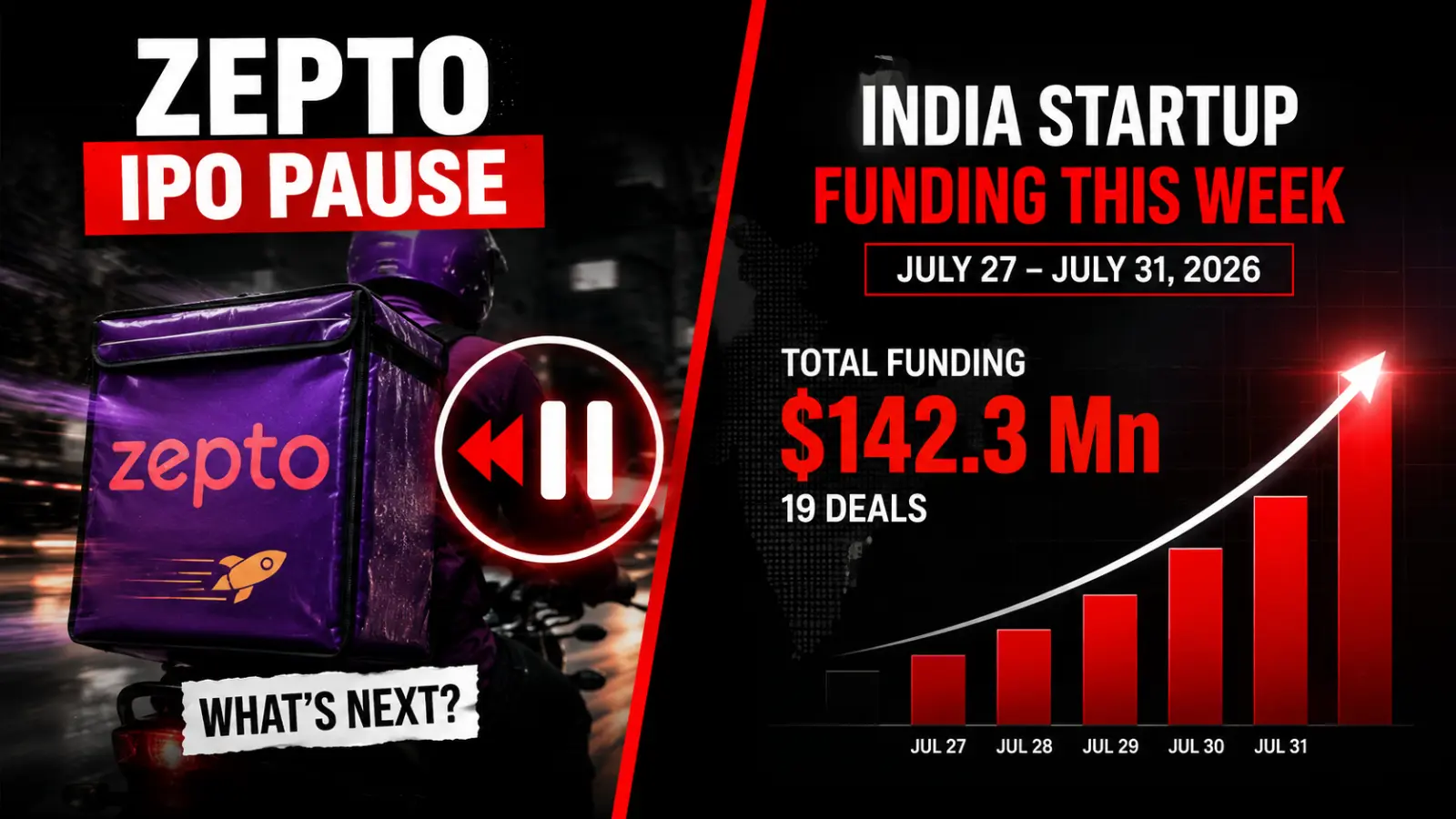
- Zepto deferred its ₹8,010 Cr IPO and is instead raising about ₹1,000 Cr ($105 Mn) from domestic investors after public market bids came in far below its $7 Bn private valuation.
- Indian startups raised $142.3 Mn across 11 deals between July 27 and 31, down 32% from $209.1 Mn the week before, with AI pulling in $92.8 Mn of that total.
- Founders eyeing 2026 listings should watch Atomberg, Klassroom and Table Space, all of which moved on IPO plans the same week Zepto pulled back.
India Startup Funding: 5-Week Trend
Weekly capital raised, June 29 – July 31, 2026 ($ Mn)
Zepto was supposed to be one of 2026’s marquee startup listings. Instead, it just became the biggest reminder yet that Indian public markets are pricing new-age tech very differently than private investors do.
The quick commerce company deferred its IPO in the last week of July, choosing instead to raise around ₹1,000 crore (roughly $105 million) through a pre-IPO placement from domestic investors. That’s a sharp comedown for a company that had filed an updated draft red herring prospectus proposing a fresh issue of ₹8,010 crore plus an offer for sale of over 11 crore existing shares, and was reportedly eyeing a July listing.
The gap came down to price. Zepto raised $450 million in October 2025 at a $7 billion valuation. When it tested the waters with public market investors this year, the bids came back between $2.5 billion and $3 billion, less than half. That’s a hard number for any founder to swallow, and it’s not really about Zepto’s growth. Revenue reportedly doubled in FY26. It’s about how differently mutual funds and insurers value a still-loss-making business compared to venture investors who can afford to wait.
Zepto isn’t alone in this. Curefoods, PhonePe and Flipkart have all pushed their own listing timelines this year for similar reasons. The pattern across 2026 IPO-bound startups is becoming hard to miss: growth alone doesn’t buy a premium multiple anymore, profitability discipline does.
The Rest of India’s Funding Week Was Quieter, and AI Still Won It
Take Zepto out of the picture, and it was a slow week for fresh capital. Indian startups raised $142.3 million across 11 deals between July 27 and 31, down about 32% from the $209.1 million raised across 14 deals the previous week.
AI was the only sector that really showed up. Three AI deals brought in $92.8 million, nearly two-thirds of the week’s total, led by enterprise AI startup Freehand, which raised $75 million from Battery Ventures and NewRoad Capital Partners, with Nexus Venture Partners and PSP Growth also participating. Voice AI startup Smallest.ai picked up $13 million in a Series A led by Seligman Ventures, and Revspot raised $4.8 million for its AI sales platform.
Sector-Wise Funding Split
India startup funding by sector, July 27–31, 2026 ($ Mn)
Outside AI, the deals were smaller and more scattered. Lucknow-based Arboreal Bioinnovations raised ₹230 crore (~$24 million) in a Series A co-led by EAAA Alternatives and Omnivore for its nutraceutical ingredients business. D2C dairy brand Sid’s Farm raised $8.5 million, also backed by Omnivore, which was the week’s only investor to back more than one startup. Quick commerce enablement platform Fixxly raised $5.5 million in seed funding from Accel and Fireside Ventures, and EV maker Omega Seiki Mobility picked up $5.2 million. Five startups raised seed rounds worth about $11.8 million combined, including drone company SUIND ($2.1 million) and student housing platform House of Student ($2 million).
Read More: India Startup Funding This Week: Udaan’s Rescue Deal and a New Unicorn Steal the Show
Beyond Zepto, IPO Season Is Actually Heating Up
Zepto pulling back doesn’t mean India’s IPO pipeline is slowing down, it’s arguably the opposite. Atomberg converted into a public entity ahead of its own listing plans, targeting a roughly ₹2,000 crore IPO with Avendus and IIFL Capital as bankers. SME edtech player Klassroom saw its ₹39 crore IPO subscribed about 73% on day one, priced at ₹151-159 a share and tentatively set to list on the BSE SME platform on August 7. Managed office provider Table Space is reportedly planning to file draft papers next month for a $350 million issue.
Put together, it’s less a story about IPOs slowing down and more about which companies get to go first. Profitable, right-sized businesses are moving. Cash-burning giants with big private valuations are the ones hitting pause.
Funds and Deals Worth Watching
A few developments away from the headline numbers matter for founders raising later this year. Groww’s co-founders, Lalit Keshre, Ishan Bansal, Harsh Jain and Neeraj Singh, are reportedly planning to launch a new venture fund with a ₹400-500 crore target corpus focused on seed and early-stage AI and frontier-tech startups. Anicut Capital floated its second early-stage vehicle, the Grand Anicut Seed Fund, at a ₹250 crore total corpus including a greenshoe, targeting more than 20 startups with initial cheques of ₹5-8 crore. Inflexor Ventures marked the first close of its ₹1,250 crore Fund III at ₹400 crore.
On the consolidation side, the all-stock merger between upGrad and Unacademy neared completion at a final transaction value of ₹1,955 crore, with Unacademy’s investors picking up one board seat. Menswear brand Snitch acquired D2C women’s fashion label Berrylush for an undisclosed sum. And Deepinder Goyal’s wearables startup Temple saw its valuation nearly double to $375 million through a secondary sale, alongside its first ESOP liquidity program for employees.
Top 5 Funding Deals
Largest India startup funding rounds, July 27–31, 2026 ($ Mn)
Read More: Free Startup Company Valuation Calculator: Know Your Worth in Under 2 Minutes
Startup INDIAX Take
The headline number this week, a 32% drop in weekly funding, is the less important story. The more important one is what Zepto’s IPO pause says about where investor patience actually sits in 2026. Private markets rewarded growth. Public markets are asking for a credible path to profitability before they’ll pay anywhere close to the same multiple. Founders building toward a 2026 or 2027 listing should treat Zepto’s valuation reset as a preview, not an outlier. The companies moving forward with listings this week, Atomberg and Klassroom, are smaller and arguably further along on unit economics. That’s probably not a coincidence.
For AI founders, the read is more straightforward: capital is still there, and it’s concentrating in the sector fast. Three AI deals accounted for nearly two-thirds of this week’s total funding. If you’re building an AI product with real enterprise traction, this remains one of the better weeks in 2026 to be raising.
What’s your read: was Zepto right to wait, or should it have taken the lower valuation and listed anyway? Let us know in the comments, and check back next week for the next Startup INDIAX funding roundup.
FAQs
How much did Indian startups raise this week (July 27-31, 2026)?
Indian startups raised $142.3 million across 11 deals, down about 32% week-on-week from $209.1 million raised across 14 deals the previous week.
Why did Zepto pull its IPO?
Zepto deferred its planned ₹8,010 crore IPO after public market investors valued it between $2.5 billion and $3 billion, sharply below its $7 billion private valuation from October 2025. It’s now raising about ₹1,000 crore from domestic investors instead.
Is Zepto’s IPO cancelled or just delayed?
It’s a deferral, not a cancellation. Zepto’s updated draft red herring prospectus remains on record with SEBI, and reports suggest the listing could be revisited within one to two quarters.
Which sector got the most funding this week?
AI led with $92.8 million across three deals, nearly two-thirds of the week’s total, driven largely by Freehand’s $75 million round.
Which other startups moved on IPO plans this week?
Atomberg converted to a public entity ahead of a roughly ₹2,000 crore IPO, Klassroom’s SME IPO was about 73% subscribed on day one, and Table Space is reportedly planning to file draft IPO papers next month for a $350 million issue.