
SUMMARY
- SISFS stopped taking startup applications on May 31, 2026, so founders now need other routes for early money.
- SISFS funds through incubators, CGSS guarantees lenders, and FoF 2.0 backs AIFs. Each scheme solves a different problem.
- All three need DPIIT recognition. Match your need to the scheme, and check its status before spending weeks on paperwork.
Ask ten founders about government startup schemes and nine will say the same thing: “There’s money, I just need to find the form.” That instinct has wasted a lot of founder time, and this week it got more expensive.
The Startup India Seed Fund Scheme, or SISFS, is no longer taking new startup applications. Meanwhile, two other schemes keep getting lumped in with it, even though they solve completely different problems. Here’s how to tell them apart.
SISFS has closed its doors to new startups
The official SISFS portal’s final notice says the last date for startups to apply was May 31, 2026, and incubators were told to complete startup selection by June 30, 2026. As of October 6, we couldn’t find an announced extension or a successor scheme.
If you were selected, your seed support continues through your incubator. If you weren’t, or you’re only now hearing about it, that window has shut. Plenty of older explainers, including some that still rank on Google, describe the scheme as open. Don’t trust them without checking the portal.
Three schemes, three middlemen
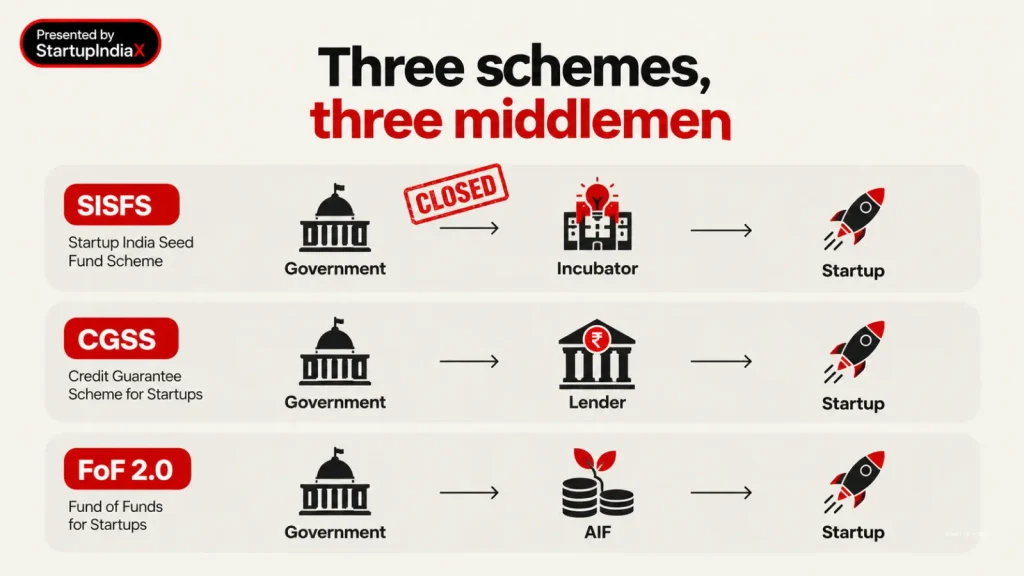
Here’s the thing that trips founders up. None of these schemes sends money straight from the government to you. Each one runs through a different middleman, and that middleman decides your next move.
| SISFS | CGSS | FoF 2.0 | |
|---|---|---|---|
| Problem it solves | Early validation money: prototype, trials, first market entry | Collateral-free loans | Equity capital for growth |
| What you get | Grant up to ₹20 lakh, plus up to ₹50 lakh in convertible debentures or debt | A loan from a lender, backed by a guarantee of up to ₹20 crore per borrower | A cheque from an AIF that holds scheme money |
| Who you deal with | An incubator | A bank or other lender | An AIF |
| Needs DPIIT recognition | Yes | Yes | Yes |
| Status for founders (Oct 6, 2026) | Startup applications closed May 31, 2026 | Running under the framework notified May 8, 2025 | In force since April 13, 2026; no sanctioned AIFs found yet |
The bottom row matters most. Before you build a plan around a scheme, check where it actually stands.
SISFS: the seed cheque that came through an incubator
SISFS had an outlay of ₹945 crore, aimed at roughly 3,600 entrepreneurs through about 300 incubators. DPIIT picked the incubators and gave them funds, and the incubators picked the startups. Startups could apply to up to three incubators at once.
The eligibility rules were tight. The startup had to be DPIIT-recognised and incorporated less than two years earlier. It also couldn’t have received more than ₹10 lakh from other central or state government schemes. The grant was meant for proof of concept, prototype work or product trials. The debt-linked support was for market entry and scaling.
So where does an early-stage founder look now? Not at a single scheme. The realistic options are incubator programmes, angel networks and micro VCs, plus state startup policies. Our guide to government grant schemes for startups lists the central and state options that are still live.
CGSS: borrowing without collateral, through a lender
The Credit Guarantee Scheme for Startups solves a different problem. It isn’t about getting a cheque. It’s about getting a lender to say yes.
NCGTC runs the scheme, and the guarantee goes to the lender, not to you. A bank or other eligible lender gives you the loan, and the guarantee covers part of its loss if you default. Under the revised framework, the maximum cover per borrower was doubled to ₹20 crore. DPIIT said the cover is 85% of the amount in default for loans up to ₹10 crore, and 75% above that. Inc42 also reported that the guarantee fee for startups in 27 champion sectors was cut to 1% in the Budget.
Adoption had been slow. As of January 3, 2025, before the cover was raised, the scheme had guaranteed 260 loans worth ₹604.16 crore to 209 startups. That’s a small number next to India’s DPIIT-recognised base, which stood at 173,413 in May 2025.
CGSS suits you if you have revenue, a working-capital or term-loan need, and don’t want to dilute equity. It’s a poor fit if you’re pre-revenue and hoping for a first cheque.
FoF 2.0: don’t apply, pitch the funds
The ₹10,000 crore Startup India Fund of Funds 2.0 is the third piece. It invests in SEBI-registered AIFs, and those AIFs back DPIIT-recognised startups. The guidelines say it “would not invest directly in startups”, so there’s no founder application at all.
We’ve covered the four AIF segments, caps and what to ask a fund in our breakdown of Startup India Fund of Funds 2.0. The short version: it matters when you’re ready for an equity round, not before.
How to pick, in three questions
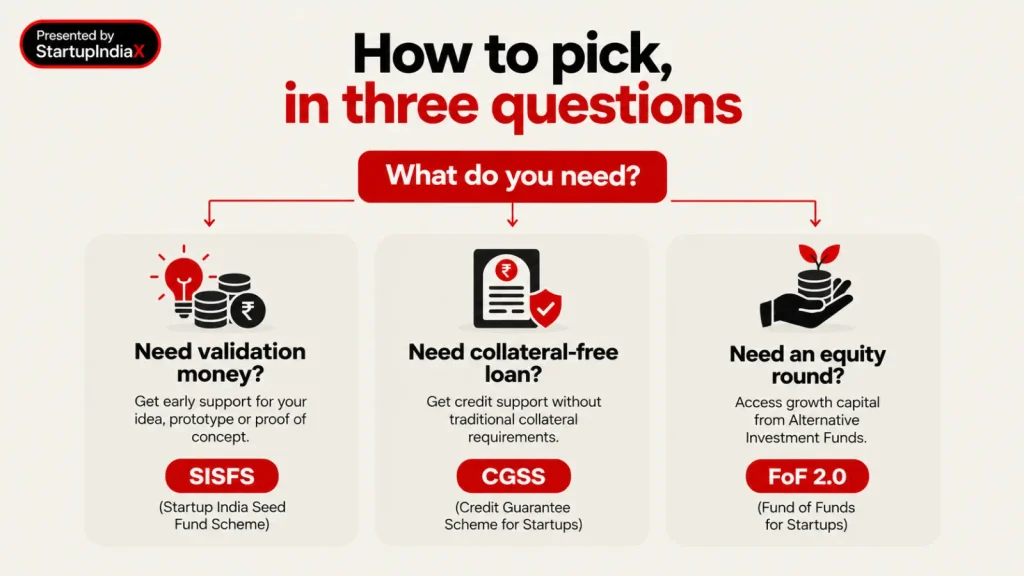
What do you need the money for? Proving an idea is a seed-stage problem, and SISFS is shut. Funding operations or equipment without giving up equity is a lending problem, which points to CGSS. Raising a priced round is an equity problem, which points to AIFs.
Are you recognised? Every route above needs DPIIT recognition. If you don’t have it, that’s your first task, whatever else you decide.
Is the scheme actually open to you today? Check the portal or the lender, not a blog post from 2024.
One more thing about stacking schemes. SISFS capped other government support at ₹10 lakh, and FoF 2.0’s guidelines tell AIFs to run due diligence that includes any other government support you’ve received. Keep a clean record of every grant and guarantee you’ve taken. Our guide to raising startup funding in India shows where each stage fits.
Our take: schemes have windows, and founders miss them
SISFS is a useful lesson. A government scheme isn’t a permanent shelf you can walk up to when you’re ready. It has an outlay, a window and a middleman, and when the window closes, the guides keep ranking while the money stops.
The smarter habit is to pick the scheme that matches your actual problem, confirm it’s open, and approach the right middleman. A founder who chases CGSS for a first prototype, or waits for a form on FoF 2.0, loses weeks they don’t have.
Three takeaways:
- SISFS no longer accepts new startup applications. Check the portal, not older articles.
- Match the problem to the middleman: incubator for seed, lender for CGSS, AIF for FoF 2.0.
- Get DPIIT-recognised and keep a clean record of all government support you’ve received.
Which of the three were you planning to chase? Tell us in the comments, and try our Founder Toolkit to see what else you qualify for. If this saves a founder friend a wasted month, share it with them.
FAQs
Is SISFS still open for startup applications?
No. The SISFS portal says the last date for startups to apply was May 31, 2026, with incubators completing selection by June 30, 2026. We found no announced extension as of October 6, 2026.
What’s the difference between SISFS and CGSS?
SISFS gave early-stage startups seed money through incubators, as a grant and debt-linked support. CGSS doesn’t give money at all. It guarantees loans that banks and other lenders make to DPIIT-recognised startups.
Can startups apply directly to FoF 2.0?
No. FoF 2.0 invests only in SEBI-registered AIFs, which then back DPIIT-recognised startups. Founders pitch those funds rather than DPIIT or SIDBI, so the route runs through the fund, not a government application form.
What is the maximum guarantee under CGSS?
The maximum guarantee cover is ₹20 crore per borrower under the revised framework notified in May 2025. The cover is 85% of the amount in default for loans up to ₹10 crore and 75% above.
Do I need DPIIT recognition for all three schemes?
Yes. SISFS, CGSS and FoF 2.0 are all limited to DPIIT-recognised startups. If you haven’t applied for recognition yet, that’s the first step before approaching any incubator, lender or fund.