
SUMMARY
- Startup India FoF 2.0 invests only through SEBI-registered AIFs, so founders pitch the funds, never DPIIT or SIDBI.
- Four AIF segments have different rules; micro VCs must put at least 50% of their corpus into seed and early-stage startups.
- Get DPIIT-recognised, match your stage to a segment, and ask every fund whether it holds FoF 2.0 money.
If you’ve been reading about India’s ₹10,000 crore Startup India Fund of Funds 2.0 and wondering where to send your pitch deck, here’s the short answer: nowhere. There’s no application form for founders, and the design means there won’t be one.
That isn’t a flaw. The government’s own operational guidelines say the scheme “would not invest directly in startups”. It puts money into other funds, and those funds choose which startups to back. Once you see the plumbing, the scheme gets a lot more useful.
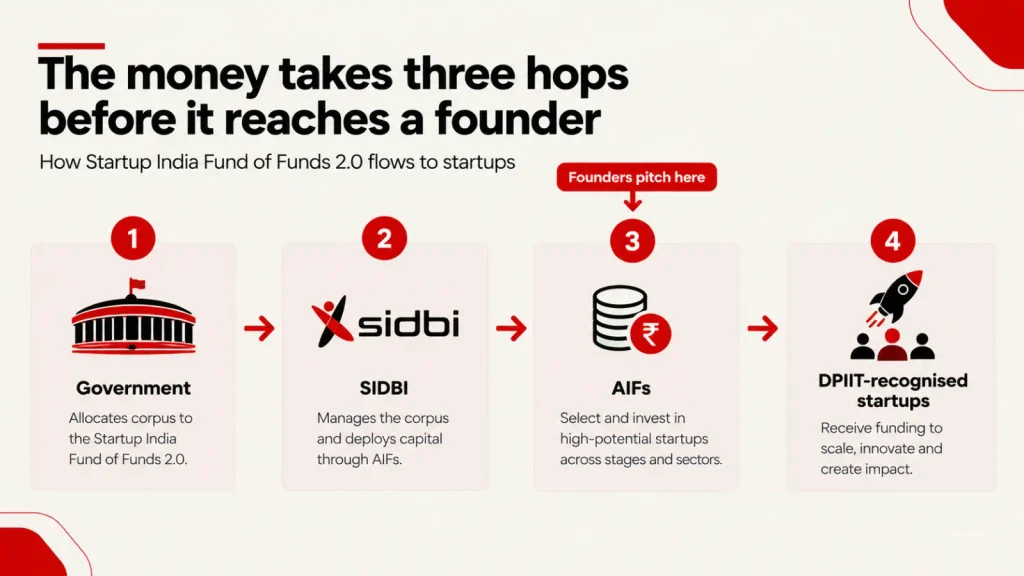
The money takes three hops before it reaches a founder
The Union Cabinet approved the scheme on February 14, 2026. SIDBI’s fund page says it came into force on April 13, and DPIIT issued operational guidelines on April 25.
Here’s the route. The government commits capital, and SIDBI runs the scheme as its first implementation agency. SIDBI then invests in SEBI-registered Category I and Category II Alternative Investment Funds, or AIFs. Those AIFs write the actual cheques to DPIIT-recognised startups. DPIIT will bring in another implementation agency in due course.
None of this is new. The first Fund of Funds for Startups, launched in 2016, committed its entire ₹10,000 crore to 145 AIFs. Those funds went on to invest over ₹25,500 crore in more than 1,370 startups, roughly 2.5 times the original corpus. FoF 2.0 reuses the same pipe with sharper aims, and commitments will be spread across the 16th and 17th Finance Commission cycles. Think multi-year programme, not a one-time release.
Four kinds of funds, four sets of rules
This is the part most coverage skips. The guidelines don’t treat every AIF the same. They sort them into four segments, each with its own limits, and the details sit in the guidelines’ Annexure I.
| Segment | Who it backs | Max share of the AIF’s corpus | Cap per AIF | Must invest (x of govt commitment) |
|---|---|---|---|---|
| Deep tech funds | Deep tech startups, as DPIIT defines them | 40% | ₹500 crore | 1.5x |
| Micro VCs | Early-growth startups; AIF corpus up to ₹400 crore | 30% | ₹100 crore | 2x |
| Manufacturing funds | Tech-driven, innovative manufacturing startups | 30% | ₹200 crore | 1.75x |
| Sector and stage-agnostic funds | Any DPIIT-recognised startup | 25% | ₹180 crore | 2.5x |
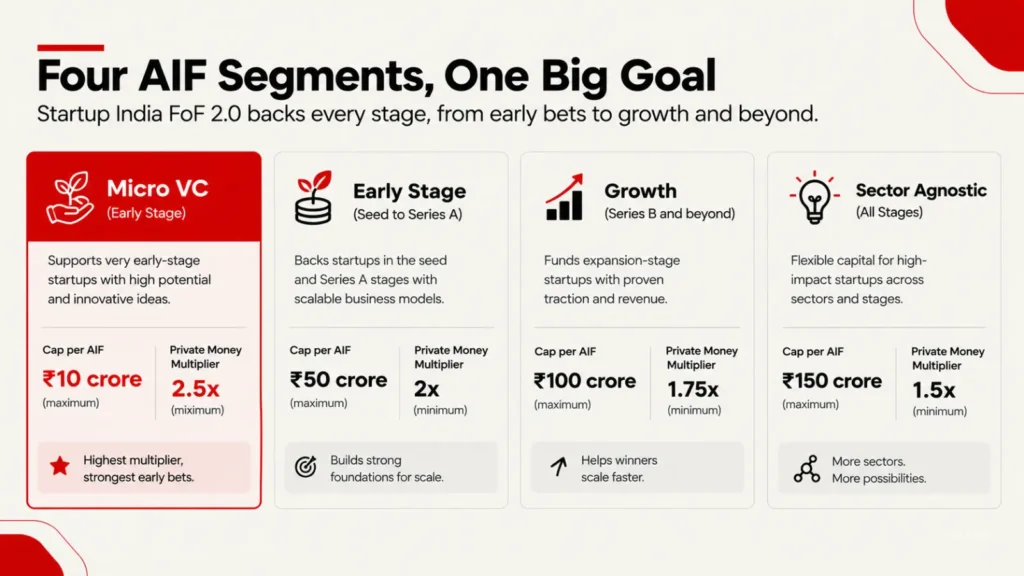
The last column is the one to understand. It’s a private-money requirement. In plain terms, if a micro VC receives ₹50 crore under the scheme, it has to put at least ₹100 crore into startups. The government wants its money to pull more capital in behind it.
For early-stage founders, the micro VC bucket is the one to watch. These funds must state in their placement memorandum that at least 50% of their corpus goes to seed and early-stage funding, with up to ₹10 crore per startup. If you’re pre-seed or seed, that’s the door.
Deep tech funds get the biggest ceiling and the lightest multiplier. Our read: the government is willing to take more risk, for longer, on the slow and expensive bets. Deep tech and manufacturing AIFs can run up to 18 years, against 10 for micro VCs.
Who picks the funds, and where things stand
Selection runs in two stages. SIDBI screens proposals and does due diligence, then a Venture Capital Investment Committee reviews them. DPIIT says that panel includes Vallabh Bhansali, Dr. Ashok Jhunjhunwala, Dr. Renu Swarup, Dr. Chintan Vaishnav and Rajesh Gopinathan, alongside SIDBI representatives. Approved proposals go to a sub-committee of SIDBI’s board, followed by a Letter of Intent and a Contribution Agreement.
Now the part you won’t read in most explainers. As of October 6, 2026, we couldn’t find a public list of AIFs sanctioned under FoF 2.0, or any committed amounts. This is a developing story. Treat any “FoF 2.0-backed fund” claim as unconfirmed until SIDBI or DPIIT publishes names. The first sanctions will be the real test of how fast this moves.
What founders should do now
Get DPIIT recognition first. AIFs under the scheme can only invest in DPIIT-recognised startups. No recognition, no access to this pool of money.
Match your stage to a segment. Raising a first round? Look at micro VCs. Building hardware, space, semiconductors or robotics? Check deep tech and manufacturing funds. Everyone else will meet the sector-agnostic funds, which carry the highest private-money requirement.
Be upfront about other government support. The guidelines tell the implementation agency to make sure AIFs run due diligence on startups, including disclosure of other government support received. If you’ve taken a grant or seed support, say so early. Our guides to the Startup India Seed Fund Scheme and government grant schemes for startups cover what that history looks like.
Ask the fund, not just the scheme. When you meet an AIF, ask directly whether it holds FoF 2.0 commitments and in which segment. Our free Founder Toolkit has a VC Investor Database to shortlist funds by stage and sector, and a Govt Scheme Finder to see what else you qualify for. If you’re mapping the whole round, start with our piece on how to raise startup funding in India.
One more detail for founders outside the big metros. The guidelines say AIF selection should give due consideration to supporting startups beyond metro regions. It’s a stated intent, not a quota, but it’s worth knowing when you’re pitching from a Tier 2 or Tier 3 city.
Our take: a signal, not a grant
FoF 2.0 won’t change your Tuesday. It changes who has money to write cheques, and what those funds are told to prioritise: deep tech, manufacturing and early-growth startups.
Compare it with the Startup India Seed Fund Scheme. SISFS reaches founders through incubators. FoF 2.0 reaches them through funds. Two doors, two different jobs, and a smart founder knows which one fits the stage they’re at.
We’d watch three things over the next few months. First, when the first AIF sanctions are announced. Second, whether DPIIT names the second implementation agency. Third, how many micro VCs make it through, because that decides how much of this money lands at seed.
Three takeaways:
- Pitch AIFs, not DPIIT or SIDBI. The scheme has no direct application for founders.
- Know your segment. Micro VCs target seed and early-stage; deep tech and manufacturing funds run longer and write bigger cheques.
- Get DPIIT-recognised now, and keep your record of other government support clean and ready to disclose.
Raising a round, or planning to? Tell us in the comments which segment you think you’d fit, and explore the rest of our Founder Toolkit. If this saved a founder friend a wasted week, share it with them.
FAQs
Can startups apply directly to Startup India Fund of Funds 2.0?
No. The scheme invests only in SEBI-registered Category I and II AIFs, which then back DPIIT-recognised startups. Founders pitch those funds through their normal fundraising process, not through SIDBI or DPIIT.
Who runs Startup India FoF 2.0?
SIDBI is the initial implementation agency, as it was for the first Fund of Funds. DPIIT will select another domestic implementation agency in due course. A Venture Capital Investment Committee screens and recommends the AIFs.
Is DPIIT recognition required to benefit from FoF 2.0?
Yes, in practice. AIFs supported under the scheme must invest in startups recognised by DPIIT under its latest notified eligibility criteria. Without recognition, a startup can’t receive capital that comes from this scheme.
How much can a single AIF get from the scheme?
It depends on the segment. The cap is ₹500 crore for deep tech funds, ₹200 crore for manufacturing funds, ₹180 crore for sector-agnostic funds and ₹100 crore for micro VCs, each also limited to a share of the fund’s corpus.
How is FoF 2.0 different from the original Fund of Funds?
The first fund committed its ₹10,000 crore to 145 AIFs. FoF 2.0 adds a fresh ₹10,000 crore with segment-wise rules, mandatory private-capital multipliers and a priority on deep tech, manufacturing and early-growth startups.
When will startups see money from FoF 2.0?
The scheme came into force on April 13, 2026, but we found no public list of sanctioned AIFs yet. AIFs also take time to deploy capital after sanction, so expect a gradual rollout.