SUMMARY
- Every director needs PAN, ID proof, address proof, a photo and a Class 3 DSC before you open the SPICe+ form on MCA V3.
- Address proofs older than two months are a common rejection trigger, so pull fresh bank statements or utility bills just before filing.
- Your registered office needs its own proof: a utility bill plus rent agreement and owner’s NOC if rented, or ownership papers if owned.
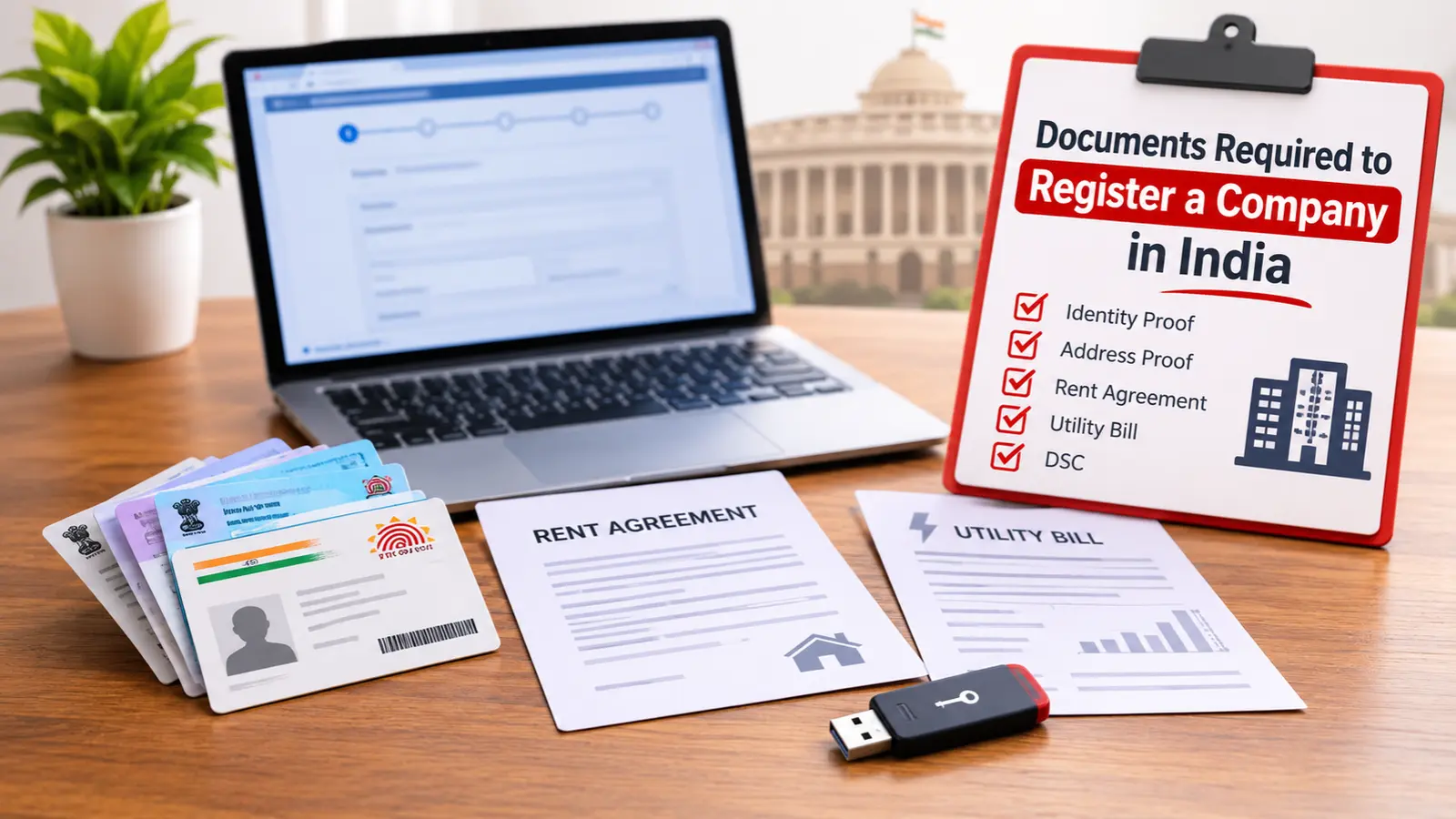
Documents Required to Register a Company in India. India’s company register keeps growing. According to MCA bulletin figures cited by IncorpX, the country had 20,36,641 active companies at the end of January 2026, with 23,280 new registrations in that month alone. Every one of them started with a pile of documents someone had to find, scan and upload.
Get that pile right and incorporation is mostly paperless, often wrapped up within one to two weeks. Get it wrong and the filing bounces back, usually over something small and avoidable.
Here’s the full checklist, organised by who has to provide what.
Documents Required to Register a Company in India: One form, a lot of paperwork behind it
Company registration now runs through SPICe+ (INC-32), the integrated form on the MCA V3 portal. It combines name reservation, DIN allotment and the PAN and TAN applications into a single filing, so you’re not chasing separate departments.
That convenience cuts both ways. One form means one place where a mistake can hold up everything.
Sort your DSC and DIN first
Nothing moves without a Class 3 Digital Signature Certificate. Every proposed director and subscriber needs one, because the incorporation forms are signed digitally. Without valid DSCs, the form can’t be submitted.
To get a DSC, you’ll typically need your PAN, Aadhaar or passport, and address proof. A DIN is applied for through the MCA system. If a director already holds one, you simply provide it.
Do this before anything else. It’s the only step where you’re waiting on a third party, and everything downstream depends on it.
What every director and shareholder needs
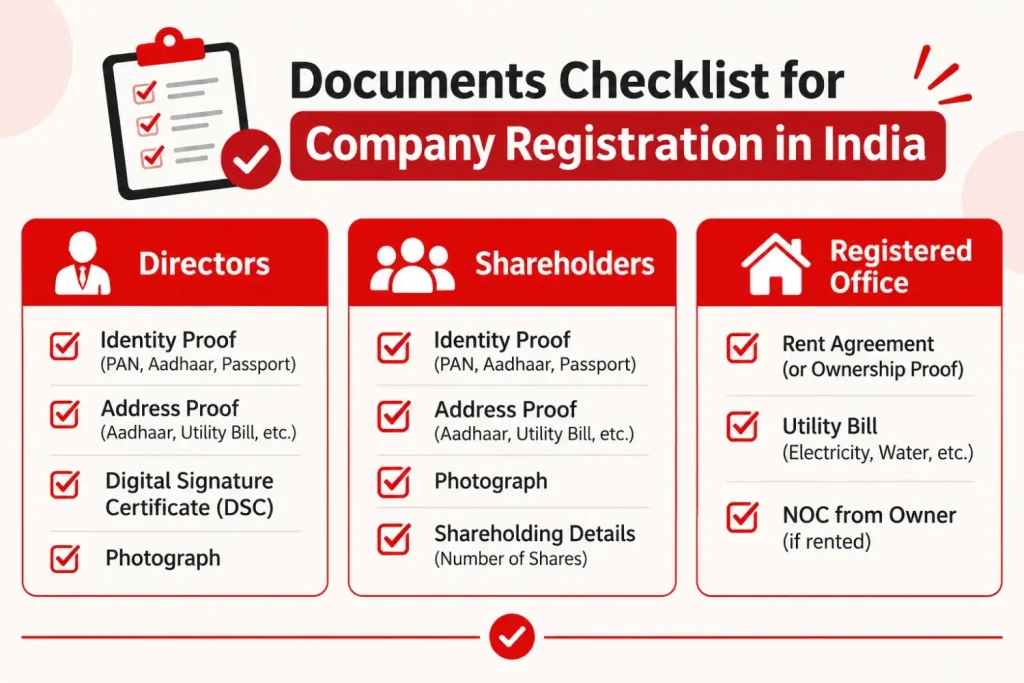
Each person on the incorporation paperwork provides:
- PAN card (mandatory for Indian nationals)
- Identity proof, any one of Aadhaar, Voter ID, passport or driving licence
- Address proof, such as a latest bank statement, electricity bill or telephone bill, not older than two months
- Passport-size photograph
- Specimen signature, which some filing firms ask for on plain white paper
- Passport, for any NRI or foreign director
- DIN and DSC, as covered above
Picture a two-founder D2C team in Bengaluru. That’s two full sets of everything, and the address on each proof has to match what’s typed into the form. It sounds obvious, but a mismatch is one of the more common reasons for a rejection.
A Pvt Ltd needs at least two directors and two shareholders, and the same people can hold both roles. If you’re building solo, a One Person Company is the route.
Read More: How to Register a Startup in India: Step-by-Step Guide
The registered office has its own paperwork
Every company must declare a registered office in India, and you upload proof for it. This is where first-time founders get tripped up, because it’s separate from anyone’s personal address proof.
What you’ll need:
- A recent utility bill, not older than two months
- If rented: the rent agreement and an NOC from the property owner
- If owned: a sale deed or property tax receipt
One filing firm points out that a postpaid mobile bill works as personal address proof but isn’t accepted as proof of the registered office. Use an electricity or water bill for the office instead.
Worried about visiting an office or branch? The process itself is fully online. Some banks may still ask a director to show up during account opening, depending on their own KYC norms.
The forms you’ll meet (most fill themselves)
You’ll see a few form names in the process. Here’s what they are:
- INC-9 is the declaration by subscribers and directors. SPICe+ auto-generates it, and you sign it with your DSC.
- DIR-2 is each director’s consent to act.
- eMoA (INC-33) and eAoA (INC-34) are the electronic Memorandum and Articles of Association.
- AGILE-PRO-S is a linked form filed alongside SPICe+ for further registrations.
You rarely write these from scratch. Your job is to make sure the details feeding them are right.
Your structure changes the list slightly
For a Private Limited Company, there’s no minimum paid-up capital, so you don’t need a lump sum to file. You do need two directors and two shareholders.
For an OPC, both the sole member and the nominee provide PAN, identity proof and address proof. The nominee also signs Form INC-3, and the details there must match their KYC documents exactly.
Not sure which structure fits? Weigh that first, because it decides whose documents you’re collecting.
Why filings get sent back
Most rejections trace back to a short list of causes:
- Address proofs older than two months, which filing firms say get rejected routinely
- Addresses that don’t match between your proof and the form
- Blurry, expired or mismatched uploads
- Wrong DSC use, such as pasting a signature image instead of signing digitally
- Names too close to an existing company or trademark
One filing guide also mentions a file-size cap of 6 MB per upload, so check the portal’s limits before you scan everything at high resolution. If you’re still hunting for a name, the Startup Name Generator in our Founder Toolkit can help you shortlist before you search the MCA database.
After the certificate arrives
The Certificate of Incorporation carries your CIN and date of incorporation, and your PAN and TAN are issued along with it. Then a second round of paperwork begins.
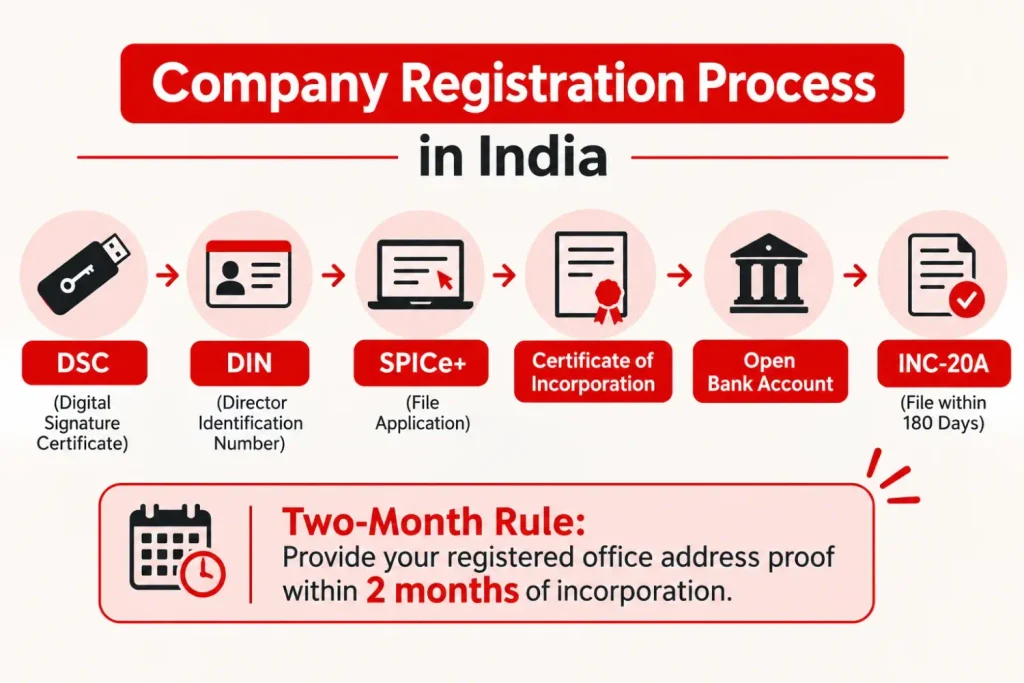
Banks need KYC and company documents to open your current account. Once you deposit the paid-up capital, you must file Form INC-20A within 180 days to declare commencement of business. GST registration follows once your turnover crosses the threshold.
If you want the government benefits that come with startup status, DPIIT recognition is applied for separately through the Startup India portal. Our Government Scheme Finder can show you which schemes you may be eligible for next.
Our take: treat this as a prep sprint
The portal isn’t the hard part. The paperwork is, and it’s mostly a matter of order. Create one folder, collect fresh address proofs last so they stay inside the two-month window, and check every name and address character by character before you upload.
Founders who do that tend to spend their energy on the product instead of rejection notices.
Before you hit submit:
- Get DSCs and DINs sorted first, since every other step waits on them.
- Pull address proofs for directors and the office at the last moment, so they stay within two months.
- Match names and addresses across every document and the SPICe+ form before uploading.
Registered a company recently, or stuck mid-filing? Tell us what tripped you up in the comments, and share this with the co-founder who’s collecting the paperwork. More step-by-step guides for first-time founders are waiting on StartupIndiaX.
FAQs
What documents are required to register a company in India?
Each director needs PAN, identity proof, address proof under two months old, a photograph and a Class 3 DSC. You also need registered office proof and the MoA and AoA, all filed through SPICe+ on the MCA portal.
Do I need a physical office to register a company?
You must declare a registered office in India and upload its proof. The filing itself is entirely online, though some banks may still ask a director to visit while opening the company’s current account.
How recent must address proof be?
Most guides say not older than two months, and some allow up to three. Stay within two months to be safe, since stale proofs are a commonly cited reason for rejection.
Is PAN or Aadhaar compulsory for directors?
PAN is mandatory for Indian nationals. For identity proof, any one of Aadhaar, Voter ID, passport or driving licence is generally accepted, with a passport needed for NRI or foreign directors.
Can one person register a company?
A Private Limited needs at least two directors and two shareholders. A solo founder can register a One Person Company, which also requires a nominee who provides their own KYC documents and consent.
What do I need to do after incorporation?
Collect your Certificate of Incorporation, open a company bank account, deposit the paid-up capital and file Form INC-20A within 180 days. Register for GST once turnover crosses the threshold.