SUMMARY
- Raising outside equity or issuing ESOPs? Pick a Private Limited company. LLPs have no share capital, so they can’t offer shares or stock options.
- LLPs suit bootstrapped, partner-run and service businesses: lighter compliance, but a flat 30% tax rate. Run the numbers before you decide.
- Skip partnership firms for a startup, since partners carry unlimited personal liability. An OPC suits a solo founder but is limited for raising equity.
Founders are registering LLPs at a pace we haven’t seen before. Mint, quoting Ministry of Corporate Affairs data in September, reported that LLP registrations between April and August 2026 jumped 31.1% to 48,972. New companies grew 12% over the same stretch, to 1,10,748.
So if you’re stuck on private limited vs llp for startup, that surge can look like a green light for the lighter option. It isn’t that simple.
The growth is real. But it tells you more about who is registering than about what investors will actually sign.
Why founders are drifting toward LLPs
An LLP gives you limited liability without the full weight of company law. You need at least two partners, and at least two designated partners who are individuals, with one of them resident in India. There’s no upper limit on the number of partners.
Compliance is lighter, too. Annual filings include Form 11, due by 30 May, and Form 8, due by 30 October. According to Kanakkupillai’s 2026 comparison, an LLP generally needs a statutory audit only once turnover crosses ₹40 lakh or partner contribution crosses ₹25 lakh. A private limited company needs an audit every year, however small it is.
Earlier MCA-based reports tied faster LLP growth to those lighter requirements, and services account for most new formations of both kinds. That’s why consultants, agencies and small service businesses like the structure. Big professional firms such as KPMG India Services LLP and EY LLP use it as well, because it fits partner-led governance.
Notice what those examples have in common. The value sits in the partners’ work, not in tradable shares.
The cap table is where this choice gets decided
Startups are the opposite case. Their value sits in equity.
An LLP has no share capital. No shares means no standard equity round, and no ESOPs for your first hires. If you want to pay early team members partly in stock, an LLP closes that door.
Venture investors don’t improvise around it. VC and angel term sheets, shareholders’ agreements and exit mechanisms are built for private limited companies, which is why virtually every venture-funded startup in India is one.
Think about what happens at your first term sheet. The investor’s lawyers will want a cap table in shares and an option pool for the team. An LLP can’t give them either. That’s the real reason founders end up converting, or starting over, when a cheque finally shows up.
Founders seem to know this. QwikFilings’ analysis of MCA data shows 93.8% of the 18,596 companies incorporated in April 2026 were Private Limited. In July, 86% of 17,001 new companies chose the same route. LLPs are tracked separately, and 8,864 were set up in July against 14,616 Private Limited companies.
Read More: How to Raise Startup Funding in India 2026
The tax and compliance bill nobody mentions in the brochure
Tax is where the LLP’s lighter paperwork gets a price tag. For AY 2026-27, LLP profits are taxed at a flat 30%, plus surcharge and cess. A private limited company can access concessional rates of 22% or 25%, depending on eligibility.
For a pre-revenue startup, that gap is academic. For a profitable, bootstrapped agency, it adds up quickly.
Private limited compliance is heavier, and the penalties bite. Annual returns such as AOC-4 and MGT-7 attract a late fee of ₹100 per day per form. Nothing dramatic if you have a good CA, but you do need one from day one.
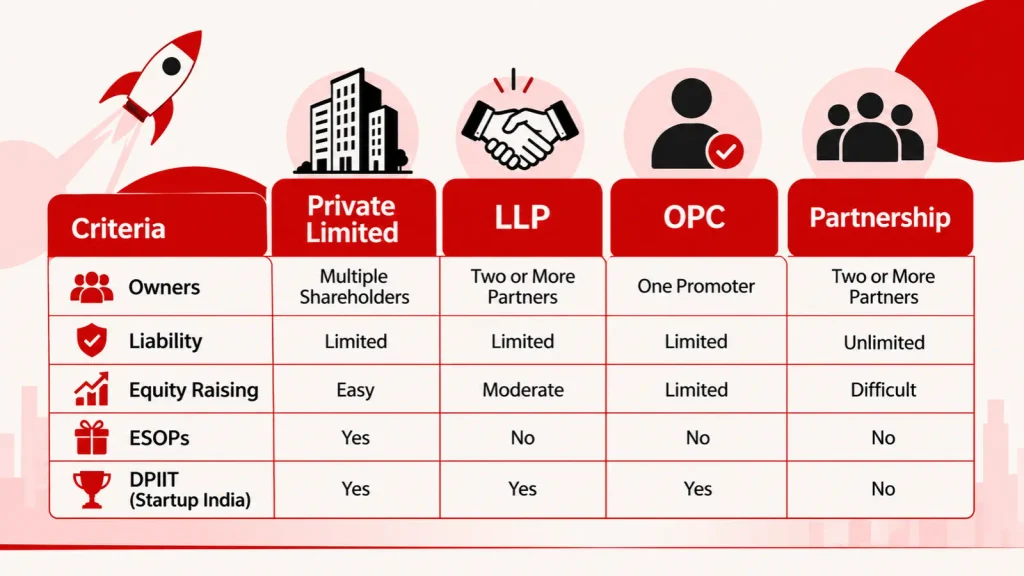
Here’s how the four structures line up.
Where OPC and partnerships fit, and where they don’t
An OPC has a single member and a nominee, and foreign nationals aren’t allowed. It works for a solo founder running a small digital or service business who wants limited liability without a co-founder. Some founders start there and convert once the business grows. Per SetIndiaBiz, the old ₹50 lakh capital and ₹2 crore turnover triggers for mandatory conversion were removed from 1 April 2021.
The catch is equity. With one member, an OPC is a limited vehicle for raising money from outsiders.
On DPIIT recognition, be careful. Startup India’s own portal lists private limited companies, LLPs and registered partnership firms. Several advisers treat an OPC as eligible because it’s a type of private company, while at least one says it isn’t. Confirm on the portal before you rely on it.
A partnership is the weakest startup option. Partners are jointly and severally liable, which means your personal assets can be pulled in. A registered firm can get DPIIT recognition, but only Private Limited companies and LLPs qualify for the Section 80-IAC tax exemption.
If you’re already running as a partnership, you can convert to an LLP under Schedule II of the LLP Act, 2008 by filing Form 17 with the MCA.
One more thing before you pick. Startup India recognition has its own tests, whichever structure you choose. Advisers commonly cite an entity age of up to 10 years and annual turnover below ₹100 crore, and you apply through the Startup India portal after incorporation. Structure gets you through the door. It doesn’t replace the eligibility check.
A quick way to decide
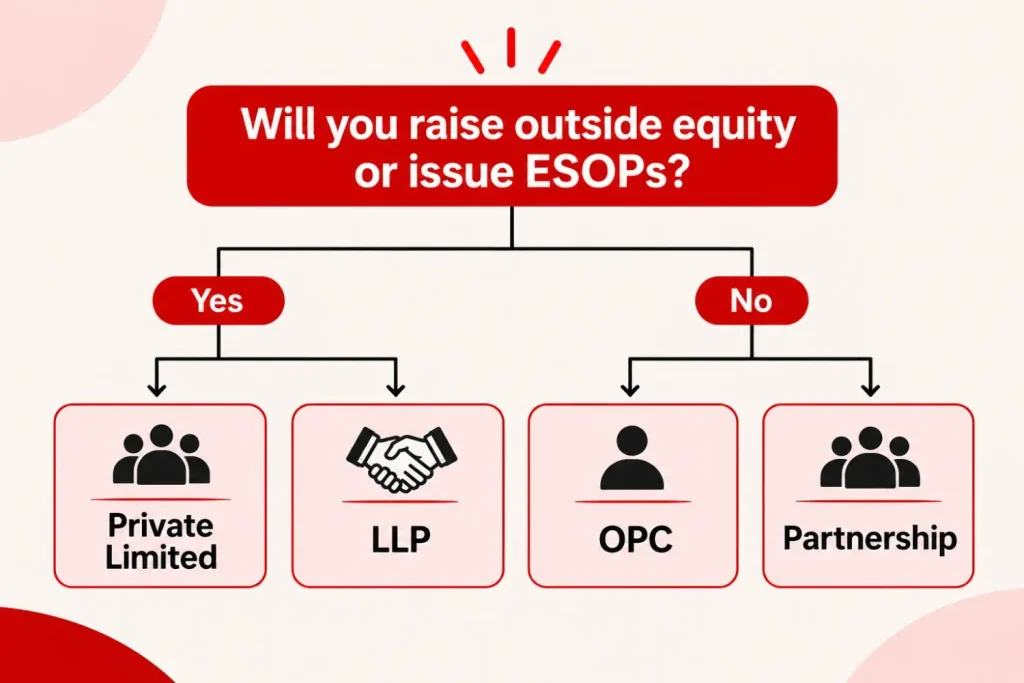
Raising venture or angel money, or planning ESOPs? Go Private Limited. Everything in the funding process assumes it.
Two or three partners, bootstrapped, service-led? An LLP can work well. Just model that 30% tax rate first.
Solo founder with a small digital business? An OPC is a reasonable start, as long as you accept its limits.
Already operating as an informal partnership? Don’t stay there. Plan the move to an LLP or a company.
What we’d tell a founder this week
The private limited vs llp for startup debate gets framed as cost against compliance. We think that’s the wrong lens. The better question is what you’ll need in 18 months, and what it would cost to switch. When you weigh private limited vs llp for startup options, price in that switching cost, not just the first-year filing fees.
If the answer includes outside equity or stock options, start as a Private Limited company. Converting later is possible, but it’s paperwork and legal fees you can skip.
If you’re building a lifestyle business or a small services firm with partners you trust, an LLP is a sensible, lighter choice. Nothing wrong with that.
Don’t read the 31% jump in LLP registrations as a verdict on funded startups. It mostly reflects founders of businesses that never planned to raise money. Also, the founder agreement matters more than the entity. Use our free Co-founder Equity Split Calculator to work out the share split, and check what DPIIT recognition could unlock with the Government Scheme Finder.
This is general information, not legal or tax advice. Talk to a CA or company secretary before you file anything.
The short version:
- Pick Private Limited if equity rounds or ESOPs are on your roadmap, because LLPs can’t issue shares.
- Choose an LLP for bootstrapped, partner-led work, and weigh the flat 30% tax against lighter compliance.
- Treat an OPC as a solo-founder starting point and a partnership as a stopgap you can convert to an LLP.
Which structure did you pick for your startup, and would you pick it again? Tell us in the comments, share this with your co-founder, and explore more founder guides on StartupIndiaX.
FAQs
Is private limited or LLP better for a startup in India?
If you plan to raise venture or angel funding or issue ESOPs, Private Limited is the better fit, since LLPs have no share capital. For small, partner-run, bootstrapped businesses, an LLP’s lighter compliance can make more sense.
Can an LLP raise funding from investors?
An LLP can’t issue shares, so standard equity rounds and ESOPs aren’t possible. Investor term sheets and shareholder agreements are built around private limited companies, which is why most funded startups choose that structure.
Which structures qualify for Startup India recognition?
Startup India’s portal lists private limited companies, LLPs and registered partnership firms. Only Private Limited and LLP get the Section 80-IAC tax exemption. Advisers differ on OPC, so confirm on the portal before applying.
Is an LLP taxed more than a private limited company?
For AY 2026-27, an LLP pays a flat 30% plus surcharge and cess. A private limited company can use concessional rates of 22% or 25% if it qualifies. Model both scenarios with your CA before choosing.
Can a partnership firm be converted into an LLP?
Yes. Under Schedule II of the LLP Act, 2008, a partnership firm can convert to an LLP by filing Form 17 with the MCA. It’s often the sensible next step for founders running informally.
Who can set up an OPC?
An OPC has one member and one nominee, and foreign nationals aren’t permitted. It suits a solo founder who wants limited liability, though its options for raising outside equity are limited.