Summary
- Bengaluru-based Airbound raised $37 million in Series A funding led by Greenoaks, with DoorDash, Lachy Groom, Lightspeed, and Humba Ventures participating.
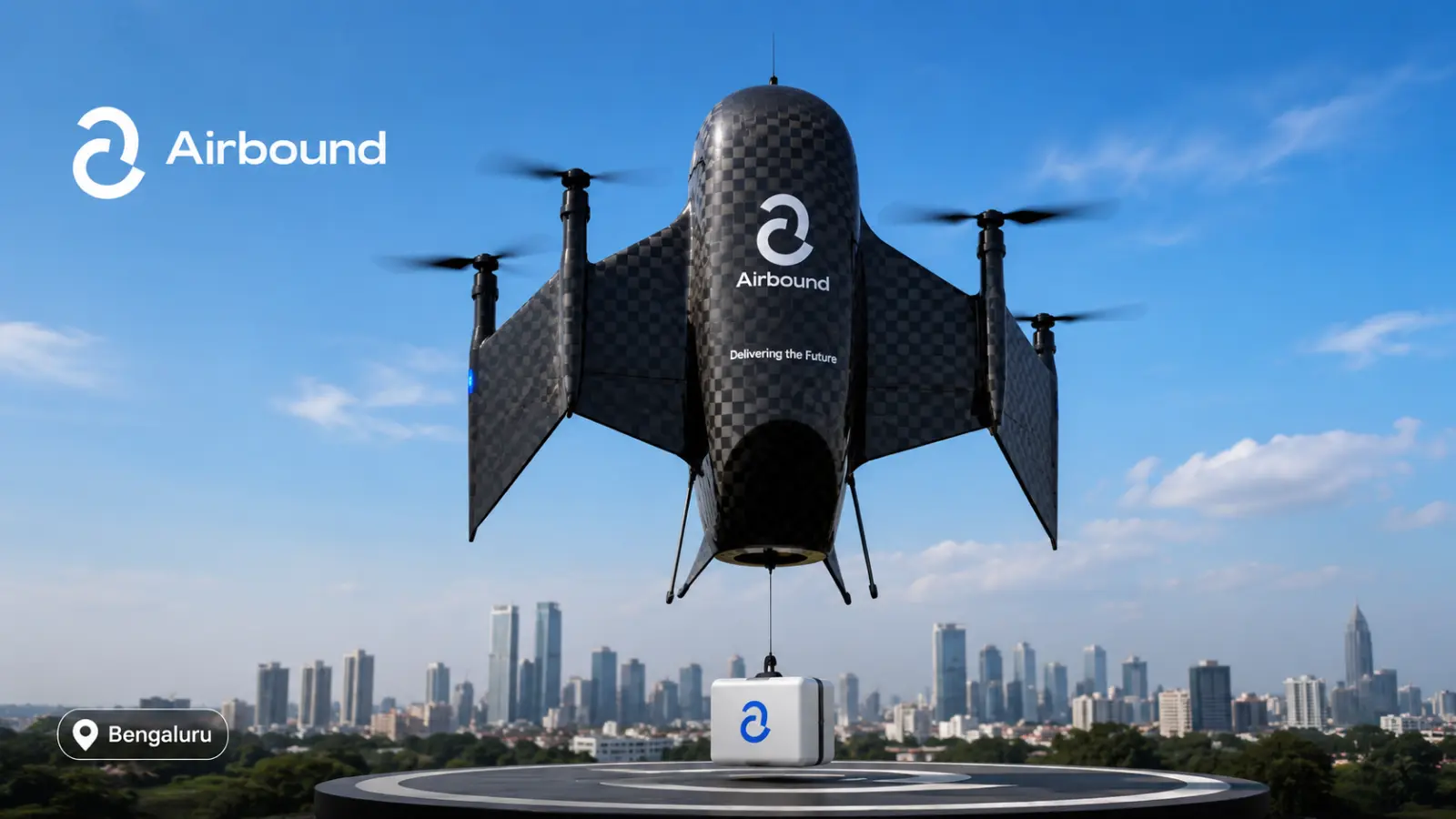
- The startup builds tail-sitter drones that weigh less than the cargo they carry, aiming for air delivery costs on par with trucking.
- Airbound has signed a deal with Andhra Pradesh to build a three-city drone network targeting 10,000 flights a day.
Most drone delivery pitches sound the same: faster than a truck, cooler to look at, still years from making commercial sense. Airbound’s pitch is different. The Bengaluru startup wants to make flying things around as cheap as trucking them, not just faster.
Investors are betting big on that idea. Airbound has raised $37 million in a Series A round led by Greenoaks, with DoorDash, Lachy Groom, Lightspeed Venture Partners, and Humba Ventures also putting money in. The round comes less than a year after Airbound’s $8.65 million seed, taking its total funding to nearly $50 million.
The physics problem nobody else was solving
Founder and CEO Naman Pushp has been building drones since he was 15. His core insight is almost embarrassingly simple: most aircraft spend the bulk of their energy just carrying their own weight, not the cargo.
Airbound flipped that ratio. Its current tail-sitter drones, which launch vertically like a rocket before switching to horizontal flight, weigh around 1.5 kg while carrying 1 kg of payload. The next generation is expected to weigh close to 3 kg while carrying nearly 5 kg, a payload-to-weight ratio that’s rare in aviation.
“We want to build towards a world where everything has cost parity with trucking,” Pushp said, describing the company’s endgame in blunt terms.
That framing matters for a country like India, where the real competition for drones isn’t other drones. It’s a truck driver who’ll do the same trip for a few hundred rupees.
Read More: How India Can Build a Self-Reliant Drone Manufacturing Ecosystem in 7 Steps
From hospital samples to quick commerce
Airbound didn’t start with grand ambitions. It began flying diagnostic samples for Narayana Health, cutting a delivery that took three to five hours by road down to about seven minutes by air. The company has now completed more than 13,000 autonomous flights across Bengaluru and Guntur, with over 1,000 of those for the hospital network alone.
The new capital is meant to take Airbound beyond healthcare logistics. The company is in talks with quick commerce and e-commerce players to carry small packages, the kind of last-mile delivery Indian consumers have gotten used to arriving in under 10 minutes.
Pushp isn’t shy about how hard that bar is. “The bar for delivery in India is high,” he said. “That’s the complexity here.”
A state government partnership, without the usual strings
Alongside the funding, Airbound has signed an agreement with the Andhra Pradesh government to build a drone delivery network connecting three cities in the state. Unlike typical government tie-ups, this one comes without a contract or subsidy attached. Instead, the state is working with Airbound on the regulatory groundwork needed to actually run the network at scale.
The target is ambitious: 10,000 flights a day across retail, e-commerce, and healthcare deliveries. Getting there will need somewhere between 250 and 1,000 aircraft, depending on route length, and Airbound isn’t the only Indian startup chasing that opportunity. Skye Air Mobility and TSAW Drones are both building competing aerial logistics networks, and drone maker Garuda Aerospace has explored delivery use cases too.
Read More : Apollo Hospitals Bets on Electric Air Ambulances to Fix India’s Golden Hour Problem
Why this matters beyond the drone itself
For founders outside the drone space, Airbound’s raise says something bigger about where Indian venture capital is willing to go right now. DoorDash backing an Indian hardware startup is not a small signal. It suggests global logistics players see Indian drone delivery infrastructure as worth a strategic bet, not just a curiosity.
It’s also a reminder that deep-tech and hard infrastructure bets, the kind that take years of physical iteration before they show traction, can still pull in serious capital in this market. That’s relevant for founders building in EV, robotics, or any category where the product has to work in the physical world before the business model does.
None of this guarantees drone delivery becomes mainstream in India anytime soon. Airbound itself acknowledges the sector is still far from matching the scale and flexibility of trucking. Scaling to thousands of daily flights means solving airspace regulation, ground infrastructure, and public trust, not just battery efficiency.
Still, a three-year-old startup pulling in $37 million on the strength of physics-first design and a state government partnership is a data point worth watching, especially for founders wondering whether India’s investors have appetite for anything beyond fintech and SaaS.
Airbound plans to put the new funding toward engineering, commercial-scale manufacturing, and expanding its customer base, including the larger aircraft it hopes will eventually carry more than packages.
Read More: World-First Fan-in-Wing Transition Flight: How Horizon Cavorite X7 Redefines eVTOL in 2025
What do you think, is drone delivery actually close to matching trucking on cost in India, or is this still a decade-long bet? Explore more funding and deep-tech coverage on StartupIndiaX.
FAQs
What does Airbound do?
Airbound builds autonomous tail-sitter drones designed to move cargo through the air as cheaply as trucking, currently used for healthcare deliveries and expanding into e-commerce.
How much has Airbound raised in total?
Airbound has raised nearly $50 million since its seed round, including the new $37 million Series A led by Greenoaks.
Who are Airbound’s investors?
The Series A round included Greenoaks as lead investor, along with DoorDash, Lachy Groom, Lightspeed Venture Partners, and Humba Ventures.
What is Airbound’s deal with Andhra Pradesh?
Airbound has signed an agreement with the Andhra Pradesh government to build a drone delivery network connecting three cities, targeting 10,000 flights a day, without a government contract or subsidy attached.
Who founded Airbound?
Airbound was founded by Naman Pushp, who started building drones at age 15 and now serves as the company’s CEO.
Who are Airbound’s competitors in India?
Airbound competes with other Indian aerial logistics startups including Skye Air Mobility and TSAW Drones.