Summary
- Awais Ahmed built Pixxel from a BITS Pilani class project into a NASA-contracted space company.
- Pixxel has raised close to ₹900 crore ($95-98M) from Google, Lightspeed, and other global investors.
- A new $80-100M round is in progress but not yet closed as of this writing.
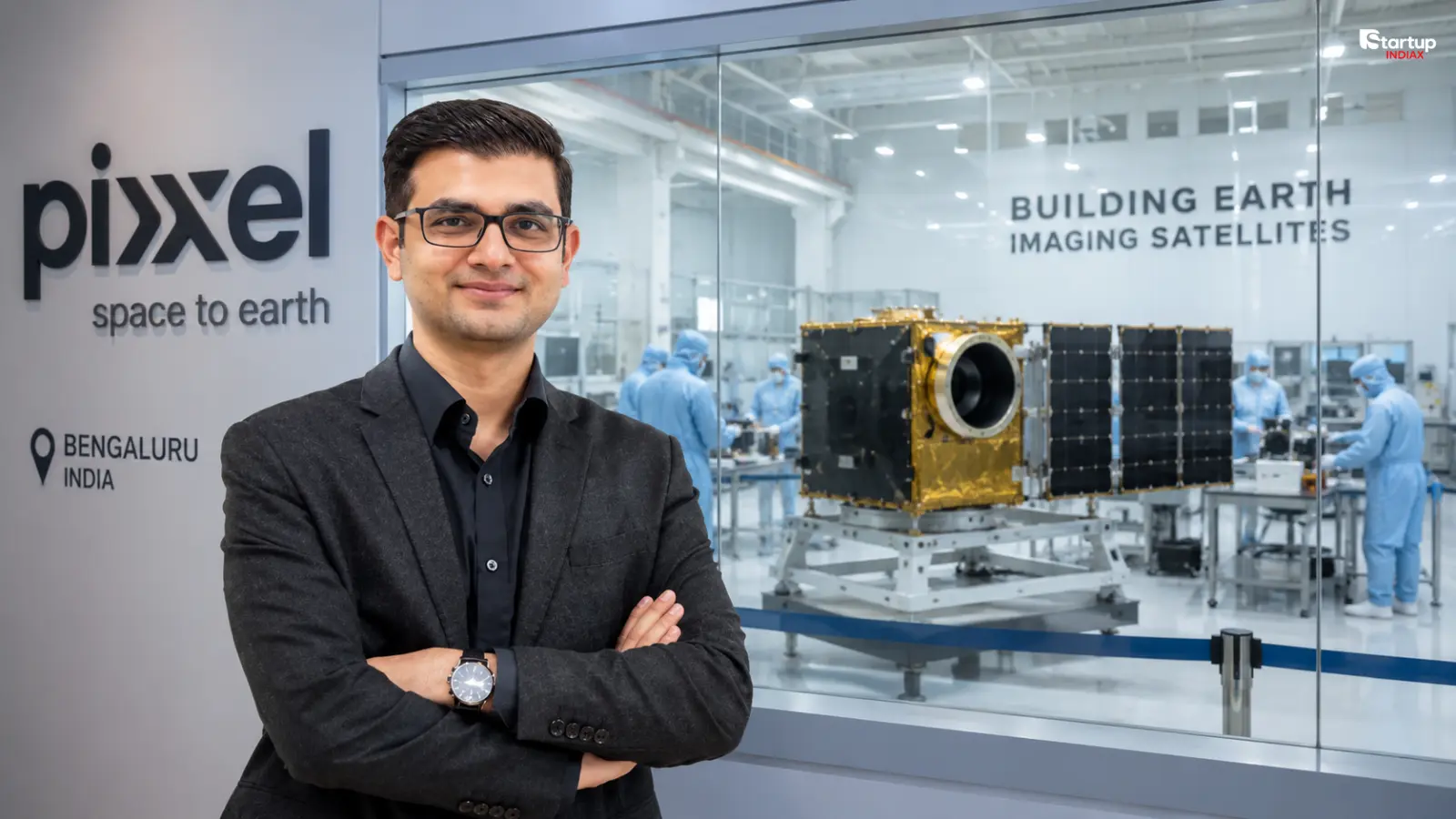
Awais Ahmed didn’t have internet access until the eighth grade. Growing up in Aldur, a small village in Karnataka’s Chikkamagaluru district, his only window into space was a stack of encyclopedias his father brought home. Today, his company Pixxel has raised close to ₹900 crore from investors like Google and Lightspeed, and become the first Indian private space-tech company to land a NASA contract. This is the story of how that happened, and why it matters for the founders reading it.
From Aldur to BITS Pilani
Ahmed’s early years had none of the usual startup-founder markers. No coding camps, no gadgets, no early exposure to Silicon Valley thinking. What he had instead was curiosity, fed by books about planets and galaxies that his father brought home from the city.
That curiosity carried him to BITS Pilani, where he studied mathematics and joined Team Anant, the institute’s student satellite project run in collaboration with ISRO. He also became a founding member and engineering lead of Hyperloop India, the only Indian team to win a spot at SpaceX’s Hyperloop Pod Competition finals in 2017, an experience that pulled him further into hands-on space engineering.
The Problem That Became Pixxel
The idea for Pixxel wasn’t born in a garage moment of inspiration. It came out of a practical dead end.
In 2018, during the IBM Watson AI Challenge, Ahmed and his classmate Kshitij Khandelwal needed detailed satellite imagery to analyze farm conditions. They discovered that no satellite data available at the time had the spectral resolution to catch problems like crop disease or early-stage industrial pollution.
That gap became the founding thesis for Pixxel. Ahmed and Khandelwal founded the company in February 2019, while still undergraduates, initially funding it with money borrowed from Ahmed’s father. For a while, the two lived on a monthly income of around ₹10,000 while building their first hyperspectral imaging prototypes.
Pixxel’s bet was on hyperspectral imaging, a technology that captures light across hundreds of narrow spectral bands instead of the handful that conventional satellites use. That extra spectral detail lets the satellites spot things invisible to standard Earth-observation systems: methane leaks, illegal mining, crop stress, water contamination.
Building Toward a NASA Contract
Getting from a BITS Pilani dorm idea to a functioning satellite constellation took years of unglamorous hardware work. Pixxel launched three demonstration hyperspectral satellites with resolutions between 10 and 30 meters, then partnered with Dragonfly Aerospace to develop sharper payloads for its commercial Fireflies constellation.
In 2025, the company successfully launched all six Firefly satellites, each capable of observing over 250 spectral bands. That track record is what caught NASA’s attention.
In September 2024, NASA selected Pixxel as part of its $476 million Commercial SmallSat Data Acquisition Program, a multi-award contract under which Pixxel supplies hyperspectral Earth observation data to NASA and its US government and academic partners through November 2028. Pixxel also went on to sign a five-year deal with the US National Reconnaissance Office, putting an Indian-founded space company inside two of America’s most security-sensitive data programs.
Along the way, Pixxel picked up recognition that’s rare for an Indian deep-tech startup this young: a spot on TIME’s 100 Best Inventions list in 2023, Technology Pioneer status from the World Economic Forum in 2024, and Forbes 30 Under 30 listings for both founders.
The Funding Behind the Mission
Pixxel’s growth has been backed by a steady climb through funding rounds, starting with an $8 million seed round in 2020 from Lightbox and Chiratae Ventures. Since then, the company has closed a Series A, a Series B, and a Series B extension, pulling in investors including Google (its first space-tech investment), Lightspeed Venture Partners, Radical Ventures, and Glade Brook Capital.
Across all rounds, Pixxel has raised close to $95-98 million, roughly ₹900 crore at current exchange rates. As of FY24, the company reported revenue of ₹30.6 crore, up 86% from the year before.
It’s worth flagging that Pixxel is currently in advanced talks for a new funding round of $80-100 million at a valuation of around $400 million, though that round hadn’t closed as of late May 2026 and one prospective investor has since stepped back from the deal. That’s a separate, developing story from the ₹900 crore already on the books, and one worth watching closely in the coming months.
Read More: Pawan Kumar Chandana: Vizag to Rocket Factory
Startup INDIAX Take
Ahmed’s story gets told as a village-to-riches arc, but the more useful lesson for founders is what he didn’t do. He didn’t chase a trendy sector or a quick exit. He picked a genuinely hard, capital-intensive hardware problem, hyperspectral imaging, that most Indian VCs would have called uninvestable in 2019.
What made it work was sequencing: prove the technology with demo satellites, build credibility with government-linked contracts and grants, then use that credibility to unlock global capital and NASA-level trust. For India’s deep-tech founders, that’s a more repeatable playbook than “grew up without internet.”
Why This Matters
Pixxel becoming the first Indian private space company trusted with US government contracts signals something bigger than one company’s success. It shows global agencies are willing to source sensitive Earth-observation data from an Indian-founded, India-headquartered startup, not just from established American or European players.
For India’s broader space-tech ecosystem, worth an estimated $44 billion by 2033 according to the Department of Space, Pixxel is proof that Indian hardware startups can compete on deep technical merit rather than cost alone. That matters for the next generation of founders deciding whether India’s space sector is investable.
The Bigger Picture
India’s private space sector has grown to more than 200 startups, spanning satellite manufacturing, launch vehicles, ground stations, and data analytics. Government reforms like the creation of IN-SPACe have opened the sector to private players and foreign investment, and companies like Skyroot Aerospace have already put Indian-built rockets into flight.
Pixxel now sits alongside global players like Planet, ICEYE, and Capella Space in commercial Earth observation, but with the added weight of NASA and NRO contracts behind it. As hyperspectral imaging shifts from a niche capability to critical infrastructure for agriculture, defense, and climate monitoring, Pixxel’s early bet on spectral depth over resolution alone looks increasingly prescient.
Read More: Aman Sanger Story: Cursor AI Founder Journey 2025
Got thoughts on India’s space-tech wave, or want to see more founder deep dives like this one? Drop a comment below and explore more founder stories on Startup INDIAX.
FAQs
Who is Awais Ahmed?
Awais Ahmed is the co-founder and CEO of Pixxel, an Indian hyperspectral satellite company. He grew up in Aldur village, Karnataka, and studied mathematics at BITS Pilani before founding Pixxel in 2019 with classmate Kshitij Khandelwal.
How much funding has Pixxel raised?
Pixxel has raised roughly $95-98 million, close to ₹900 crore, across seed, Series A, and Series B rounds from investors including Google, Lightspeed Venture Partners, and Radical Ventures.
What does Pixxel do?
Pixxel builds and operates hyperspectral imaging satellites that capture data across hundreds of spectral bands, far more than conventional satellites, to detect crop disease, methane leaks, illegal mining, and other issues invisible to standard Earth observation systems.
Why is Pixxel’s NASA contract significant?
In September 2024, Pixxel became the first Indian private space-tech company selected for a NASA contract, part of NASA’s $476 million Commercial SmallSat Data Acquisition Program, running through November 2028.
Is Pixxel raising more funding?
As of late May 2026, Pixxel is reportedly in advanced talks to raise $80-100 million at a valuation of around $400 million, though the round had not closed at the time of this reporting.