
Table of Contents
Summary
- DPIIT recognition is free and processes in 7 to 14 days, but roughly 70% of applications fail mostly due to a vague innovation description, wrong entity type, or document mismatches.
- DPIIT recognition and the Section 80-IAC tax exemption are two separate processes; receiving the certificate doesn’t grant the income tax holiday automatically.
- Founders must monitor post-submission DPIIT queries and respond on time, as unanswered queries cause applications to lapse with no appeal.
DPIIT recognition is one of the few government benefits that costs absolutely nothing, processes in days, and unlocks real money, from a three-year income tax holiday to 80% off patent fees. Yet an estimated 70% of applications are rejected and most of those rejections aren’t because the startup doesn’t qualify. They’re because founders rushed a form that deserved more care.
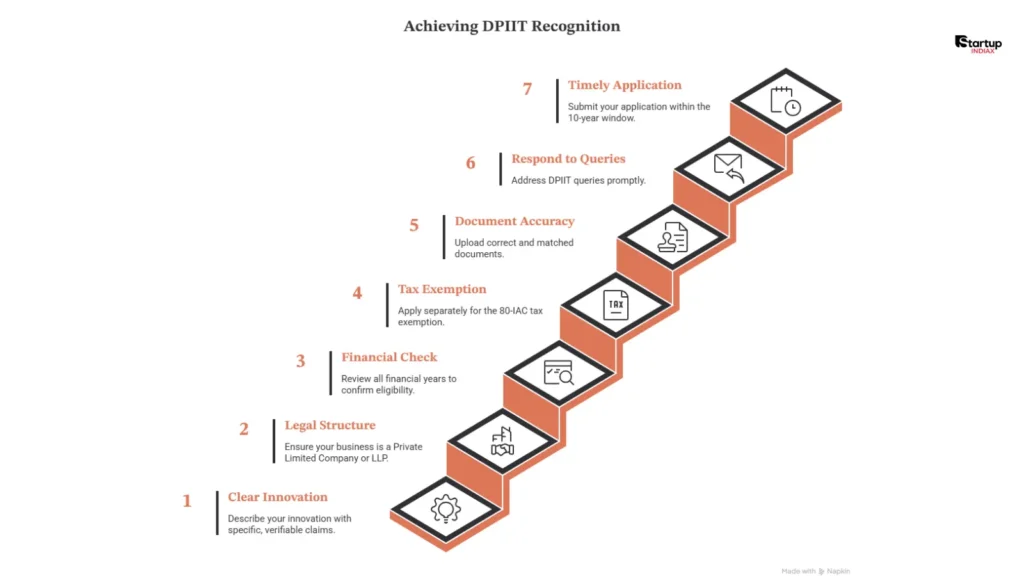
This guide breaks down the seven mistakes that kill DPIIT applications, with specific fixes for each one. If you’re planning to apply, or you’ve already been rejected, this is where to start.
Mistake 1: Writing a Vague Innovation Description
This one accounts for the majority of all rejections. No other mistake comes close.
A weak or generic description is responsible for approximately 70% of rejections. Reviewers see hundreds of applications. Phrases like “we provide innovative solutions using technology” or “we serve the underserved market with quality services” tell them nothing and nothing gets rejected.
DPIIT reviewers reject marketing language and reward factual, verifiable claims. The fix is to lead with the problem, not your product. Describe the market gap in two to three sentences, then explain exactly what you’ve built, what makes it different from what already exists, and how it scales. Name the technology. Cite a number. Reference a real competitor gap. A line like “machine learning model that identifies crop disease from a smartphone photo with 92% accuracy” is infinitely stronger than “AI-powered agri platform.”
Innovation doesn’t always mean inventing new technology. DPIIT also recognises process innovation, business model innovation, and significant improvement of existing products or services. The key is specificity not originality for its own sake.
Mistake 2: Applying as a Sole Proprietorship
Sole proprietorships, Hindu Undivided Families, and unregistered partnerships cannot apply. If you’re operating as a sole proprietor and you try to file anyway, the application gets rejected at the eligibility check before anyone even reads your innovation description.
If you’re operating as a sole proprietor, you’ll need to restructure first. Convert to a Private Limited Company or LLP before applying. This takes time and involves MCA registration, so plan ahead rather than discovering this on the day you try to submit.
Mistake 3: Not Checking Your Turnover Across All Financial Years
Many founders look at their current year’s revenue, see that it’s well under the limit, and assume they’re fine. DPIIT doesn’t work that way.
DPIIT checks all years, not just the most recent one. If your turnover crossed Rs. 100 crore in any financial year since incorporation, you’re ineligible full stop. This catches bootstrapped businesses that had a strong early year more than founders expect.
Run through every financial year since the date of incorporation before you touch the application form.
Mistake 4: Confusing DPIIT Recognition with the 80-IAC Tax Exemption
This is a structural misunderstanding that costs founders real money, sometimes lakhs of rupees in taxes they didn’t need to pay.
DPIIT recognition and the 80-IAC tax exemption are two separate applications. Getting the DPIIT certificate does not automatically grant the tax exemption. You must separately apply for 80-IAC through the Startup India portal, and the Inter-Ministerial Board reviews that application independently.
The 80-IAC process is significantly longer the Inter-Ministerial Board reviews applications over 45 to 90 days and may request additional information. The mistake founders make is assuming the job is done once the recognition certificate arrives. It isn’t. Start the 80-IAC application as soon as you receive DPIIT recognition, ideally before your first profitable year, so you don’t lose the window.
Read More: Section 80-IAC: Why Only 1.8% of DPIIT Startups Actually Get This Tax Break
Mistake 5: Uploading Wrong or Mismatched Documents
The DPIIT form doesn’t always make it obvious which documents apply to your entity type. Founders often upload what they think is required rather than what actually is.
Double-check the CIN a mismatch with MCA records causes rejection. Beyond that, submitting a Memorandum of Association when it’s not applicable to your entity type, or uploading incorrect file formats, are common document errors.
The fix is simple but tedious: verify document requirements based on your entity type before uploading anything. All names, registration numbers, and PAN details must match exactly across every document you submit. Even a minor discrepancy in formatting can flag an application for rejection.
Mistake 6: Ignoring DPIIT Queries After Submission
A lot of founders treat submission as the finish line. It isn’t.
If DPIIT sends a query requesting additional information, you must respond within the stipulated time. Failing to respond causes the application to lapse. This means you’ve wasted the time spent on the application and have to start over.
Monitor your registered email and respond quickly to avoid delays or rejection. After you submit, check the email address you registered with at least once a day. Set a reminder. This is one of the most avoidable reasons applications fail.
Mistake 7: Applying After the 10-Year Window Has Closed
This one is rarer, but it’s also irreversible.
Recognition applications submitted after 10 years from incorporation are rejected outright. There’s no extension, no appeal, no workaround. If you’re in year eight or nine of your company’s life and you’ve been putting off the DPIIT application, stop reading and file it now.
For Deep Tech startups, the 2026 policy update under G.S.R. 108(E) extended this window to 20 years, which gives qualifying founders significantly more runway. But for standard startups, the 10-year ceiling is hard.
Read More: How to Apply for Startup India Certificate in 5 Easy Steps
Startup INDIAX Take
Most DPIIT rejections aren’t a verdict on whether the startup is good. They’re a verdict on whether the founder treated a government form like a pitch. For Indian founders who’ve spent months building, the DPIIT application often becomes an afterthought something handed off to a junior team member or rushed through in an afternoon. But the innovation description, in particular, is essentially a condensed investor pitch addressed to a government official. It deserves the same care. The founders who get approved on the first attempt are rarely the ones with the most impressive businesses. They’re the ones who were specific, accurate, and patient with paperwork. That’s a skill worth building early.
Read More: Startup India Certificate 2026: Step‑by‑Step Guide to DPIIT Recognition (NSWS Portal)
Why This Matters
DPIIT recognition sits at the start of almost every meaningful government benefit available to Indian startups the income tax holiday, patent fee rebates, self-certification under labour laws, GeM procurement access, and more. None of these activate automatically. Each requires that you hold a valid recognition certificate and then take additional steps. Getting rejected, or worse, never applying because the process feels complicated, means leaving a defined set of benefits on the table. Given that the application costs nothing and processes in under two weeks when done correctly, there’s no good reason to keep getting it wrong.
The Bigger Picture
The February 2026 policy update under G.S.R. 108(E) made the DPIIT framework more founder-friendly in several ways, including expanded eligible entity types, a higher turnover cap, and a dedicated Deep Tech category. It’s a signal that the government wants more startups to qualify and benefit, not fewer. But the application process hasn’t changed much. Reviewers still look for the same thing they always have: a founder who can clearly explain what problem they’re solving and why their approach is different.
The startups that will benefit most from the updated framework are the ones that understand the process well enough to get through it cleanly the first time.
Applied for DPIIT recognition recently? Tell us in the comments what the process looked like and where you hit friction. If you’re still working through it, explore our step-by-step guide on getting your Startup India certificate and share this with a founder who needs it.
FAQs
What is the most common reason DPIIT recognition applications get rejected?
A weak or vague innovation description is the single biggest cause. Reviewers reject generic language and look for specific details the problem being solved, the technology used, and why the solution scales. Around 70% of rejections come down to this one field.
Does getting DPIIT recognition automatically give me the income tax exemption?
No. DPIIT recognition and the Section 80-IAC tax exemption are two separate applications. After receiving your recognition certificate, you must separately apply to the Inter-Ministerial Board for the 80-IAC tax holiday, which can take an additional 45 to 90 days.
Can a sole proprietorship apply for DPIIT recognition?
No. Only Private Limited Companies, LLPs, and Partnership Firms are eligible. If you’re operating as a sole proprietor, you’ll need to convert your entity structure before applying.
Is there a fee to apply for DPIIT recognition?
No. The application is completely free and filed online through the National Single Window System at nsws.gov.in. Any agency asking you to pay for this is running a scam.
What happens if DPIIT sends a query about my application?
You must respond within the stipulated time or your application will lapse. After submitting, monitor the email address you registered with regularly. Unanswered queries are one of the most avoidable causes of rejection.
Can I reapply if my DPIIT application is rejected?
Yes. There’s no limit on reapplications and no waiting period. Review the rejection reason carefully, fix the specific issue usually the innovation description and resubmit on the NSWS portal.