SUMMARY
- Pre-money is your company’s value before the cheque; post-money adds the investment. Investor ownership is calculated on the post-money number.
- A ₹2 crore cheque at ₹10 crore pre-money buys 16.7%. At ₹10 crore post-money, the same cheque buys 20%.
- Before signing, confirm in writing whether the number is pre or post, and whether the ESOP pool sits before the round.
An investor tells you they’ll back your startup at a ₹10 crore valuation, with a ₹2 crore cheque. You nod. The conversation moves on to board seats and timelines.
Here’s the catch. You may have just agreed to one of two different deals, and the difference sits in a single word.
That word is the whole story behind pre-money vs post-money valuation. Pre-money is what your company is worth before the new money arrives. Post-money is what it’s worth the moment the cheque clears.
One number, two deals
Take the same ₹10 crore and the same ₹2 crore cheque, then read the number two ways.
| If ₹10 crore is pre-money | If ₹10 crore is post-money | |
|---|---|---|
| Pre-money valuation | ₹10 crore | ₹8 crore |
| Post-money valuation | ₹12 crore | ₹10 crore |
| Investor’s stake | 16.7% (₹2 Cr ÷ ₹12 Cr) | 20% (₹2 Cr ÷ ₹10 Cr) |
| Founders and existing holders keep | 83.3% | 80% |
| Their stake is worth, on paper | ₹10 crore | ₹8 crore |
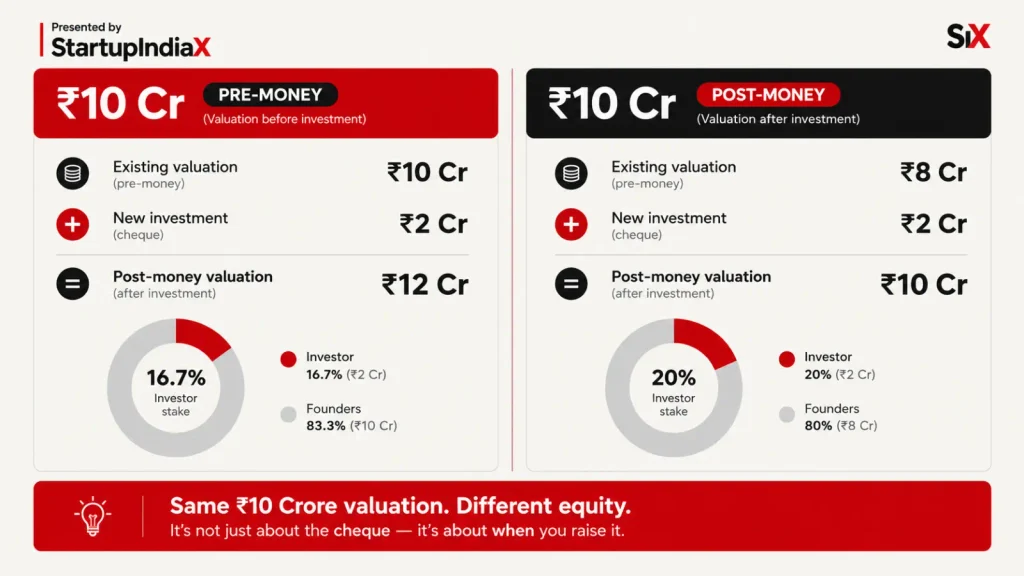
Same headline number. Same cheque. A gap of 3.3 percentage points in ownership, and about ₹2 crore in what the existing shareholders’ stake is worth on paper once the round closes.
That’s why the pre-money vs post-money valuation question isn’t a technicality. It’s the part of the term sheet where equity actually changes hands.
The three lines of maths you need
Skip the textbook. Three relationships cover almost everything:
- Post-money = pre-money + investment
- Investor’s stake = investment ÷ post-money
- Pre-money = post-money – investment
The middle line is the one that bites. An investor’s ownership is worked out on the post-money number, which is why the stake in our example jumps from 16.7% to 20% when only the label changes. A legal explainer on Indian deal terms, published on Mondaq, makes the same point: the existing cap table gets diluted by whatever percentage the investor ends up with.
Want a ballpark for where your own number might land? The Startup Valuation Calculator runs three methods in ₹ crore. To see what each round does to your ownership, plug the result into the Funding Round Dilution Calculator.
The ESOP pool twist most explainers skip
Here’s where it gets sharper. Investors commonly ask for the employee stock option pool to be created or topped up on the pre-money cap table, before their cheque goes in. That lowers the price per share they pay, and the cost lands on the founders and existing holders, not on the investor.
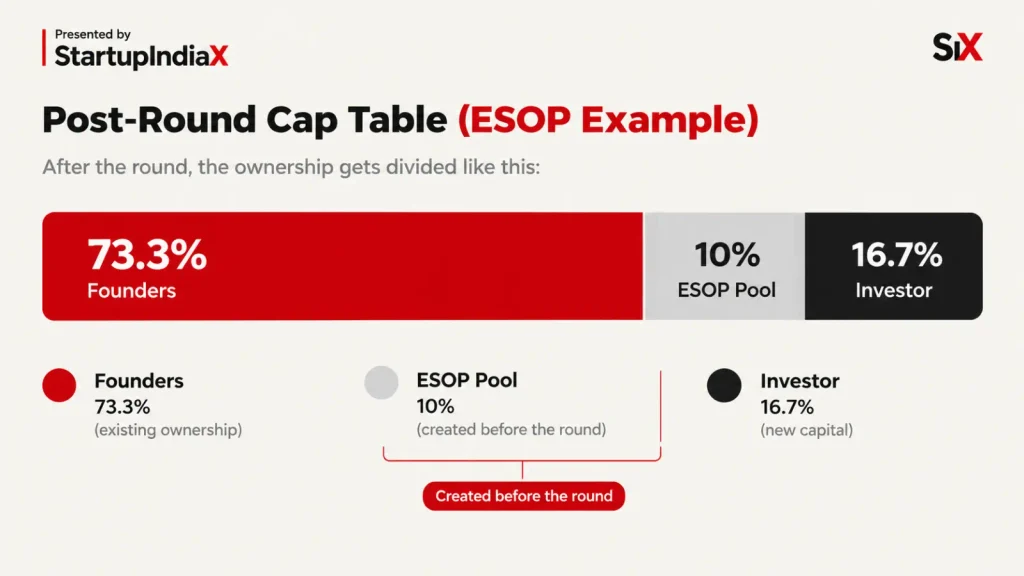
Here’s a hypothetical. Same ₹10 crore pre-money, same ₹2 crore cheque, and the investor wants a pool equal to 10% of the post-round company, created before the round:
- Investor: 16.7%
- ESOP pool: 10%
- Founders and existing holders: 73.3%
That 73.3% is worth ₹8.8 crore on a ₹12 crore post-money valuation. So the “₹10 crore pre-money” you celebrated behaves more like an ₹8.8 crore valuation for the people who built the company.
The pool isn’t a villain. You’ll need it to hire. But it belongs in the negotiation, not in a footnote.
What a funding headline doesn’t tell you
Read any funding report and you’ll find the cheque size and the lead investor. A valuation shows up far less often.
Take Kiddo, the baby-care quick-commerce startup founded by Ankit Kawatra. It announced a ₹12.5 crore pre-seed round led by Campus Fund, with the money going to customer acquisition, dark stores across Delhi NCR, technology and hiring. None of the reports we found gave a valuation. That’s normal for a private pre-seed company, and it’s a reminder of how little a headline number can tell you.
When you do see a valuation in the news, check whether it’s labelled pre or post. Benchmarking your round against a competitor’s can go wrong fast. With a ₹2 crore cheque, a ₹10 crore post-money round is really an ₹8 crore company at the moment of pricing. Compare that with a ₹10 crore pre-money company and you’re calling a ₹2 crore gap a trend.
Our view: treat pre-money as the price you’re negotiating and post-money as the ownership you’re accepting. Model both before you reply to a term sheet.
Before you sign anything
Three habits cost nothing and can protect a few percentage points of your company:
- Ask in writing whether the quoted valuation is pre-money or post-money. The same ₹10 crore can mean 16.7% or 20% for the investor.
- Divide the cheque by the post-money number to get the investor’s stake, then check the cap table agrees.
- Find out whether the ESOP pool is created before or after the round. A pre-money pool quietly lowers what founders effectively sell at.
Know a founder about to sit across a term sheet? Share this with them, and tell us in the comments which part of valuation you’d like explained next. For more tools and guides built for Indian founders, explore the Founder Toolkit.
FAQs
What is the difference between pre-money and post-money valuation?
Pre-money valuation is what a company is worth before new investment comes in. Post-money valuation is its worth right after the money lands, which means pre-money plus the amount invested in the round.
How do you calculate post-money valuation?
Add the investment amount to the pre-money valuation. For example, a ₹10 crore pre-money valuation plus a ₹2 crore cheque gives a ₹12 crore post-money valuation for the company.
How much equity does an investor get in a funding round?
Divide the investment by the post-money valuation. A ₹2 crore cheque at ₹12 crore post-money buys about 16.7%. The same cheque at ₹10 crore post-money buys 20%.
Why does the ESOP pool matter in a valuation?
If the option pool is created before the investment, the dilution falls on founders and existing holders. The investor’s percentage stays intact, so founders effectively sell at a lower valuation than the headline pre-money number.
Should founders confirm whether a valuation is pre-money or post-money?
Yes, and in writing. The same quoted number gives a different investor stake depending on the label, so it should be stated clearly in the term sheet before you agree to anything.