
SUMMARY
- Investors don’t compute one number. They triangulate several methods into a negotiated range, which is why two good investors can land far apart.
- Match method to stage: Berkus or scorecard pre-revenue, VC method at seed, DCF once you have about 18 months of revenue.
- Raise from foreign investors and a certified fair value becomes your legal price floor. Model dilution before you sign.
Your cousin says your startup is worth ₹50 crore. Your co-founder says ₹20 crore. The angel you met last week hinted at ₹8 crore, and now you’re not sure whose math to trust.
Here’s the uncomfortable part: none of them is doing math the way you’d hope. Early-stage valuation is a structured opinion, not arithmetic. A guide from iPleaders points out that two capable investors can look at the same seed-stage company and land on figures that are 2x or more apart.
So why is your number probably wrong? Usually because it came from a gut feeling, a friend, or a headline about somebody else’s unicorn. Investors do something different. They work backwards from the return they need. This guide shows you how, in rupees.
Want to test your own number as you read? Try the free Startup Valuation Calculator. It runs the VC method, a revenue multiple and the scorecard method, all in ₹ crore.
The market sets the mood before you walk in
Indian startups raised $7.62 billion across 759 equity rounds between January and May 2026, an 8.91% drop from the same stretch of 2025, according to Tracxn data cited by advisory firm Treelife. Yet Q1 alone brought in $3.9 billion, and seed plus Series A funding crossed $1 billion in a single quarter for the first time in a while, per Entrackr.
Read that as selective, not frozen. Investors are writing fewer cheques and backing stronger businesses.
Treelife’s indicative pre-money ranges for 2026 give you a rough sense of where rounds land:
| Funding stage | Indicative pre-money (India) | Typical round size |
|---|---|---|
| Pre-seed | ₹3 to ₹10 crore | ₹50 lakh to ₹2 crore |
| Seed | ₹25 to ₹70 crore | ₹3 to ₹12 crore |
| Series A | ₹150 to ₹400 crore | ₹40 to ₹120 crore |
| Series B | ₹450 to ₹1,000 crore | ₹150 to ₹400 crore |
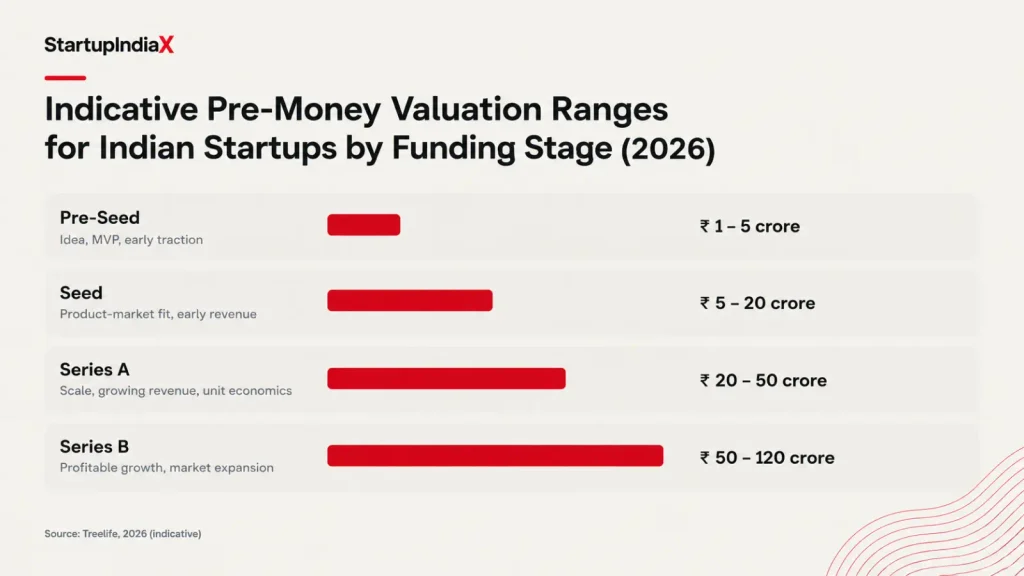
Treat these as guides, not rules. Another 2026 guide, from Incorpx, puts pre-revenue seed rounds in metro cities at roughly ₹3 crore to ₹8 crore. Which tells you how much the “right” number depends on who you ask.
Read More : Free Startup Company Valuation Calculator: Know Your Worth in Under 2 Minutes
Investors don’t pick one method. They triangulate.
Before revenue, there’s nothing to multiply, so investors score risk instead.
The Berkus method gives a capped value (about $500,000 in the original version) to five things: the idea, a prototype, the team, strategic relationships and early rollout. Add them up and the ceiling is roughly $2.5 million. Indian deals usually adjust that downward.
The scorecard method starts from the average valuation of recently funded startups in your region and sector, then adjusts it. The usual weights: team 30%, market size 25%, product 15%, competition 10%, sales channels 10%, funding need 5%, other 5%. Notice who’s at the top. A strong team moves your number more than a clever feature will.
Once revenue shows up, multiples take over. Treelife puts private SaaS at 4x to 8x ARR globally in 2026, with a median around 4.5x, and says Indian multiples typically sit at a discount to global ones. Incorpx suggests 3x to 5x revenue for consumer tech. Both are rough guides, and your own category may differ.
Investors also compare you to others. Outlook Startup’s valuation primer notes that when assessing a company like Swiggy, investors may look at global peers such as DoorDash or Meituan. Your version is simpler: which Indian startups at your stage and sector raised recently, and at what price?
Only at the growth stage, usually after 18 months or more of revenue data, does discounted cash flow (DCF) become the main tool, with comparable-company analysis as a cross-check. Running DCF on a pre-revenue idea is just writing fiction in a spreadsheet.
The VC method: how a ₹500 crore dream becomes today’s price
This is the one that surprises founders, because it starts with the investor’s return, not your business.
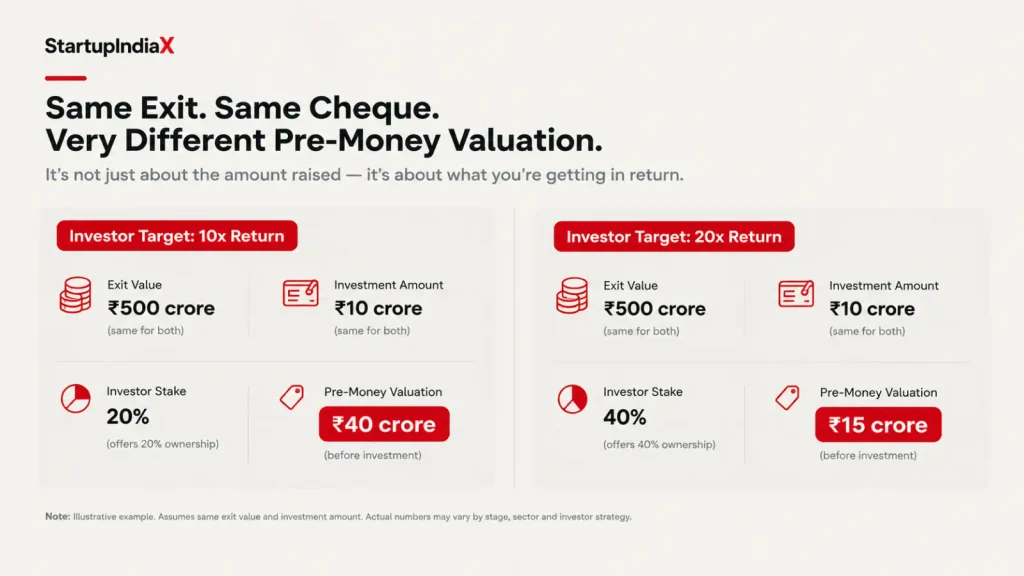
Say an investor thinks your company could sell for ₹500 crore in five years. They put in ₹10 crore and want 10x back, so they need ₹100 crore at exit. That’s a 20% stake. ₹10 crore for 20% means a post-money valuation of ₹50 crore and a pre-money of ₹40 crore. It’s the worked example Treelife uses.
Now watch what happens when the investor asks for more. Seed investors often target 20x to 30x, while Series A investors aim for 10x to 15x, per Ascend Valuations figures cited by Treelife. Keep the same exit and the same ₹10 crore, but ask for 20x. The investor needs ₹200 crore back, which is a 40% stake. Post-money drops to ₹25 crore. Pre-money lands at ₹15 crore.
Same company. Same exit. A pre-money of ₹40 crore or ₹15 crore, depending on the return the investor needs. That gap is where most “my number is wrong” conversations begin.
The pre-money and post-money split matters for your cap table too. Post-money is pre-money plus the new money. With 10 lakh shares outstanding and a ₹40 crore pre-money, the price is ₹4,000 per share, and ₹10 crore buys 2,50,000 new shares.
Raising foreign money? Your price has a legal floor
Here’s the part most valuation guides bury. If you issue shares to a non-resident investor, the RBI doesn’t set a minimum rupee valuation. It demands a process. Rule 21 of the FEMA Non-Debt Instruments Rules, 2019 requires the price to sit at or above a fair value certified by a SEBI-registered merchant banker or a practising chartered accountant, using an internationally accepted method, as Treelife explains.
So your term-sheet number can be higher than the certified fair value. It can’t be lower. After allotment, the company files Form FC-GPR within 30 days, with the valuation report attached.
The sequence that works is simple. Agree commercial terms, commission the valuation before the board meeting that approves the issue, check that your price clears the floor, then sign. Founders who do it backwards often find the problem only when the lawyers start drafting.
One old worry is gone. Angel tax under Section 56(2)(viib) was abolished from 1 April 2025, per Treelife. That doesn’t touch the FEMA floor, though, and secondary share sales below the prescribed fair value can still create tax exposure for buyer and seller. Check specifics with your CA. This article is general information, not legal or tax advice.
How founders overprice themselves, and pay for it later
A high seed valuation feels like a win. It’s often a loan against your future. If you can’t grow into the number by Series A, you face a down round. That can trigger anti-dilution rights for earlier investors, and it leaves employees holding options priced above the new valuation.
Work backwards instead. Decide the Series A valuation you’d need to hit, list the growth milestones that requires, and ask whether you can reach them in 18 to 24 months on the seed money you’re raising.
Then check what you keep. Treelife warns that a founder holding 70% after seed can end up under 25% by Series C if dilution isn’t modelled early, thanks to option-pool top-ups, pro-rata rights and anti-dilution adjustments. Run your own rounds through the free Funding Round Dilution Calculator before you accept a number.
And watch the date on your valuation. A big customer win, a co-founder exit or a pivot changes what the company is worth. Treelife notes the ROC typically expects a valuation report to be no older than about 90 days.
The StartupIndiaX take
Stop hunting for the number. Walk in with a range and the reasoning behind it.
Run at least two methods suited to your stage. Know which comparable rounds you’re pointing to. Know the return the investor needs and how your price shifts if that target moves. And if foreign money is in the picture, know the fair-value floor before the term sheet lands.
Founders who prepare this way don’t win every negotiation. They do avoid the worst ones, where the investor’s spreadsheet is the only spreadsheet in the room.
Valuation is a negotiation, but a prepared founder negotiates from data. Your cousin can keep his opinion.
Three things to carry into your next investor meeting:
- Bring a range built from at least two stage-appropriate methods, not a single number from a friend.
- Know the investor’s target return, because 10x versus 20x can cut your pre-money by more than half.
- Check the FEMA fair-value floor and model dilution through Series C before signing any term sheet.
Where did your last valuation number come from? Tell us in the comments, share this with a founder who’s about to pitch, and explore more free tools in the Founder Toolkit.
FAQs
How do investors value a startup in India?
Investors triangulate. They use methods matched to your stage, such as Berkus or scorecard before revenue, the VC method and revenue multiples at seed, and DCF with comparables later. The result is a negotiated range, not one exact figure.
What’s the difference between pre-money and post-money valuation?
Pre-money is your company’s value before new investment. Post-money is pre-money plus the new money. If you’re valued at ₹40 crore pre-money and raise ₹10 crore, post-money is ₹50 crore and the investor owns 20%.
Is there a minimum startup valuation in India?
The RBI doesn’t set a rupee minimum. For shares issued to non-residents, though, the price must be at or above a fair value certified by a SEBI-registered merchant banker or practising CA under Rule 21 of the FEMA NDI Rules, 2019.
Which valuation method suits a pre-revenue startup?
Berkus and scorecard are the usual picks, since they score risk and compare you to similar funded startups instead of relying on revenue. They help negotiation with domestic investors but aren’t accepted for FEMA fair-value certificates.
Did abolishing angel tax end the need for a valuation?
No. Angel tax under Section 56(2)(viib) was abolished from 1 April 2025, but the FEMA fair-value requirement for shares issued to non-residents still applies. Secondary sales below prescribed fair value can also carry tax consequences, so check with a CA.
How much equity will I give up in a funding round?
Divide the new investment by the post-money valuation. Raising ₹10 crore at a ₹50 crore post-money gives the investor 20%. A higher valuation means less dilution, so model future rounds too, using a dilution calculator.