SUMMARY
- Build the deck as 12 slides: opener, problem, solution, market, product, traction, model, competition, team, financials, ask, close. One message per slide.
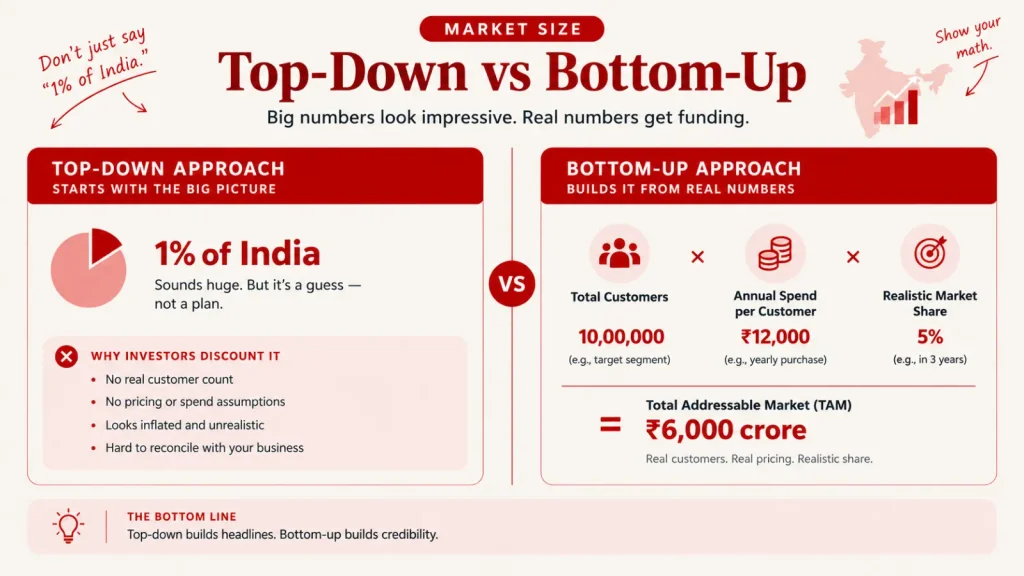
- Size your market bottom-up, with customers and annual spend, because investors discount top-down claims like 1% of India.
- Send a PDF under 8 MB, keep claims reconcilable to your books, and spend your time on traction, not design polish.
Most founders treat the pitch deck like a design project. Investors treat it like a filter.
YourStory’s January 2026 pitch deck playbook says Indian VCs see hundreds of decks a month and spend under four minutes on each. That’s the playbook’s claim, not a measured figure, but the point holds: your deck gets skimmed, not studied.
So the deck has a smaller job than you might think. It doesn’t close a round. It earns the next meeting. Here’s how to build twelve slides that do that, and where Indian investors tend to push back.
Test the story before you open PowerPoint
Here’s a check from the same playbook that’s worth running first. Can you explain your startup in 30 seconds to someone who knows nothing about your industry? If they don’t get the problem and the fix, no slide design will rescue it.
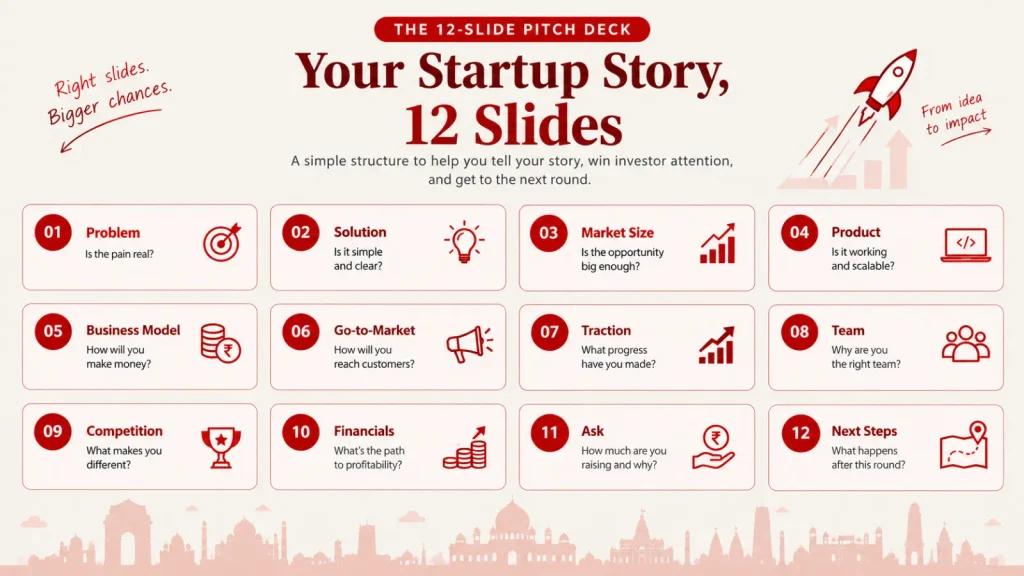
Once that passes, build the deck as a sequence of questions an investor is already asking in their head. Is the pain real? Is the market big enough? Is there proof? Can this team deliver?
The first three slides: hook, pain, fix
Slide 1, the opener. One sentence and, if you have it, one number. YourStory’s advice is to show a clear outcome instead of a vague ambition. “AI for education” tells an investor nothing. A specific result for a specific number of students does.
Slide 2, the problem. Investors back painkillers, not vitamins. Make the pain feel expensive, frequent and urgent, and back it with verifiable data. Skip problems you’ve never lived with yourself.
Slide 3, the solution. Don’t list features. Show the before and after: what life looks like today, and what changes once someone uses your product.
The market slide is where founders lose credibility
Slide 4. Both YourStory and a CA-led guide from CalcGuru say the same thing: Indian investors discount inflated top-down numbers. The fix is a bottom-up calculation. How many customers exist, what do they pay each year, and what share can you realistically win?
A headline figure like the $56 billion baby-care market projection quoted in coverage of Kiddo’s ₹12.5 crore pre-seed round sounds big. But an investor still wants to know how many parents you can reach from your first few dark stores. That’s the number the slide should answer.
Put your assumptions on paper before they go on the slide. The StartupIndiaX TAM/SAM/SOM Calculator is a free way to do that.
Show what works before you show what’s coming
Slide 5, the product. Show what exists today, not what’s on the roadmap. Screenshots of the real thing beat architecture diagrams.
Slide 6, traction. If you have any, this is the slide that matters most. YourStory’s view is that even small numbers beat big claims with no proof: a growing waitlist, early revenue, repeat usage, month-on-month growth. The CalcGuru guide goes a step further and argues investors care more about quality, like retention and revenue concentration, than raw size.
Here’s the uncomfortable part. YourStory’s closing advice is that if traction isn’t there yet, pause the raise and go build it. A mediocre deck with momentum beats a perfect deck with nothing behind it.
The money slides should be boring and believable
Slide 7, the business model. Say exactly how you make money. “We’ll figure out monetisation later” ends the conversation. YourStory suggests a lifetime value of at least three times your customer acquisition cost as a rule of thumb, and says even early estimates beat silence.
Slide 8, competition. Never write “we have no competitors.” It signals you haven’t looked. Name the strong players, say where they’re good, and explain your difference. A comparison chart where you win every row doesn’t help your credibility.
Slide 10, financials. Keep it to an 18 to 24 month operating view with visible assumptions on hiring, pricing and acquisition cost. Going from zero to ₹50 crore in three years with no explanation is the classic hockey stick that costs you trust.
Why this team, and why this amount
Slide 9, the team. Indian investors back people as much as ideas. Show relevant experience and complementary skills. YourStory notes that even a failed earlier startup can add credibility. The CalcGuru guide adds a practical flag: part-time founders tend to get discounted.
Slide 11, the ask. Be specific about how much, what it buys and which milestone it reaches. YourStory’s own example ties ₹2.5 crore at a ₹12 crore pre-money valuation to 18 months of milestones.
Sources split on whether the valuation belongs in the deck at all. CalcGuru suggests stating the amount only and letting pricing come out of the process. We’d say the milestone matters more than either choice. If your raise is at the pre-seed stage, our guide on how to raise pre-seed funding in India covers the cheque sizes and terms behind this slide.
Slide 12, the close. Repeat your core message, your key metric and the ask, and add contact details. If you include a roadmap, keep it to the next 12 to 24 months. Put the cap table, detailed cohort data and any regulatory position in the appendix, not the main arc.
Small details that get decks passed over
- Format: Send a PDF, not an editable file, under 8 MB. The CalcGuru guide suggests 15 slides at most plus an appendix, while YourStory says most funded decks run 10 to 12.
- Claims: Every number should reconcile to your books. That’s the standard diligence applies.
- Cap table: Founders’ majority intact, a clean ESOP pool and DPIIT recognition signal an organised company.
- Cost: If you’re recognised under Startup India, its portal lists a PitchDeck partner offering one free deck build for recognised startups. Check the current terms first.
For a free structure to start from, the Founder Toolkit at StartupIndiaX includes a Pitch Deck Structure Tool.
Before you hit send
- Run the 30-second test, then cut any slide that doesn’t answer an investor’s question.
- Rebuild your market slide bottom-up, with every assumption visible.
- Make sure your ask names a milestone, and save the PDF under 8 MB.
Which slide gives you the most trouble? Tell us in the comments, or share this with a founder who’s about to start raising. For more tools and funding explainers, explore the StartupIndiaX Founder Toolkit.
FAQs
How many slides should a startup pitch deck have in India?
YourStory says most funded Indian decks run 10 to 12 slides. A CalcGuru guide allows up to 15 plus an appendix. Twelve main slides with the detail pushed into an appendix is a safe middle.
What should a pre-revenue pitch deck focus on?
Team, problem and market carry the most weight when there’s no revenue. Show whatever evidence you have: a waitlist, pilots, or early customer conversations. Investors would rather see honest early signals than invented projections.
Should I put my valuation in the pitch deck?
Sources disagree. YourStory’s example includes a pre-money valuation, while CalcGuru advises stating only the raise amount. Whichever you choose, tie the ask to a specific milestone so investors see what the money unlocks.
What file format should I send to investors?
Send a PDF, not an editable file. A CalcGuru guide suggests keeping it under 8 MB and 15 slides or fewer plus an appendix, so it opens easily on a phone.
Is there a free pitch deck tool in India?
The Startup India portal lists a PitchDeck partner that gives recognised startups one free deck build. StartupIndiaX’s Founder Toolkit also has a free Pitch Deck Structure Tool and a TAM/SAM/SOM Calculator.
What is a good LTV to CAC ratio for a pitch deck?
YourStory suggests a lifetime value of at least three times your customer acquisition cost as a rule of thumb. Even a rough early estimate is better than leaving the business model slide vague.