
SUMMARY
- Get free DPIIT recognition first. Most startup-specific schemes, including SISFS, CGSS and SIPP, name recognised startups as eligible.
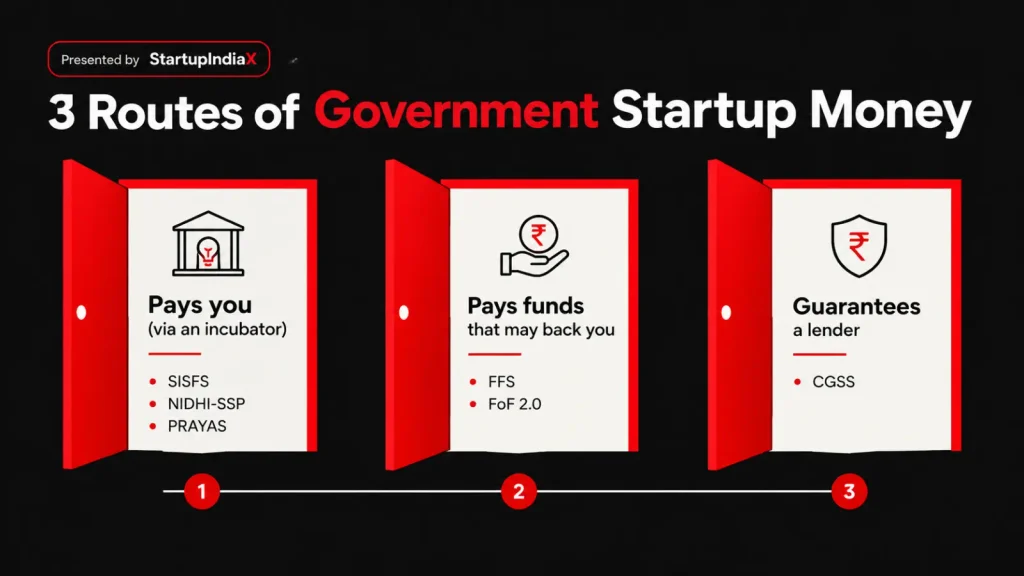
- Fund of Funds money flows through venture funds and CGSS only guarantees lender loans. Your pitch goes to the fund or the lender.
- Check the window first. SISFS applications closed on 31 May 2026, per the playbook, while BIRAC’s BIG grant typically opens calls twice a year.
Here’s a mistake that costs founders weeks: applying for a government scheme that was never built for them.
It’s easy to make. Startup India’s own Startup Schemes Playbook, dated June 2026, lists 65+ central programmes across 35+ ministries, departments and public sector bodies. By the end of 2025, DPIIT had recognised 2,07,135 entities, so the pool of founders chasing this support is big and growing. A long list feels like opportunity. In practice, it hides a sorting problem.
Most government schemes for startups in India don’t hand money to a founder. Some pay an incubator. Some pay a venture fund. Some only promise a bank that the government will share the risk. So this guide sorts them by who actually receives the money, then by stage, so you know what to skip before you lose a weekend to forms.
Start with the one step almost everything depends on
DPIIT recognition is free, and it’s the entry ticket for most startup-specific schemes. In the playbook, SISFS, CGSS, SIPP and GeM Startup Runway all name DPIIT-recognised startups as eligible. Without it, you can be filtered out before anyone reads your pitch.
Read More: DPIIT Recognition Application Mistakes
Tax exemption under Section 80-IAC is a separate approval with its own rules, so don’t assume recognition covers it.
Read More: Section 80-IAC Tax Exemption Explained
The money that never reaches you directly
The biggest number in the playbook is also the most misunderstood. The Fund of Funds for Startups carries a corpus of ₹10,000 crore, run by SIDBI. Startup India Fund of Funds 2.0 adds another ₹10,000 crore. Neither writes a cheque to a startup.
Both put capital into SEBI-registered Category I and II alternative investment funds. Those funds then invest in DPIIT-recognised startups. Under the first fund, supported AIFs have to invest at least twice what they receive from the scheme.
DPIIT released the FoF 2.0 operational guidelines in April 2026. They group funds into segments that include deep tech funds, micro VCs backing early-growth startups, and technology-led manufacturing funds.
So what does that mean for you? Your “application” is really a pitch. Being a recognised startup makes you eligible, but it doesn’t make you chosen. Find which funds get commitments, check their stage and sector, and approach them like any other investor.
The wider effect is worth watching. For smaller funds, FoF 2.0 is a fundraising door. If it works, more domestic early-stage cheques could exist. The names of the funds that get selected will show where that money sits.
Read More: How to Raise Startup Funding in India 2026
A guarantee isn’t a grant
The same sorting applies to debt. The Credit Guarantee Scheme for Startups, run by NCGTC, gives cover to lenders, up to ₹20 crore or the outstanding credit, whichever is less. You borrow from a bank, NBFC or AIF that’s a member institution. DPIIT puts nothing in your account. What you gain is a loan without collateral that a lender might otherwise have refused. The Jan Samarth portal is one application route the playbook lists.
Mudra and Stand-Up India are easier to misread. Mudra loans go up to ₹10 lakh and target non-corporate, non-farm micro and small enterprises. Stand-Up India covers ₹10 lakh to ₹1 crore for greenfield businesses with at least one SC/ST or woman borrower. Both are bank loans with entity conditions, so check the fit before you queue at a branch.
Schemes that fund the incubator, not the founder
Read Part B of the playbook and a pattern shows up. NIDHI-TBI, i-TBI, Centres of Excellence, Atal Incubation Centres, Atal Community Innovation Centres and the Established Incubation Centres scheme all pay incubators. Atal Incubation Centres, for instance, get up to ₹10 crore each. Startups benefit through services, not a transfer. Atal Tinkering Labs go to schools.
None of those has a form for your startup. But your choice of incubator matters a lot, because many founder-facing grants run through one. SISFS, NIDHI-SSP, BIRAC’s SEED fund, the RKVY agri grants and NIDHI-PRAYAS all route money through approved incubators or centres.
Before you pitch for a seat, ask which of these schemes that incubator can actually disburse.
The window that already closed
Take the Startup India Seed Fund Scheme. It offers up to ₹20 lakh as a grant for proof of concept, prototype or product trials. It also offers up to ₹50 lakh through convertible debentures or debt-linked instruments for market entry and scaling. The startup must be recognised, no more than two years old, and shouldn’t have received more than ₹10 lakh from other central or state schemes.
Plenty of guides still tell founders to apply. The June 2026 playbook says the last date to apply under SISFS was 31 May 2026, with disbursals continuing. Check the official SISFS portal for a fresh window before you build an application around it.
Timing bites elsewhere too. BIRAC’s Biotechnology Ignition Grant, up to ₹50 lakh for up to 18 months, typically opens national calls around 1 January and 1 July, each open for 30 to 45 days. Miss one and you wait.
Read More: Startup India Seed Fund Scheme: Incubators and Eligibility
Match the scheme to your stage
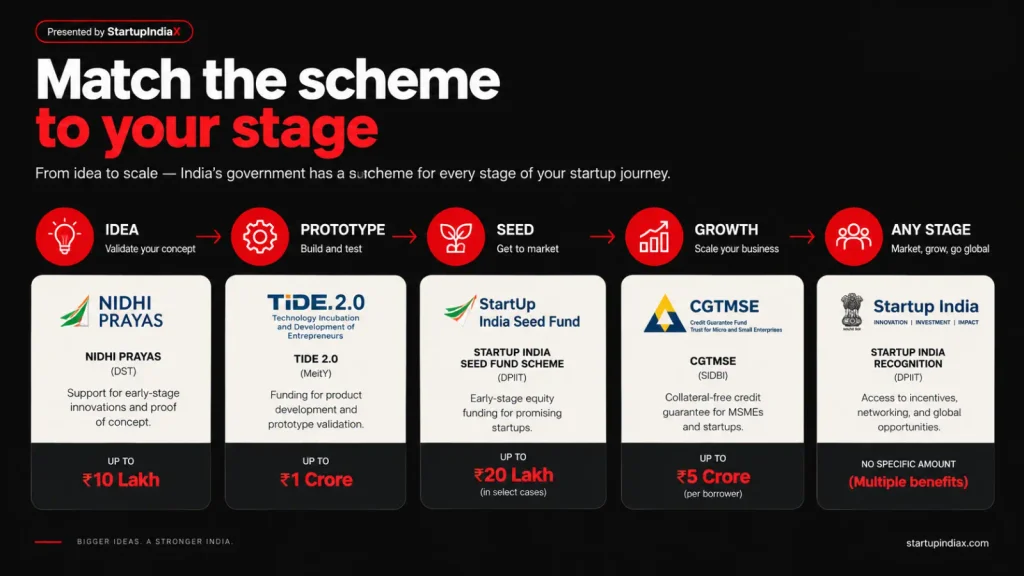
Once you’ve cleared the “wrong door” schemes, the useful ones sort out fast. Amounts below come from the playbook’s summary tables, so confirm each on the official page before applying.
| Stage | Scheme | What it offers | Route |
|---|---|---|---|
| Idea, pre-startup | NIDHI-EIR | ₹10,000 to ₹30,000 a month for 12 months | Via NIDHI-supported incubators |
| Idea to prototype | NIDHI-PRAYAS 2.0 | Up to ₹20 lakh, or ₹40 lakh for deep tech | Via PRAYAS Centres; startup up to 5 years old, turnover up to ₹1 crore |
| Seed | NIDHI-SSP | Up to ₹1 crore, subject to incubator guidelines | Via incubators, after three months of residency |
| Seed, Tier II and III | GENESIS | ₹10 lakh to ₹1 crore for deep tech | Via implementing agencies |
| Seed to growth, software | SAMRIDH | Up to ₹40 lakh with matching private money | Via selected accelerators |
| Growth, equity | FFS and FoF 2.0 | Equity via venture funds | Pitch the AIFs |
| Growth, debt | CGSS | Guarantee up to ₹20 crore | Bank, NBFC or AIF |
| Deep tech scaling | RDI Scheme | Loan up to 50% of project cost, or equity up to 50% of a round | Via second-level fund managers |
| Any stage | SIPP | Facilitator fees covered; 80% rebate on patent fees, 50% on trademark and design | IP India facilitators |
| Any stage | GeM Startup Runway | Exemption from prior turnover, experience and EMD rules | Apply on GeM |
Sector schemes often carry bigger numbers. iDEX offers defence grants of ₹1.5 crore to ₹10 crore, and ADITI goes up to ₹25 crore. IN-SPACe’s seed grant is ₹1 crore for space-tech, DCIS goes up to ₹50 lakh for telecom, and RKVY offers up to ₹25 lakh for agri. If you build in one of those areas, start there instead of the general schemes.
Where we’d start
Here’s our read: spend your first month on the cheap, certain steps.
Get DPIIT recognition. File through SIPP if you’re building IP, since facilitator fees are covered. List on GeM if government could be a customer. Pick an incubator based on which scheme it can disburse. Only then start courting funds and lenders.
And read the instrument before you celebrate. SISFS’s ₹50 lakh part is convertible debt, not a gift. If you’re weighing a convertible or an equity route, run the numbers in the Funding Round Dilution Calculator first. To filter schemes by your stage and sector, try the Government Scheme Finder in the StartupIndiaX Founder Toolkit.
Three things to take with you:
- Sort every scheme by who receives the money: you, an incubator, a venture fund or a lender.
- Pick your incubator for the schemes it can disburse, not just its address.
- Verify every window and limit on the official portal before you apply.
Have you applied for a scheme and found out halfway that you weren’t eligible? Tell us which one in the comments, and share this with a founder who’s still filling out forms.
FAQs
What are the main government schemes for startups in India in 2026?
The core DPIIT schemes are SISFS for seed support through incubators, the Fund of Funds and FoF 2.0 for venture capital, CGSS for collateral-free loans, and SIPP for IP costs. Sector schemes like iDEX and BIRAC’s BIG sit alongside them.
Do I need DPIIT recognition before applying?
For most startup-specific schemes, yes. SISFS, CGSS, SIPP and GeM Startup Runway all name DPIIT-recognised startups as eligible. Recognition is free, so it’s usually the first step before you look at any scheme.
Can a startup apply directly to the ₹10,000 crore Fund of Funds 2.0?
No. Applications come from SEBI-registered Category I and II AIFs, and SIDBI manages the process. Startups approach the selected venture funds for investment, so your job is pitching those funds, not the government.
Is the Startup India Seed Fund Scheme still accepting applications?
According to the June 2026 Startup India playbook, the last date to apply was 31 May 2026, though disbursals continue. Check the SISFS portal for any new window before you spend time preparing an application.
How does the Credit Guarantee Scheme for Startups help a founder?
CGSS guarantees part of a loan so lenders can offer it without collateral, up to ₹20 crore. The startup borrows from a bank, NBFC or AIF and receives nothing directly from DPIIT.
Where can I see every central scheme for startups in one place?
Startup India publishes a Startup Schemes Playbook, dated June 2026, covering 65+ central schemes with eligibility and how to apply. It says it may not be exhaustive, so confirm details on each scheme’s official page.