startupindiax.com
  • Home
  • News
  • Startup Stories
  • Funding
  • Founder Toolkit
    • Startup Valuation Calculator
    • Startup Runway Calculator
    • Indian VC & Investor Database
    • Co-founder Equity Split Calculator
    • Government Scheme Finderfor Indian Startups
    • Pitch Deck Structure Tool
    • Market Size Calculator TAM · SAM · SOM
    • Find the perfect startup name
    • Funding Round Dilution Calculator
  • Sectors
    • Agritech
    • AI & DeepTech
    • Fintech
    • Green Energy
    • HealthTech
    • EV
    • Digital
    • Automobile
startupindiax.com
SUBSCRIBE
Monday, October 5, 2026
  • Home
  • News
  • Startup Stories
  • Funding
  • Founder Toolkit
    • Startup Valuation Calculator
    • Startup Runway Calculator
    • Indian VC & Investor Database
    • Co-founder Equity Split Calculator
    • Government Scheme Finderfor Indian Startups
    • Pitch Deck Structure Tool
    • Market Size Calculator TAM · SAM · SOM
    • Find the perfect startup name
    • Funding Round Dilution Calculator
  • Sectors
    • Agritech
    • AI & DeepTech
    • Fintech
    • Green Energy
    • HealthTech
    • EV
    • Digital
    • Automobile
startupindiax.com
startupindiax.com
  • Privacy Policy
  • Disclaimer
  • Terms

@2025 - All Right Reserved.

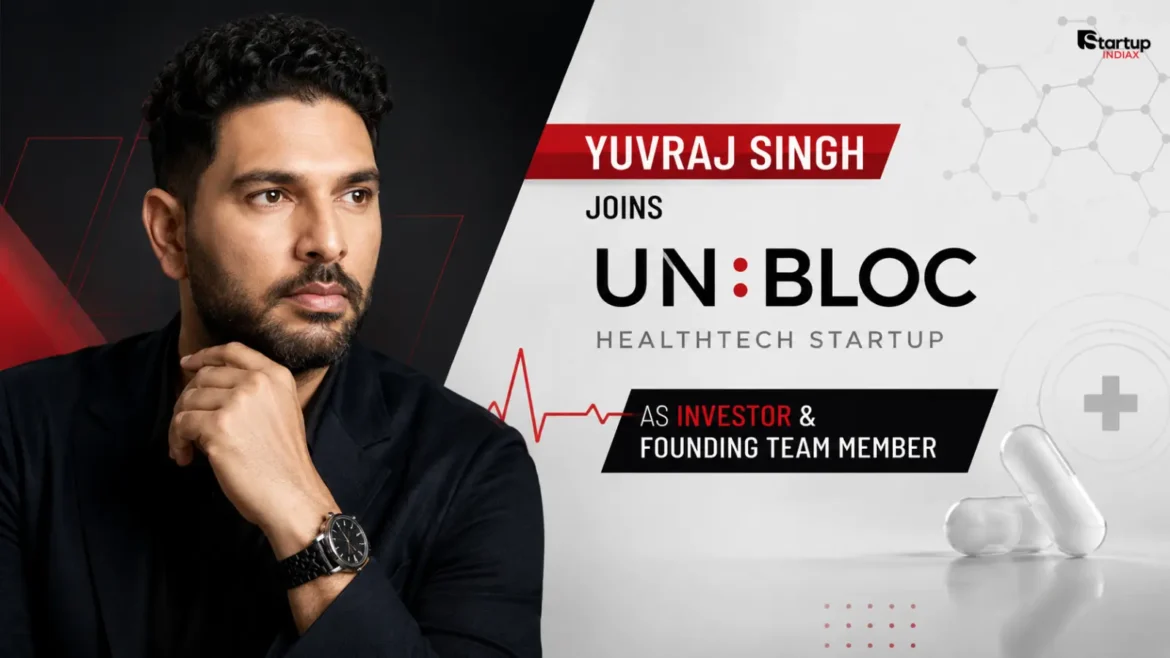
Yuvraj Singh joins UN:BLOC healthtech startup as investor and founding team member
Startup StoriesFundingHealthTech

Yuvraj Singh Is Betting on Deepak Sahni Again, Before UN:BLOC Even Has a Product

Cricketer joins Healthians founder's stealth healthtech venture as investor and founding team member, marking their second startup partnership in over a decade
by Aalam Rohile August 5, 2026
3 min read

Summary

  • Yuvraj Singh has joined UN:BLOC, Deepak Sahni’s stealth-mode healthtech startup, as an investor and founding team member.
  • Sahni, who built Healthians into a major at-home diagnostics platform, stepped back from daily operations there in January 2026.
  • UN:BLOC is raising a pre-launch round from founders and healthcare leaders; product details remain undisclosed.

Yuvraj Singh has done this before. Back in 2015, when Deepak Sahni was building Healthians into one of India’s largest at-home diagnostics networks, Yuvraj backed him through his fund YouWeCan Ventures, at a stage when institutional money was still hard to come by for the company.

A decade later, Sahni is starting over. And Yuvraj is showing up again, this time even earlier.

Yuvraj has joined UN:BLOC, Sahni’s new healthtech venture, as both an investor and a member of the founding team. The company is still in stealth. There’s no product to try, no launch date, and barely any public detail about what it actually does. Yuvraj is committing anyway.

What UN:BLOC is trying to build

Sahni founded UN:BLOC earlier this year, not long after stepping down from day-to-day responsibilities at Healthians in January 2026 to, in his own words, focus on solving deeper problems in healthcare and building new ventures with more clarity. Healthians made diagnostic testing accessible at scale. UN:BLOC is aiming at something bigger and messier: chronic disease management.

The pitch, as far as it’s been shared, is a shift away from treating chronic illness as something to be managed with medication for life. Instead, UN:BLOC wants to build an AI-powered platform that goes after the root cause, spanning early diagnosis, treatment and ongoing disease management under one system. Headquartered in Gurugram, the company says it wants to focus on areas of healthcare that have received relatively less attention.

That’s still a broad, early-stage framing. No product architecture, timeline, or specific disease focus has been made public yet, and Startup INDIAX is flagging that as unconfirmed until UN:BLOC shares more.

Read More : Stop Googling for Startup Templates. We Built You a Free Founder Toolkit for Startup Needs in 2026.

A relationship, not just a round

What makes this deal worth writing about isn’t the size of the check. It’s the timing. UN:BLOC’s model and product are still being kept under wraps, which means Yuvraj is committing before the wider world knows what the company is actually building. He’s betting on the founder, not the pitch deck.
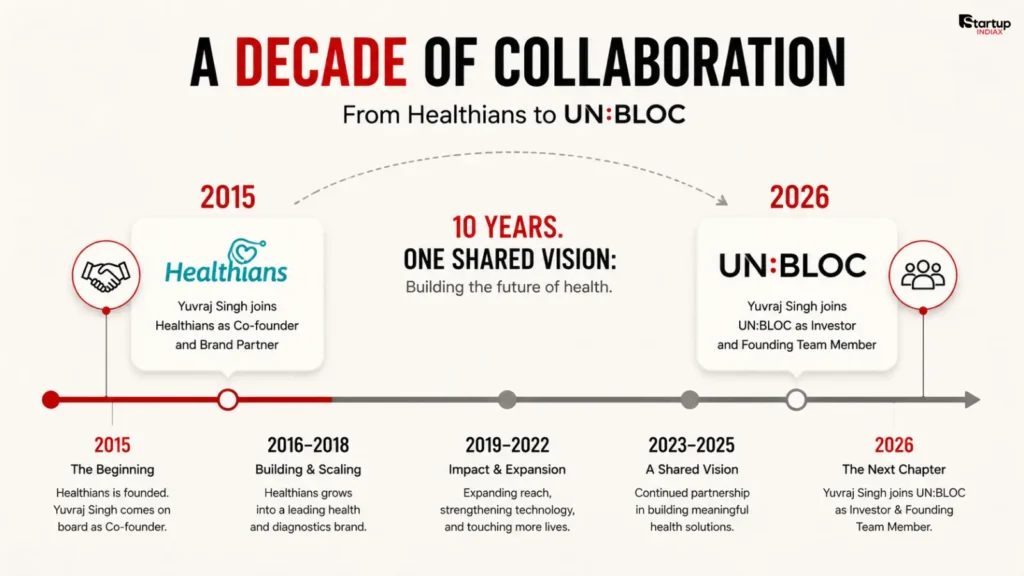
Timeline of Yuvraj Singh and Deepak Sahni's decade-long startup partnership

Sahni has been direct about what that means to him. “Yuvi backed me when I was building Healthians, at a time when very few people did,” he said, adding that having him return as an investor and founding team member “means a great deal to me personally.” Yuvraj, for his part, has described knowing Sahni for over twelve years and believing UN:BLOC has the potential to change how people think about health.

The company is currently raising a pre-launch round from a small circle of founders, healthcare leaders and business executives. No funding amount has been disclosed, and this should be read as an early, developing story rather than a closed round.

Read More : From Rs 5,000 to Rs 50 Crore: Parul Gulati’s Unlikely Startup Playbook

The bigger pattern: cricketers as repeat startup backers

UN:BLOC isn’t happening in isolation. Indian cricketers have increasingly moved from brand ambassadors to startup investors over the past decade, with more than 20 current and former players now holding stakes across fintech, healthtech, D2C, fitness, gaming, EVs and consumer products. Virat Kohli has built one of the largest athlete-led investment portfolios in the country, while MS Dhoni, Jasprit Bumrah and Hardik Pandya have all backed gaming startup LightFury Games.
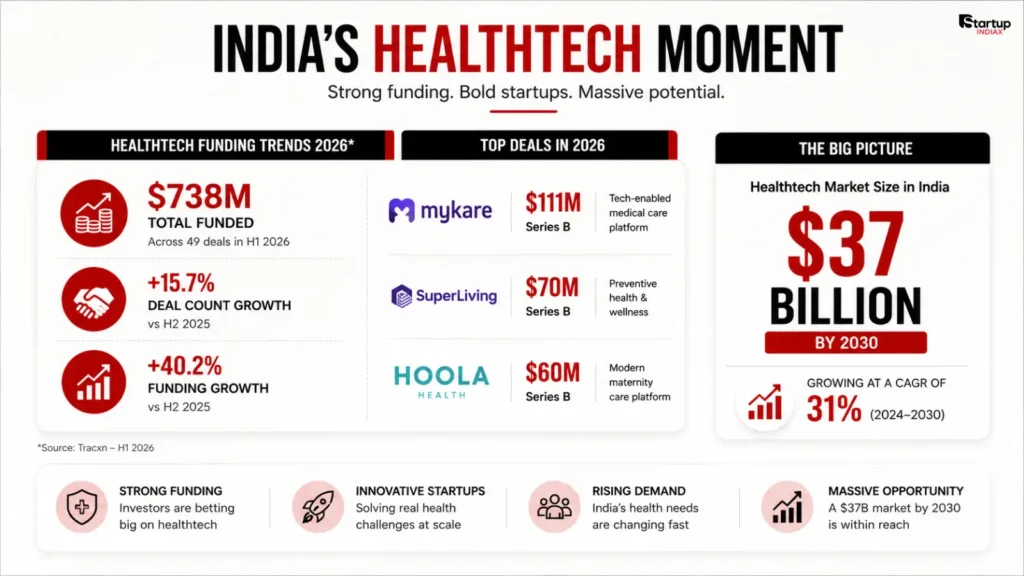
India healthtech funding trend 2026 and market growth projection

Yuvraj’s angle is narrower and arguably more interesting: he isn’t spreading bets across sectors, he’s doubling down on one founder he’s watched build a company from scratch before. That’s a different kind of conviction than a celebrity checking a box on a hot sector.

It also lands at a moment when Indian healthtech is drawing real institutional money, not just celebrity interest. Preventive healthcare platform CENT, founded by Practo’s co-founder Shashank ND, is building precision radiology tools to catch diseases before symptoms appear. In June, healthtech startup Mykare raised an additional $1 million, AI-native platform SuperLiving closed a $7 million Series A led by Lightspeed, and paediatric care brand Hoola Health secured $5 million from Peak XV’s Surge. Analysts peg India’s homegrown healthtech opportunity at roughly $37 billion by 2030.

Read More : Ashneer Grover Launches Fund My Staff: What It Is, How It Works, Who It’s For

Why founders should be watching this

For early-stage founders, the UN:BLOC story is less about the specific startup and more about what it says about fundraising leverage. Sahni didn’t need a working product, a website, or even a disclosed thesis to get a marquee name into his founding team. He needed a track record and a relationship he’d invested in years earlier.

That’s not a repeatable trick for most first-time founders. But it’s a reminder that in India’s current healthtech climate, with AI tooling and post-pandemic consumer awareness pushing serious capital toward the sector, reputation and prior execution are starting to matter as much as the pitch itself, especially at the earliest, riskiest stage.

UN:BLOC still has to prove it can build what it says it wants to build. But it’s already proven something else: that a decade-old bet, paid back once, can buy a founder a running start the second time around.

Got thoughts on cricketers building serious startup portfolios, or on what UN:BLOC might actually launch with? Drop them in the comments, and keep an eye on Startup INDIAX for updates as more details on UN:BLOC surface.

FAQs

What is UN:BLOC?

UN:BLOC is a stealth-mode healthtech startup founded by Deepak Sahni, aiming to build an AI-powered platform for chronic disease management covering diagnosis, treatment and long-term care.

Why did Yuvraj Singh invest in UN:BLOC?

Yuvraj Singh has a prior relationship with founder Deepak Sahni, having backed his earlier company Healthians in 2015 through YouWeCan Ventures. He’s joined UN:BLOC as both an investor and founding team member.

What is Deepak Sahni’s background?

Sahni founded Healthians in 2014, growing it into one of India’s largest at-home diagnostics networks, before stepping back from daily operations in January 2026 to build new healthcare ventures.

How much funding has UN:BLOC raised?

The company hasn’t disclosed a funding amount. It’s currently raising a pre-launch round from a small group of founders, healthcare leaders and business executives.

When will UN:BLOC launch?

No launch timeline or product details have been made public. The company remains in stealth mode.

Is Yuvraj Singh’s involvement his first startup investment?

No. Yuvraj has invested in startups before through YouWeCan Ventures, including Healthians in 2015. UN:BLOC marks his second collaboration specifically with founder Deepak Sahni.
August 5, 2026 0 comments 171 views
FacebookTwitterLinkedinWhatsapp
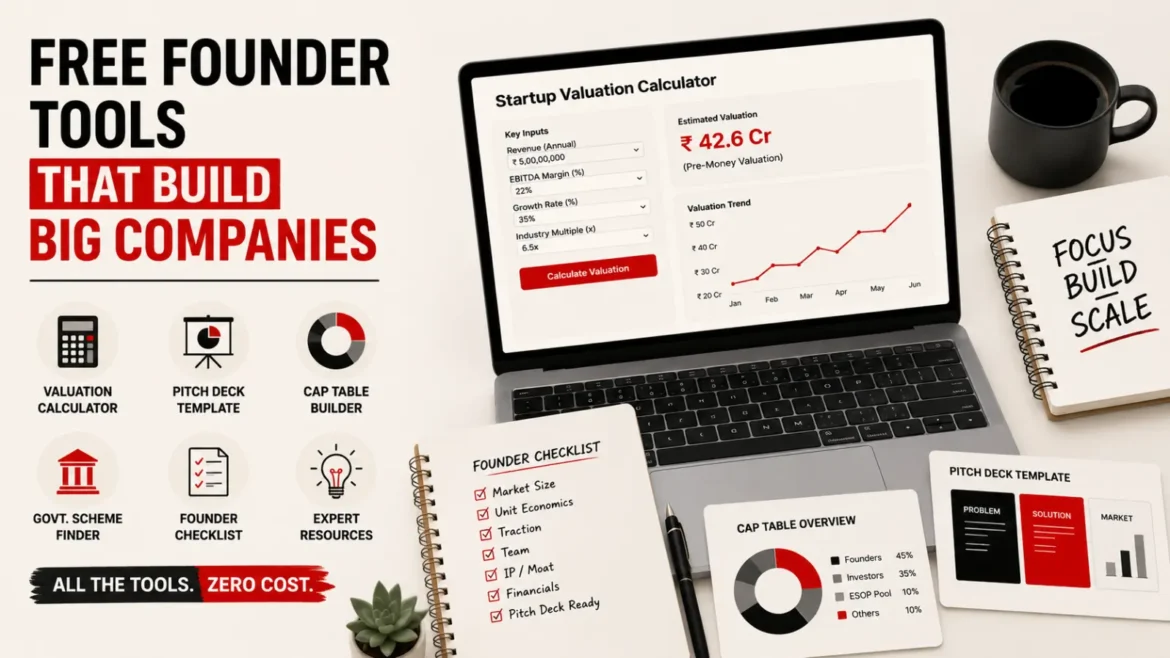
Founder desk with laptop showing a startup valuation dashboard, representing Startup INDIAX free founder toolkit
Founder ToolkitStartup Learning

Stop Googling for Startup Templates. We Built You a Free Founder Toolkit for Startup Needs in 2026.

9 free, no-login tools for Indian founders, from idea to term sheet
by Aalam Rohile August 4, 2026
3 min read

Summary

  • Startup INDIAX’s Founder Toolkit bundles 9 free, no-login calculators and tools built specifically for Indian founders.
  • Every tool runs on Indian Crore values, Indian VC benchmarks, and India-specific stage definitions, not US templates.
  • From naming your company to finding the right investor, the toolkit covers the full pre-fundraise founder journey in one place.

If you’ve built anything in India’s startup ecosystem, you know the drill. You need a cap table, so you download three different Excel templates and none of them account for how Indian ESOPs actually vest. You need a valuation range before a coffee meeting with an angel, so you open five browser tabs, half of them written for Silicon Valley. You need to check if your startup qualifies for a DPIIT scheme, and you end up on a government portal that hasn’t been updated since the last budget.

We got tired of watching founders lose hours to this. So we built a Founder Toolkit, nine free tools, hosted directly at startupindiax.com/tools, with no signup, no paywall, and no US-first assumptions baked into the math.

Why this isn’t another “best tools for startups” roundup

Most founder tool lists just link out to other people’s software, half of which wants your card details after a two-week trial. Ours is different because we built the tools ourselves, specifically for the numbers Indian founders deal with: valuations in crores, not dollars, VC stage definitions that match how funds like Sequoia India, Blume, and 3one4 actually structure rounds, and government schemes that are actually live in 2026.

Where Each Toolkit Tool Fits in Your Founder Journey

Startup INDIAX Founder Toolkit — tools mapped to stage

Idea & Naming 1 tool Building the Pitch 3 tools Fundraising Prep 1 tool Cash & Runway 1 tool Team & Equity 2 tools Investor & Govt Access 2 tools

Idea & Naming: Startup Name Generator  |  Building the Pitch: TAM/SAM/SOM, Valuation, Pitch Deck Tool  |  Fundraising Prep: Valuation Calculator  |  Cash & Runway: Runway Calculator  |  Team & Equity: Equity Split, Dilution  |  Investor & Govt Access: Investor Matchmaker, Govt Scheme Finder

Every tool on the list below is a standalone calculator you can open, use, and walk away from in minutes. Here’s what’s in it, why each one matters, and how to actually use it.

Start with a name nobody else is using

Startup Name Generator (try it here) sounds like the smallest tool in the kit, but it solves a real early-stage problem: founders burn weeks on naming, only to discover the domain’s taken or the name already exists as a registered trademark.

Why it matters: A weak or already-claimed name creates legal and branding headaches you don’t want to inherit six months in.

How to use it: Feed it your sector, target audience, and the personality you want the brand to have. It generates AI-suggested names, including options rooted in Hindi and Sanskrit if you want that flavour, and checks domain availability across .com, .in, .io, and a few others in the same pass, along with a brandability score so you’re not choosing on gut feel alone.

Before you talk to a single investor, know your own numbers

Three tools in the kit exist purely so you don’t walk into a pitch meeting guessing.

TAM / SAM / SOM Calculator (open it) sizes your market the way Indian VCs actually expect to see it, both bottom-up and top-down, and spits out pitch-ready visuals instead of a spreadsheet only you understand.

Startup Valuation Calculator (open it) is the most-used tool in the kit, and for good reason. It runs three separate valuation methods, the VC method, revenue multiple, and scorecard method, side by side, with every output in Indian Crores. You’re not guessing at a number to defend; you’ve got three defensible ones.

Pitch Deck Structure Tool (open it) walks you slide by slide through what Indian investors actually want to see at Seed, Series A, and Series B+, including the mistakes that get decks rejected before the first meeting.

How to use them together: Size your market first, then run your valuation, then structure your deck around both. That order matters more than most first-time founders realize, a deck built before you’ve sized your market tends to fall apart under investor questions.

Read More: How to Apply for Startup India Certificate in 5 Easy Steps

Every rupee you raise changes who owns your company

This is the part of fundraising that founders understand least, and it’s where the toolkit does the most work.

Co-founder Equity Split Calculator (open it) helps you and your co-founders divide equity based on actual contribution, risk taken, and commitment, not just a gut-feel 50-50 split that causes resentment later. It factors in eight variables, shows a live donut chart of the split, and recommends a vesting schedule with Indian legal context.

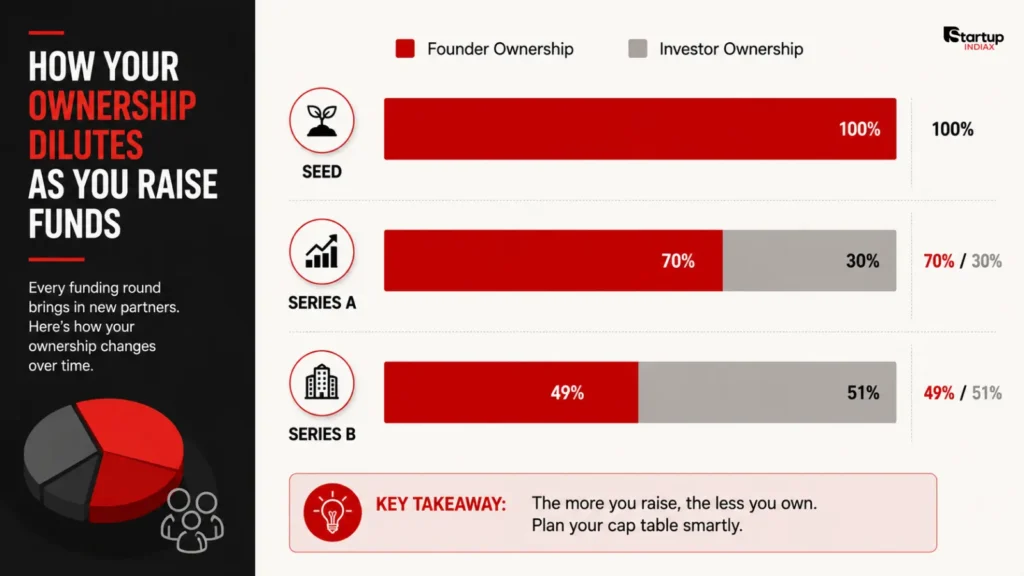
Funding Round Dilution Calculator (open it) tracks exactly how your ownership shrinks with every round, Seed through Series B, with a colour-coded cap table so you can see the dilution coming before you sign a term sheet, not after.

Cap table chart showing founder equity dilution across funding rounds

Why this matters: Founders who skip this step tend to find out too late that a generous early hire grant or a poorly negotiated Series A left them with a smaller slice than they expected. Bootstrapped founders in particular, the kind Startup INDIAX covers often in D2C and Shark Tank India stories, tend to guard equity fiercely for exactly this reason.

Read More: Startup India Certificate 2026: Step-by-Step Guide

Cash runs out faster than most founders think

Startup Runway Calculator (open it) tells you, in plain numbers, how many months of cash you have left, when you’ll hit zero at your current burn rate, and what changes actually extend your survival window. It runs six burn-rate scenarios so you can stress-test decisions like a new hire or an ad spend increase before you make them, not after the bank balance tells you.

How to use it: Update it monthly, not once at the start of the year. Runway math changes every time your burn rate or revenue does, and founders who only check it during a crisis are usually already in one.

Read More: Tsenta: Indian Students’ AI Job Startup Bags ₹5 Cr From YC

Finding the right investor, and the government money founders leave on the table

Investor Matchmaker (open it) filters India’s VCs, micro-VCs, and angel networks by sector, stage, and cheque size, with direct apply links instead of a cold LinkedIn message into the void.

Government Scheme Finder (open it) filters more than 30 central government grants, tax benefits, and loans by sector and stage, covering DPIIT, MSME, DST, and BIRAC programs. Non-dilutive money is still money, and most founders never check whether they qualify.

Read More: Top 10 Government Schemes Boosting AgriTech and Rural Startups

What’s actually free here, and what isn’t

Every one of these nine tools works instantly in your browser. No account, no email capture, no “free trial” that quietly starts billing you in week three. That’s a deliberate choice, not a limited-time offer.

To put it plainly: this toolkit puts nine tools that used to mean separate spreadsheets, consultant calls, or paid SaaS trials into one free hub built specifically for Indian founders, running on Indian numbers, and it gets new additions every month.

Bookmark startupindiax.com/tools. Use whichever tool solves today’s problem, not all nine at once.

9 Free Tools, by Category

Startup INDIAX Founder Toolkit breakdown

9 tools
Fundraising Prep (3) Financial Planning (1) Team & Equity (2) Investor & Govt Access (2) Branding (1)

What’s the one founder problem you wish had a free calculator? Tell us in the comments, we’re building the next tool based on what founders actually ask for.

Read More: Airtel Adobe Express Free: 12-Month Premium Worth ₹4,000

FAQs

What is the Startup INDIAX Founder Toolkit?

It’s a set of 9 free, no-login tools built for Indian startup founders, covering valuation, fundraising, pitch decks, equity splits, runway, and government schemes, all in one place.

Is the Founder Toolkit really free?

Yes. Every tool is free with no account, no email capture, and no paid tier. Startup INDIAX has stated all nine tools stay free.

Which tool should a first-time founder use first?

Most founders start with the Startup Valuation Calculator or the Startup Name Generator, depending on whether they’re pre-idea or already pitching investors.

Do the calculators work for bootstrapped founders too?

Yes. The Runway Calculator, Equity Split Calculator, and Government Scheme Finder are all useful whether or not you’re raising outside capital.

How often is the Government Scheme Finder updated?

It currently indexes 30+ central schemes across DPIIT, MSME, DST, and BIRAC, and Startup INDIAX adds new tools and updates existing ones monthly.

Can I embed these tools on my own site?

Each tool is built as a standalone, WordPress-ready HTML file that can be pasted into a Custom HTML block, according to the toolkit’s own listing.

August 4, 2026 0 comments 140 views
FacebookTwitterLinkedinWhatsapp
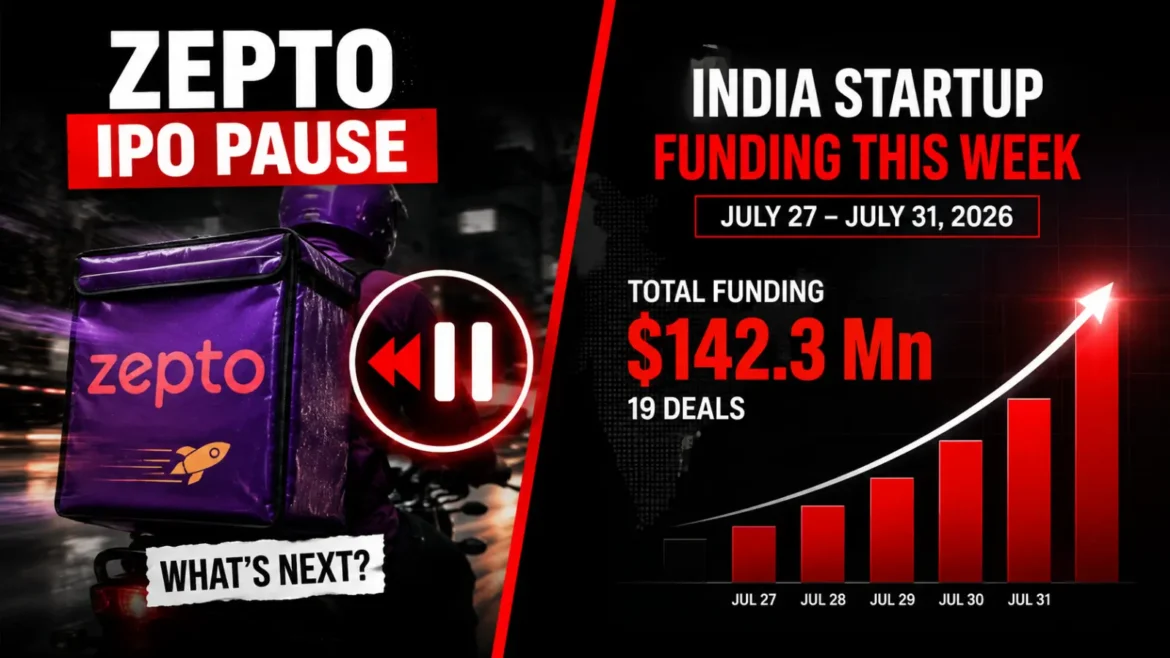
Zepto IPO pause and India startup funding this week July 27-31 2026 infographic
NewsFunding

Zepto Just Pulled Its IPO. Here’s Everything Else That Happened in Indian Startup Funding This Week

by Aalam Rohile August 3, 2026
3 min read

Summary

  • Zepto deferred its ₹8,010 Cr IPO and is instead raising about ₹1,000 Cr ($105 Mn) from domestic investors after public market bids came in far below its $7 Bn private valuation.
  • Indian startups raised $142.3 Mn across 11 deals between July 27 and 31, down 32% from $209.1 Mn the week before, with AI pulling in $92.8 Mn of that total.
  • Founders eyeing 2026 listings should watch Atomberg, Klassroom and Table Space, all of which moved on IPO plans the same week Zepto pulled back.
India Startup Funding: 5-Week Trend

India Startup Funding: 5-Week Trend

Weekly capital raised, June 29 – July 31, 2026 ($ Mn)

$0M $75M $150M $225M $300M $125.7M $132.1M $297.3M $209.1M $142.3MJun 29-Jul 4 Jul 6-11 Jul 13-18 Jul 20-25 Jul 27-31

Zepto was supposed to be one of 2026’s marquee startup listings. Instead, it just became the biggest reminder yet that Indian public markets are pricing new-age tech very differently than private investors do.

The quick commerce company deferred its IPO in the last week of July, choosing instead to raise around ₹1,000 crore (roughly $105 million) through a pre-IPO placement from domestic investors. That’s a sharp comedown for a company that had filed an updated draft red herring prospectus proposing a fresh issue of ₹8,010 crore plus an offer for sale of over 11 crore existing shares, and was reportedly eyeing a July listing.

The gap came down to price. Zepto raised $450 million in October 2025 at a $7 billion valuation. When it tested the waters with public market investors this year, the bids came back between $2.5 billion and $3 billion, less than half. That’s a hard number for any founder to swallow, and it’s not really about Zepto’s growth. Revenue reportedly doubled in FY26. It’s about how differently mutual funds and insurers value a still-loss-making business compared to venture investors who can afford to wait.

Zepto isn’t alone in this. Curefoods, PhonePe and Flipkart have all pushed their own listing timelines this year for similar reasons. The pattern across 2026 IPO-bound startups is becoming hard to miss: growth alone doesn’t buy a premium multiple anymore, profitability discipline does.

The Rest of India’s Funding Week Was Quieter, and AI Still Won It

Take Zepto out of the picture, and it was a slow week for fresh capital. Indian startups raised $142.3 million across 11 deals between July 27 and 31, down about 32% from the $209.1 million raised across 14 deals the previous week.

AI was the only sector that really showed up. Three AI deals brought in $92.8 million, nearly two-thirds of the week’s total, led by enterprise AI startup Freehand, which raised $75 million from Battery Ventures and NewRoad Capital Partners, with Nexus Venture Partners and PSP Growth also participating. Voice AI startup Smallest.ai picked up $13 million in a Series A led by Seligman Ventures, and Revspot raised $4.8 million for its AI sales platform.

Sector-Wise Funding Split, July 27-31 2026

Sector-Wise Funding Split

India startup funding by sector, July 27–31, 2026 ($ Mn)

$142.3M total this week
AI — $92.8M (65.2%)
Enterprise/Mfg — $24M (16.9%)
Ecommerce D2C — $9.1M (6.4%)
Consumer Services — $5.5M (3.9%)
Clean Tech/EV — $5.2M (3.7%)
Adv. Hardware — $3.7M (2.6%)
Real Estate Tech — $2M (1.4%)

Outside AI, the deals were smaller and more scattered. Lucknow-based Arboreal Bioinnovations raised ₹230 crore (~$24 million) in a Series A co-led by EAAA Alternatives and Omnivore for its nutraceutical ingredients business. D2C dairy brand Sid’s Farm raised $8.5 million, also backed by Omnivore, which was the week’s only investor to back more than one startup. Quick commerce enablement platform Fixxly raised $5.5 million in seed funding from Accel and Fireside Ventures, and EV maker Omega Seiki Mobility picked up $5.2 million. Five startups raised seed rounds worth about $11.8 million combined, including drone company SUIND ($2.1 million) and student housing platform House of Student ($2 million).

Read More: India Startup Funding This Week: Udaan’s Rescue Deal and a New Unicorn Steal the Show

Beyond Zepto, IPO Season Is Actually Heating Up

Zepto pulling back doesn’t mean India’s IPO pipeline is slowing down, it’s arguably the opposite. Atomberg converted into a public entity ahead of its own listing plans, targeting a roughly ₹2,000 crore IPO with Avendus and IIFL Capital as bankers. SME edtech player Klassroom saw its ₹39 crore IPO subscribed about 73% on day one, priced at ₹151-159 a share and tentatively set to list on the BSE SME platform on August 7. Managed office provider Table Space is reportedly planning to file draft papers next month for a $350 million issue.

Put together, it’s less a story about IPOs slowing down and more about which companies get to go first. Profitable, right-sized businesses are moving. Cash-burning giants with big private valuations are the ones hitting pause.

Funds and Deals Worth Watching

A few developments away from the headline numbers matter for founders raising later this year. Groww’s co-founders, Lalit Keshre, Ishan Bansal, Harsh Jain and Neeraj Singh, are reportedly planning to launch a new venture fund with a ₹400-500 crore target corpus focused on seed and early-stage AI and frontier-tech startups. Anicut Capital floated its second early-stage vehicle, the Grand Anicut Seed Fund, at a ₹250 crore total corpus including a greenshoe, targeting more than 20 startups with initial cheques of ₹5-8 crore. Inflexor Ventures marked the first close of its ₹1,250 crore Fund III at ₹400 crore.

On the consolidation side, the all-stock merger between upGrad and Unacademy neared completion at a final transaction value of ₹1,955 crore, with Unacademy’s investors picking up one board seat. Menswear brand Snitch acquired D2C women’s fashion label Berrylush for an undisclosed sum. And Deepinder Goyal’s wearables startup Temple saw its valuation nearly double to $375 million through a secondary sale, alongside its first ESOP liquidity program for employees.

Top 5 Funding Deals, July 27-31 2026

Top 5 Funding Deals

Largest India startup funding rounds, July 27–31, 2026 ($ Mn)

$0M $40M $80M Freehand Arboreal Bioinnovations Smallest.ai Sid’s Farm Fixxly $75M $24M $13M $8.5M $5.5M

Read More: Free Startup Company Valuation Calculator: Know Your Worth in Under 2 Minutes

Startup INDIAX Take

The headline number this week, a 32% drop in weekly funding, is the less important story. The more important one is what Zepto’s IPO pause says about where investor patience actually sits in 2026. Private markets rewarded growth. Public markets are asking for a credible path to profitability before they’ll pay anywhere close to the same multiple. Founders building toward a 2026 or 2027 listing should treat Zepto’s valuation reset as a preview, not an outlier. The companies moving forward with listings this week, Atomberg and Klassroom, are smaller and arguably further along on unit economics. That’s probably not a coincidence.

For AI founders, the read is more straightforward: capital is still there, and it’s concentrating in the sector fast. Three AI deals accounted for nearly two-thirds of this week’s total funding. If you’re building an AI product with real enterprise traction, this remains one of the better weeks in 2026 to be raising.

What’s your read: was Zepto right to wait, or should it have taken the lower valuation and listed anyway? Let us know in the comments, and check back next week for the next Startup INDIAX funding roundup.

FAQs

How much did Indian startups raise this week (July 27-31, 2026)?

Indian startups raised $142.3 million across 11 deals, down about 32% week-on-week from $209.1 million raised across 14 deals the previous week.

Why did Zepto pull its IPO?

Zepto deferred its planned ₹8,010 crore IPO after public market investors valued it between $2.5 billion and $3 billion, sharply below its $7 billion private valuation from October 2025. It’s now raising about ₹1,000 crore from domestic investors instead.

Is Zepto’s IPO cancelled or just delayed?

It’s a deferral, not a cancellation. Zepto’s updated draft red herring prospectus remains on record with SEBI, and reports suggest the listing could be revisited within one to two quarters.

Which sector got the most funding this week?

AI led with $92.8 million across three deals, nearly two-thirds of the week’s total, driven largely by Freehand’s $75 million round.

Which other startups moved on IPO plans this week?

Atomberg converted to a public entity ahead of a roughly ₹2,000 crore IPO, Klassroom’s SME IPO was about 73% subscribed on day one, and Table Space is reportedly planning to file draft IPO papers next month for a $350 million issue.

August 3, 2026 0 comments 145 views
FacebookTwitterLinkedinWhatsapp
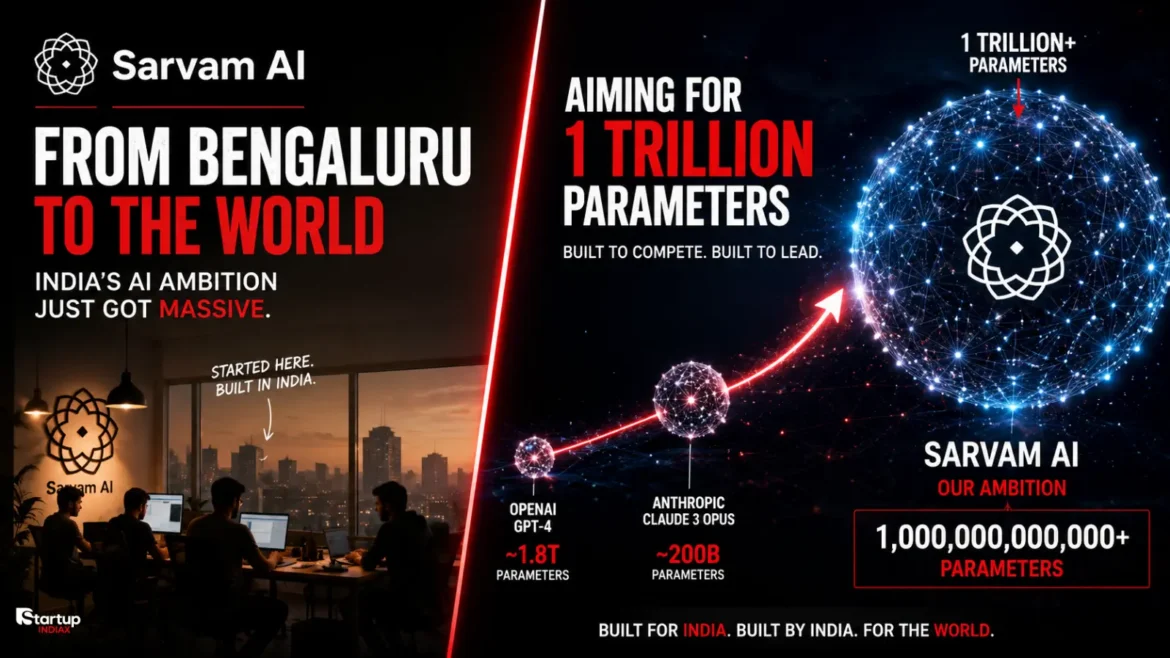
Sarvam AI's trillion parameter model ambition compared to OpenAI and Anthropic
NewsAI & DeepTech

Sarvam AI Wants to Build a Trillion-Parameter AI Model to Take On OpenAI and Anthropic

Inside the Bengaluru startup's plan to build India's biggest AI model yet, and why it's still a work in progress
by Aalam Rohile July 30, 2026
3 min read

Summary

  • Bengaluru’s Sarvam AI is targeting a trillion-parameter model, a scale that would put it in the same conversation as frontier labs abroad.
  • The plan follows Sarvam’s $234 million Series B in June, which took it to unicorn status at a $1.5 billion valuation.
  • At its Epoch conference today, Sarvam launched new 7B and 70B models first, treating the trillion-parameter model as the next big leap, not a finished product.

Sarvam AI wants to build a model with a trillion parameters. Say that out loud and it sounds like the kind of thing only OpenAI, Anthropic, or Google can pull off. A two-year-old startup out of Bengaluru is saying it anyway.

The company first signalled the plan back in May, when Sarvam co-founder circles confirmed on X that training would begin within nine months. Since then, the story has moved fast. Sarvam turned unicorn in June with a $234 million Series B led by HCLTech, hitting a $1.5 billion valuation, one of the largest AI funding rounds an Indian startup has ever closed. Part of that money is explicitly earmarked for what Sarvam calls its next frontier model, aimed at agentic, coding, and cybersecurity use cases.

Then, today, Sarvam hosted Epoch, its first flagship AI conference, in Bengaluru. The headline launch wasn’t the trillion-parameter model itself. It was Epoch Builder Edition, a new developer platform with fresh 7-billion and 70-billion parameter models trained on 2 trillion tokens, aimed at helping Indian developers and enterprises fine-tune and deploy their own AI systems. The bigger model is still ahead, not behind.

Why the scale matters, and why it’s still a plan

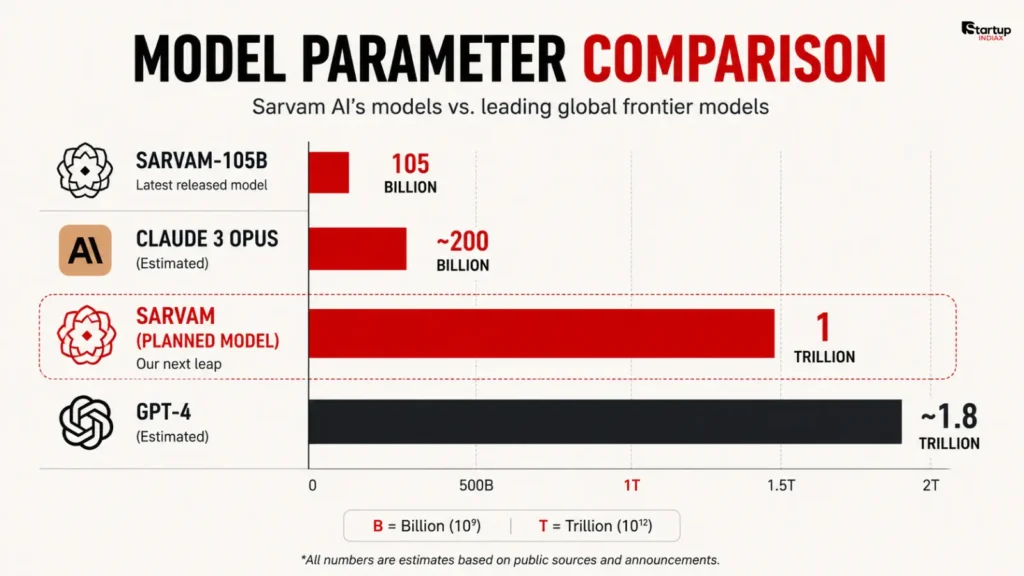
For context, Sarvam’s current flagship, Sarvam-105B, launched in February at the India AI Impact Summit, sits at 105 billion parameters. It uses a mixture-of-experts design that activates only around 10 billion parameters at a time, which is how a startup with a fraction of Big Tech’s compute budget can compete at all. Sarvam positioned that model against OpenAI’s GPT-OSS-120B and Alibaba’s Qwen-3-Next-80B.

Parameter size comparison of Sarvam AI models versus global frontier AI models

A trillion-parameter model is roughly ten times bigger. For comparison, models in that range globally include Ant Group’s open-source Ling-1T and Moonshot AI’s Kimi K2. Frontier closed models from OpenAI and Anthropic are widely estimated to run even larger. So a trillion parameters gets Sarvam into serious company, but it’s not automatically a GPT-4 or Claude killer. Parameter count alone doesn’t decide who wins; training data, architecture, and how well the model actually performs on real tasks matter just as much.

It’s also worth being precise about where things stand. As of today, Sarvam has not announced that training has started, let alone finished. What’s confirmed: the intent, the funding tied to a “next frontier model,” and a public timeline that points to training beginning sometime around this year. Anyone reading this as a finished product announcement is reading ahead of the facts.

Read More: India’s First Homegrown Sovereign AI Model, Sarvam AI To Build

Why Sarvam is betting this big

Sarvam was founded in 2023 by Vivek Raghavan and Pratyush Kumar, both formerly with AI4Bharat at IIT Madras. It was the first company selected under India’s IndiaAI Mission, the government’s sovereign AI programme, and got access to Nvidia H100 GPUs in exchange for an equity stake. That government backing has been central to Sarvam’s pitch: build AI that’s trained in India, on Indian languages, run on Indian infrastructure.

The company says its platforms already handle over 2 million daily interactions and process close to 10 million API requests a day. Its voice agents have been used in a government farmer outreach programme reaching 17 million farmers, and in an insurance campaign covering 45 million policyholders. That’s meaningful usage for a company that was pre-revenue not long ago.

A model like Zoho or Krutrim scaling infrastructure is one story. A trillion-parameter foundation model is a different order of ambition entirely, and it puts real pressure on Sarvam to prove that Indian AI labs can play at frontier scale, not just build efficient smaller models for local use cases.

Read More: Krutrim’s Bold Leap: Unveiling Its Agentic AI Assistant Kruti

What this means for founders and the ecosystem

For Indian AI startups, Sarvam’s trajectory is a live case study in sequencing: build a working smaller model, get government backing, raise big once you’ve got usage numbers to show, and only then chase the very top of the scale ladder. It’s also a signal to enterprise customers evaluating sovereign AI options that Sarvam intends to stay in that conversation for the long run, not just ship one flagship model and coast.

Whether the trillion-parameter model actually lands, and whether it can compete on more than just size, remains to be seen. But the ambition itself says something about how far India’s AI ecosystem has come in under three years.

What do you think, can an Indian startup genuinely compete at the same parameter scale as OpenAI and Anthropic, or is this more about signalling than substance? Drop your take in the comments, and keep following Startup INDIAX for how this story develops.

FAQs

What is Sarvam AI’s trillion-parameter model?

It’s a planned large language model that Sarvam AI says it intends to train, targeting roughly a trillion parameters, a scale meant to put it in direct competition with frontier models from OpenAI and Anthropic.

Has Sarvam actually started training the trillion-parameter model?

As of this article, Sarvam hasn’t confirmed training has begun. The plan was first reported in May 2026, with funding from its June Series B partly earmarked for this “next frontier model.”

How is this different from Sarvam-105B?

Sarvam-105B, launched in February 2026, has 105 billion parameters. A trillion-parameter model would be roughly ten times larger, requiring far more compute and training data.

Why did Sarvam launch Epoch Builder Edition instead of the big model?

Sarvam is building up in stages. Epoch Builder Edition, launched July 30, gives developers new 7B and 70B models to build with now, while the trillion-parameter model remains a longer-term goal.

Who funds Sarvam AI?

Sarvam is backed by Lightspeed Venture Partners, Peak XV Partners, and Khosla Ventures from earlier rounds, with HCLTech and Bessemer Venture Partners joining as lead investors in its $234 million Series B.

July 30, 2026 0 comments 190 views
FacebookTwitterLinkedinWhatsapp
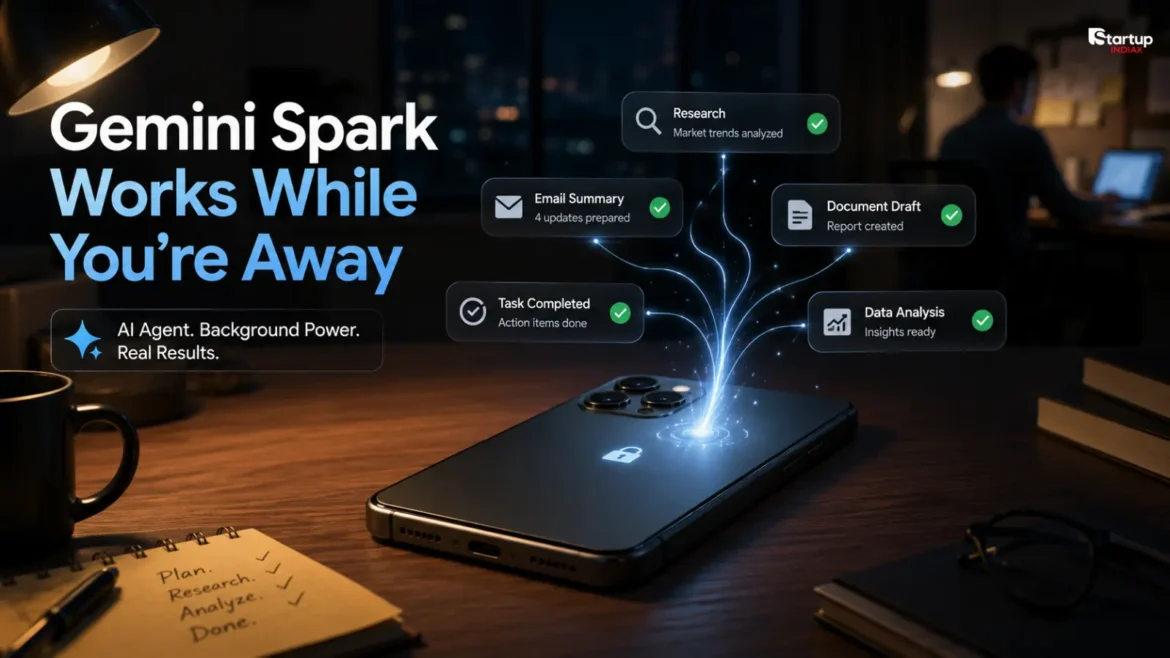
Gemini Spark AI agent working in the background on a locked phone
NewsAI & DeepTech

Google Just Launched an AI That Works While You Sleep, Here’s What Gemini Spark Does

Gemini Spark is now rolling out to Google AI Pro and Ultra users in India, and it does not wait for you to ask
by Aalam Rohile July 30, 2026
3 min read

Summary

  • Google is rolling out Gemini Spark, a 24/7 background AI agent, to Google AI Pro and Ultra subscribers in India.
  • Spark runs on Gemini 3.6 Flash and works inside Gmail, Docs and Sheets without extra setup, even when your device is off.
  • It asks permission before high-stakes actions like spending money, but pricing and full India availability details are still unclear.

Most AI tools wait for you to type something before they do anything. Gemini Spark does not work that way. Google has started rolling it out in India, and the pitch is simple: give it a task once, and it keeps chipping away at it in the background, even after you have locked your phone and gone to bed.

It’s a meaningful shift from the chatbot era Google itself helped build. And for a country where WhatsApp Business automations and Zapier workflows already run half the D2C backend, an AI agent baked directly into Gmail, Docs and Sheets is worth paying attention to.

What Gemini Spark Actually Does

Gemini Spark is being rolled out to Google AI Pro and Google AI Ultra subscribers in India over the coming weeks, and unlike traditional AI assistants that respond only when prompted, it’s designed to work autonomously in the background. The agent carries out tasks on a user’s behalf across Google Workspace apps without needing the user to be actively present or even have their device switched on.

It’s already accessible to Google AI Ultra subscribers, while Pro subscribers get it in the coming weeks. Google describes it as a 24/7 personal agent that automates workflows across services while remaining under the user’s direction, and on the web, Spark shows up as its own tab inside the Gemini app, with Android and iOS users finding it alongside Search chats and Daily Brief.

Under the hood, it now runs on Gemini 3.6 Flash, an upgrade from the Gemini 3.5 model it used when Google first previewed it. It’s built for complex, agentic workflows rather than one-off answers.

Read More: Free Google Gemini Pro: Jio’s ₹35,100 Gift to Young Users

Tasks, Schedules and Skills

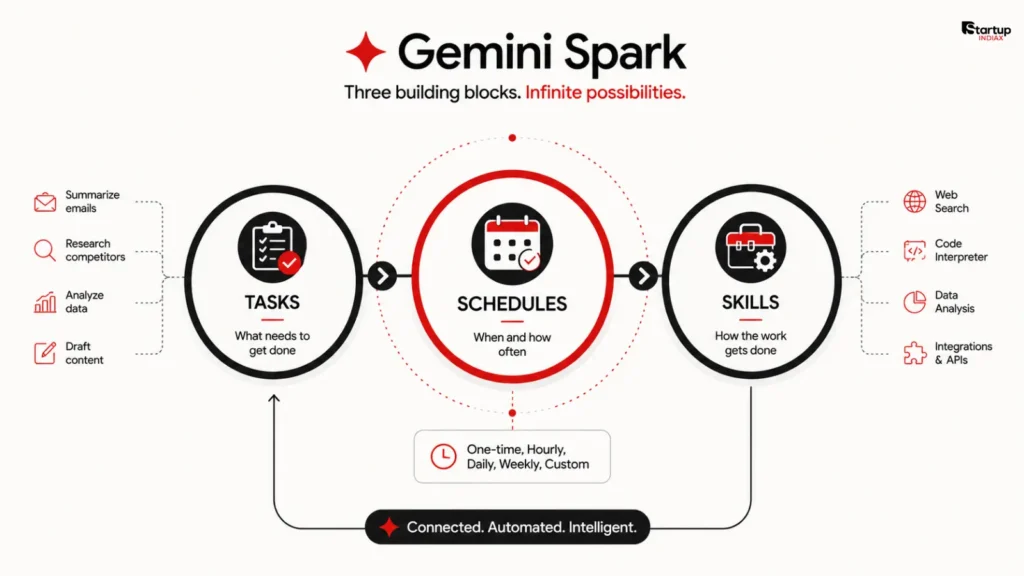
Google has structured the agent around three components: Tasks, Schedules and Skills. A Task is simply the outcome a user wants, whether that’s a quick job like organising an inbox or a bigger workflow like planning a multi-city business trip. Schedules let you set up recurring automations, and Skills are the specific capabilities Spark can apply, a list Google says will grow over time.

Diagram of Gemini Spark's Tasks, Schedules and Skills structure.

Users can track everything through a Tasks page in the Gemini app, where they can pin, rename, filter or delete individual task threads. Real examples Google has shared include pulling flight and hotel details out of confirmation emails into a trip spreadsheet, and turning a pile of wedding RSVP emails into a dietary-restrictions table for the caterer.

The Permission Problem, Solved (Mostly)

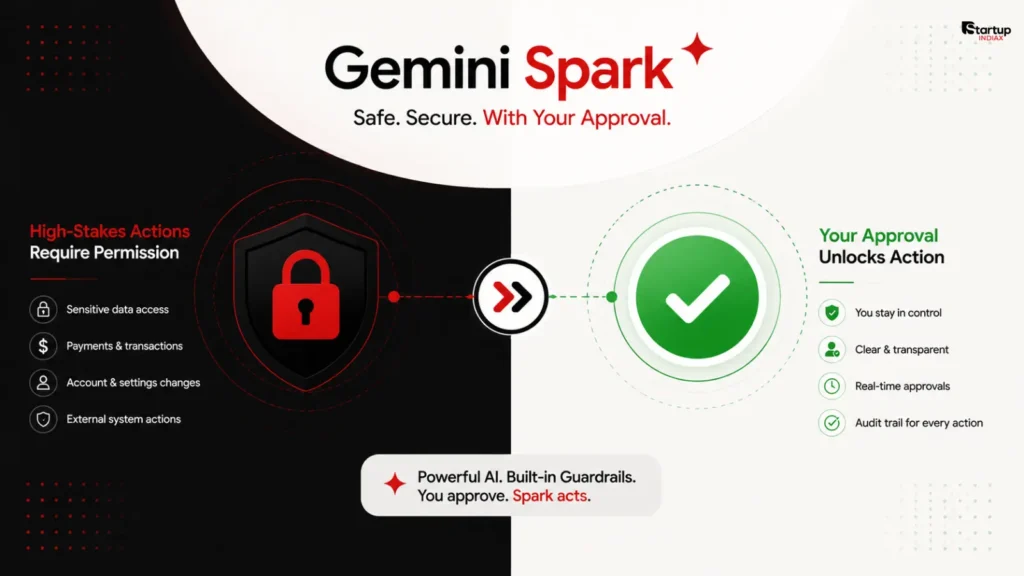
Handing an AI standing access to your inbox raises an obvious question: what stops it from doing something you didn’t actually want? Google says the agent has been designed to seek explicit user approval before carrying out anything it classifies as high-stakes, such as spending money or sending an email without prior review, and users can toggle Spark off entirely or restrict which apps it connects to.

Gemini Spark permission and approval system for high-stakes actions

That’s a reasonable guardrail on paper. But the trust model is really the whole story here. A chatbot that gets something wrong fails right in front of you, in a window you’re already watching. An agent working while your phone is locked fails quietly, and you might not notice until you open a spreadsheet next week and find something off.

Read More: Browser Dia vs Chrome & Edge: The Battle of AI Browsers in 2025

What’s Still Unclear

A few things Google hasn’t spelled out for the India rollout yet. Exact India pricing for Spark access isn’t confirmed; Google AI Pro costs around ₹1,950 a month in India, but whether that unlocks Spark fully or only partially compared to Ultra hasn’t been detailed. Google also hasn’t specified whether all of Spark’s browser-based capabilities, like interacting with websites on a user’s behalf, will be available immediately as part of the India rollout.

Founders and small teams weighing this should treat the first week as a trial, not a full handover: start with one low-stakes recurring task, like a weekly unread-email summary, and watch what it actually produces before connecting anything tied to payments or client communication.

Read More: Krutrim’s Bold Leap: Unveiling Its Agentic AI Assistant Kruti in 2025

Why This Matters for Indian Founders

This isn’t happening in isolation. Google is racing OpenAI, which recently pushed into similar territory with ChatGPT Work, and India’s own players are making the same bet. Ola-backed Krutrim launched its agentic assistant Kruti with promises of booking cabs and paying bills autonomously, and Perplexity has been striking telco deals to get its AI in front of Indian users at scale. The agentic AI fight is no longer a US-only story, it’s playing out in Indian inboxes right now.

For a small team running a D2C brand or an early-stage startup, this could mean genuinely cutting hours spent on repetitive Workspace admin, compiling data from emails, updating trackers, drafting first passes at replies. Whether it’s worth the subscription jump from Plus to Pro or Ultra will depend on how much of that admin your team is actually drowning in.

If you’ve already got AI Pro or Ultra in India, keep an eye on your Gemini app over the next few weeks, Spark’s arrival won’t come with a big announcement banner. Have thoughts on handing an AI standing access to your inbox? Drop them in the comments, and check out more of Startup INDIAX’s coverage on India’s AI race.

Read More: Airtel Partners with Perplexity – 12-Month Perplexity Pro Subscription Free to All 36 Crore Customers

Google Spark work stats aren’t the only thing worth watching this week, keep exploring Startup INDIAX for what else is shaping India’s startup and AI landscape.

FAQs

What is Gemini Spark?

Gemini Spark is Google’s 24/7 background AI agent that performs multi-step tasks across Google Workspace apps like Gmail, Docs and Sheets on a user’s behalf, continuing to work even when their device is locked or switched off.

Who can access Gemini Spark in India?

It’s rolling out to Google AI Ultra subscribers first, with Google AI Pro subscribers getting access over the coming weeks. Google hasn’t confirmed exact India pricing specific to Spark access.

What model powers Gemini Spark?

It runs on Gemini 3.6 Flash, an upgrade from the Gemini 3.5 model Google used when it first previewed Spark at Google I/O 2026.

Does Gemini Spark act without permission?

No. Google says Spark checks in first before high-stakes actions like spending money or sending an email, and users can turn it off or limit which apps it connects to.

How is Gemini Spark different from a regular AI chatbot?

Regular chatbots respond only when prompted. Spark is designed to work continuously in the background on assigned Tasks and Schedules, without needing constant instructions.

Does Gemini Spark compete with ChatGPT Work?

Yes, it positions Google directly against OpenAI’s recent enterprise and productivity agent push, alongside India-focused agentic tools like Krutrim’s Kruti.

July 30, 2026 0 comments 140 views
FacebookTwitterLinkedinWhatsapp
WhatsApp Web calling feature announced by Kunal Shah, CRED founder and new WhatsApp global CEO
NewsTechnology

WhatsApp Web Can Now Make Calls, Announced by a CRED Founder Turned Global CEO

Kunal Shah's first public move as WhatsApp's global CEO brings browser calling, call transfer, waiting rooms and noise suppression to over a billion users
by Aalam Rohile July 29, 2026
3 min read

Summary

• WhatsApp Web now supports full audio and video calls, 1:1 and group, with no app download needed.

• Kunal Shah, CRED’s founder and WhatsApp’s new global CEO, announced it with a browser call to Mark Zuckerberg.

• The update also adds Call Transfer, Waiting Room and Background Noise Suppression, rolling out gradually worldwide.

For over a decade, picking up a WhatsApp call meant reaching for your phone. That changed on July 28, 2026, when Meta rolled out full voice and video calling on WhatsApp Web, no desktop app required.

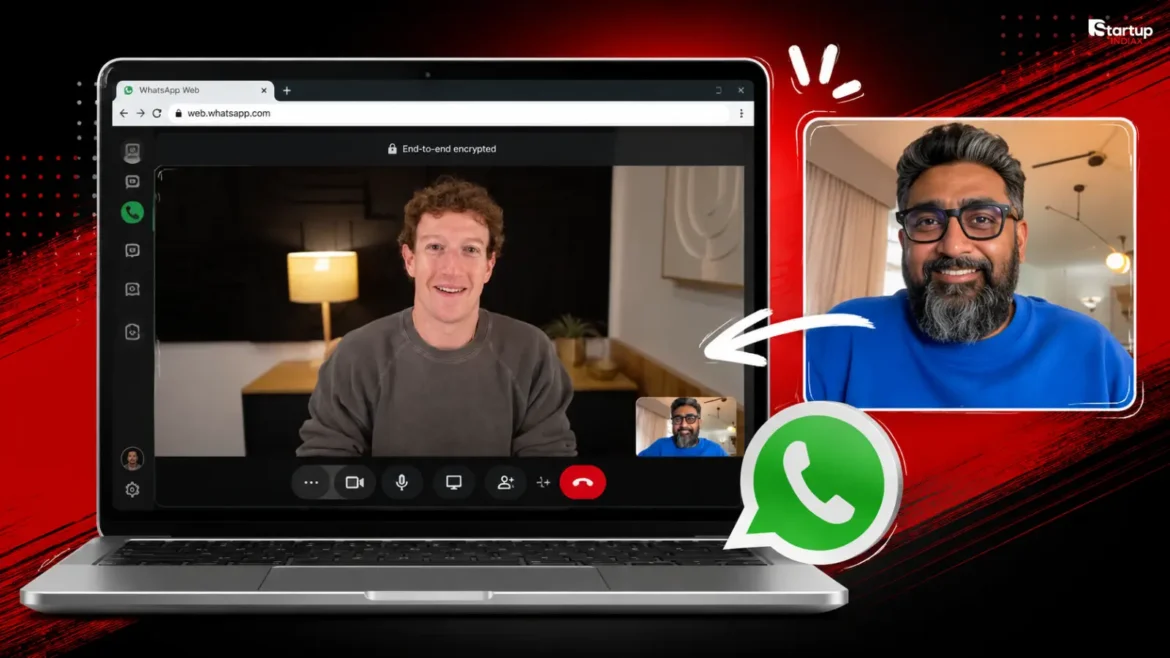
The announcement itself was the story within the story. It came from Kunal Shah, the CRED founder who joined Meta about a month ago to lead WhatsApp’s next phase of growth, in his first big public move as the app’s global CEO. Shah posted a screenshot on X of himself on a browser call with Meta CEO Mark Zuckerberg, captioning it: “WhatsApp calls now work in your browser. Your 47 open Chrome tabs finally got company that’s actually useful.“

WhatsApp calls now work in your browser. Your 47 open Chrome tabs finally got company that's actually useful. pic.twitter.com/TRRqW9bvRV

— Kunal Shah (@kunalb11) July 28, 2026

It’s a very Kunal Shah way to announce something. No press release, no roadshow, just a screenshot and a line that sounds like it belongs in a CRED ad.

What actually shipped

Web Calling is the headline feature. You can now start or answer one-on-one and group audio or video calls straight from web.whatsapp.com, with the same protections as the app: end-to-end encryption, no time limits, and no cost. Screen sharing, reactions, and a dedicated Calls tab with your full call history come along with it.

Three more features are rolling out alongside it:

  • Call Transfer lets you move an active group call from your phone to your browser or desktop app without hanging up or rejoining.
  • Waiting Room gives hosts control over who joins a group call before they’re let in, useful for anyone running larger or more public calls.
  • Background Noise Suppression cleans up audio automatically, aimed at the reality that most calls happen from cafes and offices, not quiet rooms.

Some coverage also points to a fifth addition called QuickHD, which sharpens video quality in the first few seconds of a call instead of the usual blurry start. Meta hasn’t detailed it in its own blog post, so treat it as a feature still surfacing through the rollout rather than a confirmed headline item.

Meta says the features are live but rolling out gradually, so not everyone will see them on day one.

Read More: Arattai vs WhatsApp: India’s New Messaging App Explained

Why this matters more than a typical feature drop

WhatsApp has quietly become India’s most important piece of communication infrastructure, used for everything from family group chats to running small D2C businesses on WhatsApp Business. A browser gap that forced users back to their phones or a separate desktop app was a small but real friction point, especially for anyone on a work laptop that doesn’t allow installs, or a shared computer at a cyber cafe or college lab.

It also lands at a moment when WhatsApp is facing more competition at home than it has in years. Arattai, the government-backed Indian messaging app, has been pitched as a homegrown alternative built around local data storage, something Startup INDIAX has covered in detail. Shipping a feature that closes an obvious usability gap, right as an Indian founder takes charge of the app, is unlikely to be a coincidence.

The founder angle Startup INDIAX cares about

Shah built FreeCharge, then built CRED into one of India’s most talked-about fintech unicorns, known as much for its cinematic ad campaigns as its product. Now he’s running global product decisions for an app with billions of users. His first move wasn’t a splashy AI feature or a new business tool. It was closing a basic gap that’s existed for years.

That’s worth watching. Founders who’ve built consumer products in India tend to obsess over friction points that look small on paper but matter enormously in daily use. If Shah’s early WhatsApp moves keep following that instinct, it’s a signal for how he might run product at Meta scale.

Read More: Pavel Durov-led Telegram: $30B Company, 30 Employees

If you’re building anything that runs on top of WhatsApp, whether that’s customer support, D2C order updates, or community groups, this closes a real gap in how your team can use it day to day. Drop a comment if you’ve already tried calling from web.whatsapp.com, or if you’re holding out for Arattai instead.

FAQs

What is WhatsApp Web Calling?

It’s a new feature letting users make and receive one-on-one and group audio or video calls directly from a browser at web.whatsapp.com, without needing the desktop app.

Who announced the WhatsApp Web calling feature?

Kunal Shah, the CRED founder who recently became WhatsApp’s global CEO, announced it on X with a screenshot of a browser call with Meta CEO Mark Zuckerberg.

Is WhatsApp Web calling encrypted?

Yes. Meta says web calls carry the same end-to-end encryption as calls on the mobile and desktop apps, with no time limits and no cost.

What is Call Transfer on WhatsApp?

It lets you move an active group call from one device to another, say phone to browser, without hanging up or rejoining.

What is the Waiting Room feature?

It lets the host of a group call approve who joins before letting them in, giving more control over larger or public calls.

Is this feature available to everyone right now?

It’s rolling out gradually worldwide, so availability may vary by region and app version for the next few weeks.

July 29, 2026 0 comments 178 views
FacebookTwitterLinkedinWhatsapp
Parul Gulati Nish Hair founder journey from home business to Shark Tank India deal
Founder StoryFashion & LifestyleWomen Entrepreneurs

From Rs 5,000 to Rs 50 Crore: Parul Gulati’s Unlikely Startup Playbook

How an actress with no business degree built Nish Hair from her living room floor to a brand valued at Rs 50 crore, and what founders can actually learn from the slow parts of her story
by Aalam Rohile July 29, 2026
3 min read

Summary

  • Parul Gulati started Nish Hair in 2017 with a small personal investment, hand-stitching extensions with her mother before hiring any staff.
  • A Shark Tank India Season 2 pitch landed her Rs 1 crore for 2% equity from Amit Jain, tripling monthly revenue soon after.
  • The brand is now widely valued at Rs 50 crore, though 2026 has also brought fraud and workplace allegations founders should note.

Most founders don’t get asked to explain their first year of revenue on national television. Parul Gulati did, and the number she gave was Rs 40,000. Not lakhs. Not crores. Forty thousand rupees, from a business she now says is worth Rs 50 crore.

That gap, between where Nish Hair started and where it stands today, is the whole story. And it’s a messier, slower story than the headline number suggests.

An Actress With a Hair Problem, Not a Business Plan

Gulati didn’t set out to build a beauty brand. According to her own retelling, the idea came from a frustrating audition experience: a role needed long hair, the production wouldn’t cover the cost of extensions, and when she went looking for her own, the good ones were imported and priced far beyond what most Indian buyers could justify.

That’s a familiar founder origin story: a personal problem, a gap in the market, a decision to fix it yourself. What’s less common is what she did next. In 2017, working out of her own home with her mother, Gulati began hand-stitching hair extensions herself. The brand name, Nish Hair, came from her mother’s nickname for her, Nishu.

There was no manufacturing line and no warehouse. There were phone calls to hairstylists, home visits for customer trials, and months where sales came in units, not orders. It’s the unglamorous version of a founder story, the one that doesn’t usually make it into the headline.

The Pitch That Changed the Business

By the time Gulati walked into Shark Tank India Season 2 in 2023, Nish Hair was already a functioning company, not a pitch-deck idea. She told the sharks the business was doing roughly Rs 80 lakh a month in revenue before the show aired, and asked for Rs 1 crore in exchange for 2% equity.

Vineeta Singh and Aman Gupta offered the same amount for 3% equity. Amit Jain, CEO of CarDekho, matched her exact ask instead, Rs 1 crore for 2%, and won the deal. Gulati later called the moment out on social media, writing that she had made it with her business and asking, “Who could have ever thought my business will one day be valued at 50 Crores?”

The show did what Shark Tank appearances tend to do for the right brand: it compressed years of slow word-of-mouth growth into a few months of national visibility. Revenue reportedly tripled after the episode aired, and Nish Hair moved from a niche D2C product into something closer to a household name in the hair extension category.

Where the Business Stands Now

Today, Nish Hair sells 100% human hair extensions, toppers, wigs, and clip-in accessories, positioned for women dealing with hair loss, thinning, or damage, alongside customers who simply want a styling option. The company has grown from a two-person kitchen-table operation to a team of roughly 35 people, and has expanded into international markets including Dubai, where Gulati has said the brand connects with South Asian, Middle Eastern, and diaspora customers looking for the same product she once couldn’t find affordably in India.

Compare that trajectory to another Shark Tank India founder story: Bonkers Corner, the streetwear brand built by Shubham Gupta after his family’s textile business collapsed. Different sector, same pattern, a founder who starts with almost nothing, builds slowly and stubbornly, and uses a Shark Tank moment as an accelerant rather than a starting point.

Read More: Shark Tank Bonkers Corner: From Broke to Rs 300 Cr Valuation

The Part of the Story That Doesn’t Fit the Highlight Reel

Here’s where this piece has to be honest rather than just inspirational. In 2026, Nish Hair has also been in the news for reasons that have nothing to do with growth metrics.

In early April, multiple people identifying themselves as former employees posted allegations online about a difficult workplace culture at the company, including claims about mandatory NDAs used to prevent staff from speaking about internal operations. Nish Hair and Gulati did not publicly respond to those claims at the time they surfaced.

Then in July, Gulati went public herself with a separate issue: an alleged Rs 8 lakh fraud at the brand’s Bengaluru store, where she said two employees, including the store manager, diverted customer payments into personal accounts. She said she spent a full day at a police station after uncovering the discrepancy during an unannounced store visit.

None of this erases what Nish Hair built. But it’s a useful, if uncomfortable, addition to the founder-story genre: scaling a bootstrapped D2C brand from a living room to 35 employees and multiple cities brings governance problems that a founder who started out sewing extensions by hand was never trained to handle. That’s not a knock on Gulati specifically, it’s close to universal for founder-led Indian D2C brands that grow fast without early investment in systems and HR processes.

Read More: Top 10 Indian D2C Beauty Brands Disrupting FMCG Giants in 2025

What Founders Should Actually Take From This

The lesson here isn’t “start with Rs 5,000 and you’ll end up at Rs 50 crore.” Plenty of founders start small and stay small, and Gulati herself has been candid that different reports have quoted different starting figures for a reason: the exact rupee amount matters less than what she did with it.

What does hold up as a repeatable lesson is the sequencing. Gulati built real operational discipline, sourcing, quality control, customer trust, before she had a media moment to amplify it. The Shark Tank appearance worked because there was already a functioning business behind it, not a pitch built to look good on camera.

For early-stage Indian founders, especially those building D2C brands in Tier 1 cities, that’s the transferable part: get the unglamorous fundamentals right first. Virality and investor attention are accelerants. They’re not substitutes for a product that already works.

Nish Hair’s current headlines, both the Rs 50 crore valuation and the recent allegations, are a reminder that the founder story doesn’t end at the funding announcement. It just gets more complicated.

A few things worth sitting with:

  • Nish Hair went from a Rs 40,000 first-year revenue to a business reportedly valued at Rs 50 crore within roughly seven years.
  • The Shark Tank India deal, Rs 1 crore for 2% equity from Amit Jain, reportedly tripled monthly revenue soon after airing.
  • Recent 2026 fraud and workplace allegations are a reminder that scaling a founder-led brand brings governance risks worth planning for early.

If you’ve followed Nish Hair’s rise, or you’re building your own D2C brand and wondering how to sequence growth versus visibility, drop your take in the comments. And if founder stories like this one are your thing, there’s more where this came from on Startup INDIAX.

FAQs

What is Nish Hair and who founded it?

Nish Hair is an Indian D2C hair extension and haircare brand founded by actress-entrepreneur Parul Gulati in 2017, offering human hair extensions, toppers, wigs, and accessories for women dealing with hair loss or styling needs.

How much did Parul Gulati invest to start Nish Hair?

Gulati has cited a modest starting investment, commonly reported as around Rs 5,000, though some sources mention figures up to Rs 30,000-40,000. The exact number varies by report and hasn’t been independently audited.

What deal did Parul Gulati get on Shark Tank India?

She secured Rs 1 crore for 2% equity from shark Amit Jain of CarDekho during the Season 2 finale in 2023, after Vineeta Singh and Aman Gupta offered the same amount for 3% equity.

What is Nish Hair’s valuation today?

Nish Hair is widely reported to be valued at around Rs 50 crore following its Shark Tank India deal and subsequent growth, though this figure comes from company and founder statements rather than an independent audit.

Has Nish Hair faced any controversies recently?

Yes. In 2026, the brand faced allegations of a toxic workplace culture from former employees, and Gulati separately disclosed an alleged Rs 8 lakh fraud by staff at its Bengaluru store.

July 29, 2026 0 comments 241 views
FacebookTwitterLinkedinWhatsapp
Apollo Hospitals ePlane electric air ambulance eVTOL aircraft over Indian city
NewsAI & DeepTechHealthTech

Apollo Hospitals Bets on Electric Air Ambulances to Fix India’s Golden Hour Problem

Apollo Hospitals has signed an MoU with Chennai's ePlane Company to bring electric air ambulances and medical drones to India, targeting the country's toughest trauma care gap.
by Aalam Rohile July 28, 2026
3 min read

Summary

  • Apollo Hospitals and The ePlane Company signed an MoU to bring electric air ambulances and medical delivery drones into India’s emergency care system.
  • ePlane’s e200X aircraft aims to move patients seven times faster than road transport, but it’s still awaiting DGCA certification.
  • The deal could also lead to Apollo making a strategic investment in ePlane, though terms are yet to be finalized.

Every 3.5 minutes, someone dies in a road accident in India. Most of them never reach a trauma centre within the golden hour, the first 60 minutes that decide survival odds. Apollo Hospitals just placed a bet on fixing that gap from the sky. It has signed an MoU with Chennai based aerospace startup The ePlane Company to bring electric air ambulances and medical delivery drones into India’s emergency healthcare network.

What Happened (Apollo Hospitals and The ePlane Company signed an MoU)

The MoU was signed in Chennai and announced at the Farnborough International Airshow in the UK on July 23. It brings together Apollo’s hospital network and ePlane’s aircraft, which are still working through regulatory approval in India.

ePlane e200X electric vertical takeoff and landing air ambulance aircraft

Under the agreement, Apollo will evaluate ePlane’s e200X electric vertical take off and landing aircraft for inter-hospital transfers, trauma response, cardiac and stroke emergencies, and organ transportation. ePlane’s subsidiary, Amber Wings, will handle the drone side of the partnership, moving blood products, organs, vaccines, medicines and diagnostic samples between facilities.

Apollo is bringing real scale to the table. The hospital group will contribute its network of 1,066 ambulances, hospitals, clinics, pharmacies and diagnostic centres to build what both companies describe as a connected emergency response system that combines air and road transport.

Read More : World-First Fan-in-Wing Transition Flight: How Horizon Cavorite X7 Redefines eVTOL in 2025

Why ePlane, Why Now

ePlane isn’t new to this conversation. The startup has already picked up an order from ICATT for 788 air ambulances, and it’s targeting DGCA type certification for the e200X in early 2027. That timeline matters, because the aircraft at the centre of this MoU doesn’t exist commercially yet. What’s being signed today is a plan, not a deployed fleet.

The pitch is speed and cost. ePlane says the e200X can move patients roughly seven times faster than a road ambulance, at a fraction of what a traditional helicopter transfer costs. For a country where urban traffic and long distances routinely eat into the golden hour, that math is the whole argument.

There’s also a financial thread worth watching. The MoU leaves open the possibility of a future strategic investment by Apollo in ePlane, subject to terms still being worked out. If that happens, it turns a healthcare partnership into a capital bet on India’s eVTOL sector.

Read More: Ashneer Grover Launches Fund My Staff: What It Is, How It Works, Who It’s For

Startup INDIAX Take

This deal says more about Apollo’s ambitions than about ePlane’s readiness. Apollo isn’t buying finished aircraft, it’s securing first mover position in a category that barely exists in India yet. For ePlane, an anchor partner with 1,066 touchpoints across the country is worth more right now than any single aircraft order, because it gives regulators and future customers a reason to take the e200X seriously before it’s even certified. Founders building in deep tech and healthtech should read this as a signal that large incumbents are willing to move early on unproven hardware, provided the problem is big enough and the upside is clear enough.

Why This Matters

Road accidents kill more than 170,000 people in India every year, and only one in five patients reach trauma care within the golden hour. That’s not a small gap, it’s the difference between survivable and fatal outcomes for a huge share of emergencies. Air ambulances have existed in India before, but mostly as an expensive, helicopter based option available to very few. An electric alternative that costs less to run changes who can realistically access it, which is the more interesting story here than the aircraft itself.

The Bigger Picture

India’s eVTOL sector is still pre-commercial, but it’s no longer theoretical. Certification timelines like ePlane’s 2027 target, combined with large incumbents like Apollo signing on early, suggest the regulatory and business groundwork is happening in parallel rather than one waiting on the other. Whether this scales depends on DGCA approval actually landing on schedule and on Apollo following through with orders once the aircraft clears certification. Until then, this is a partnership on paper with a real network behind it.

If you’re tracking India’s healthtech and deep tech crossover, this is one to watch closely over the next year. Drop your take in the comments, and check out more Startup INDIAX coverage on India’s aviation and healthcare startups below.

FAQ

Is the Apollo-ePlane air ambulance service operational yet?

No. The e200X aircraft is still undergoing DGCA type certification, targeted for early 2027, so this partnership is currently at the planning and evaluation stage.

What is The ePlane Company?

The ePlane Company, legally registered as Ubifly Technologies Private Limited, is a Chennai based aerospace startup building the e200X electric aircraft, with a drone subsidiary called Amber Wings.

What will the air ambulances be used for?

Apollo plans to evaluate the e200X for inter-hospital patient transfers, trauma response, cardiac and stroke emergencies, and organ transportation.

Will Apollo invest in ePlane?

The MoU leaves open the possibility of a future strategic investment by Apollo in ePlane, but the terms haven’t been finalized yet.

How much faster are these air ambulances compared to road transport?

ePlane says the e200X is designed to move patients up to seven times faster than road transport, at a lower cost than a traditional helicopter transfer.

July 28, 2026 0 comments 134 views
FacebookTwitterLinkedinWhatsapp
Free Startup Company Valuation Calculator Know Your Worth in Under 2 Minutes
Founder ToolkitFunding

Free Startup Company Valuation Calculator: Know Your Worth in Under 2 Minutes

Run the VC Method, Revenue Multiple, or Scorecard model in seconds, no signup, no consultant fee, just the numbers Indian investors actually use.
by Aalam Rohile July 25, 2026
3 min read

Summary

  • The tool runs three methods, VC Method, Revenue Multiple, and Scorecard, so you’re never relying on a single number.
  • Pre-revenue founders should start with Scorecard; anyone with ARR should check Revenue Multiple first.
  • Treat the output as a planning range, not a certified valuation. FEMA and ESOP pricing still need a registered valuer.

Most founders find out their startup’s valuation the hard way: in a term sheet, after the investor has already anchored the number. A startup company valuation calculator flips that. You get the range before the meeting, not during it.

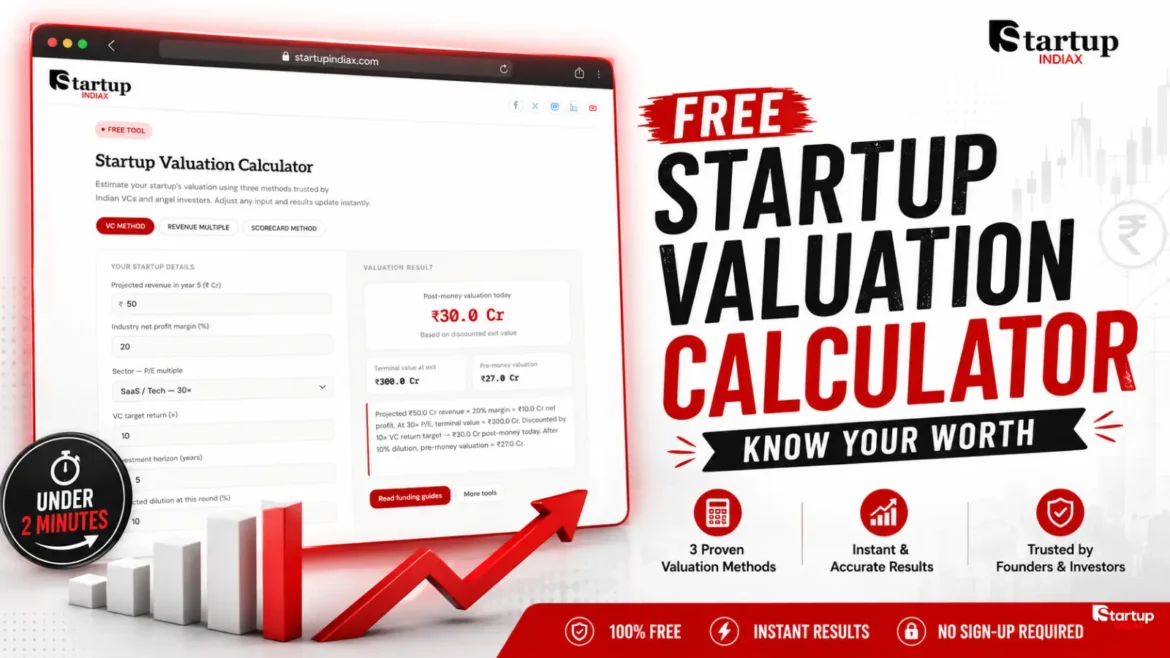
Startup INDIAX built a free tool that runs three methods Indian VCs and angel investors actually rely on, side by side, with your own numbers. No email gate, no call booking. Here’s how to use it, and why the range it gives you matters more than any single figure.

What the Tool Actually Does (Startup Company Valuation Calculator)

The Startup Valuation Calculator runs three separate models, because no single method fits every stage.

VC Method. You enter projected year-5 revenue, an industry profit margin, and a sector P/E multiple (SaaS and tech sit at 30x, fintech at 25x, healthtech at 20x, D2C and e-commerce lower at 15x). The tool works backwards from a terminal exit value, applies your investor’s target return multiple and investment horizon, and lands on a post-money and pre-money figure. Best for startups with a visible path to an exit, not idea-stage teams.

Revenue Multiple. This one’s built for anyone already generating ARR. Pick your business model (SaaS multiples typically run 8-12x, marketplaces 5-8x, D2C 3-6x, fintech 6-10x), factor in your growth rate and gross margin, and get a conservative-to-optimistic valuation range rather than one number.

Scorecard Method. For pre-revenue founders, this compares your startup against a benchmark valuation and adjusts it based on five weighted factors: team strength (30%), market size (25%), product moat (20%), traction (15%), and competitive landscape (10%). You rate yourself 1-5 on each, and the tool shows exactly what percentage of the benchmark your score lands you at.

Each tab updates live as you adjust inputs, so you can see how sensitive your valuation is to a single assumption, like what happens to your number if your growth rate drops five points, or your P/E multiple assumption was too aggressive.

Why a Range Beats a Single Number

Here’s the thing most calculators don’t say out loud: the value isn’t the final figure; it’s seeing three methods disagree.

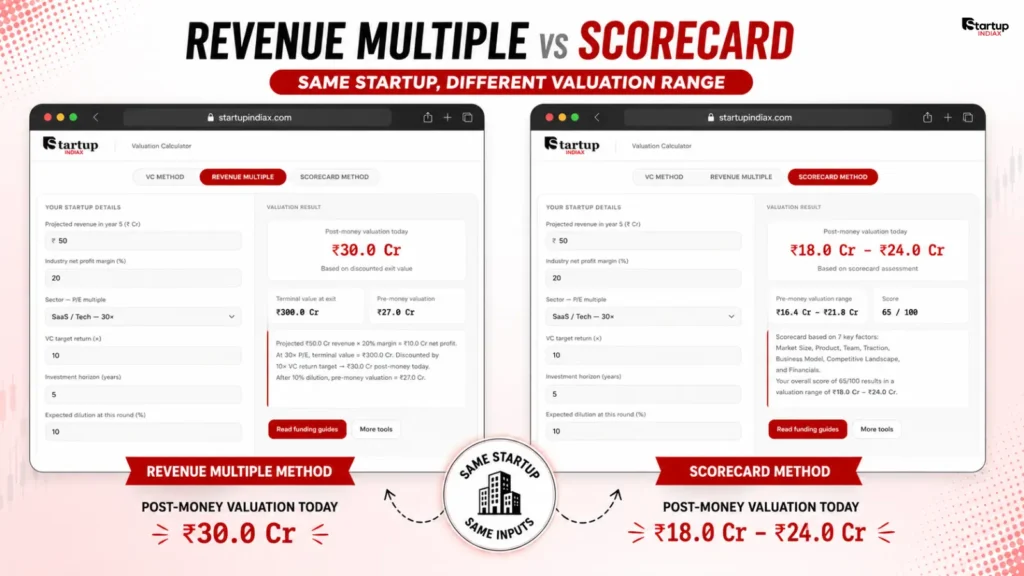
Comparison of Revenue Multiple and Scorecard valuation results for the same startup

If your VC Method output says ₹30 crore and your Scorecard says ₹18 crore, that gap is information. It tells you your growth story is priced ahead of your current traction, which is exactly the kind of thing an investor will flag in diligence. Better to find that out from a free tool than from a term sheet renegotiation three weeks in.

This is also why the tool is genuinely free and doesn’t ask for your financials to be emailed anywhere first. You should be able to stress-test your own assumptions before you’re in a room defending them.

Who Should Use Which Tab

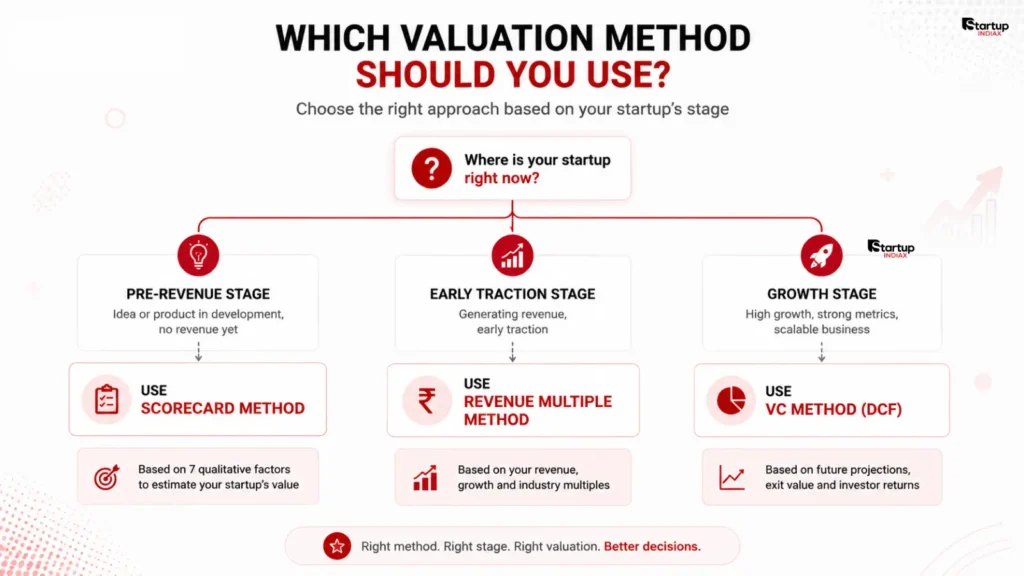
Pre-revenue and idea-stage founders should start with Scorecard. It’s the only method of the three that doesn’t require revenue projections to mean anything.

Founders with early ARR, even just a few months of it, should run the revenue multiple first, since it’s the method most seed and Series A investors will reach for anyway.

Founders further along, with a real growth trajectory and a plausible exit story, should use VC method as their primary number and the other two as a sanity check.

What the Tool Won’t Tell You

Be upfront about this with your readers, because your competitors mostly aren’t. A free calculator gives you a planning range, not a certified valuation. It can’t replace a registered valuer’s report, and it isn’t a substitute for the DCF-based fair market value report required under FEMA when a foreign investor is in your round. If you’ve gone through DPIIT recognition, that status doesn’t change the number either, though it does strengthen your position at the table.

Use the output to walk into a fundraising conversation informed, not to skip the professional step entirely.

Startup INDIAX Take

We built this because most valuation calculators online are lead-generation funnels dressed up as free tools. Ours isn’t trying to book you a consulting call. It’s trying to make sure a first-time founder doesn’t walk into a term sheet negotiation with a number they can’t defend.

The real skill a tool like this teaches isn’t reading one output. It’s noticing when your three methods disagree, and asking yourself why. That instinct is worth more in a negotiation than any single figure the tool spits out.

Why This Matters

For founders, a two-minute check before a pitch meeting means fewer moments where an investor’s number catches you off guard. For investors, a founder who shows up already having triangulated their own range is easier to negotiate with in good faith. For the ecosystem, tools like this quietly push back against the inflated seed pricing that leads to painful down rounds eighteen months later.

The Bigger Picture

Free valuation tools have multiplied across Indian fintech and advisory sites over the past year, most of them built by CA firms and consultancies using the calculator as a lead magnet for paid valuation reports. That’s a reasonable business model, but it means the tool’s incentive is to nudge you toward booking a call, not necessarily toward the most useful range.

A media-first tool doesn’t have that conflict. The incentive here is simply getting founders to a more informed starting point, and back to reading the funding and policy coverage that explains what the number actually means for their next raise.

Run your numbers through the calculator and see how much your three methods agree. If you’re mapping out your next raise, our dilution calculator and equity split calculator are good next stops.

FAQs

Is the Startup INDIAX valuation calculator really free?

Yes, all three methods (VC Method, Revenue Multiple, Scorecard) are free with no signup or email required to see your results.

Which method should a pre-revenue startup use?

Start with the Scorecard Method. It’s built specifically for startups without revenue, using weighted qualitative factors instead of financial projections.

Can I use this calculator instead of hiring a valuer?

No. It’s an educational planning tool. Any round involving a foreign investor still legally requires a certified fair value report under FEMA from a SEBI-registered merchant banker or chartered accountant.

What revenue multiple does the tool use for SaaS startups?

The Revenue Multiple tab applies an 8-12x ARR range for SaaS businesses, adjusted for your growth rate and gross margin.

Why do the three methods give different numbers for the same startup?

Each method weighs different things. VC Method prices off a future exit, Revenue Multiple prices off current ARR, and Scorecard prices off qualitative benchmarking. A gap between them usually means your growth story and current traction aren’t yet aligned.

July 25, 2026 0 comments 111 views
FacebookTwitterLinkedinWhatsapp
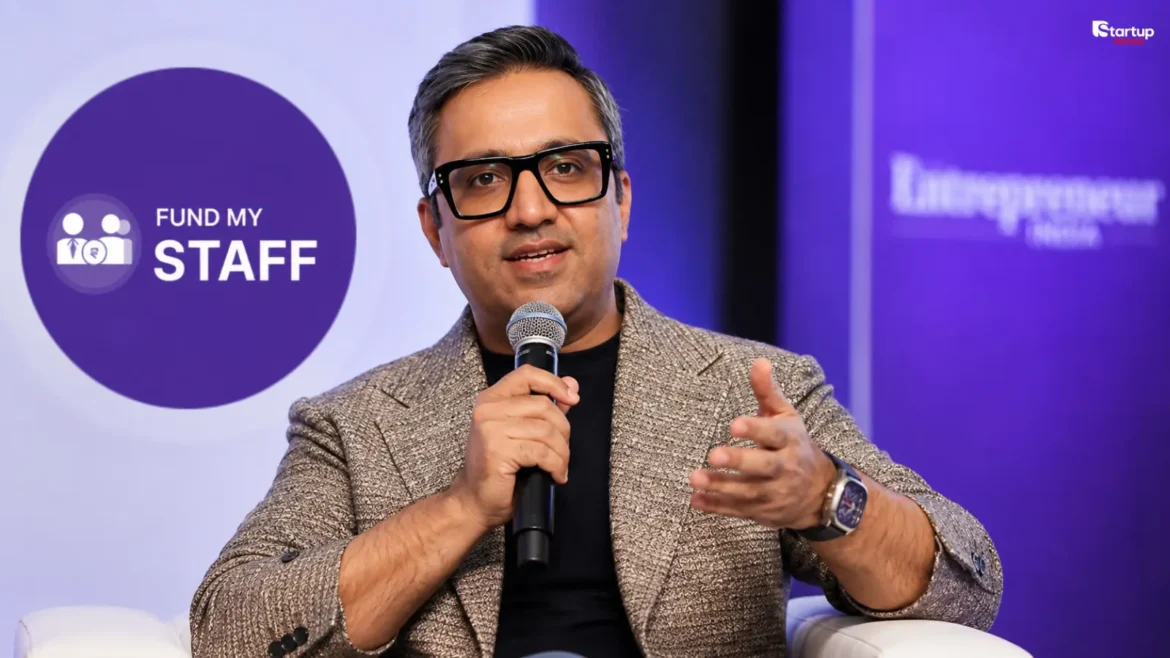
Ashneer Grover, founder of Third Unicorn, launches Fund My Staff employer-guaranteed lending platform
NewsFintechStartup Stories

Ashneer Grover Launches Fund My Staff: What It Is, How It Works, Who It’s For

Ashneer Grover's third startup at Third Unicorn turns employers into loan guarantors for their own staff, betting that workplace trust can do what a credit score can't.
by Aalam Rohile July 25, 2026
3 min read

Summary

  • Ashneer Grover has launched Fund My Staff, letting employers act as guarantors for employee loans instead of lending their own money directly.
  • Loans are disbursed by Ash Grove Capital, an RBI-registered NBFC, and repaid via EMIs over tenures of 3 to 12 months.
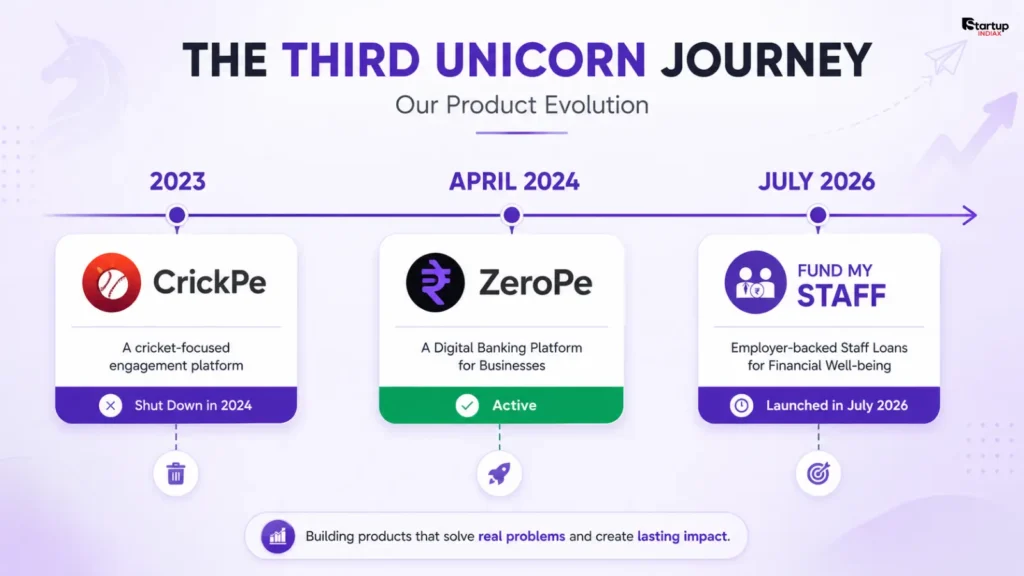
  • It’s the third product from Grover’s Third Unicorn, after CrickPe’s shutdown in 2024 and ZeroPe’s ongoing but unproven scale.

Ashneer Grover isn’t done building. On July 23, the former BharatPe co-founder announced Fund My Staff, a fintech platform where employers act as guarantors so their employees can access formal loans. It’s his third product out of Third Unicorn, after CrickPe shut down and ZeroPe kept going. This time, the pitch is built on something simpler than an app feature: your boss’s word.

What Fund My Staff Actually Does

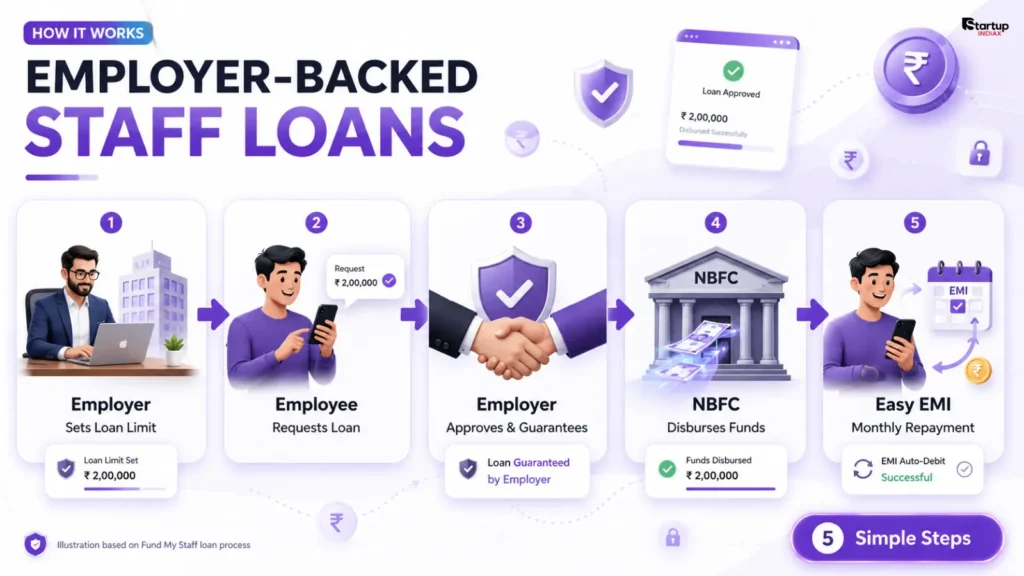
The idea is straightforward. Employers onboard their staff on the platform, set a loan limit each person is eligible for, and review requests before agreeing to guarantee them. Employees can also start the process themselves by sending a loan request directly to their employer through the app.

How Fund My Staff employer-guaranteed loan process works step by step

Once an employer approves and guarantees a request, the loan gets disbursed to the employee. Repayment happens through monthly EMIs over a tenure the employee picks, reportedly ranging from three to 12 months.

Here’s the part that matters most: employers don’t hand over any money. <cite index=”6-1″>Employers do not pay the loan amount; they simply act as guarantors while the employee receives and repays the funds over the selected tenure.</cite> The actual capital comes from a regulated lender, not the company’s balance sheet.

Who’s Actually Lending the Money

Fund My Staff isn’t a lender itself. <cite index=”2-1″>The platform operates as a Lending Service Provider (LSP) in compliance with the Reserve Bank of India’s digital lending guidelines, with loans originated and sanctioned by RBI registered lending partners.</cite> The named partner is Ash Grove Capital Private Limited, an RBI-registered NBFC.

Former @bharatpeindia co-founder @Ashneer_Grover has launched Fund My Staff, a fintech platform that enables employees to secure loans with their employer acting as a guarantor.

The platform operates as a Lending Service Provider (LSP) under RBI's Digital Lending Guidelines,… pic.twitter.com/77oHmBXokl

— YourStory (@YourStoryCo) July 24, 2026

Borrower verification runs on standard rails too, with Aadhaar and PAN-based KYC, credit bureau checks, and income verification built into onboarding.

Read More: The Real Story Behind Nithin Kamath’s Zerodha: Two Brothers, One Trading Desk, No Funding

Why Grover Is Building This Now

Grover announced the launch in a LinkedIn post that leaned hard into his own past controversy. <cite index=”6-1″>He wrote, “Ameer – Garib debate bahut ho gayi. Let’s walk the talk. Sab house staff ko paise ki dikkat rehti hai – aap help to karna chahte hai staff ki – par baat paise pe aa kar ruk jaati hai. Aap bas apni guarantee do – paise hum denge!”</cite>

That’s a direct reference to the “rich versus poor” debate his wife Madhuri Jain Grover’s comments stirred up earlier this year. Whatever you think of the framing, the underlying problem is real. Millions of Indians with steady jobs and payslips still get rejected by lenders because they have no formal credit history. Fund My Staff is trying to convert an employer’s trust in a worker, something a credit bureau can’t measure, into a bankable signal.

The Track Record Behind It

Fund My Staff runs under Third Unicorn, the company Grover started with Madhuri Jain Grover and Aseem Ghavri after his BharatPe exit. This is the venture’s third consumer product.

Timeline of Ashneer Grover Third Unicorn products from CrickPe to Fund My Staff

CrickPe, a fantasy cricket app, launched first and shut down in late 2024. ZeroPe followed in April 2024 as a healthcare financing platform for hospital bills, and it’s still running, though the company hasn’t published loan volumes, revenue, or NPA figures for either ZeroPe or the new platform.

Read More: Meet the Pune Woman Who Turned Time Into a ₹2Cr Business: The Story of Mauji Cafe

Startup INDIAX Take

Fund My Staff is a bet on distribution, not technology. Grover already knows the fintech lending playbook from BharatPe. What he’s testing now is whether an employer-guarantee model can unlock a market that salary-advance and BNPL apps have mostly ignored, workers at small and mid-sized firms with no digital credit footprint at all.

The risk sits with employers, not just borrowers. Guaranteeing a loan means absorbing the downside if an employee defaults, which is a bigger ask than most workplace benefit programs make. Whether HR teams and small business owners are willing to take on that liability, even indirectly, will decide if this scales past a LinkedIn launch post.

Why This Matters

For employees with thin or no credit files, formal loans are usually out of reach no matter how stable their job is. A model where the employer’s standing substitutes for a credit score could open access for exactly this group, particularly at SMEs where salaried staff rarely show up on lender radars.

For employers, it’s a low-cost way to offer a real benefit without lending their own cash. But it also means taking on reputational and financial exposure tied to a subordinate’s repayment behavior, a very different commitment than offering a salary advance or reimbursing a phone bill.

For the broader lending ecosystem, it’s another signal that fintechs are moving past pure digital underwriting and back toward relationship-based trust signals, just packaged through an app and an NBFC partner instead of a village moneylender.

Read More: Lalit Keshre: Farmer’s Son to ₹9,448 Crore Billionaire Story

The Bigger Picture

Workplace finance has been heating up in India for a while now, with earned wage access, salary-linked credit, and employee wellness benefits all competing for the same HR budget line. Fund My Staff enters that space with a distinct wedge: it doesn’t need the employer to pre-fund anything, just to sign off.

The bigger question is whether Grover can build sustained trust in a Third Unicorn product after CrickPe’s shutdown and ZeroPe’s still-unproven scale. Fintech lending in India also sits under an increasingly watchful RBI, and any employer-guarantee structure will likely draw scrutiny on how defaults, disputes, and employer liability actually get handled once real money is on the line.

Join the Conversation

Would you want your employer vouching for your loan, or does that blur a line that shouldn’t be blurred? Drop your take in the comments, and explore more fintech launch coverage on Startup INDIAX.

FAQs

What is Fund My Staff?

It’s a fintech platform launched by Ashneer Grover’s Third Unicorn where employers act as guarantors so employees can access formal personal loans from an RBI-registered NBFC partner.

How does Fund My Staff work?

Employers onboard staff, set eligible loan limits, and review and approve requests as guarantors. Approved loans are disbursed to employees, who repay through monthly EMIs.

Who is Fund My Staff meant for?

It targets employees with limited or no formal credit history, particularly at small and mid-sized businesses, who typically struggle to get loans from traditional lenders or existing digital lending apps.

Does the employer pay the loan amount?

No. The employer only provides a guarantee. The actual loan money comes from Ash Grove Capital, the RBI-registered NBFC partner, not from the employer’s funds.

Is Fund My Staff Ashneer Grover’s first fintech venture since BharatPe?

No. It’s his third product under Third Unicorn, after fantasy cricket app CrickPe, which shut down in late 2024, and healthcare financing platform ZeroPe, which remains active.

Is Fund My Staff regulated?

The platform says it operates as a Lending Service Provider under RBI’s digital lending guidelines, with loans originated and sanctioned by RBI-registered lending partners.

July 25, 2026 0 comments 183 views
FacebookTwitterLinkedinWhatsapp
Newer Posts
Older Posts

Follow Us

Facebook Twitter Instagram

Recent Posts

  • Indian Startup News This Week: Simple Energy’s ₹1,750 Crore Round, AceVector’s IPO and 5 More Stories (Sep 28 to Oct 4)

  • Deepinder Goyal’s Temple Is Coming in 6 Colours, and Pre-Orders Could Open Next Week

  • Simple Energy Raises Rs 1,750 Crore: Why Thyrocare’s Velumani Is Betting Big on EV Scooters

  • WhatsApp Parental Controls for Teens in India: What the PIN Lock Does and How to Set It Up

  • What September Taught Us About India’s Startup Ecosystem in 2026

Newsletter

Subscribe our newsletter for latest news. Let's stay updated!

Categories

  • Advertising (2)
  • Agritech (3)
  • AI & DeepTech (120)
  • AI Tools (18)
  • Automobile (16)
  • Beauty & Wellness (3)
  • Bootstrapped Wins (3)
  • Crowdfunding Hub (1)
  • Debt Financing (2)
  • Ecom (12)
  • EV (36)
  • Failure Lessons (1)
  • Fashion & Lifestyle (8)
  • Finance (37)
  • Fintech (11)
  • FoodTech (6)
  • Founder Story (7)
  • Founder Toolkit (7)
  • Funding (49)
  • Government Schemes (14)
  • Green Energy (10)
  • HealthTech (9)
  • Investor Directory (1)
  • News (235)
  • Politics (12)
  • Real Estate (1)
  • Science (13)
  • Startup (152)
  • Startup Learning (24)
  • Startup Stories (29)
  • Technology (118)
  • Unicorn Journeys (5)
  • Women Entrepreneurs (11)

About Us

India’s independent startup media for founders, investors and ecosystem builders.

Facebook Instagram Twitter Linkedin

Explore

  • News
  • Startup Stories
  • Funding
  • Sectors

Free Tools

  • Valuation Calc
  • Pitch Deck Builder
  • Runway Calc
  • VC Database

Company

  • About Us
  • Contact
  • Careers
  • Advertise

© 2026 StartupIndiaX. All rights reserved.

  • Privacy Policy
  • Disclaimer
  • Terms
startupindiax.com
  • Home
  • News
  • Startup Stories
  • Funding
  • Founder Toolkit
    • Startup Valuation Calculator
    • Startup Runway Calculator
    • Indian VC & Investor Database
    • Co-founder Equity Split Calculator
    • Government Scheme Finderfor Indian Startups
    • Pitch Deck Structure Tool
    • Market Size Calculator TAM · SAM · SOM
    • Find the perfect startup name
    • Funding Round Dilution Calculator
  • Sectors
    • Agritech
    • AI & DeepTech
    • Fintech
    • Green Energy
    • HealthTech
    • EV
    • Digital
    • Automobile