startupindiax.com
  • Home
  • News
  • Startup Stories
  • Funding
  • Founder Toolkit
    • Startup Valuation Calculator
    • Startup Runway Calculator
    • Indian VC & Investor Database
    • Co-founder Equity Split Calculator
    • Government Scheme Finderfor Indian Startups
    • Pitch Deck Structure Tool
    • Market Size Calculator TAM · SAM · SOM
    • Find the perfect startup name
    • Funding Round Dilution Calculator
  • Sectors
    • Agritech
    • AI & DeepTech
    • Fintech
    • Green Energy
    • HealthTech
    • EV
    • Digital
    • Automobile
startupindiax.com
SUBSCRIBE
Monday, October 5, 2026
  • Home
  • News
  • Startup Stories
  • Funding
  • Founder Toolkit
    • Startup Valuation Calculator
    • Startup Runway Calculator
    • Indian VC & Investor Database
    • Co-founder Equity Split Calculator
    • Government Scheme Finderfor Indian Startups
    • Pitch Deck Structure Tool
    • Market Size Calculator TAM · SAM · SOM
    • Find the perfect startup name
    • Funding Round Dilution Calculator
  • Sectors
    • Agritech
    • AI & DeepTech
    • Fintech
    • Green Energy
    • HealthTech
    • EV
    • Digital
    • Automobile
startupindiax.com
startupindiax.com
  • Privacy Policy
  • Disclaimer
  • Terms

@2025 - All Right Reserved.

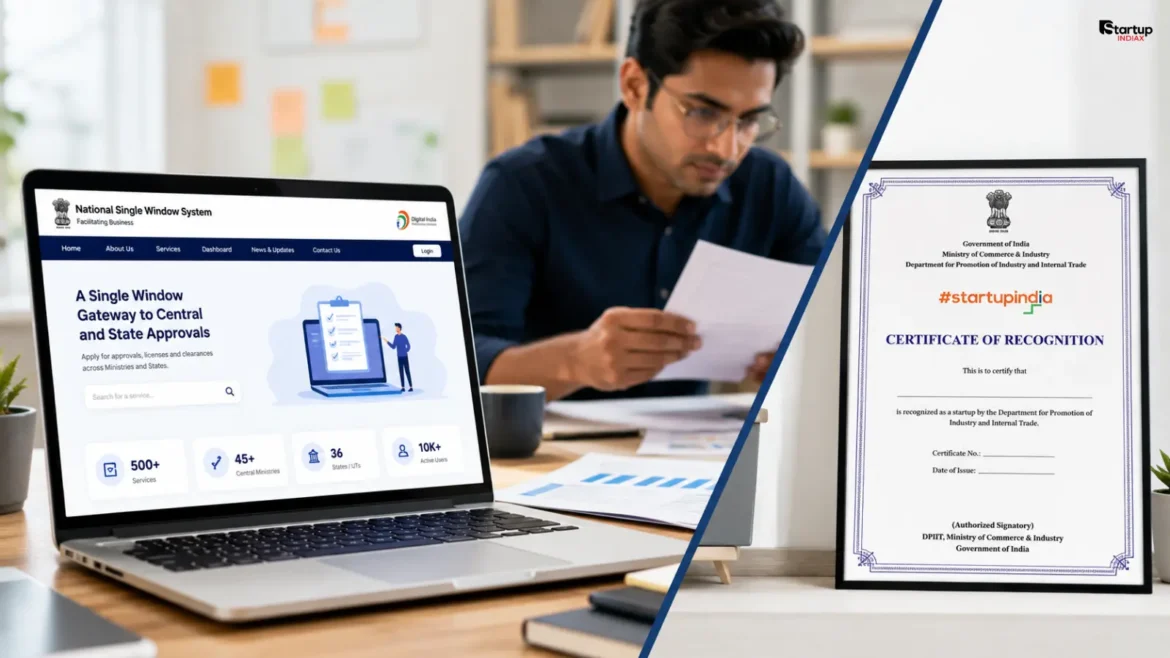
Founder reviewing DPIIT recognition application on the NSWS portal with a Startup India certificate displayed
Startup Learning

7 DPIIT Recognition Mistakes That Get Founders Rejected and How to Fix Them

Getting DPIIT recognition should take less than a week. Most founders take months or never succeed because they keep making the same seven mistakes.
by Aalam Rohile June 27, 2026
3 min read

Summary

  • DPIIT recognition is free and processes in 7 to 14 days, but roughly 70% of applications fail mostly due to a vague innovation description, wrong entity type, or document mismatches.
  • DPIIT recognition and the Section 80-IAC tax exemption are two separate processes; receiving the certificate doesn’t grant the income tax holiday automatically.
  • Founders must monitor post-submission DPIIT queries and respond on time, as unanswered queries cause applications to lapse with no appeal.

DPIIT recognition is one of the few government benefits that costs absolutely nothing, processes in days, and unlocks real money, from a three-year income tax holiday to 80% off patent fees. Yet an estimated 70% of applications are rejected and most of those rejections aren’t because the startup doesn’t qualify. They’re because founders rushed a form that deserved more care.

This guide breaks down the seven mistakes that kill DPIIT applications, with specific fixes for each one. If you’re planning to apply, or you’ve already been rejected, this is where to start.
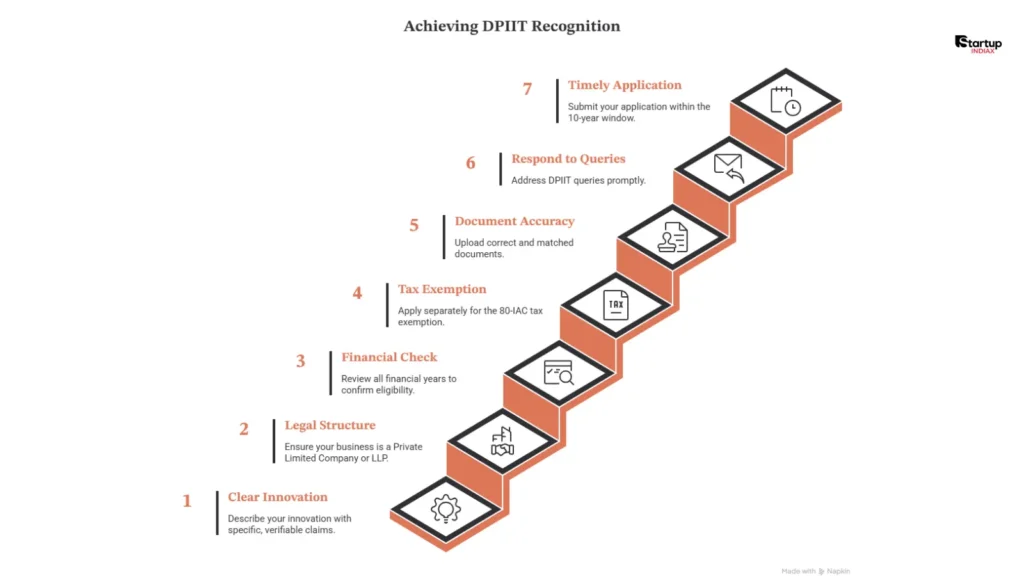
DPIIT Recognition Steps

Mistake 1: Writing a Vague Innovation Description

This one accounts for the majority of all rejections. No other mistake comes close.

A weak or generic description is responsible for approximately 70% of rejections. Reviewers see hundreds of applications. Phrases like “we provide innovative solutions using technology” or “we serve the underserved market with quality services” tell them nothing and nothing gets rejected.

DPIIT reviewers reject marketing language and reward factual, verifiable claims. The fix is to lead with the problem, not your product. Describe the market gap in two to three sentences, then explain exactly what you’ve built, what makes it different from what already exists, and how it scales. Name the technology. Cite a number. Reference a real competitor gap. A line like “machine learning model that identifies crop disease from a smartphone photo with 92% accuracy” is infinitely stronger than “AI-powered agri platform.”

Innovation doesn’t always mean inventing new technology. DPIIT also recognises process innovation, business model innovation, and significant improvement of existing products or services. The key is specificity not originality for its own sake.

Mistake 2: Applying as a Sole Proprietorship

Sole proprietorships, Hindu Undivided Families, and unregistered partnerships cannot apply. If you’re operating as a sole proprietor and you try to file anyway, the application gets rejected at the eligibility check before anyone even reads your innovation description.

If you’re operating as a sole proprietor, you’ll need to restructure first. Convert to a Private Limited Company or LLP before applying. This takes time and involves MCA registration, so plan ahead rather than discovering this on the day you try to submit.

Mistake 3: Not Checking Your Turnover Across All Financial Years

Many founders look at their current year’s revenue, see that it’s well under the limit, and assume they’re fine. DPIIT doesn’t work that way.

DPIIT checks all years, not just the most recent one. If your turnover crossed Rs. 100 crore in any financial year since incorporation, you’re ineligible full stop. This catches bootstrapped businesses that had a strong early year more than founders expect.

Run through every financial year since the date of incorporation before you touch the application form.

Mistake 4: Confusing DPIIT Recognition with the 80-IAC Tax Exemption

This is a structural misunderstanding that costs founders real money, sometimes lakhs of rupees in taxes they didn’t need to pay.

DPIIT recognition and the 80-IAC tax exemption are two separate applications. Getting the DPIIT certificate does not automatically grant the tax exemption. You must separately apply for 80-IAC through the Startup India portal, and the Inter-Ministerial Board reviews that application independently.

The 80-IAC process is significantly longer the Inter-Ministerial Board reviews applications over 45 to 90 days and may request additional information. The mistake founders make is assuming the job is done once the recognition certificate arrives. It isn’t. Start the 80-IAC application as soon as you receive DPIIT recognition, ideally before your first profitable year, so you don’t lose the window.

Read More: Section 80-IAC: Why Only 1.8% of DPIIT Startups Actually Get This Tax Break

Mistake 5: Uploading Wrong or Mismatched Documents

The DPIIT form doesn’t always make it obvious which documents apply to your entity type. Founders often upload what they think is required rather than what actually is.

Double-check the CIN a mismatch with MCA records causes rejection. Beyond that, submitting a Memorandum of Association when it’s not applicable to your entity type, or uploading incorrect file formats, are common document errors.

The fix is simple but tedious: verify document requirements based on your entity type before uploading anything. All names, registration numbers, and PAN details must match exactly across every document you submit. Even a minor discrepancy in formatting can flag an application for rejection.

Mistake 6: Ignoring DPIIT Queries After Submission

A lot of founders treat submission as the finish line. It isn’t.

If DPIIT sends a query requesting additional information, you must respond within the stipulated time. Failing to respond causes the application to lapse. This means you’ve wasted the time spent on the application and have to start over.

Monitor your registered email and respond quickly to avoid delays or rejection. After you submit, check the email address you registered with at least once a day. Set a reminder. This is one of the most avoidable reasons applications fail.

Mistake 7: Applying After the 10-Year Window Has Closed

This one is rarer, but it’s also irreversible.

Recognition applications submitted after 10 years from incorporation are rejected outright. There’s no extension, no appeal, no workaround. If you’re in year eight or nine of your company’s life and you’ve been putting off the DPIIT application, stop reading and file it now.

For Deep Tech startups, the 2026 policy update under G.S.R. 108(E) extended this window to 20 years, which gives qualifying founders significantly more runway. But for standard startups, the 10-year ceiling is hard.

Read More: How to Apply for Startup India Certificate in 5 Easy Steps

Startup INDIAX Take

Most DPIIT rejections aren’t a verdict on whether the startup is good. They’re a verdict on whether the founder treated a government form like a pitch. For Indian founders who’ve spent months building, the DPIIT application often becomes an afterthought something handed off to a junior team member or rushed through in an afternoon. But the innovation description, in particular, is essentially a condensed investor pitch addressed to a government official. It deserves the same care. The founders who get approved on the first attempt are rarely the ones with the most impressive businesses. They’re the ones who were specific, accurate, and patient with paperwork. That’s a skill worth building early.

Read More: Startup India Certificate 2026: Step‑by‑Step Guide to DPIIT Recognition (NSWS Portal)

Why This Matters

DPIIT recognition sits at the start of almost every meaningful government benefit available to Indian startups the income tax holiday, patent fee rebates, self-certification under labour laws, GeM procurement access, and more. None of these activate automatically. Each requires that you hold a valid recognition certificate and then take additional steps. Getting rejected, or worse, never applying because the process feels complicated, means leaving a defined set of benefits on the table. Given that the application costs nothing and processes in under two weeks when done correctly, there’s no good reason to keep getting it wrong.

The Bigger Picture

The February 2026 policy update under G.S.R. 108(E) made the DPIIT framework more founder-friendly in several ways, including expanded eligible entity types, a higher turnover cap, and a dedicated Deep Tech category. It’s a signal that the government wants more startups to qualify and benefit, not fewer. But the application process hasn’t changed much. Reviewers still look for the same thing they always have: a founder who can clearly explain what problem they’re solving and why their approach is different.

The startups that will benefit most from the updated framework are the ones that understand the process well enough to get through it cleanly the first time.

Applied for DPIIT recognition recently? Tell us in the comments what the process looked like and where you hit friction. If you’re still working through it, explore our step-by-step guide on getting your Startup India certificate and share this with a founder who needs it.

FAQs

What is the most common reason DPIIT recognition applications get rejected?

A weak or vague innovation description is the single biggest cause. Reviewers reject generic language and look for specific details the problem being solved, the technology used, and why the solution scales. Around 70% of rejections come down to this one field.

Does getting DPIIT recognition automatically give me the income tax exemption?

No. DPIIT recognition and the Section 80-IAC tax exemption are two separate applications. After receiving your recognition certificate, you must separately apply to the Inter-Ministerial Board for the 80-IAC tax holiday, which can take an additional 45 to 90 days.

Can a sole proprietorship apply for DPIIT recognition?

No. Only Private Limited Companies, LLPs, and Partnership Firms are eligible. If you’re operating as a sole proprietor, you’ll need to convert your entity structure before applying.

Is there a fee to apply for DPIIT recognition?

No. The application is completely free and filed online through the National Single Window System at nsws.gov.in. Any agency asking you to pay for this is running a scam.

What happens if DPIIT sends a query about my application?

You must respond within the stipulated time or your application will lapse. After submitting, monitor the email address you registered with regularly. Unanswered queries are one of the most avoidable causes of rejection.

Can I reapply if my DPIIT application is rejected?

Yes. There’s no limit on reapplications and no waiting period. Review the rejection reason carefully, fix the specific issue usually the innovation description and resubmit on the NSWS portal.

June 27, 2026 0 comments 189 views
FacebookTwitterLinkedinWhatsapp
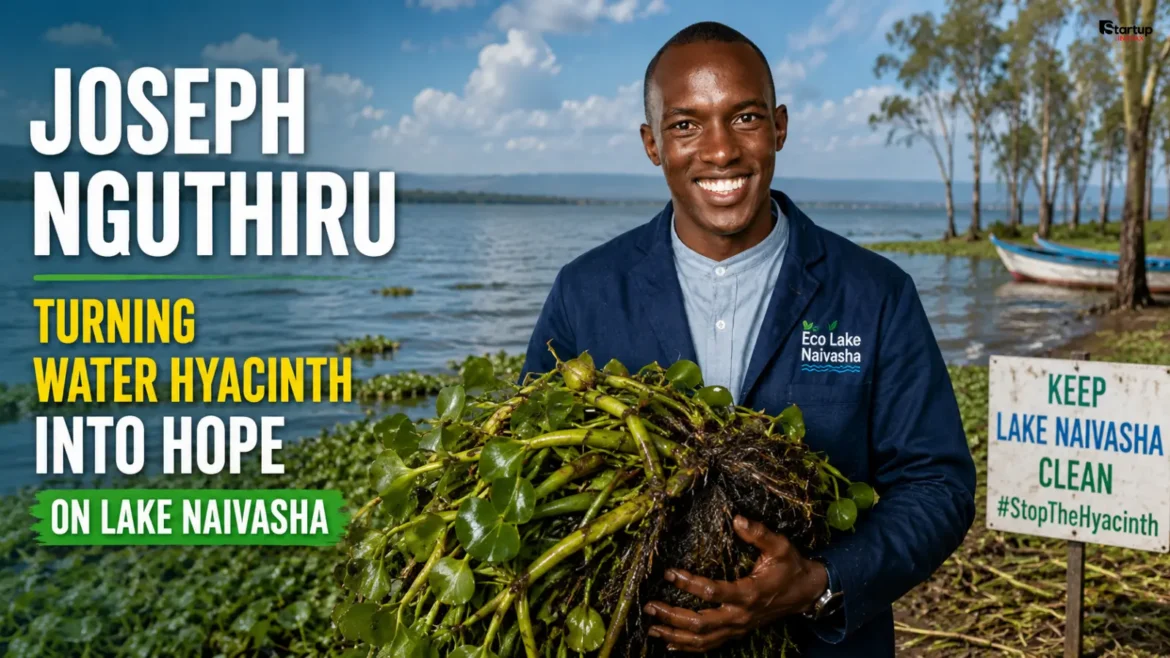
Joseph Nguthiru HyaPak founder holding water hyacinth at Lake Naivasha Kenya
Startup StoriesGreen EnergyNews

Joseph Nguthiru Got Stuck in a Weed-Choked Lake. Now His Water Hyacinth Biodegradable Plastic Startup Has the UN’s Attention

Joseph Nguthiru didn't just study environmental engineering. He used it to turn water hyacinth biodegradable plastic into a global climate startup that's restoring lakes, replacing single-use bags, and creating green jobs in communities that need them most.
by Aalam Rohile June 23, 2026
3 min read

Summary

  • Joseph Nguthiru founded HyaPak in 2022 after getting his boat trapped in water hyacinth on Lake Naivasha. His startup converts the invasive weed into biodegradable packaging bags, seedling wrappers, and carton linings that perform like plastic but break down naturally.
  • HyaPak has cleared over 20 hectares of hyacinth from Lake Naivasha, created 45 green jobs for local fishermen, and won Kenya’s Presidential Innovation Award, the COP28 Prototypes for Humanity Award, and the 2025 UNEP Young Champion of the Earth title.
  • HyaPak’s partnership with Kenya’s national Jaza Miti tree-planting programme and export deals into the US and Germany signal a model ready to scale, and one that Indian founders dealing with identical invasive species problems should study closely.

In 2021, a group of Egerton University engineering students got their boat stuck on Kenya’s Lake Naivasha.

For five hours, they couldn’t move. Dense mats of water hyacinth had closed in from every direction.

For most people, it would have been a frustrating afternoon. For Joseph Nguthiru, it became the idea that changed everything.

Nguthiru, now 27, is the founder and CEO of HyaPak Ecotech Limited. His Kenyan startup converts water hyacinth into biodegradable alternatives to single-use plastic. In 2025, the United Nations Environment Programme named him a Young Champion of the Earth, its highest recognition for young environmental innovators.

He was one of three selected globally from over 5,000 applicants.

The Weed Nobody Wanted

Water hyacinth originally comes from South America. Today it’s classified by the Intergovernmental Platform on Biodiversity and Ecosystem Services as one of the world’s most widespread invasive species.

It covers vast stretches of Lake Naivasha, Lake Victoria, and dozens of other African water bodies.

The damage is well-documented.

The plant floats on the surface, blocking sunlight and cutting off oxygen from below. Fish die. Boats can’t pass. Irrigation systems clog. Stagnant hyacinth-covered water creates ideal breeding conditions for malaria-carrying mosquitoes.

In Kenya alone, losses linked to water hyacinth across fisheries, transport, and tourism run into hundreds of millions of dollars every year.

Fishermen hated it. Governments funded removal drives that couldn’t keep pace. The hyacinth grew back faster than anyone could clear it.

Nguthiru saw a raw material.

A Final-Year Project That Became a Business

After the boat incident, Nguthiru and his classmates brought the problem back to campus.

Their lecturers suggested it as a final-year engineering project. Funding was tight at the public university, so they started with samples from the campus botanical garden before eventually working with hyacinth harvested directly from the lake.

The core idea was straightforward but took real engineering to execute.

Dried water hyacinth is combined with binders and additives, then shaped into products that feel and perform like conventional plastic. The difference is they biodegrade in a short time.

HyaPak was formally founded in 2022.

What HyaPak Actually Makes

The product line that emerged solves problems most green packaging companies in richer markets don’t even think about.

HyaPak biodegradable water hyacinth seedling bag being planted in soil Kenya

Biodegradable seedling bags. Farmers plant these directly into the soil alongside the seedling. As the bag decomposes, it releases nutrients that accelerate plant growth. No plastic waste left behind. No bag to remove before planting.

Courier packaging bags. Replaces single-use plastic mailers for parcel delivery services.

Carton linings. Keeps fresh produce cool during transport without refrigeration. Cold storage infrastructure is expensive and patchy across much of sub-Saharan Africa. A biodegradable lining that extends shelf life over long distances without electricity is genuinely useful here.

HyaPak’s seedling bags were presented directly to Kenya’s President William Ruto as part of the country’s Jaza Miti reforestation programme, which targets 15 billion trees by 2032.

That’s not a pilot relationship. It’s a national government deployment.

Three Problems. One Business Model.

What makes HyaPak worth paying attention to isn’t just the product. It’s the logic of the supply chain.

Local fishermen harvesting water hyacinth from Lake Naivasha for HyaPak biodegradable plastic production

Communities around Lake Naivasha, fishermen and locals whose livelihoods were being damaged by the weed, are now paid to harvest it.

The people who suffered most from the invasion are earning from its removal.

HyaPak has cleared over 20 hectares of hyacinth from Lake Naivasha and created 45 green jobs directly tied to that removal.

Three problems closed by one model: invasive species control, plastic waste reduction, and community income generation.

“Our solution at HyaPak is to use one problem of water hyacinth to solve yet another problem of plastic waste pollution while creating green jobs for the local communities,” Nguthiru told UNEP.

It’s a circular economy argument that actually closes the loop.

The Awards Keep Coming

HyaPak’s recognition has moved fast.

At COP28 in Dubai, it won the Prototypes for Humanity Award in the Nature, Food, and Water Systems category. The selection came from 2,800 submissions across more than 200 research fields.

The Yale Africa Startup Review listed HyaPak among the top 30 startups on the continent.

Kenya’s East Africa Science and Technology Commission gave Nguthiru the Presidential Award for Best Innovator in 2022.

The 2025 UNEP Young Champions of the Earth award came with seed funding, mentorship, and global communications support. It also included entry into the first Planet A pitch competition, which offered a US$100,000 business growth grant and the chance at a potential US$1 million investment in a future fundraising round.

HyaPak’s products have started reaching international markets including the United States and Germany.

Nguthiru has also co-founded M-Situ AI, which uses satellite imagery to detect deforestation and illegal charcoal burning in Kenyan forests, and AfroClimate, a non-profit backing African climate entrepreneurs.

He’s building an ecosystem, not just a single company.

Startup INDIAX Take

HyaPak matters to Indian readers for reasons that go beyond inspiration.

India faces the same water hyacinth problem. Dal Lake in Kashmir, Loktak Lake in Manipur, Kerala’s backwaters, and parts of the Krishna and Godavari river systems all deal with invasive hyacinth infestations. The same ecological damage plays out here too: blocked waterways, oxygen depletion, declining fisheries, and mosquito breeding.

India also banned single-use plastic bags and still doesn’t have enough affordable, locally produced alternatives at scale.

The HyaPak model is, in principle, replicable. Nguthiru himself has said he hopes the solution can be adopted across countries facing similar problems.

For Indian founders working in sustainable packaging or circular economy models, the bigger lesson isn’t the product. It’s the supply chain logic.

When your raw material is someone else’s problem, and your workforce is the community most affected by it, your business case becomes almost self-evident.

That’s a template worth studying.

Why This Matters

Kenya banned single-use plastic bags in 2020. But enforcement hit a practical wall: there weren’t enough affordable alternatives being produced locally.

People smuggled plastic bags in from neighbouring countries because the substitute didn’t exist at the right price point.

HyaPak is one of the startups filling that gap. Its products don’t just replace plastic. They come from a supply chain that actively repairs an ecological problem while doing so.

That’s a different value proposition from conventional bioplastics, which typically still require agricultural inputs, energy-intensive processing, and clean raw material sources.

The invasive species angle also matters for climate economics. Removing water hyacinth manually is expensive and temporary. The weed grows back. Building commercial demand for it creates a self-sustaining reason for communities to keep removing it.

That’s pest management through market design. It’s far more durable than government cleanup drives.

The Bigger Picture

The global biodegradable packaging market is growing fast as single-use plastic bans spread across Asia, Africa, and Europe.

But most innovation in this space happens in labs and factories in wealthy countries, producing materials that don’t account for infrastructure realities in emerging markets.

HyaPak sits at the intersection of two trends that will define the next decade of green business: circular economy thinking, and locally appropriate innovation.

Nguthiru’s approach, engineering a solution from what’s already causing a problem in your own backyard, is increasingly cited by international development organisations as the model for African climate entrepreneurship.

That HyaPak now exports to the US and Germany while still serving Kenyan farmers and fishermen suggests the model scales in both directions.

Read More: Stone Paper vs. Traditional Paper: Can Sand into Paper Halt Deforestation in 2025?

What Do You Think?

Is water hyacinth a problem in your region? Could the HyaPak model work in India’s lakes and backwaters? Drop your thoughts in the comments. We’d love to hear from founders thinking about circular economy solutions closer to home.

FAQs

Who is Joseph Nguthiru and what did he build?

Joseph Nguthiru is a 27-year-old Kenyan environmental engineer and founder of HyaPak Ecotech Limited. He built a startup that converts water hyacinth, an invasive aquatic weed, into biodegradable alternatives to single-use plastic bags, seedling wrappers, and food packaging liners.

How does HyaPak turn water hyacinth into biodegradable plastic?

Harvested hyacinth is dried, then combined with binders and additives, mixed, and shaped into products. The result performs like conventional plastic but biodegrades naturally. Seedling bags can be planted directly into soil and release nutrients as they decompose, eliminating plastic waste from nurseries and reforestation sites.

What awards has HyaPak won?

HyaPak has won the 2025 UNEP Young Champion of the Earth award, the COP28 Prototypes for Humanity Award in the Nature, Food, and Water Systems category, and Kenya’s Presidential Award for Best Innovator. The Yale Africa Startup Review also listed it among the top 30 startups on the continent.

Why is water hyacinth such a serious problem in Kenya?

The plant is one of the world’s most widespread invasive species. It blocks sunlight and oxygen in water bodies, killing aquatic life. It disrupts navigation, irrigation, and fishing, and creates stagnant water that breeds malaria-carrying mosquitoes, raising health risks for lakeside communities.

Is HyaPak’s model relevant for India?

Yes. India faces water hyacinth problems in Dal Lake, Loktak Lake, and parts of Kerala’s backwaters. Combined with India’s single-use plastic ban and the shortage of affordable local alternatives, there’s a clear opening for a similar invasive-species-to-bioplastic model to be developed and scaled here.

What is HyaPak’s government partnership about?

HyaPak has partnered with the Kenyan government to supply biodegradable seedling bags to the Jaza Miti reforestation initiative, which targets 15 billion trees by 2032. The startup’s products were directly presented to President William Ruto, giving HyaPak a large-scale, consistent commercial channel tied to national policy.

June 23, 2026 0 comments 162 views
FacebookTwitterLinkedinWhatsapp
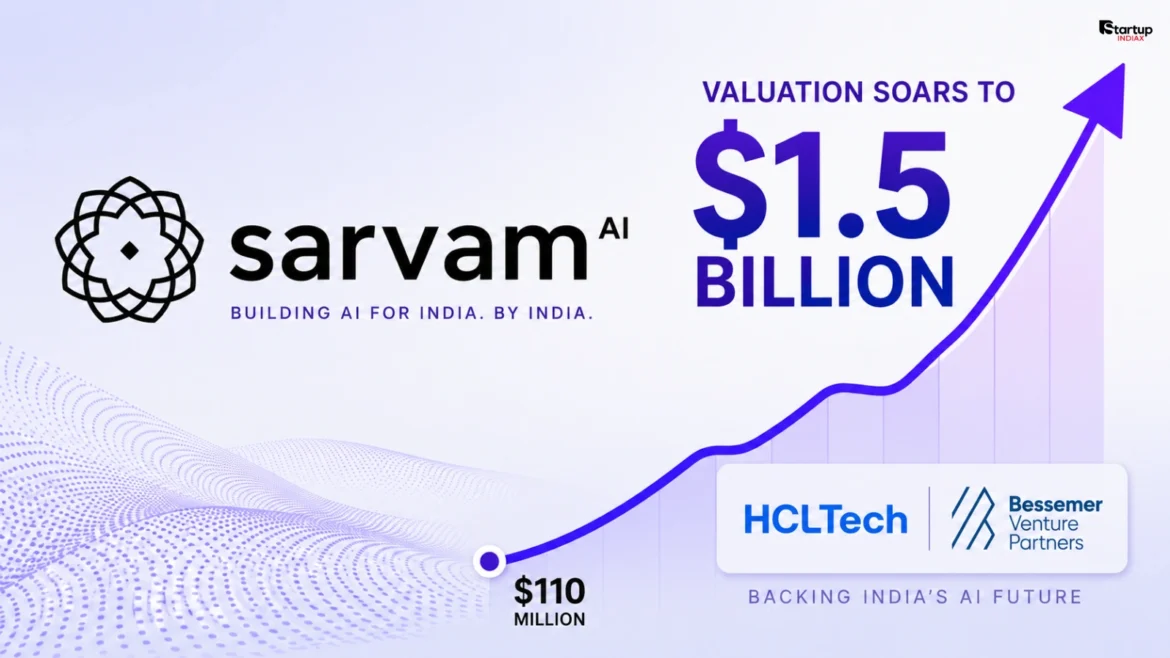
Sarvam AI Series B funding graphic showing $234 million raise and $1.5 billion valuation
FundingAI & DeepTechNews

Sarvam AI Just Became a Unicorn, Here’s the $234 Million Story Behind It

The Bengaluru AI startup raised $234 million from HCLTech and Bessemer Venture Partners, crossing a $1.5 billion valuation just two and a half years after its Series A.
by Aalam Rohile June 22, 2026
3 min read

Summary

  • Sarvam AI raised $234 million of a $300 million Series B, hitting a $1.5 billion valuation and unicorn status.
  • HCLTech led with $150 million for a 10.46% stake; Bessemer, Khosla Ventures, and Peak XV Partners also joined.
  • Funds will fund a next frontier model and GPU access, with the remaining $66 million still to close.

Sarvam AI’s Series B funding round just made it India’s newest AI unicorn, and the way the deal is structured says as much as the number does. On June 15, the Bengaluru startup announced it had raised $234 million in the first close of a $300 million round, taking its valuation to $1.5 billion. What’s different here is who wrote the biggest check. It wasn’t a Silicon Valley fund. It was HCLTech, an Indian IT services giant putting real money behind a domestic AI lab for the first time at this scale.

What Actually Happened

Sarvam closed $234 million of a planned $300 million Series B, with HCLTech leading as strategic investor at $150 million, enough to take a 10.46% stake worth roughly ₹1,427 crore. Bessemer Venture Partners co-led the round. Existing backers Khosla Ventures and Peak XV Partners returned for another round, while Lightspeed Venture Partners, an early investor, sat this one out.

The company hasn’t said when it expects to close the remaining $66 million, though there’s been speculation about Nvidia joining a later tranche. Co-founder Vivek Raghavan declined to confirm that directly, telling Business Standard only that people should wait for the second closing.

From $41 Million to $1.5 Billion

Sarvam’s funding history is a useful reminder of how fast Indian AI valuations have moved. The startup, founded in 2023 by Vivek Raghavan and Pratyush Kumar, both veterans of the IIT Madras language-AI initiative AI4Bharat, raised $41 million across its seed and Series A rounds back in December 2023. That round, led by Lightspeed, valued the company at roughly $110 million. Eighteen months and one product cycle later, Sarvam is worth more than ten times that.

The jump tracks two things: a string of model releases and a string of enterprise deployments that turned Sarvam from a research project into something companies actually pay to use.

What Sarvam Actually Builds

Sarvam describes itself as a full-stack sovereign AI company, meaning it builds everything from foundation models to the enterprise applications running on top of them, all trained and hosted in India. Earlier this year it released two open-source models built entirely from Indian infrastructure and data: Sarvam 105B, a reasoning model the company says matches larger international models on knowledge and agentic benchmarks, and Sarvam 30B, a lighter model designed to run on consumer-grade hardware.

The usage numbers behind those models are what likely got investors’ attention. Sarvam’s conversational AI platform now handles more than 2 million interactions a day, roughly double its volume from two months ago. Its inference platform processes around 10 million API calls daily, triple what it was three months back. Its speech models transcribe over 500,000 hours of audio every month, and its document AI tool, Sarvam Vision, has digitised more than 35 million pages of records, from insurance forms to old land documents.

Those tools are already running inside real institutions. A multilingual voice agent built for the Ministry of Agriculture and Farmers Welfare collected data from 17 million farmers. A nationwide voice campaign for a major insurer supported policy renewals for 45 million policyholders, and Sarvam has separately partnered with SBI Life Insurance on customer engagement. On the enterprise side, a large fintech company is using Sarvam’s agentic platform to support a sales force of more than 350,000 people.

Read More: How Drools Became the First Pet Food Unicorn of India in 2025

Why HCLTech Specifically

Indian conglomerates have backed startups before, usually through small, symbolic checks from corporate venture arms. A $150 million lead investment from an IT services company is a different kind of bet. HCLTech CEO C Vijayakumar framed it as a step toward building India’s own competitive AI ecosystem, and the stated plan is to pair Sarvam’s models with HCLTech’s enterprise client relationships, engineering workforce, and existing software business to sell AI products directly to banks, insurers, and government bodies that already work with HCLTech.

Bessemer’s Pankaj Mitra made a related point in the company’s announcement: India’s AI ambitions need more than good foundation models. They need the full stack, infrastructure, data, applications, and deployment, built domestically. That’s the bet Sarvam’s investor list is making collectively.

Fresh capital from the round is earmarked for training Sarvam’s next frontier model, focused on agentic AI, coding, and cybersecurity use cases, along with securing more GPU access. Raghavan has said anywhere from 30% to 50% of the funds will likely go toward compute procurement alone, which gives a sense of how capital-intensive frontier AI work still is, even for a company already generating real revenue.

Read More: India’s First Homegrown Sovereign AI Model, Sarvam AI To Build

Startup INDIAX Take

What makes this round worth watching isn’t just the unicorn label, it’s who’s funding it. Most of India’s AI capital so far has come from the same global funds that back Silicon Valley startups. HCLTech leading at $150 million signals that domestic capital is now willing to underwrite frontier AI research, not just buy services from it. For founders building in deep tech or infrastructure-heavy categories, that’s a meaningful shift in who’s available to write the big checks. For India’s broader AI ambitions, it suggests the “sovereign AI” pitch has moved from policy talking point to something investors are pricing into real valuations.

Why This Matters

For Indian AI founders, Sarvam’s round is proof that building foundation models domestically, rather than wrapping a foreign model in a local interface, can attract serious capital and serious enterprise customers. For investors, it’s a signal that AI infrastructure plays in India are no longer purely speculative; Sarvam’s usage numbers show real institutional adoption, not just demo traction. For enterprises and government bodies, the HCLTech partnership specifically points toward sovereign AI products becoming commercially available at scale, rather than staying confined to pilot programs. And for consumers, it means more AI tools built for Indian languages and use cases, deployed through institutions people already interact with, from insurers to government agriculture programs.

The Bigger Picture

Sarvam’s round lands at a moment when sovereign AI has become a serious global theme, not just an Indian one. Governments from Europe to the Gulf are funding domestic AI infrastructure as a hedge against depending entirely on US or Chinese frontier labs. India’s own push, through the IndiaAI Mission and its planned compute infrastructure, has already backed multiple homegrown model efforts, and Sarvam was among the first startups selected under that program.

What’s notable is the capital source. Indian IT services firms have deep enterprise relationships but historically thin AI research capability. Foreign-funded Indian AI startups have research talent but limited enterprise distribution inside India’s regulated sectors. Sarvam’s deal effectively merges the two, and if it works, it could become a template other Indian conglomerates look to repeat with other AI startups over the next year.

Read More: Krutrim’s Bold Leap: Unveiling Its Agentic AI Assistant Kruti in 2025

Got thoughts on whether Indian conglomerates backing AI startups is the playbook other founders should be chasing? Drop them in the comments, and check out more of Startup INDIAX’s funding coverage for the deals shaping India’s AI race this year.

FAQs

What is Sarvam AI’s Series B funding round?

Sarvam AI raised $234 million in the first close of a $300 million Series B round, announced on June 15, 2026, at a $1.5 billion post-money valuation, led by HCLTech and Bessemer Venture Partners.

Who led Sarvam AI’s Series B round?

HCLTech led as the strategic investor with $150 million, acquiring a 10.46% stake. Bessemer Venture Partners co-led, alongside returning investors Khosla Ventures and Peak XV Partners.

Why didn’t Lightspeed Venture Partners participate in this round?

Lightspeed, an early backer of Sarvam’s seed and Series A rounds, did not take part in the Series B. The company hasn’t publicly explained why.

What will Sarvam AI use the funding for?

The capital will go toward training Sarvam’s next frontier AI model, focused on agentic AI, coding, and cybersecurity, along with securing additional GPU and compute infrastructure to support its growing deployments.

What does “sovereign AI” mean in Sarvam’s case?

It means Sarvam builds and trains its models entirely within India, using Indian infrastructure and data, rather than relying on foreign-built foundation models, aiming to keep critical AI capabilities under domestic control.

How is Sarvam AI’s technology actually being used?

Its products are deployed across banking, insurance, government services, and agriculture, including voice agents used by India’s Ministry of Agriculture and a nationwide insurance policy renewal campaign reaching 45 million policyholders.

June 22, 2026 0 comments 212 views
FacebookTwitterLinkedinWhatsapp
Startup India Certificate 2026 Step‑by‑Step Guide to DPIIT Recognition (NSWS Portal)
Startup Learning

Startup India Certificate 2026: Step‑by‑Step Guide to DPIIT Recognition (NSWS Portal)

A complete founder-friendly guide to Startup India registration, DPIIT recognition, eligibility criteria, required documents, approval timeline, and how to apply through the NSWS Portal in 2026.
by Aalam Rohile June 21, 2026
3 min read

Getting the Startup India certificate is one of the most important early steps for any Indian founder today. It unlocks tax benefits, access to government schemes, easier fundraising, and recognition as an official startup by DPIIT (Department for Promotion of Industry and Internal Trade). In this guide, you’ll learn exactly how to apply for Startup India recognition online using the NSWS portal in 2026, with documents list, screenshots checklist, and common mistakes to avoid.

What is the Startup India certificate?

The Startup India certificate is an official recognition issued by DPIIT under the Startup India initiative of the Government of India. Once your company is recognized as a startup, you receive a unique Startup Recognition Number and a downloadable PDF certificate from the portal.

This recognition confirms that your business meets the government’s definition of a “startup” (innovation, age, turnover, etc.) and makes you eligible for benefits like income‑tax exemptions, easier patent filings, and access to government funding schemes.

Benefits of getting Startup India recognition

Here are the main reasons founders actively apply for the Startup India certificate today:

  • Eligibility for income‑tax exemptions under section 80‑IAC for eligible startups (subject to separate approval from the Inter‑Ministerial Board).
  • Faster and discounted intellectual property (IP) services such as patent filing and trademark support through the scheme.
  • Better chances of getting grants, funds of funds support, and access to incubators and government‑backed accelerators.
  • Signalling advantage with investors, banks, and corporate partners, because DPIIT recognition acts like an official stamp of innovation.

If you plan to raise funding or tap into government schemes in the next 1–3 years, it is worth applying early.

Read More: Startup India Seed Fund Scheme Incubators: How to Apply Now

Eligibility criteria for Startup India certificate (2026)

Before you start the application, check whether your venture is eligible. The key points are:

  • Age of entity: Your company should be a private limited company, registered partnership firm, or LLP, and must not be older than 10 years from date of incorporation.
  • Turnover limit: Annual turnover should not have exceeded ₹100 crore in any financial year since incorporation.
  • Nature of business: The startup should be working towards innovation, development, or improvement of products/services/processes, or a scalable business model with high potential for employment or wealth creation.
  • Non‑split condition: The entity should not be formed by splitting up or reconstructing an existing business.

If you don’t match these points, your application is likely to be rejected or kept on hold.

Documents required for Startup India registration

Prepare clear soft copies (PDF/JPEG) of the following before you sit to apply:

  • Certificate of incorporation/registration of your company, LLP, or partnership.
  • PAN of the entity and PAN of the authorised signatory.
  • Founder/authorised signatory’s Aadhaar and basic KYC details.
  • Brief write‑up describing your business, problem you solve, your innovation, and how it creates jobs or wealth.
  • Website URL, app links, pitch deck, or product demo (if available) to support the innovation claim.

Keep all names, addresses, and dates exactly matching your incorporation documents to avoid mismatch issues.

Step‑by‑step: How to apply via NSWS portal

The Government has moved the Startup India recognition process to the National Single Window System (NSWS). Follow these steps carefully:

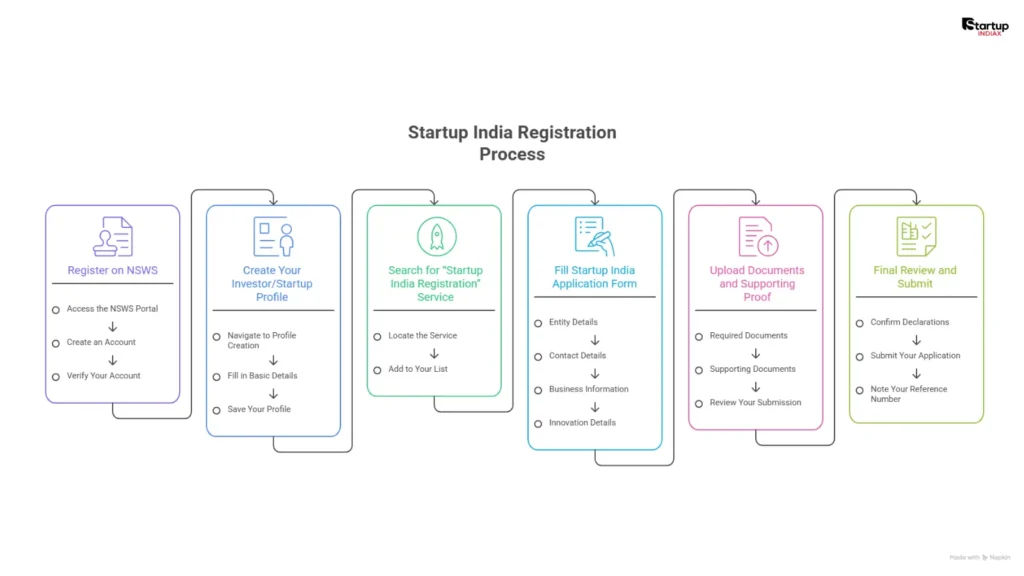
Step‑by‑step How to apply via NSWS portal

Step 1 – Register on NSWS

  1. Go to the NSWS portal (National Single Window System) used for central schemes and licenses.
  2. Click on “Register” and create an account with your email ID and mobile number.
  3. Verify your OTPs and log in to your new NSWS account dashboard.

Step 2 – Create your investor/startup profile

  1. In your dashboard, you’ll see an option to create an “Entity profile” or “Business profile.”
  2. Fill in basic details about the company: name, CIN/LLPIN/firm registration number, type of entity, and registered office address.
  3. Save the profile; this profile will be reused for other NSWS services as well.

Step 3 – Search for “Startup India Registration” service

  1. Use the NSWS search bar or the “Schemes and Services” section to find “Startup India Registration/DPIIT Recognition.”
  2. Add this service to your list and proceed to the application form.

Step 4 – Fill Startup India application form

The form will ask for:

  • Entity details: incorporation date, PAN, registration type, number of directors/partners.
  • Contact details: official email ID, phone number, website/app links.
  • Business information: sector, sub‑sector, stage of business, number of employees.
  • Innovation details:
    • Problem your startup solves.
    • How your solution is innovative compared to existing options.
    • Evidence of traction (customers, revenue, pilots, awards).

Write these answers carefully in plain English, with specific examples and numbers instead of generic lines like “We are unique and innovative.”

Step 5 – Upload documents and supporting proof

  1. Upload your certificate of incorporation/registration and PAN.
  2. Attach a pitch deck, product demo, or any supporting document that proves innovation and scalability.
  3. Review all fields for spelling mistakes and mismatch between portal data and uploaded documents.

Step 6 – Final review and submit

  1. Tick the declarations confirming that all information is true and that you meet the Startup India eligibility criteria.
  2. Submit the application. There is currently no government fee for Startup India recognition itself, but normal incorporation costs are separate.
  3. Note the reference number/acknowledgement for future tracking.

After submission, your application goes to DPIIT for review. If they need clarification, they may email you for more details or keep the application “On Hold” until you respond.

How long does Startup India approval take?

Founders commonly report that straightforward applications with clear documentation can get approved within a few days to a couple of weeks. However, if DPIIT asks for clarifications or if there is a backlog, the process can take longer.

Keep checking your email and the NSWS/Startup India portal for status updates so you can respond quickly if any queries are raised.

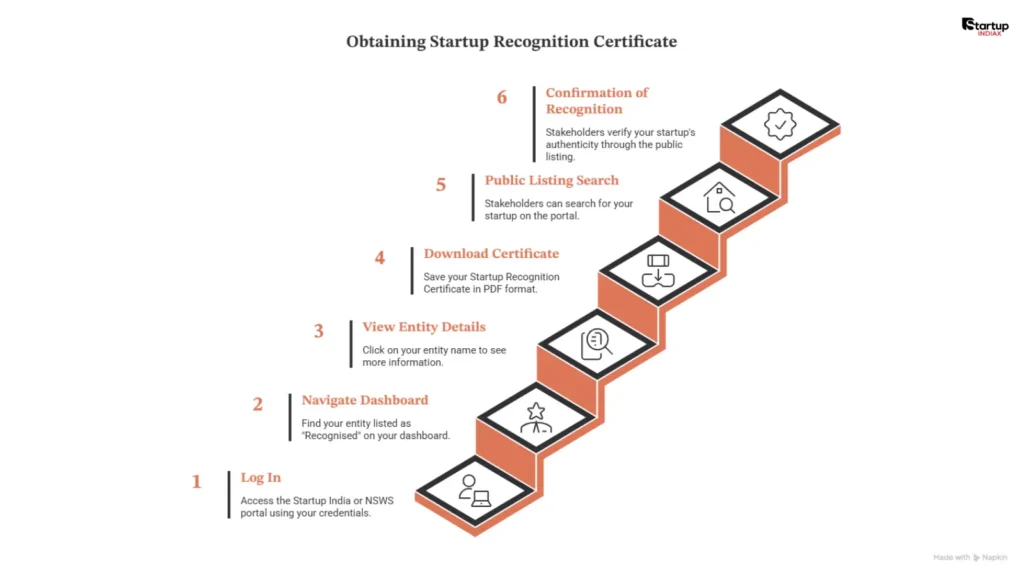
How to download and verify your Startup India certificate

Once your startup is approved:

  1. Log into the Startup India or NSWS portal with the same credentials you used for the application.
  2. Go to your dashboard; you should see your entity listed as “Recognised.”
  3. Click on the entity name to view details, and there will be an option to download your Startup Recognition Certificate (PDF).
  4. For verification (for investors, banks, clients), they can search your startup’s name or recognition number in the public listing on the Startup India portal to confirm authenticity.
Obtaining Startup India Certificate

Always save the PDF in multiple locations (cloud, email, local storage) and keep your login details secure.

Read More : The Indian Startup Funding Guide

Common reasons for rejection or “On Hold” status

Many founders face rejection or long delays because of avoidable mistakes. Some common issues are:

  • Weak or generic “innovation” description that doesn’t clearly differentiate from existing businesses.
  • Documents not matching the details entered on the form (name, address, incorporation date mismatches).
  • Business model is basically a regular trading or service activity with no scalable or innovative component in the eyes of DPIIT.
  • Entity older than 10 years or turnover crossing the prescribed limit.

If your application is on hold, you can usually respond with clarifications, better explanation of innovation, and additional proof such as user traction or product demos.

What to do after getting recognised

Getting the Startup India certificate is the beginning, not the end. Here are the next steps you should consider:

  • Apply separately for tax benefits under section 80‑IAC, if your startup qualifies and you plan to use this exemption.
  • Explore schemes and incubators listed on the Startup India portal that are available only to recognised startups.
  • Use your recognition status in pitch decks, website, and conversations with banks/investors as a mark of credibility.
  • Stay compliant with regular company law, tax filings, and other regulations; recognition does not exempt you from these.

Quick summary checklist (for founders)

Before you click “Apply,” confirm these points:

  • You are registered as a private limited company, LLP, or partnership and are less than 10 years old.
  • Turnover has never crossed ₹100 crore in any year.
  • You have a clear and specific explanation of your innovation and scalability.
  • All documents are ready: incorporation certificate, PAN, KYC, and supporting decks/links.
  • You are applying via the NSWS portal’s “Startup India Registration/DPIIT Recognition” service.

FAQs

Who is eligible for the Startup India certificate?

To be eligible, your business must be a Private Limited Company, LLP, or registered partnership firm, be less than 10 years old, and have turnover within the allowed limit. It should also be working on innovation, improvement, or a scalable business model.

Is Startup India registration free?

Yes, the Startup India recognition itself is free on the official portal. You may still pay normal business incorporation charges or professional fees if you hire help.

How long does Startup India approval take?

If your documents are clear and complete, approval usually takes around 7–10 working days. If the application needs clarification, it can take longer.

What documents are needed for Startup India registration?

You usually need your incorporation certificate, PAN, details of directors or partners, and a short explanation of your business and innovation. Supporting documents like a pitch deck or website link can also help.

June 21, 2026 0 comments 316 views
FacebookTwitterLinkedinWhatsapp
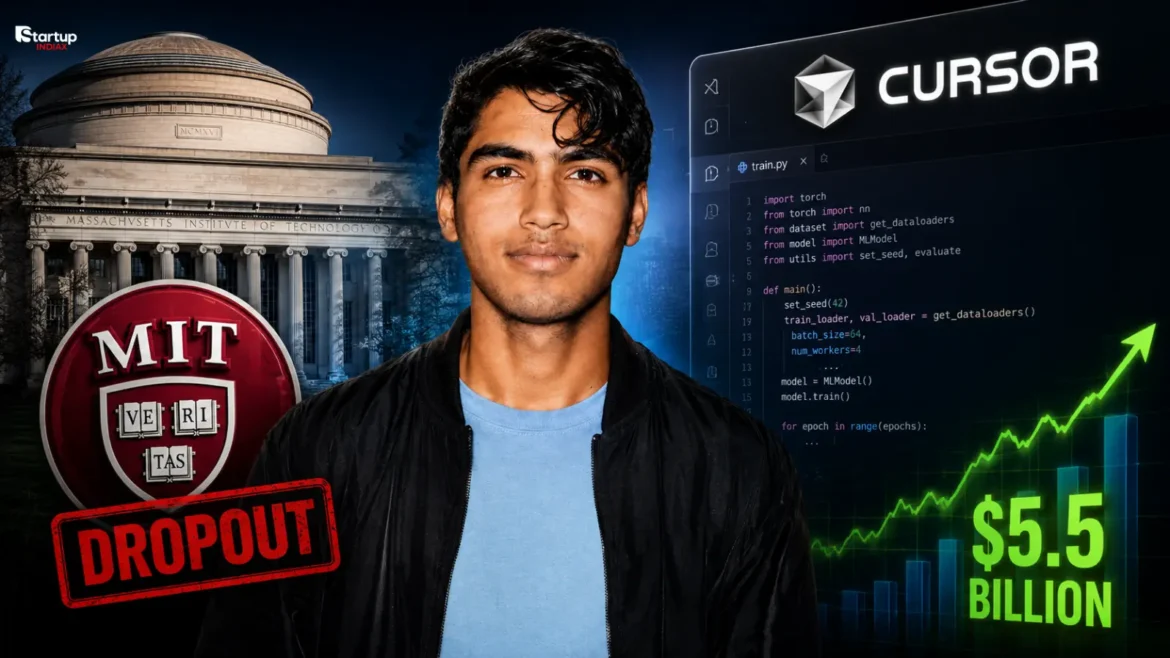
Aman Sanger MIT Dropout Turned 5.5 Billion Cursor Billionaire
NewsAI & DeepTechStartup Stories

Aman Sanger: MIT Dropout Turned $5.5 Billion Cursor Billionaire

How a 25-year-old who started coding at 14 co-built Cursor, the AI tool now at the center of SpaceX's $60 billion acquisition deal.
by Aalam Rohile June 20, 2026
3 min read

SUMMARY

  • Aman Sanger’s Cursor stake could be worth $2.7 billion after SpaceX’s $60B deal
  • SpaceX acquisition of Anysphere expected to close by Q3 2026 via SEC filing
  • Cursor’s ARR jumped from $1B to $4B in under a year, fueled by Cloud Agents

Aman Sanger just became one of the richest young founders on the planet, and he didn’t even need a decade to do it. At 25, this MIT dropout co-built Cursor, the AI coding tool now being scooped up by Elon Musk’s SpaceX in a deal worth $60 billion. So how did a teenager who started coding at 14 end up rewriting Silicon Valley’s playbook?

Four years ago, Aman Sanger was just another computer science student at MIT. Today, he’s one of four co-founders behind a $60 billion acquisition that has Silicon Valley and India’s startup circles buzzing in equal measure.

SpaceX has agreed to acquire Anysphere Inc., the parent company of AI coding platform Cursor, in an all-stock deal expected to close by Q3 2026. The transaction, confirmed through a US Securities and Exchange Commission filing, instantly made Sanger and his three co-founders some of the youngest multi-billionaires in tech history.

Read More: Aman Sanger Story: Cursor AI Founder Journey 2025

Who Is Aman Sanger?

Sanger was born in New York and started coding at just 14 years old. His father, Arvind Sanger, is an IIT Bombay graduate who built a career in hedge funds, while his mother, Shilpa Sanger, is an orthodontist, entrepreneur, and board member of the education nonprofit Pratham USA.

He studied computer science and AI at MIT between 2018 and 2022, where he crossed paths with Michael Truell, Sualeh Asif, and Arvid Lunnemark. Before co-founding Anysphere, Sanger picked up real-world experience at Bridgewater Associates and Google, and even ran his own AI consultancy on the side.

That technical grounding mattered. In 2022, the four classmates made the leap, leaving MIT to build Anysphere full-time, betting that AI could work directly inside a developer’s daily workflow instead of sitting beside it.

How Did Cursor Become a $60 Billion Target?

The founders’ first idea, an AI tool for computer-aided design, didn’t take off. So they pivoted hard toward a problem they personally understood: the pain of navigating massive, messy codebases. That pivot became Cursor.

Unlike typical autocomplete tools, Cursor was built to read and reason across entire codebases, generate functional code, catch bugs, and handle tasks that demand real engineering judgment. Developers now call this style of building software “vibe coding,” a term Collins Dictionary named its Word of the Year for 2025.

Read More: Sarvam AI: India’s First Homegrown Sovereign AI Model

The growth numbers back up the hype. Cursor crossed $1 billion in annualized recurring revenue (ARR) in November 2025, then accelerated to roughly $4 billion ARR by June 2026, fueled in part by a feature called Cloud Agents that handles long-running programming tasks. More than 50,000 enterprise teams use the platform today, including engineering groups at Nvidia, Adobe, Uber, Shopify, and PayPal, with reports suggesting Cursor is now used across roughly two in three Fortune 500 companies.

Anysphere had already raised $2.3 billion in a Series D round led by Thrive Capital and Coatue Management in November 2025, pushing its valuation to $29.3 billion. SpaceX’s offer values the company at more than double that figure, just months later.

How Much Is Aman Sanger Worth Now?

This is where the story gets eye-popping for Indian startup watchers. Sanger reportedly holds around a 4.5% stake in Anysphere, matching each of his three co-founders. Forbes estimates the SpaceX deal will push each founder’s stake to roughly $2.7 billion in value, with some reports placing Sanger’s total net worth closer to $5.5 billion once the broader portfolio is accounted for.

Reacting to the announcement on X, Sanger reportedly kept it short: he’s excited to “train some very strong models.” That’s a notably understated reaction for someone who just became a multi-billionaire before turning 26.

Read More: Google Visakhapatnam Investment: $10B India Tech Deal 2025

The deal also fits a wider pattern. SpaceX, through its xAI division, has been racing to compete with Anthropic’s Claude Code and OpenAI’s Codex in the AI coding space. Buying Cursor outright, rather than just partnering with it, gives Musk’s company direct access to a massive developer base and the underlying technology powering it, according to industry analysts tracking the deal.

Why This Matters for India’s Startup Ecosystem

For Indian founders and engineers, Sanger’s rise is a reminder that the AI coding gold rush isn’t slowing down. It also reinforces a pattern Startup INDIAX has tracked closely: young, technically sharp founders building tools that solve their own frustrations tend to outpace founders chasing trends.

Sanger’s journey, from a coding hobby at 14 to a $60 billion exit at 25, offers a blueprint Indian AI startups are already studying closely.

Read More: Pavel Durov-led Telegram Runs $30B Empire With 30 People

What do you think, will Cursor stay developer-first under SpaceX, or become just another piece of Musk’s AI empire? Drop your take in the comments, share this story with your network, and explore more founder journeys and funding deep-dives on Startup INDIAX!

FAQs

Who is Aman Sanger?

Aman Sanger is an MIT-educated, Indian-origin entrepreneur and co-founder of Anysphere, the company behind the AI coding platform Cursor, where he serves as Chief Operating Officer.

Why is Aman Sanger trending right now?

SpaceX agreed to acquire Anysphere for $60 billion in an all-stock deal, instantly making Sanger and his three co-founders multi-billionaires and putting his background in the spotlight.

How much is Aman Sanger worth?

Forbes estimates Sanger’s roughly 4.5% Anysphere stake will be worth about $2.7 billion after the SpaceX deal closes, with some reports estimating his total net worth near $5.5 billion.

What is Cursor known for?

Cursor is an AI coding assistant that reads entire codebases to generate code, fix bugs, and handle complex programming tasks through natural-language prompts, a practice known as vibe coding.

When will the SpaceX-Cursor deal close?

According to the SEC filing, the all-stock merger between SpaceX and Anysphere is expected to close by the third quarter of 2026.

June 20, 2026 0 comments 212 views
FacebookTwitterLinkedinWhatsapp
SunCharge Motors founder Sanskar Modi with India's first solar-powered commercial electric three-wheeler in Pune
Startup StoriesEVGreen Energy

This 24-Year-Old from Ratlam Is Delivering India’s First Solar-Powered Commercial EVs – Without a Single Charging Station

Sanskar Modi spent two years building a solar electric three-wheeler that charges while it moves - and in 2026, SunCharge Motors started putting them in the hands of fleet operators.
by Aalam Rohile June 20, 2026
3 min read

Summary

  • SunCharge Motors, founded in 2024 by 24-year-old Sanskar Modi, began delivering India’s first solar-powered commercial electric three-wheelers to fleet operators in 2026.
  • The startup closed a seed round led by JIIF in May 2026; the vehicle offers ~120 km range and charges continuously via rooftop solar panels while driving.
  • Priced at Rs 4.5 lakh, the cargo auto targets last-mile delivery operators and MSMEs in Tier-2 and Tier-3 cities where charging infrastructure remains limited.

Most EV startups in India are waiting for the charging network to grow. Sanskar Modi decided that was the wrong bet.

The 24-year-old founder of Pune-based SunCharge Motors has spent the last two years building a solar-powered electric three-wheeler that generates power while it drives, making charging stations largely beside the point. This June, with seed funding closed and the first Solar Autos rolling out to fleet operators, his startup has staked a claim most didn’t see coming: India’s first solar-powered commercial electric vehicle company.

The Problem He Went Looking For

Before SunCharge Motors existed, Modi spent time doing something most EV founders skip: talking to auto drivers.

What he heard was consistent. The vehicle wasn’t the problem. The charging was. For commercial drivers who earn by the kilometre, time spent at a charging station is money lost. And in smaller cities and rural areas, reliable charging infrastructure doesn’t really exist yet.

India has around 40 million three-wheelers on its roads, and nearly 90% of last-mile deliveries run through them. The electric alternatives coming to market had a real gap: certified load capacity often didn’t match real-world performance, and range anxiety was compounded by the absence of charging points outside major urban centres.

Modi’s read on the situation was blunt. India took decades to build its petrol and diesel network. CNG still has significant gaps. Betting EV adoption on a charging rollout of similar scale, especially for Tier-2, Tier-3, and rural operators, felt like the wrong plan.

So he didn’t wait for the network. He built around it.

Read More : Honda’s eQuad: 5 Powerful Reasons It’s Revolutionizing Urban Deliveries

Building the Technology Before Anything Else

When Modi founded SunCharge Motors in September 2024, he was working alone.

He made a deliberate choice early on: focus on the core technology first, not the vehicle’s appearance. He personally developed a production controller designed to transfer 30% more electrical charge from the solar panels to the battery while cutting electrical and heat losses. The first prototype looked rough. The underlying systems worked.

“I knew that before raising external funding, we needed to prove that the technology actually worked,” Modi told Startup Pedia. The strategy was product-first, investor-second, in a funding environment where that’s genuinely the harder path.

It paid off. By 2025, SunCharge Motors’ first Solar Auto prototype had clocked 180 km of real-world range with a solar roof operating at over 25% efficiency. The prototype-to-production-ready timeline: four months.

How the Solar System Actually Works

The vehicle uses proprietary solar cells mounted on the roof to generate electricity continuously during daylight operation. That power runs through a custom-built controller, into the Battery Management System, and charges the battery while the vehicle is moving.

On a full charge, the battery provides around 120 kilometres of range – closely matching the average daily distance commercial auto drivers cover in India. A backup onboard charger and standard 3-pin socket handle the rest.

The most common objection Modi gets is obvious: what happens when it rains? His answer is data-driven. India doesn’t experience heavy rainfall year-round. Even accounting for roughly 30 days of significant rain annually, the vehicle remains economically practical for the other 335. The solar cells also continue to generate power under partial cloud cover through what the company calls photonic ionization, at reduced efficiency but not zero output.

Read More : From India to Europe: Ultraviolette F77’s Historic 10-Country Launch

From Prototype to Actual Deliveries

In 2026, deliveries began. The first Solar Autos were rolled out to fleet operators, with a connected driver app shipping alongside the vehicles.

On social media, Modi marked the moment plainly: “2 years ago this vehicle existed only in my head. Then it existed as a rough sketch. Then as a prototype that broke down more times than I can count, in more ways than I expected. But every failure taught me something the lab never would have.”

The commercial cargo auto is priced at Rs 4.5 lakh. SunCharge Motors is working with banks and financial institutions to offer vehicle financing, with fleet operators and MSMEs as key target customers.

The Funding Picture

In May 2026, SunCharge Motors closed a seed funding round led by JITO Incubation and Innovation Foundation (JIIF), alongside a group of strategic angel investors. The company has not disclosed the size of the round, but confirmed the capital will go toward technology development, infrastructure research, and scaling its solar-assisted mobility systems.

The startup now operates with a core team of 12 – a mix of full-time employees and freelancers covering engineering, design, procurement, finance, and operations.

Read More : Aircela’s Air-to-Fuel Technology: The Future of Fossil-Free Energy?

Why Solar Over Battery Swapping?

Modi has a clear view on the debate. Battery swapping works in specific contexts: Tier-1 cities, predictable logistics routes, vehicles operating between fixed supply hubs. For the large number of auto drivers and small operators in Tier-2, Tier-3, and Tier-4 cities, the model is harder to rely on. The economics don’t hold without the infrastructure density, and building that density takes time.

Solar charging, in SunCharge Motors’ model, doesn’t need a network to exist before it can be useful. The vehicle is the infrastructure.

SunCharge Motors’ competitors in the electric three-wheeler space include funded players like ETO Motors, TI Clean Mobility, and Atul Greentech. None have taken the solar-integrated commercial route that SunCharge is pursuing.

The Founder Behind It

Modi isn’t a first-timer. He’s been building businesses since he was 16.

Growing up in Ratlam, Madhya Pradesh, he launched BooksForYou at 16, a book distribution venture for students that turned a profit of around Rs 10 lakh before closing after a year. In 2018, he built Solar NXT, a tech-driven solar marketplace, which was later acquired by a real estate developer for over Rs 50 lakh. A third venture, Exzellens Motors, focused on vehicle prototyping before winding down at breakeven.

He graduated from MIT World Peace University, Pune, with a B.Tech in 2024. A few months later, SunCharge Motors was registered.

Startup INDIAX Take

What SunCharge Motors represents isn’t just an interesting product – it’s a specific kind of founder thesis. Modi didn’t start with a market deck. He started by talking to auto drivers, identified the actual constraint (not range, but charging dependency), and built directly at that constraint. He went product-first in a year when investors were pulling back, and he validated the tech before asking for money.

That sequence matters. A lot of EV startups have raised funding on slides and timelines. SunCharge went from prototype to delivery in under two years with a lean team, a bootstrapped start, and a first-principles approach to a problem that better-funded competitors are still working around. For founders in deep-tech or mobility, that’s the more instructive story here.

Why This Matters

The electric three-wheeler market is genuinely large. Last-mile logistics, passenger auto, and fleet operations together represent millions of vehicles and billions in annual fuel spend. The transition to EVs in this segment has stalled partly because of charging infrastructure gaps in Tier-2 and smaller cities, and partly because the vehicles haven’t always performed as advertised under real commercial loads.

A solar-integrated vehicle that reduces charging dependency doesn’t just solve a convenience problem – it changes the business case for operators in places where a charging point simply doesn’t exist nearby. If the technology proves out at scale, SunCharge’s approach could be more relevant for rural and semi-urban India than most current EV offerings.

The Bigger Picture

India’s electric three-wheeler segment has been growing fast, but it remains dominated by players betting on battery swapping, fast-charging networks, or financing innovation rather than fundamental energy-source innovation. SunCharge is an outlier in that field.

The company is targeting 30-35% market share in its segment within five years, with revenue projections above Rs 110 crore in its first year of commercial operations and sales of 2,500 to 3,000 vehicles. Those are ambitious numbers for a team of 12. But the product is now real, the deliveries have started, and the funding is in. The next 12 months will show whether a solar-first thesis can hold up under actual commercial conditions – and whether the market will catch up to where Modi built.

If you’re building in deep-tech, mobility, or clean energy – or investing in those spaces – SunCharge Motors is a story worth watching closely. What do you think: is solar-integrated charging the missing piece for EV adoption in smaller Indian cities? Share your take in the comments, and pass this along to a founder who needs to read it.

FAQs

Who is Sanskar Modi and what did he build before SunCharge Motors?

Sanskar Modi is a 24-year-old entrepreneur from Ratlam, Madhya Pradesh. Before SunCharge Motors, he built a book distribution venture, a solar marketplace that was acquired for over Rs 50 lakh, and an EV prototyping company – all before graduating from college in 2024.

How does SunCharge Motors’ solar charging actually work?

The vehicle’s rooftop solar cells generate electricity continuously during the day. That power runs through a custom controller into the battery management system, charging the battery while the vehicle is in motion. A backup 3-pin wall charger is also included for overnight or cloudy-day top-ups.

What happens to SunCharge Motors’ vehicles during the rainy season?

The company’s solar cells continue generating power even under partial cloud cover. Modi’s case is based on usage data: India sees roughly 30 days of heavy rain annually, leaving the vehicle highly practical for the remaining period. Full charging via wall socket is always available as a backup.

Who has invested in SunCharge Motors?

The company closed a seed funding round in May 2026, led by JITO Incubation and Innovation Foundation (JIIF) alongside strategic angel investors. The funding amount has not been publicly disclosed.

How does SunCharge Motors compare to battery-swapping EV startups?

Battery swapping works well in Tier-1 cities with predictable routes and dense swap-station networks. SunCharge Motors argues it’s far less practical for smaller cities and rural operators who lack that infrastructure. Their solar model makes the vehicle self-sufficient, removing dependency on any external network.

What is the price of SunCharge Motors’ electric three-wheeler?

The commercial cargo auto is priced at Rs 4.5 lakh. The company is working with financial institutions to offer vehicle financing for fleet operators and individual drivers.

June 20, 2026 0 comments 232 views
FacebookTwitterLinkedinWhatsapp
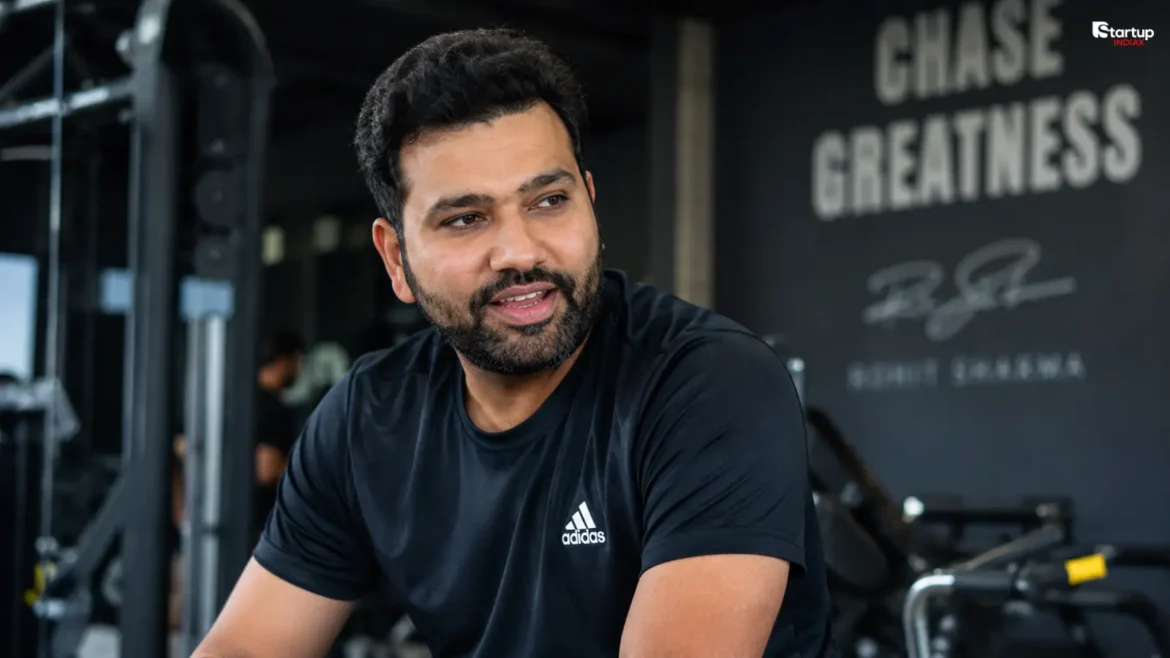
Rohit Sharma, Indian cricketer and new FITTR equity partner
HealthTechFundingStartup Stories

Why Rohit Sharma Decided to Invest in FITTR After Years as Its Face

by Aalam Rohile June 15, 2026
3 min read

Summary

  • Rohit Sharma has become an equity partner in FITTR after years as its brand ambassador, with the investment amount undisclosed.
  • FITTR turned profitable in FY25, reporting ₹128 crore revenue and ₹11 crore profit before tax after years of losses.
  • The deal signals growing investor confidence in India’s subscription based fitness coaching model as the sector heads toward ₹37,700 crore by 2030.

Rohit Sharma is now more than the face of FITTR. The Indian cricket captain has become an investor and equity partner in the Pune based health and fitness platform, deepening a relationship that started when he signed on as its first brand ambassador. FITTR did not disclose how much Sharma has put in, but the move marks a shift from paid endorsement to genuine ownership, and it comes right as the startup’s numbers start looking a lot healthier.

What Happened

Fittr announced that Sharma has come on board as an investor and equity partner, expanding a relationship that began with his role as brand ambassador. The company framed it as a natural progression rather than a sudden celebrity endorsement deal.

Sharma spent several months engaging with founder and CEO Jitendra Chouksey and the leadership team, going through the business model, growth plans, and broader mission before agreeing to come on board as an investor

In his own words, Sharma said he’d spent time with the team, understood the business, and seen the growth opportunity first hand, and that the fundamentals are strong, the mission is clear, and there’s an opportunity to create meaningful and lasting impact.

Chouksey, for his part, pointed to a shared philosophy. He said the world is witnessing a sharp rise in lifestyle-related health concerns and that FITTR has always believed there are no shortcuts to good health, and that Sharma not only shares this belief but lives it every day.

Read More : Rohit Sharma Invests in Prozo: Is This India’s Logistics Boom?

Why It Happened: The Numbers Behind the Deal

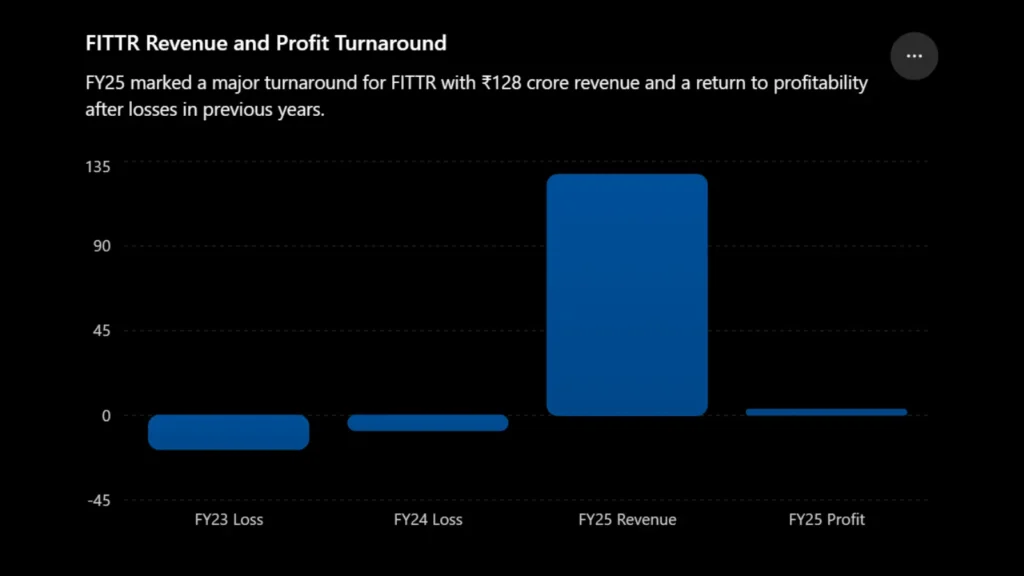
This isn’t happening in a vacuum. Fittr reported revenue of ₹128 crore and a profit before tax of ₹11 crore in FY25, a real turnaround after losses over the previous three financial years. Its online fitness coaching business accounted for about ₹122 crore of total revenue, showing the subscription model is the engine driving this profitability.

FITTR revenue and profit turnaround in FY25

For a company that spent years bleeding money, hitting profitability is the kind of milestone that makes a celebrity ambassador’s “let’s just put my name on it” arrangement feel a lot more credible as an actual investment thesis.

Founded in 2016 by Jitendra Chouksey, Bala Krishna Reddy, Rohit Chattopadhyay, and Jyoti Dabas, Fittr runs online health and fitness communities and platforms, claiming to have helped more than 4 lakh users through a network of over 700 coaches, with its broader community exceeding 30 lakh users globally. The startup has raised close to $17 million so far from investors including Rainmatter, Peak XV’s Surge, and Elysian Park Ventures, and counts actor Sunil Shetty among its backers too.

Why This Matters

FITTR operates in a crowded space. It competes with platforms like Healthify, Cult.fit, FitBudd, and MyFitnessPal, all chasing the same urban Indian consumer who’s suddenly very interested in step counts, macros, and “consistency.”

A profitable year changes the conversation with investors. Most fitness-tech startups in India have spent the last several years burning cash to acquire users, betting that scale would eventually translate into margins. FITTR getting there, even modestly, with an ₹11 crore PBT, gives it leverage that a lot of its competitors don’t currently have. Bringing in a recognizable name as an actual stakeholder, rather than just a paid face, signals the company wants long-term alignment, not just a marketing boost for the next campaign cycle.

For consumers, it probably means more visibility, more campaigns, and possibly new product lines aimed at the kind of mainstream audience that watches cricket more than it scrolls fitness influencers on Instagram.

The Bigger Picture

India’s health and fitness market isn’t slowing down. The sector is expected to grow from roughly ₹16,200 crore ($1.9 billion) to ₹37,700 crore ($4.5 billion) by 2030, and that growth is pulling in everyone from VCs to celebrities looking for a stake in the “wellness economy.”

What’s notable here isn’t just that an athlete invested in a fitness company, that’s almost expected at this point. It’s the order of events: brand ambassador first, investor only after the company proved it could actually make money. FITTR has also said it doesn’t want to be seen as “just a fitness company” and is positioning itself as an end to end healthcare business going forward, which suggests Sharma’s stake might be a bet on something bigger than workout plans and meal trackers.

Startup INDIAX Take

This deal is a useful signal for founders chasing celebrity backing: investors, including famous ones, increasingly want to see the business work before they put money behind it. A few years ago, brand deals with athletes were mostly about reach. Now they’re starting to look more like due diligence exercises that happen to also come with a famous face attached.

For India’s fitness-tech sector, FITTR’s profitability matters more than Sharma’s name. It’s proof that the subscription-coaching model, long dismissed as too thin-margin to scale in India, can actually work if the user base is large enough. Expect more “ambassador to investor” conversions across categories as profitable D2C and subscription startups look for partners who already have skin in the game, literally.

Got thoughts on celebrities trading endorsement deals for equity stakes? Drop a comment, and check out more funding stories from India’s startup ecosystem on Startup INDIAX.

FAQs

Did Rohit Sharma disclose how much he invested in FITTR?

No. FITTR confirmed Sharma joined as an investor and equity partner but did not disclose the size of the investment.

What was Rohit Sharma’s earlier relationship with FITTR?

He previously served as the company’s first brand ambassador before transitioning into an equity stake.

Is FITTR profitable now?

Yes. FITTR reported revenue of ₹128 crore and a profit before tax of ₹11 crore in FY25, after several years of losses.

Who founded FITTR and when?

FITTR was founded in 2016 by Jitendra Chouksey, Bala Krishna Reddy, Rohit Chattopadhyay, and Jyoti Dabas.

Who else has backed FITTR besides Rohit Sharma?

Investors include Rainmatter, Peak XV’s Surge, and Elysian Park Ventures, and the platform is also backed by actor Sunil Shetty.

Who are FITTR’s main competitors?

FITTR competes with Healthify, Cult.fit, FitBudd, and MyFitnessPal, among others, in India’s crowded fitness app space.

June 15, 2026 0 comments 206 views
FacebookTwitterLinkedinWhatsapp
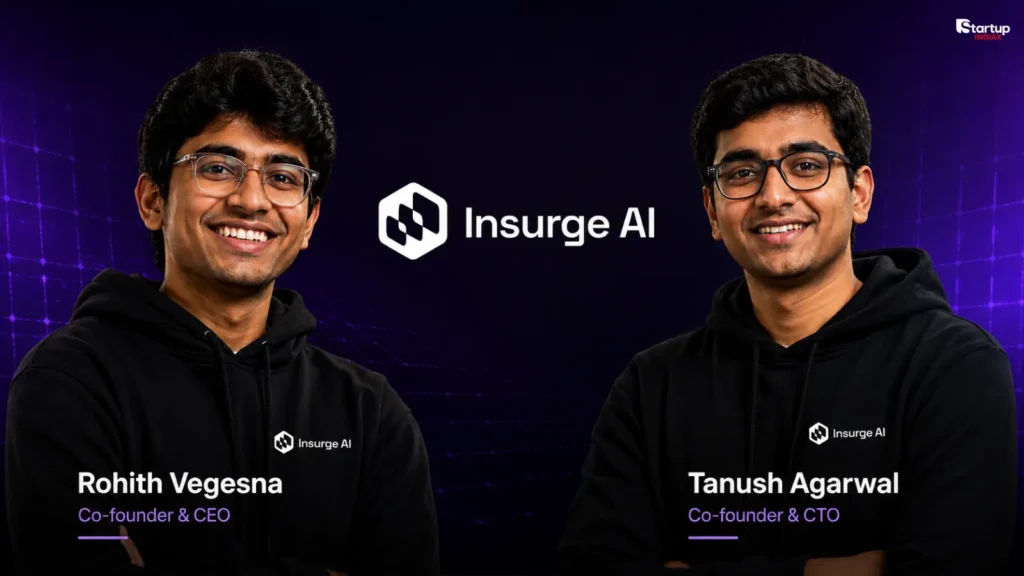
Insurge AI founders Rohith Vegesna Tanush Agarwal - AI meeting agent platform Hyderabad1
AIAI & DeepTechStartup Stories

Insurge AI: Two Engineering Students Build the World’s First AI Meeting Agent Platform – Backed by ISB DLabs

Hyderabad-based Insurge AI, founded by Rohith Vegesna and Tanush Agarwal, has built autonomous AI meeting agents that replace human-led sales conversations - and just secured pre-seed backing from ISB DLabs.
by Aalam Rohile May 31, 2026
3 min read

Key Takeaways

  • Insurge AI builds autonomous AI meeting agents that replace human-led sales and support conversations end-to-end
  • The startup secured Rs 15 lakhs from ISB DLabs and is raising US$500,000 in seed funding to scale globally
  • Founded by two engineering students, Insurge AI targets a global AI SaaS market projected at US$367.6 billion by 2034

Insurge AI, a Hyderabad-based SaaS startup founded by two engineering students, is turning heads across India’s tech scene in 2026. Rohith Vegesna from Manipal Institute of Technology and Tanush Agarwal from IIT Kharagpur have built what they claim is the world’s first AI meeting agent platform – one that conducts full sales conversations without a single human in the room. Backed by ISB DLabs with Rs 15 lakhs in pre-seed funding and a $500,000 seed round in active discussions, this one is hard to ignore.

From FIITJEE Classmates to Startup Co-founders

Most co-founder stories start in a dorm room or a college canteen. For Rohith Vegesna and Tanush Agarwal, it started in a Hyderabad coaching centre in 2021.

The two first met while cramming for engineering entrance exams at a FIITJEE centre in Hyderabad. Late-night conversations about AI breakthroughs, tech disruptions, and building something from scratch quickly became a shared obsession.

Insurge AI founders Rohith Vegesna Tanush Agarwal - AI meeting agent platform Hyderabad

By 2023, both had secured seats at top institutions. Rohith joined Manipal Institute of Technology for data science. Tanush enrolled at IIT Kharagpur for industrial and systems engineering. Different cities, same dream.

Read More: Pranjali Awasthi – 100 Crore at 16! Meet India’s Youngest AI CEO

Their formal journey began in July 2024 when they registered Openzo Softcorp Private Limited, the parent company behind what would eventually become Insurge AI.

The Pivot That Changed Everything

Before Insurge AI, the duo launched a hyperlocal grocery delivery app called Openzo in September 2024. It briefly scaled to over 1,000 monthly users and hit a peak monthly GMV of Rs 8 lakhs – a solid early signal.

But razor-thin margins and high operational costs forced a shutdown in January 2025. The total loss came to around Rs 1.2 lakhs – painful, but defining.

What followed was a sharp pivot. The founders won a Rs 4 lakh grant from MeitY under its GENESIS Entrepreneur-in-Residence programme to build an AI-powered shopping agent. That concept slowly evolved into something far more ambitious.

Read More: IndiaAI Mission: Soket AI, Gnani.ai, and Gan.ai Unleash 3 Revolutionary Indigenous AI Models

Rohith took a sabbatical from Manipal to join the I-Venture Immersive programme at ISB Hyderabad, a full-time residential track for early-stage founders. Tanush continued building remotely from IIT Kharagpur. Together, the engineering students spent ten months on research and development, navigating technical hurdles and financial constraints with very limited external support.

In June 2025, Insurge AI was officially founded as a SaaS startup focused on sales enablement and autonomous customer engagement.

How the AI Meeting Agent Platform Actually Works

This is where things get genuinely interesting. Insurge AI has built AI meeting agents that conduct fully personalised, voice-led, and visual conversations – entirely without a human representative in the picture.

These agents explain products, run real-time demos, filter leads, answer questions, and handle onboarding or post-sales support on demand. Companies simply embed the agent on their website or share a direct link over email, WhatsApp, or LinkedIn.

The moment a visitor arrives, the AI agent reads their intent, customises the conversation, presents relevant visuals in real time, and qualifies them as a sales lead – all in one seamless interaction.

As Startup INDIAX has reported in its AI and DeepTech coverage, autonomous AI tools targeting enterprise sales workflows are among the fastest-growing categories in India’s startup ecosystem right now. Insurge AI is positioning itself squarely at the center of that shift.

Read More: AI Startup Acquisition: Meta’s $32B Shock Fails, Now It’s Hiring the CEO

“We realised this is the best time in history to build an AI company, and solving for meetings is one of the most critical problems in business workflows. Over one billion meetings happen every single day, and almost all of them are still human-led,” says Tanush Agarwal, co-founder and CTO of Insurge AI.

The platform currently serves SaaS and cloud software companies, banks, insurance firms, real estate platforms, healthcare providers, edtech companies, and staffing agencies – essentially any sector where human-led meetings create costly bottlenecks. Its modular middleware approach gives it an edge over tools built directly on third-party APIs, keeping costs controlled and performance high.

ISB DLabs Backing and the Road to a $500K Seed Round

In November 2025, Insurge AI secured Rs 15 lakhs in pre-seed funding from DLabs at ISB Hyderabad, one of India’s most reputed startup incubators attached to a top-tier business school.

Full-scale commercial operations launched in early April 2026 after extensive testing. The startup is now in active discussions to raise US$500,000 in seed funding to accelerate its next phase of growth.

Much of the early development was bootstrapped using personal savings and the MeitY grant. That discipline kept the burn rate lean while the team remained focused on product-market fit over premature scaling.

“We have raised very limited external investor funding so far. This disciplined approach allowed us to prioritise achieving solid product-market fit before scaling spend,” explains Tanush Agarwal.

The revenue model is a SaaS subscription structure. Enterprises pay monthly or annual fees based on the number of AI meeting agents deployed and the volume of interactions. Usage-based pricing tiers are also planned for high-volume customers across new verticals.

The global AI SaaS market is projected to reach US$367.6 billion by 2034, growing at a CAGR of 36.59%, according to Fortune Business Insights. For a startup that launched commercial operations just weeks ago, Insurge AI’s entry timing could not be sharper.

Read More: Nvidia $900M Deal: Indian CEO Rochan Sankar Joins Chip Giant

Netizens React

The launch of Insurge AI has triggered a wave of responses across LinkedIn, X (formerly Twitter), and Indian startup communities online.

One user wrote, “Finally a product that solves something real. I spend over 60% of my week in pre-sales calls that an AI could honestly handle better. This is the startup I’ve been waiting for.”

Another commenter raised a fair point: “Curious how this handles tricky objections in live demos. AI handles scripted flows well, but real customers throw curveballs. Would love to see a stress test.”

A third user took a wider view: “Two students from Manipal and IIT Kharagpur building what could be a billion-dollar SaaS category. This is exactly why India’s startup ecosystem keeps surprising everyone.”

What’s Next for Insurge AI

The expansion roadmap starts with India, then moves to the US, UK, Middle East, and Southeast Asia – markets where high-volume sales meeting workflows are a known pain point for enterprises.

The founders plan to grow a full-time team, build domain-specific features for each target vertical, and sharpen their understanding of real customer workflows through hands-on feedback loops.

“Our vision is to become the world’s default AI-powered communication interface between companies and their customers – agents that can explain, demo, onboard, and support any user, anywhere in the world, at any time, at infinite scale,” says Rohith Vegesna, CEO of Insurge AI.

For a startup born from a coaching centre friendship and shaped by a failed grocery app, Insurge AI is marking the next phase of what autonomous AI can deliver for modern business.

What Do You Think?

Could AI meeting agents completely replace human sales conversations in the next five years? Drop your thoughts in the comments and share this story with your network. Explore more breakthrough Indian startup stories on Startup INDIAX!

FAQs

What is Insurge AI?

Insurge AI is a Hyderabad-based SaaS startup that builds autonomous AI meeting agents capable of running personalised, voice-led, and visual sales or support conversations without any human involvement.

Who founded Insurge AI?

Insurge AI was co-founded by Rohith Vegesna (CEO) from Manipal Institute of Technology and Tanush Agarwal (CTO) from IIT Kharagpur, in June 2025.

How does an AI meeting agent work?

The agent embeds on a company website or is shared via a link. It greets visitors, explains products using real-time visuals, qualifies them as leads, and handles onboarding – all without a human representative.

Has Insurge AI raised funding?

Yes. Insurge AI raised Rs 15 lakhs in pre-seed funding from ISB DLabs in November 2025 and is currently in discussions to close a US$500,000 seed round.

Which industries does Insurge AI serve?

Insurge AI serves SaaS firms, banks, insurance companies, real estate platforms, healthcare providers, edtech companies, and staffing agencies – any sector where high-volume customer meetings create operational bottlenecks.

May 31, 2026 0 comments 302 views
FacebookTwitterLinkedinWhatsapp
Meta Muse Spark AI Launches - 5 Things That Make It Different
AIAI & DeepTechNewsTechnology

Meta Muse Spark AI Launches – 5 Things That Make It Different

by Aalam Rohile April 22, 2026
3 min read

Summary

  • Meta Muse Spark AI marks the company’s biggest AI push yet, backed by a $14.3 billion investment in Scale AI and Meta Superintelligence Labs
  • The model brings multimodal reasoning, health AI powered by 1,000+ doctors, and Contemplating mode to WhatsApp, Instagram, and Meta’s glasses
  • Meta Muse Spark AI scores 52 on the Intelligence Index, trailing top rivals but excelling in health tasks and consumer-facing applications

Meta Muse Spark AI is finally here, and the tech world is paying close attention. After nearly a year of silence, billions in investment, and a massive talent overhaul, Meta dropped its most ambitious AI model yet on April 8, 2026 – and the stakes could not be higher.

This is not just another chatbot update. Muse Spark is the first model out of Meta Superintelligence Labs, a unit built from scratch after Meta’s Llama 4 release was widely considered a disappointment. With OpenAI, Google, and Anthropic raising the bar every few months, Meta needed to show the world it is still in the game.

So what exactly is Muse Spark, and what can it do? Here is a breakdown of everything you need to know.

What Is Meta Muse Spark AI?

Muse Spark is Meta’s newest large language model – and its first closed-source AI model. That last part is a big deal. Meta built its reputation on open-source AI through the Llama series. Muse Spark marks a sharp shift in strategy.

The model is described as “small and fast by design, yet capable enough to reason through complex questions in science, math, and health.” It is the first in a new “Muse” series, where each model validates and builds on the last before Meta scales up to something bigger.

It currently powers the Meta AI app and the meta.ai website, with rollouts planned for WhatsApp, Instagram, Facebook, Messenger, and Meta’s Ray-Ban AI glasses in the coming weeks.

Read More: GeoSpy AI: 5 Shocking Ways It Tracks You From Photos

The Man Behind the Model – Alexandr Wang’s $14.3 Billion Gamble

The story of Muse Spark begins with one of the biggest bets in tech history. In June 2025, Meta spent $14.3 billion to acquire a 49% stake in Scale AI and brought in its co-founder Alexandr Wang as Meta’s first-ever Chief AI Officer.

The Man Behind the Model - Alexandr Wang
Source – The Financial Express

Wang was handed the reins of the newly created Meta Superintelligence Labs. He then led an aggressive hiring campaign, pulling top AI researchers from OpenAI, Anthropic, and Google with pay packages reportedly running into the hundreds of millions when equity was included.

“Over the last nine months, Meta Superintelligence Labs rebuilt our AI stack from the ground up, moving faster than any development cycle we have run before,” Meta stated in its official launch blog. The result of all that speed and spending is Muse Spark.

Read More: Anjali Sardana Pronto: 23-Year-Old Builds $100M Startup in a Year

5 Things Meta Muse Spark AI Can Actually Do

1. Multimodal Perception – It Can See the World

Muse Spark is not limited to text. It comes with strong multimodal capabilities, meaning it can process and understand images alongside text. Snap a photo of a food label and ask about its protein content. Scan a product and ask how it compares to competitors. The AI does not wait for you to type out a description – it looks at the image itself.

This becomes even more powerful when Muse Spark comes to the Ray-Ban Meta AI glasses, where the assistant can see the physical world around you in real time.

2. Health Reasoning – Backed by 1,000+ Doctors

One standout feature is Muse Spark’s health reasoning capability. Meta collaborated with over 1,000 physicians to curate training data, enabling more factual and detailed responses to health-related questions, including those involving medical images and charts.

On HealthBench Hard, a standard AI health benchmark, Muse Spark scored 42.8 – putting it ahead of many rival models in this specific area. For Indian users dealing with limited access to medical professionals, this could be genuinely useful.

3. Contemplating Mode – Multi-Agent Reasoning

For complex, multi-step problems, Muse Spark has a “Contemplating” mode. This orchestrates multiple AI subagents that reason in parallel – essentially letting the model tackle different parts of a problem simultaneously.

Meta claims this mode allows Muse Spark “to compete with the extreme reasoning modes of frontier models such as Gemini Deep Think and GPT Pro.” That is a bold claim, and one the AI community is already putting to the test.

4. Visual Coding and Mini-Game Creation

One surprisingly fun feature: Muse Spark excels at visual coding. Users can generate custom websites, dashboards, or retro mini-games directly from a text prompt. Ask it to build a flight simulator, and it will. Ask it to create a party planner dashboard, done.

This could be a game-changer for small Indian businesses and solo entrepreneurs who need functional digital tools but lack coding skills.

5. Shopping Mode and Social Context

Muse Spark includes a shopping mode that draws on styling trends and brand content across Meta’s platforms. Ask it what to wear or how to style a room, and it pulls from creators and communities you already follow on Instagram.

When you search for a place or topic, it surfaces relevant public posts from locals and community members – mixing AI intelligence with real social context.

Read More: Pawan Kumar Chandana: From 51 in Maths to India’s Largest Rocket Factory

How Does Muse Spark Compare to Rivals?

Let’s talk benchmarks. On the Intelligence Index, Muse Spark scored 52. That puts it behind Google’s Gemini 3.1 Pro and OpenAI’s GPT-5.4, both of which scored 57, and slightly behind Anthropic’s Claude Opus 4.6 at 53.

So Muse Spark is competitive but not dominant. Meta has acknowledged the gaps, particularly in long-horizon agentic tasks and coding workflows. As Startup INDIAX reported earlier this year, the AI race is no longer just about raw benchmarks – specialization and ecosystem integration are increasingly what matter.

What Muse Spark does have going for it is distribution. Meta reaches over 3.3 billion people daily across its apps. No AI model from OpenAI, Google, or Anthropic comes close to that kind of built-in user base.

Zuckerberg wrote on Threads after the launch: “We are building products that don’t just answer your questions but act as agents that do things for you.” That vision of agentic AI embedded across WhatsApp and Instagram is something no rival can replicate in the near term.

Read More: GPT-5 vs Gemini 3.0 vs Claude: Which AI Model Should Indian Startups Use in 2026? – Startup INDIAX

The Business Question – Can Meta Turn This Into Revenue?

This is where things get tricky. While Meta generated $201 billion in full-year 2025 revenue – a 22% year-over-year jump – virtually none of that came from direct AI monetization.

Muse Spark is currently free to use. Meta plans to offer private API access to select partners eventually, following OpenAI and Anthropic’s lead. But the company is late to the API game, and catching up will take time.

Wall Street, at least, loved the launch. Meta’s stock jumped 6.5% on announcement day alone, contributing to a nearly 10% gain over five trading days, closing at $629.86 per share. Investors are betting that Muse Spark, even if not immediately profitable, is proof that Meta’s massive AI investment is finally producing results.

One important caveat: users need to log in with a Facebook or Instagram account to use Muse Spark. That raises data privacy questions that Meta has not fully addressed yet – a concern that is particularly relevant for Indian users who are increasingly aware of digital privacy rights.

Netizens React

The launch generated enormous chatter on social media, with reactions ranging from genuine excitement to healthy skepticism.

One user on X wrote, “Muse Spark on WhatsApp is going to change how small business owners in India get things done. This is bigger than people realize.“

Another tech professional commented, “The benchmarks are decent but not groundbreaking. Meta needed a home run after Llama 4. This is more like a solid double.“

A privacy-focused commenter noted, “Interesting model, but requiring a Facebook login is a dealbreaker for a lot of people. Meta still has a trust problem it hasn’t solved.“

What’s Next for Meta Muse Spark AI?

This is explicitly the first in a series. Meta has already confirmed that a larger, more powerful model in the Muse family is in development. The company is also planning to release updated open-source models in the future, signaling it has not fully abandoned its Llama roots.

The question for users – and particularly for India’s 500 million+ WhatsApp user base – is how quickly Muse Spark rolls out to these platforms and whether it lives up to the promise of a genuinely helpful AI assistant.

The potential is real. The execution, as always, is what counts.

What do you think about Meta’s Muse Spark AI? Could it change how you use WhatsApp or Instagram? Drop your thoughts in the comments below and share this with someone who needs to know about it. Explore more breakthrough AI and startup stories only on Startup INDIAX!

FAQs

What is Meta Muse Spark AI?

Meta Muse Spark AI is Meta’s first closed-source large language model, built by Meta Superintelligence Labs. It supports multimodal reasoning, health tasks, and agentic workflows across Meta’s apps.

Which apps will Meta Muse Spark AI be available on?

Muse Spark currently powers the Meta AI app and meta.ai. It will soon roll out to WhatsApp, Instagram, Facebook, Messenger, and Ray-Ban Meta AI glasses.

How does Meta Muse Spark AI compare to ChatGPT and Gemini?

Muse Spark scores 52 on the Intelligence Index, slightly below GPT-5.4 and Gemini 3.1 Pro at 57, but it outperforms rivals in health-specific benchmarks and consumer integration.

Who built Meta Muse Spark AI?

Muse Spark was built by Meta Superintelligence Labs, led by Alexandr Wang, former CEO of Scale AI, whom Meta hired in June 2025 for $14.3 billion.

Is Meta Muse Spark AI free to use?

Yes, Muse Spark is currently free on the Meta AI app and meta.ai. A private API preview for select business partners is planned for the future.

April 22, 2026 0 comments 281 views
FacebookTwitterLinkedinWhatsapp
OffBeat Studios Raises ₹100 Crore in Seed Funding Led by Bessemer Venture Partners
Fashion & LifestyleStartupTechnology

OffBeat Studios Raises ₹100 Crore in Seed Funding Led by Bessemer Venture Partners

by Aalam Rohile April 10, 2026
3 min read

Summary

  • OffBeat Studios secures ₹100 crore in seed funding from Bessemer Venture Partners, one of the world’s top VC firms
  • OffBeat Studios founder Aman Gupta cites AI and global strategic support as the core reasons behind the Bessemer partnership
  • boAt’s IPO push accelerates under new CEO Gaurav Nayyar, targeting a valuation of ₹13,000 crore

OffBeat Studios, the newly unveiled venture by boAt co-founder Aman Gupta, has raised ₹100 crore in seed funding led by Bessemer Venture Partners – one of the most storied VC firms in the world. The announcement, made just a month after OffBeat Studios was publicly revealed, is already turning heads across India’s startup ecosystem.

This is not just another funding round. When a founder with Aman Gupta’s track record picks a firm like Bessemer – the backers behind Anthropic, Shopify, Canva, and LinkedIn – over a simple cheque, people listen.

Why Did Aman Gupta Choose Bessemer Over a Bigger Cheque?

The announcement wasn’t without personal flair. Gupta shared the news on LinkedIn on his wedding anniversary, drawing an unusual and memorable analogy: “Taking on an investor is like choosing a life partner. You need to get it right. You will live with them through the highs and the lows.”

He was candid about the reasoning. Having already built boAt from zero to a market-leading consumer electronics brand, Gupta says he wasn’t chasing capital for its own sake. “I didn’t raise capital because I needed the cheque,” he wrote. “I raised it because Anant, Vishal, and Bessemer’s partners across the world bring speed, credibility, network, and strategic support that money alone cannot buy.“

The reference to AI was pointed. Gupta specifically called out technology and AI as the lens through which OffBeat Studios will operate – signalling that this is not just another consumer brand play.

Read More: Lalit Keshre: Farmer’s Son to ₹9,448 Crore Billionaire Story

What Exactly Is OffBeat Studios?

That’s the question everyone is asking – and the answer remains deliberately incomplete.

Aman Gupta first announced OffBeat Studios on 3 March 2026, marking a new chapter after transitioning to a non-executive role at boAt. The venture’s branding features a stylised “OFF/BEAT” logo. Beyond that, Gupta has not publicly disclosed the sector, business model, team composition, or launch timeline.

Aman Gupta OffBeat Studios LinkedIn announcement seed funding

What is clear is the strategic direction. The emphasis on AI, a globally connected VC partner, and Gupta’s own pivot away from day-to-day operations at boAt all point to something more ambitious than a consumer hardware sequel.

It also remains unclear whether OffBeat Studios will have any association with boAt’s ecosystem or function as a fully independent venture.

Read More: Anjali Sardana Pronto: 23-Year-Old Builds $100M Startup in a Year

Bessemer Venture Partners – Why This Investor Matters

Not all seed cheques are equal. Bessemer Venture Partners has a global portfolio that reads like a Silicon Valley Hall of Fame – Anthropic, Shopify, Canva, LinkedIn, Twitch, and Pinterest all have Bessemer’s fingerprints.

For an Indian founder, landing Bessemer as a seed-stage backer carries serious weight. The firm brings not just capital but global distribution, strategic credibility, and a deep bench of operator networks – precisely what Gupta says he was looking for.

As Startup INDIAX reported earlier this year, the Indian startup ecosystem is increasingly seeing global tier-1 VCs double down on India-first founders with regional scale ambitions. Bessemer’s participation in OffBeat Studios fits neatly into that trend.

The ₹100 crore seed raise is one of the larger seed rounds in recent memory for a pre-product-disclosure Indian startup, reflecting the premium placed on Gupta’s founder brand equity and execution track record.

Read More: GeoSpy AI: 5 Shocking Ways It Tracks You From Photos

Leadership Shake-Up at boAt and the Long-Awaited IPO

While Gupta builds his next act, boAt itself is going through a significant internal transition.

Co-founder Sameer Mehta has moved into an executive director role. Meanwhile, Gaurav Nayyar, former Chief Operating Officer, has stepped in as the new CEO – marking the first time an outside professional leads the brand at the operational level.

These changes arrive as Imagine Marketing, boAt’s parent company, has secured approval from SEBI for its long-anticipated IPO. The Warburg Pincus-backed firm reportedly eyes a valuation of around ₹13,000 crore – a significant jump from earlier estimates.

This is actually boAt’s second crack at going public. The company first filed draft IPO papers in January 2022, targeting a ₹2,000 crore raise. That effort was eventually shelved. The revised plan reportedly aims to raise ₹1,500 crore, split between ₹500 crore in fresh equity and ₹1,000 crore through an offer for sale by existing investors.

boAt IPO SEBI approval Imagine Marketing Warburg Pincus valuation 2025

The timing of Gupta’s exit to a non-executive role – right before a public listing attempt – is notable. Founders stepping back from executive functions ahead of an IPO is a common institutional signal of maturing governance.

Netizens React

The announcement triggered a wave of responses online, with founders, investors, and fans all weighing in.

One user wrote, “Aman Gupta raising seed funding from Bessemer is the most ‘Shark Tank India judge’ plot twist ever. From the other side of the table to being the one pitching!“

Another commenter noted, “The wedding anniversary timing was genius PR. Whether intentional or not, it dominated my entire feed. Guy knows marketing.“

A more skeptical voice added, “Until we know what OffBeat Studios actually does, this is mostly founder-brand fundraising. But if anyone can pull it off on vibes alone, it’s probably him.“

The thread on LinkedIn alone reportedly crossed thousands of reactions within hours of the post going live.

What do you think about OffBeat Studios and Aman Gupta’s bold new bet? Drop your thoughts in the comments below, and share this with a fellow founder who needs to know. Discover more stories shaping India’s startup future on Startup INDIAX.

Read More: How Alka Kalkani Built Nipposh: India’s Comfort-First Nipple Cover Brand

FAQs

What is OffBeat Studios?

OffBeat Studios is a new venture founded by boAt co-founder Aman Gupta, announced in March 2026. The company’s sector and business model have not yet been publicly disclosed.

How much funding did OffBeat Studios raise?

OffBeat Studios raised ₹100 crore in seed funding, led by Bessemer Venture Partners – the global VC firm behind Anthropic, Shopify, and Canva.

Who is leading Bessemer’s investment in OffBeat Studios?

Bessemer’s investment in OffBeat Studios involves partners Anant and Vishal, as referenced by Aman Gupta in his LinkedIn announcement, along with Bessemer’s global partner network.

What is Aman Gupta’s current role at boAt?

Aman Gupta has transitioned to a non-executive board role at boAt, stepping back from day-to-day operations as the company prepares for its IPO under new CEO Gaurav Nayyar.

Is boAt planning an IPO in 2025?

Yes, boAt’s parent company Imagine Marketing has received SEBI approval for an IPO, targeting a valuation of approximately ₹13,000 crore. The company is backed by Warburg Pincus and previously attempted a public listing in 2022.

April 10, 2026 0 comments 225 views
FacebookTwitterLinkedinWhatsapp
Newer Posts
Older Posts

Follow Us

Facebook Twitter Instagram

Recent Posts

  • Indian Startup News This Week: Simple Energy’s ₹1,750 Crore Round, AceVector’s IPO and 5 More Stories (Sep 28 to Oct 4)

  • Deepinder Goyal’s Temple Is Coming in 6 Colours, and Pre-Orders Could Open Next Week

  • Simple Energy Raises Rs 1,750 Crore: Why Thyrocare’s Velumani Is Betting Big on EV Scooters

  • WhatsApp Parental Controls for Teens in India: What the PIN Lock Does and How to Set It Up

  • What September Taught Us About India’s Startup Ecosystem in 2026

Newsletter

Subscribe our newsletter for latest news. Let's stay updated!

Categories

  • Advertising (2)
  • Agritech (3)
  • AI & DeepTech (120)
  • AI Tools (18)
  • Automobile (16)
  • Beauty & Wellness (3)
  • Bootstrapped Wins (3)
  • Crowdfunding Hub (1)
  • Debt Financing (2)
  • Ecom (12)
  • EV (36)
  • Failure Lessons (1)
  • Fashion & Lifestyle (8)
  • Finance (37)
  • Fintech (11)
  • FoodTech (6)
  • Founder Story (7)
  • Founder Toolkit (7)
  • Funding (49)
  • Government Schemes (14)
  • Green Energy (10)
  • HealthTech (9)
  • Investor Directory (1)
  • News (235)
  • Politics (12)
  • Real Estate (1)
  • Science (13)
  • Startup (152)
  • Startup Learning (24)
  • Startup Stories (29)
  • Technology (118)
  • Unicorn Journeys (5)
  • Women Entrepreneurs (11)

About Us

India’s independent startup media for founders, investors and ecosystem builders.

Facebook Instagram Twitter Linkedin

Explore

  • News
  • Startup Stories
  • Funding
  • Sectors

Free Tools

  • Valuation Calc
  • Pitch Deck Builder
  • Runway Calc
  • VC Database

Company

  • About Us
  • Contact
  • Careers
  • Advertise

© 2026 StartupIndiaX. All rights reserved.

  • Privacy Policy
  • Disclaimer
  • Terms
startupindiax.com
  • Home
  • News
  • Startup Stories
  • Funding
  • Founder Toolkit
    • Startup Valuation Calculator
    • Startup Runway Calculator
    • Indian VC & Investor Database
    • Co-founder Equity Split Calculator
    • Government Scheme Finderfor Indian Startups
    • Pitch Deck Structure Tool
    • Market Size Calculator TAM · SAM · SOM
    • Find the perfect startup name
    • Funding Round Dilution Calculator
  • Sectors
    • Agritech
    • AI & DeepTech
    • Fintech
    • Green Energy
    • HealthTech
    • EV
    • Digital
    • Automobile